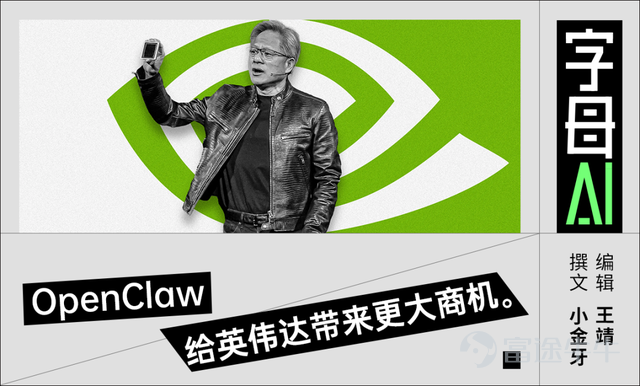

NVIDIA's Q4 earnings report was impressive, but why is the market not responding positively?

After raking in $120 billion, Jensen Huang announced that another turning point has arrived

NVIDIA released its Q4 and full-year financial report for the fiscal year 2026. Over the past 12 months, the company's net profit reached 1.2 trillion US dollars.
There are only a few companies that make hundreds of billions of dollars in a year, such as Alphabet, the parent company of Google, Microsoft, Apple, and NVIDIA.
But the issue is that hardly anyone has risen to this level in such a short time - three years ago, NVIDIA's profit was only 4.4 billion US dollars. In just 36 months, its profit scale has increased nearly 30 times. Such a leap is rare in modern technology history.
NVIDIA holds about 90% of the high-end AI chip market share, and these chips are the 'fuel' for global tech giants' frenzied construction of data centers. Google, Amazon, Microsoft, and Meta collectively plan to spend over 500 billion US dollars this year to expand AI computing power, and it's not hard to guess who the biggest beneficiary is.
Of course, the market is also becoming sensitive. Such massive investment has caused Wall Street to have some doubts about the sustainability of the AI boom, and NVIDIA's stock price has been relatively flat in recent months.
But the signal sent by this freshly released earnings report is very clear: demand is still rising, and the AI train is far from hitting the brakes.
01.
Easily surpassing expectations
NVIDIA's fourth-quarter revenue (ending in January) grew by 73% year-over-year to 68.1 billion US dollars, with profits nearly doubling to approximately 43 billion US dollars, or 1.76 US dollars per share.
In its core data center business, NVIDIA achieved revenue of 62.3 billion US dollars, higher than the expected 60.36 billion US dollars, representing a 75% increase year-over-year, accounting for more than 91% of the company’s sales.

CFO Colette Kress stated that a significant portion of the funds came from hyperscale data center operators.
In the statement, she noted, 'Revenue from hyperscale data centers grew in the fourth quarter, remaining our largest customer category, accounting for just over 50% of data center revenue, while growth from other data center customers drove revenue diversification.'
NVIDIA segments its data center business into three key areas: computing, graphics chips and CPUs, and networking. The company reported that compute revenue grew 58% year-over-year this quarter, while networking revenue surged 263% to reach $11 billion.
The explosive growth in networking revenue signals a trend: customers are not only buying chips but also complete cluster systems, indicating large-scale deployments.
NVIDIA's total annual revenue reached $215.9 billion, with earnings per share at $4.77, surpassing previous expectations of $213.8 billion and $4.69, respectively.
NVIDIA further sought to alleviate investor concerns about the sustainability of its growth momentum:
The company expects current-quarter revenue to grow 77% year-over-year to $78 billion, higher than Wall Street's previous forecast of $72 billion.
Following the earnings report, NVIDIA's stock price rose 1% in after-hours trading.
'Artificial intelligence will only get better from here,' NVIDIA CEO Jensen Huang said during a conference call with Wall Street analysts. 'This is the future of computing.'
Every year, NVIDIA launches a new generation of chips aimed at reducing the cost of AI data processing. Last year's Blackwell chip significantly lowered the cost per token compared to its predecessor, and this year’s Rubin chip will bring costs down even further.
NVIDIA's Chief Financial Officer, Colette Kress, stated during the earnings call that sales of Blackwell chips accounted for two-thirds of the company’s data center revenue in the quarter. She also added that customers are seeing strong returns on their investments. For instance, AI systems running on NVIDIA chips have driven a 3.5% increase in ad click-through rates for Facebook.
Notably, in the recently concluded fiscal year 2026, NVIDIA's sales concentration increased.Sales to a few key customers accounted for 36% of total revenue, compared to 34% from three customers in the previous fiscal year.
This also implies that NVIDIA’s growth remains highly tied to leading technology companies, and structural risks have not disappeared.
02
OpenAI, xAI, and OpenClaw
During the earnings call, Jensen Huang not only discussed specific business metrics but also spent considerable time describing NVIDIA's role within the broader AI ecosystem, its development logic, and his views on industry trends.
“Fundamentally, NVIDIA’s core is our ecosystem. Almost all ventures operate on NVIDIA’s platform. We are present in every cloud service provider, every data center, and every AI-native environment. Thousands of AI projects are built on NVIDIA. We will continue to support various networking capabilities and push the boundaries of AI infrastructure.”
He particularly emphasized the ‘convergence’ and ‘universality’ of the platform, which he believes provides NVIDIA with a strong competitive moat for the coming years.

“Our platform can run the majority of open-source models globally and supports a wide range of software ecosystems. For example, there are over 1.5 million AI models on Hugging Face, all running on NVIDIA’s CUDA platform. This versatility makes our platform easy to use and encourages developers worldwide to invest in this ecosystem.”
NVIDIA’s earnings calls are never limited to just the numbers in the financial report. NVIDIA has complex relationships with key players in the AI field and is often expected to provide insights into emerging trends.
In this conference call, there were three interesting Q&A sessions.
The first was about OpenAI.
NVIDIA CEO Jensen Huang stated that he believes the negotiations between the two parties are 'close' to being finalized.
This partnership was initially proposed last year, with plans to invest 100 billion US dollars in AI infrastructure. Recent reports suggest NVIDIA might add an additional investment of approximately 30 billion US dollars.
If completed, this would be one of the most significant computing power partnerships in the AI era.
Huang stated that NVIDIA is very satisfied with its long-term partnership with OpenAI, referring to OpenAI as a once-in-a-century company.
The second was about Elon Musk's space-based data center.
When asked about the concept of a space-based data center (an idea Elon Musk is investing in), Huang commented that the current economic feasibility is 'poor,' but 'will improve over time.'
This is a classic Jensen Huang-style response—neither discouraging the other party nor taking sides prematurely.
The third was about OpenClaw.
Jensen Huang discussed various AI companies and projects, mentioning OpenClaw, an open-source AI agent that has garnered significant attention. Its founder was recently hired by OpenAI.
He said, 'The demand for AI applications and computing power between Claude Cowork and OpenClaw is surging.'
'I am confident that, at this moment, with the efficient use of Codex and Claude Code products, the excitement brought by Claude Cowork, and the enthusiasm for OpenClaw and its enterprise version, all enterprise-grade independent software vendors (ISVs) are now developing agent systems on their tool platforms—I am confident we are at a turning point.'
If last year was about the model wars, this year feels more like an 'application explosion year.' From coding to enterprise automation, to agent platforms, computational power is moving from the training phase into large-scale inference.
And this is exactly the scenario NVIDIA hopes to see most. $NVIDIA (NVDA.US)$$GraniteShares 2x Long NVDA Daily ETF (NVDL.US)$$GraniteShares 2x Short NVDA Daily ETF (NVD.US)$$Nancy Pelosi Portfolio (LIST20883.US)$$NVIDIA Portfolio (LIST20882.US)$$Virtual Reality (LIST2139.US)$$Metaverse (LIST2567.US)$$AI Chip (LIST2548.US)$$Semiconductors (LIST22912.HK)$
Risk Disclaimer: The above content only represents the author's view. It does not represent any position or investment advice of Futu. Futu makes no representation or warranty.Read more
Comments
to post a comment