English
Back
Open Account
NVIDIA's Q4 earnings report was impressive, but why is the market not responding positively?

Futubull Options Sir
joined discussion · ·

Earnings Season Options Strategy | Focus on 5 Key Highlights! Ahead of CoreWeave's earnings, smart money has already started positioning itself...

*The following content and data are as of the close of the US stock market on February 23, 2026. This article is for investment education purposes only and does not constitute any investment advice.
After the close of the US stock market on February 26 Eastern Time, $CoreWeave (CRWV.US)$ will release its Q4 2025 fiscal year earnings.
As one of the fastest-growing and most controversial names in the AI cloud computing space, this company, dubbed the 'computing heart of the AI era,' delivered explosive revenue growth of over 134% year-over-year last quarter, but ongoing losses and high debt have also widened market divisions.
What the market is truly concerned about goes far beyond whether revenue has exceeded expectations. The key question is — after burning through massive capital expenditures, how far is CoreWeave from achieving self-sustaining profitability? In an environment marked by 'high growth + high losses + high debt,' what's the status on critical issues like the pace of commissioning new data centers, the speed at which major client orders are fulfilled, and the visibility of a cash flow inflection point?
On the eve of earnings, the options market has already started to stir with underlying movements. Below, we willbreak down CoreWeave’s investment logic and earnings game plan across three dimensions: 'Key highlights from earnings, technical aspects and options signals, and options strategies under three scenarios.'
I. Earnings preview: What exactly is the market watching? Focus on the following five key points
1. Key point one: Can it continue to maintain high growth?
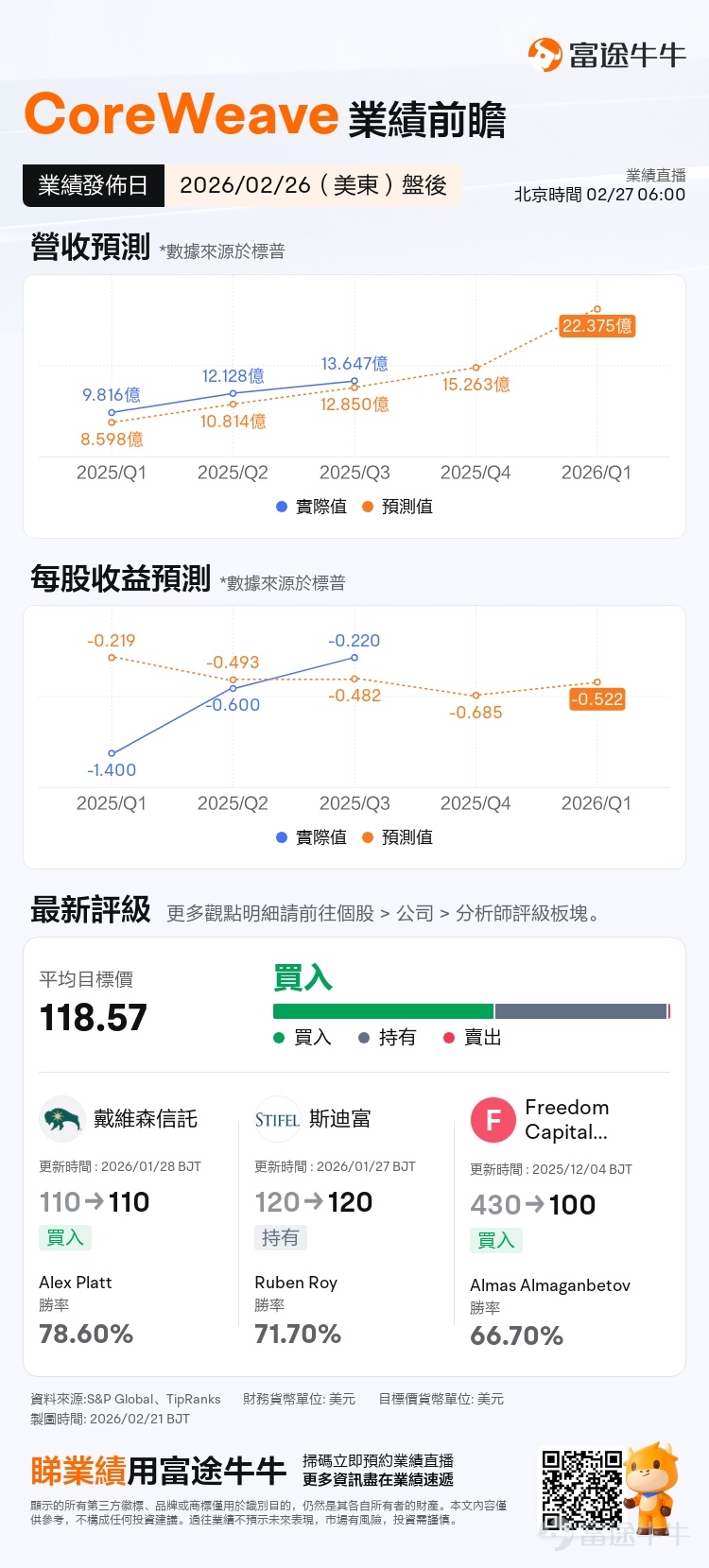
Looking back at Q3 of the 2025 fiscal year,$CoreWeave (CRWV.US)$ CoreWeave delivered impressive growth but is still burning cash: revenue reached $1.365 billion, a year-over-year increase of 133.7%, with gross margins maintained at a high of 72.97%, reflecting strong pricing power and operational efficiency in its core computing services.
On the other hand, the company reported a net loss of $110 million for the quarter, showing the typical characteristic of 'positive operating cash flow, negative free cash flow'—meaning that while daily operations are generating cash, the enormous capital expenditures required for data center expansion still far exceed operating income, and the company has yet to reach a turning point in profitability.
With this backdrop entering the Q4 earnings report, Wall Street's general expectation is: revenue around $1.5263 billion, with a GAAP loss per share (EPS) of -$0.685. Notably, analysts’ forecasts for EPS over the past 90 days have fluctuated both upward and downward, indicating an unstable market consensus, with significant divergence between bulls and bears on the extent of losses.
This means that market reaction to Q4 results is likely to be asymmetric:
If revenue meets or exceeds expectations, particularly if the growth rate of computing services remains high, the market will see it as strong evidence of continued explosive demand for AI computing power, further reinforcing CoreWeave's narrative as an industry leader;
But if revenue falls short of expectations, even by a small margin, in the current environment of high expectations and high valuations, market sentiment could quickly turn, interpreting it as a signal of slowing or peaking demand, putting significant pressure on the stock price.
*The following content and data are as of the close of the US stock market on February 23, 2026. This article is for investment education purposes only and does not constitute any investment advice. After the close of the US stock market on February 26 Eastern Time, $CoreWeave (CRWV.US)$ will release its Q4 2025 fiscal year earnings. As one of the fastest-growing and most controversial names in the AI cloud computing space, this company, dubbed the 'computing heart of the AI era,' delivered explosive revenue growth of over 134% year-over-year last quarter, but ongoing losses and high debt have also widened market divisions. What the market is truly concerned about goes far beyond whether revenue has exceeded expectations. The key question is — after burning through massive capital expenditures, how far is CoreWeave from achieving self-sustaining profitability? In an environment marked by 'high growth + high losses + high debt,' what's the status on critical issues like the pace of commissioning new data centers, the speed at which major client orders are fulfilled, and the visibility of a cash flow inflection point? On the eve of earnings, the options market has already started to stir with underlying movements. Below, we willbreak down CoreWeave’s investment logic and earnings game plan across three dimensions: 'Key highlights from earnings, technical aspects and options signals, and options strategies under three scenarios.'。 I. Earnings preview: What exactly is the market watching? Focus on the following five key points 1. Key point one: Can it continue to maintain high growth? Looking back at Q3 of the 2025 fiscal year,$CoreWeave (CRWV.US)$ delivered a surprisingly impressive growth...
2. The second key focus: Data center deliveries—are they catching up, or are there further delays?
The market’s requirement this time for infrastructure delivery is clear progress improvement, because the entire AI infrastructure narrative is shifting: GPU supply can be abundant, but actual online power capacity must be visible.
CEO Mike Intrator stated on the Q3 earnings call that the majority of delays should be resolved within Q1 of next year. This earnings report will be a critical moment to verify that promise. If management explicitly confirms that Q3 delays have been caught up in Q4 and provides a clear delivery timeline for 2026, it will be seen as confirmation of CoreWeave's execution capabilities entering a positive cycle. Conversely, even if total revenue exceeds expectations but delivery progress becomes unclear again, under the current conditions, the stock price will face considerable pressure.
Point 3: How is the visibility of the $55.6 billion backlog?
The most eye-catching data in Q3 is the backlog, which reached $55.6 billion, nearly doubling from Q2's $30.1 billion. The market's perception of a moat has been established, but the focus is no longer on whether there are orders, but rather on:
Have the delivery schedules for these orders been postponed due to delays in Q3?
Is customer concentration continuing to decline? (The proportion of a single client in Q3 has dropped from 85% at the beginning of the year to less than 35%)
What is the fulfillment progress with major clients such as Meta (a six-year contract worth $14.2 billion) and OpenAI (an additional $6.5 billion, bringing the total to $22.4 billion)?
Roth Capital analysts emphasized the need to focus on 'the quality of the backlog and new booking conditions,' which relates to growth visibility beyond 2026.
Point 4: Will CapEx in 2026 bring negative pressure?
The company previously disclosed its CapEx (capital expenditure) guidance for 2025 to be between $12 billion and $14 billion, while CapEx for 2026 will far exceed twice that of 2025.
For a company with total debt already reaching $14 billion and Q3 interest expenses as high as $311 million (approximately 23% of revenue), such an aggressive spending plan requires robust cash flow evidence. This directly determines whether the market is willing to continue giving CoreWeave a high valuation premium.
The market already has a reference point: $Meta Platforms (META.US)$$Microsoft (MSFT.US)$ Tech giants, driven by strong AI demand, have significantly increased their capital expenditures. However, the market's tolerance for 'excessive spending + insufficient return justification' is decreasing, directly triggering a repricing of valuations.
The upward revision of CapEx itself is not simply a bearish signal, but it must be accompanied by evidence of improved data center delivery efficiency, growth in backlog orders, and progress in customer diversification. Investors need to see signs of an inflection point in profitability. Otherwise, it will follow the path of other high-valuation growth stocks after earnings releases: growth may not be an issue, but the lack of cash flow evidence could directly weigh on the stock price.
5, Key Point Five: After NVIDIA's $2 billion investment, has there been any change in the financial structure or technological narrative?
At the end of last month, $NVIDIA (NVDA.US)$ NVIDIA invested an additional $2 billion in CoreWeave at $87.20 per share, increasing its stake to 11.5%. This funding is critical for CoreWeave, which has a current ratio of just 0.49. Investors should pay attention to how management describes the use of these funds – whether to reduce debt, improve financing costs, or continue aggressive capacity expansion.
A deeper point of interest lies in the fact that under the cooperation agreement, CoreWeave has gained priority deployment rights to future top-tier hardware such as the Rubin platform and Vera CPU. As NVIDIA’s direct affiliate, whether CoreWeave can leverage its technological first-mover advantage to build differentiated services and enhance pricing power will be a forward-looking topic during the earnings call.
II. Technical Analysis and Options Signals: What are the smart money betting on behind the tug-of-war between bulls and bears?
1. Technical Analysis Signal: Bulls and bears are deadlocked in a key range, with a directional decision imminent.
Based on daily K-line data from the past month, the stock price has been oscillating widely between $74.0 (low on February 5) and $114.45 (high on January 28). The current price is in the lower-middle part of this range, with significant day-to-day volatility still present.
Several technical indicators show short-term neutral signals. For instance, MACD indicates that DIF and DEA are above the zero axis but very close, with negative histogram values suggesting upward momentum may be weakening, indicating a period of directional choice. KDJ has not entered overbought or oversold territory, showing a neutral consolidation trend. RSI also fluctuates around the neutral line of 50, with no clear one-sided strength or weakness signals.
Moreover, the BOLL line shows that the stock price is currently trading near the middle band (approximately $93.72), with extremely wide bandwidth, reflecting expectations of high market volatility.
*The following content and data are as of the close of the US stock market on February 23, 2026. This article is for investment education purposes only and does not constitute any investment advice. After the close of the US stock market on February 26 Eastern Time, $CoreWeave (CRWV.US)$ will release its Q4 2025 fiscal year earnings. As one of the fastest-growing and most controversial names in the AI cloud computing space, this company, dubbed the 'computing heart of the AI era,' delivered explosive revenue growth of over 134% year-over-year last quarter, but ongoing losses and high debt have also widened market divisions. What the market is truly concerned about goes far beyond whether revenue has exceeded expectations. The key question is — after burning through massive capital expenditures, how far is CoreWeave from achieving self-sustaining profitability? In an environment marked by 'high growth + high losses + high debt,' what's the status on critical issues like the pace of commissioning new data centers, the speed at which major client orders are fulfilled, and the visibility of a cash flow inflection point? On the eve of earnings, the options market has already started to stir with underlying movements. Below, we willbreak down CoreWeave’s investment logic and earnings game plan across three dimensions: 'Key highlights from earnings, technical aspects and options signals, and options strategies under three scenarios.'。 I. Earnings preview: What exactly is the market watching? Focus on the following five key points 1. Key point one: Can it continue to maintain high growth? Looking back at Q3 of the 2025 fiscal year,$CoreWeave (CRWV.US)$ delivered a surprisingly impressive growth...
There is also some divergence in fund flows, with unstable movements. On February 17, there was a significant net outflow of funds, but when the stock price plummeted by 8.12% on February 20, major funds (very large orders + large orders) still recorded a small net inflow of about $1 million. On February 23, very large and large orders combined for a net inflow of nearly $33 million, indicating that large funds are showing interest in entering at current price levels.
*The following content and data are as of the close of the US stock market on February 23, 2026. This article is for investment education purposes only and does not constitute any investment advice. After the close of the US stock market on February 26 Eastern Time, $CoreWeave (CRWV.US)$ will release its Q4 2025 fiscal year earnings. As one of the fastest-growing and most controversial names in the AI cloud computing space, this company, dubbed the 'computing heart of the AI era,' delivered explosive revenue growth of over 134% year-over-year last quarter, but ongoing losses and high debt have also widened market divisions. What the market is truly concerned about goes far beyond whether revenue has exceeded expectations. The key question is — after burning through massive capital expenditures, how far is CoreWeave from achieving self-sustaining profitability? In an environment marked by 'high growth + high losses + high debt,' what's the status on critical issues like the pace of commissioning new data centers, the speed at which major client orders are fulfilled, and the visibility of a cash flow inflection point? On the eve of earnings, the options market has already started to stir with underlying movements. Below, we willbreak down CoreWeave’s investment logic and earnings game plan across three dimensions: 'Key highlights from earnings, technical aspects and options signals, and options strategies under three scenarios.'。 I. Earnings preview: What exactly is the market watching? Focus on the following five key points 1. Key point one: Can it continue to maintain high growth? Looking back at Q3 of the 2025 fiscal year,$CoreWeave (CRWV.US)$ delivered a surprisingly impressive growth...
On the other hand, short-selling data shows that the recent short ratio has declined, but the current short position remains significantly higher than the market average, with accumulated short positions still being substantial. However, conversely, this could potentially become a driving force for future price increases if short covering occurs.
*The following content and data are as of the close of the US stock market on February 23, 2026. This article is for investment education purposes only and does not constitute any investment advice. After the close of the US stock market on February 26 Eastern Time, $CoreWeave (CRWV.US)$ will release its Q4 2025 fiscal year earnings. As one of the fastest-growing and most controversial names in the AI cloud computing space, this company, dubbed the 'computing heart of the AI era,' delivered explosive revenue growth of over 134% year-over-year last quarter, but ongoing losses and high debt have also widened market divisions. What the market is truly concerned about goes far beyond whether revenue has exceeded expectations. The key question is — after burning through massive capital expenditures, how far is CoreWeave from achieving self-sustaining profitability? In an environment marked by 'high growth + high losses + high debt,' what's the status on critical issues like the pace of commissioning new data centers, the speed at which major client orders are fulfilled, and the visibility of a cash flow inflection point? On the eve of earnings, the options market has already started to stir with underlying movements. Below, we willbreak down CoreWeave’s investment logic and earnings game plan across three dimensions: 'Key highlights from earnings, technical aspects and options signals, and options strategies under three scenarios.'。 I. Earnings preview: What exactly is the market watching? Focus on the following five key points 1. Key point one: Can it continue to maintain high growth? Looking back at Q3 of the 2025 fiscal year,$CoreWeave (CRWV.US)$ delivered a surprisingly impressive growth...
Another noteworthy point is that on February 17, Chief Development Officer McBee Brannin and CEO Michael Intrator sold shares ahead of earnings, at execution prices ranging from approximately $89 to $97. The signal sent by senior management's reduction in holdings is worth noting, but the market’s willingness to chase prices does not seem to have been severely affected, as the stock price subsequently climbed to $97.14.
In summary,The market has significant divergence at the current price level, is accumulating strength, and is waiting for catalysts such as earnings reports to determine direction.
2. Breakdown of Options Signals: High Volatility Expectations, Short-Term Bias Towards Upside, Long-Term Resistance?
According to the latest data,$CoreWeave (CRWV.US)$ The options market is conveying several key characteristics:
First, implied volatility (IV) remains elevated. The IV is as high as 125.30%, with an IV percentile at 89% (higher than 89% of the time over the past year), far exceeding the historical volatility of 112.82%. Market pricing already reflects extreme volatility expectations (the market expects a one-day post-earnings fluctuation range of ±20.36%). Current option prices are expensive, making direct purchases of options relatively costly.
*The following content and data are as of the close of the US stock market on February 23, 2026. This article is for investment education purposes only and does not constitute any investment advice. After the close of the US stock market on February 26 Eastern Time, $CoreWeave (CRWV.US)$ will release its Q4 2025 fiscal year earnings. As one of the fastest-growing and most controversial names in the AI cloud computing space, this company, dubbed the 'computing heart of the AI era,' delivered explosive revenue growth of over 134% year-over-year last quarter, but ongoing losses and high debt have also widened market divisions. What the market is truly concerned about goes far beyond whether revenue has exceeded expectations. The key question is — after burning through massive capital expenditures, how far is CoreWeave from achieving self-sustaining profitability? In an environment marked by 'high growth + high losses + high debt,' what's the status on critical issues like the pace of commissioning new data centers, the speed at which major client orders are fulfilled, and the visibility of a cash flow inflection point? On the eve of earnings, the options market has already started to stir with underlying movements. Below, we willbreak down CoreWeave’s investment logic and earnings game plan across three dimensions: 'Key highlights from earnings, technical aspects and options signals, and options strategies under three scenarios.'。 I. Earnings preview: What exactly is the market watching? Focus on the following five key points 1. Key point one: Can it continue to maintain high growth? Looking back at Q3 of the 2025 fiscal year,$CoreWeave (CRWV.US)$ delivered a surprisingly impressive growth...
Second, the short-term bias is bullish but consensus remains fragile. The latest Put/Call ratio stands at 0.43, indicating a short-term options trading sentiment leaning towards bullishness; however, observing the data from recent days, this ratio has fluctuated between 0.85 and 0.95, showing intense tug-of-war between bulls and bears.
*The following content and data are as of the close of the US stock market on February 23, 2026. This article is for investment education purposes only and does not constitute any investment advice. After the close of the US stock market on February 26 Eastern Time, $CoreWeave (CRWV.US)$ will release its Q4 2025 fiscal year earnings. As one of the fastest-growing and most controversial names in the AI cloud computing space, this company, dubbed the 'computing heart of the AI era,' delivered explosive revenue growth of over 134% year-over-year last quarter, but ongoing losses and high debt have also widened market divisions. What the market is truly concerned about goes far beyond whether revenue has exceeded expectations. The key question is — after burning through massive capital expenditures, how far is CoreWeave from achieving self-sustaining profitability? In an environment marked by 'high growth + high losses + high debt,' what's the status on critical issues like the pace of commissioning new data centers, the speed at which major client orders are fulfilled, and the visibility of a cash flow inflection point? On the eve of earnings, the options market has already started to stir with underlying movements. Below, we willbreak down CoreWeave’s investment logic and earnings game plan across three dimensions: 'Key highlights from earnings, technical aspects and options signals, and options strategies under three scenarios.'。 I. Earnings preview: What exactly is the market watching? Focus on the following five key points 1. Key point one: Can it continue to maintain high growth? Looking back at Q3 of the 2025 fiscal year,$CoreWeave (CRWV.US)$ delivered a surprisingly impressive growth...
Third, there is a price ceiling in medium to long-term expectations.Large block trades in options indicate that, from a medium-to-long term perspective, large option orders are primarily selling Calls, with strike prices ranging from $120 to $165, suggesting these funds believe the stock price will struggle to reach these levels in the medium term.
*The following content and data are as of the close of the US stock market on February 23, 2026. This article is for investment education purposes only and does not constitute any investment advice. After the close of the US stock market on February 26 Eastern Time, $CoreWeave (CRWV.US)$ will release its Q4 2025 fiscal year earnings. As one of the fastest-growing and most controversial names in the AI cloud computing space, this company, dubbed the 'computing heart of the AI era,' delivered explosive revenue growth of over 134% year-over-year last quarter, but ongoing losses and high debt have also widened market divisions. What the market is truly concerned about goes far beyond whether revenue has exceeded expectations. The key question is — after burning through massive capital expenditures, how far is CoreWeave from achieving self-sustaining profitability? In an environment marked by 'high growth + high losses + high debt,' what's the status on critical issues like the pace of commissioning new data centers, the speed at which major client orders are fulfilled, and the visibility of a cash flow inflection point? On the eve of earnings, the options market has already started to stir with underlying movements. Below, we willbreak down CoreWeave’s investment logic and earnings game plan across three dimensions: 'Key highlights from earnings, technical aspects and options signals, and options strategies under three scenarios.'。 I. Earnings preview: What exactly is the market watching? Focus on the following five key points 1. Key point one: Can it continue to maintain high growth? Looking back at Q3 of the 2025 fiscal year,$CoreWeave (CRWV.US)$ delivered a surprisingly impressive growth...
To summarize the above, CoreWeave currently shows a deadlock between bulls and bears, with technical indicators being neutral while options imply high volatility expectations—a typical pattern ahead of major events.Technical analysis and options data both point to an approaching decision on direction, warning investors to be cautious of high volatility risks. Simply 'buying lottery tickets' comes at a very high cost; the focus of options strategies should be accurately aligning directional judgment or profiting from volatility pullbacks.
Three scenarios, three strategies: Practical options playbook for earnings speculation.
Based on the analysis of key earnings highlights, technicals, and options signals, we can categorize CoreWeade’s post-earnings movement into three potential scenarios and design corresponding options strategies for each. It's important to note that implied volatility (IV) is currently at an extremely high level, and an IV crush following the earnings announcement is almost a certainty—a factor that must be considered across all strategy designs.
Scenario One: Earnings significantly beat expectations, leading to a sharp rise in stock price.
Trigger conditions include:
Q4 revenue significantly exceeded the market expectation of $15.263 billion, with the computing power service growth rate maintaining or surpassing the 134% level.
The data center delivery progress has clearly made up for the Q3 delays, and the timeline for 2026 is clear.
The quality of the backlog orders has improved, and substantial progress has been made in customer diversification.
Management has signaled a clear inflection point in cash flow and an upcoming profitability turning point.
The use of funds from NVIDIA’s investment is clear, and forward guidance indicates that technical cooperation will enhance pricing power.
Suitable strategies include:Bull Call Spread
Strategy construction:“Buy Call A” + “Sell Call B”, where the strike price of Call A < strike price of Call B.
Strategy Logic:In an environment where implied volatility (IV) is as high as 125%, the cost of simply buying call options (Long Call) is extremely expensive, and the post-earnings IV crush will rapidly erode the time value of the options. This strategy partially offsets the high premium of buying calls by selling calls with higher strike prices, effectively reducing the cost of establishing the position while also partially mitigating losses from the decline in IV. The strike price of the sold call can consider strong resistance levels, which allows capturing upside potential after earnings exceed expectations without paying excessive premiums for unlikely extreme gains.
Profit and loss analysis:The maximum profit is (Call B's strike price - Call A's strike price - premium per share) * contract multiplier * number of contracts, the maximum loss is the net premium paid, and the breakeven point is Call A's strike price + premium per share. The profit and loss characteristics at expiration can be referenced in the figure below, for educational purposes only and not as any form of investment advice.
*The following content and data are as of the close of the US stock market on February 23, 2026. This article is for investment education purposes only and does not constitute any investment advice. After the close of the US stock market on February 26 Eastern Time, $CoreWeave (CRWV.US)$ will release its Q4 2025 fiscal year earnings. As one of the fastest-growing and most controversial names in the AI cloud computing space, this company, dubbed the 'computing heart of the AI era,' delivered explosive revenue growth of over 134% year-over-year last quarter, but ongoing losses and high debt have also widened market divisions. What the market is truly concerned about goes far beyond whether revenue has exceeded expectations. The key question is — after burning through massive capital expenditures, how far is CoreWeave from achieving self-sustaining profitability? In an environment marked by 'high growth + high losses + high debt,' what's the status on critical issues like the pace of commissioning new data centers, the speed at which major client orders are fulfilled, and the visibility of a cash flow inflection point? On the eve of earnings, the options market has already started to stir with underlying movements. Below, we willbreak down CoreWeave’s investment logic and earnings game plan across three dimensions: 'Key highlights from earnings, technical aspects and options signals, and options strategies under three scenarios.'。 I. Earnings preview: What exactly is the market watching? Focus on the following five key points 1. Key point one: Can it continue to maintain high growth? Looking back at Q3 of the 2025 fiscal year,$CoreWeave (CRWV.US)$ delivered a surprisingly impressive growth...
Risk Warning: Even if earnings exceed expectations, if management’s remarks on 2026 CapEx during the earnings call are overly aggressive without a corresponding inflection in profitability, the stock may exhibit a 'sell the news' pattern with limited upside. Investors should pay close attention to the wording used in the post-market earnings call.
Scenario Two: Earnings meet expectations but lack surprises, leading to range-bound stock price movement.
Trigger conditions include:
Revenue falls within the $15.0–15.5 billion range, meeting market expectations but showing no significant outperformance.
Data center delivery progress aligns with prior commitments, with no major surprises or negative developments.
Backlog remains flat or sees slight growth, with no notable change in customer concentration.
2026 CapEx guidance appears high, but management provides limited disclosure on return-related details.
Losses are broadly in line with market expectations, while the cash flow inflection point remains aspirational.
The market continues to oscillate between concerns over high debt and high growth, awaiting further signals.
Appropriate strategy example: Short Iron Condor, selling an iron condor spread
Strategy construction:Buy 1 call1, sell 1 call2, sell 1 put1, buy 1 put2; Call1, call2, put1, and put2 have the same underlying asset, quantity, and expiration date, but differ in strike prices: call1 > call2 > put1 > put2
Strategy Logic:The current implied volatility (IV) is at a historical high, meaning option sellers can collect substantial premiums. The core logic of this strategy is "selling volatility"—anticipating that the actual price movement after earnings will be smaller than the implied volatility priced into the options market. As long as the stock price remains within the defined range after earnings, all four option contracts will expire worthless, allowing investors to capture the full net premium income. The strike prices of the sold options may consider key support and resistance levels.
Profit and loss analysis:Maximum profit equals the net premium income from the option combination; maximum loss = (strike price distance between same-type options - net premium per share) * contract multiplier * number of contracts; breakeven points are (sold put strike price - net premium per share) and (sold call strike price + net premium per share). The profit/loss characteristics at expiration can be referenced in the figure below, for educational purposes only, and do not represent any investment advice.
*The following content and data are as of the close of the US stock market on February 23, 2026. This article is for investment education purposes only and does not constitute any investment advice. After the close of the US stock market on February 26 Eastern Time, $CoreWeave (CRWV.US)$ will release its Q4 2025 fiscal year earnings. As one of the fastest-growing and most controversial names in the AI cloud computing space, this company, dubbed the 'computing heart of the AI era,' delivered explosive revenue growth of over 134% year-over-year last quarter, but ongoing losses and high debt have also widened market divisions. What the market is truly concerned about goes far beyond whether revenue has exceeded expectations. The key question is — after burning through massive capital expenditures, how far is CoreWeave from achieving self-sustaining profitability? In an environment marked by 'high growth + high losses + high debt,' what's the status on critical issues like the pace of commissioning new data centers, the speed at which major client orders are fulfilled, and the visibility of a cash flow inflection point? On the eve of earnings, the options market has already started to stir with underlying movements. Below, we willbreak down CoreWeave’s investment logic and earnings game plan across three dimensions: 'Key highlights from earnings, technical aspects and options signals, and options strategies under three scenarios.'。 I. Earnings preview: What exactly is the market watching? Focus on the following five key points 1. Key point one: Can it continue to maintain high growth? Looking back at Q3 of the 2025 fiscal year,$CoreWeave (CRWV.US)$ delivered a surprisingly impressive growth...
Risk Warning: The biggest enemy of this strategy is extreme one-sided movements caused by earnings reports. The market expects a single-day post-earnings fluctuation of ±20.36%. Based on the current share price of around $90, the corresponding fluctuation range would be approximately $72–$109. Therefore, setting the strike prices requires sufficient safety margins, and position sizing should not be excessive.
Scenario three: Earnings miss expectations, putting downward pressure on the stock price
Trigger conditions include:
Revenue below $1.5 billion, significant slowdown in computing power services growth
Data center delivery delays again, 2026 timeline remains unclear
Backlog growth stagnates, or customer concentration rebounds
2026 CapEx guidance appears too high, but lacks evidence of cash flow improvement
Management's response on the profitability inflection point is vague, and market concerns over high debt levels intensify
Negative signals such as senior management sell-offs are being amplified by the market
Suitable strategies include:Bear Put Spread – Directional bearish strategy using out-of-the-money put options
Strategy construction:Sell Put A + Buy Put B, where the strike price of Put A < strike price of Put B
Strategy Logic:Compared to simply buying put options (Long Put), this strategy also faces the risk of IV Crush, but by selling puts with lower strike prices, the cost of establishing the position can be effectively reduced. The strike price of the sold puts can consider key support levels.
Profit and loss analysis:The maximum profit is [(Put B's strike price - Put A's strike price - net option premium per share) * contract multiplier * number of contracts]. The maximum loss equals the net option premium expenditure of this strategy. The breakeven point is [Put B's strike price - net premium per share]. Refer to the diagram below for the profit and loss characteristics at expiration, for educational purposes only, not representing any investment advice.
*The following content and data are as of the close of the US stock market on February 23, 2026. This article is for investment education purposes only and does not constitute any investment advice. After the close of the US stock market on February 26 Eastern Time, $CoreWeave (CRWV.US)$ will release its Q4 2025 fiscal year earnings. As one of the fastest-growing and most controversial names in the AI cloud computing space, this company, dubbed the 'computing heart of the AI era,' delivered explosive revenue growth of over 134% year-over-year last quarter, but ongoing losses and high debt have also widened market divisions. What the market is truly concerned about goes far beyond whether revenue has exceeded expectations. The key question is — after burning through massive capital expenditures, how far is CoreWeave from achieving self-sustaining profitability? In an environment marked by 'high growth + high losses + high debt,' what's the status on critical issues like the pace of commissioning new data centers, the speed at which major client orders are fulfilled, and the visibility of a cash flow inflection point? On the eve of earnings, the options market has already started to stir with underlying movements. Below, we willbreak down CoreWeave’s investment logic and earnings game plan across three dimensions: 'Key highlights from earnings, technical aspects and options signals, and options strategies under three scenarios.'。 I. Earnings preview: What exactly is the market watching? Focus on the following five key points 1. Key point one: Can it continue to maintain high growth? Looking back at Q3 of the 2025 fiscal year,$CoreWeave (CRWV.US)$ delivered a surprisingly impressive growth...
Risk Warning: Be cautious of a potential reversal after negative news has been fully priced in. Even if earnings miss expectations, a convincing mid-to-long-term vision released by management during the earnings call (e.g., announcing a significant new customer contract or deeper cooperation with NVIDIA) could trigger short covering, driving a rapid stock rebound.
Additionally, if you already hold$CoreWeave (CRWV.US)$ the underlying shares based on pessimistic expectations, consider directly purchasing an equivalent number of Puts to hedge and protect your holdings.
If you'd like more inspiration regarding options strategies, you can easily access it via the mobile app or the new desktop platform using the following path!
*The following content and data are as of the close of the US stock market on February 23, 2026. This article is for investment education purposes only and does not constitute any investment advice. After the close of the US stock market on February 26 Eastern Time, $CoreWeave (CRWV.US)$ will release its Q4 2025 fiscal year earnings. As one of the fastest-growing and most controversial names in the AI cloud computing space, this company, dubbed the 'computing heart of the AI era,' delivered explosive revenue growth of over 134% year-over-year last quarter, but ongoing losses and high debt have also widened market divisions. What the market is truly concerned about goes far beyond whether revenue has exceeded expectations. The key question is — after burning through massive capital expenditures, how far is CoreWeave from achieving self-sustaining profitability? In an environment marked by 'high growth + high losses + high debt,' what's the status on critical issues like the pace of commissioning new data centers, the speed at which major client orders are fulfilled, and the visibility of a cash flow inflection point? On the eve of earnings, the options market has already started to stir with underlying movements. Below, we willbreak down CoreWeave’s investment logic and earnings game plan across three dimensions: 'Key highlights from earnings, technical aspects and options signals, and options strategies under three scenarios.'。 I. Earnings preview: What exactly is the market watching? Focus on the following five key points 1. Key point one: Can it continue to maintain high growth? Looking back at Q3 of the 2025 fiscal year,$CoreWeave (CRWV.US)$ delivered a surprisingly impressive growth...
That’s all for today.Finally, here’s a small perk for fellow investors—welcome to claim it!Beginner's Options Package*This promotion is available exclusively to HK invited users; click to learn more.Event Details Rules >>
Risk Disclaimer: The above content only represents the author's view. It does not represent any position or investment advice of Futu. Futu makes no representation or warranty.Read more
Thumbs Up
47
Sob
1
Emm
1
Respect
1
467K Views
Report
Comments (2)
Write a Comment...
2
50
47