

Multi-Asset Outlook — February 2026

Following Kevin Warsh's nomination as the next Federal Reserve Chair, uncertainty over the future direction of U.S. monetary policy and the balance sheet has increased, leading to heightened volatility in global markets and triggering a rotation of funds from previously crowded tech sectors into value and traditional economic sectors.
In the Greater China market, divergent macro data, persistently weak consumption, and concerns related to VAT have pressured market sentiment. At the same time, visibility on corporate earnings has become increasingly important. China A-shares have remained relatively stable, supported by a stronger renminbi, but elevated valuations have prompted a shift from the previously surging tech sector towards financials and industrials.
The divergence within Asia (ex-Japan) markets has widened further. Despite high valuations, Taiwan and South Korean stocks continue to benefit from AI-driven hardware demand and upward revisions in earnings; Southeast Asian stock markets are seeing selective recovery amid improved political uncertainty and trade developments. In Japan, positive prospects for fiscal expansion support economic growth, but rising government bond yields could pressure market valuations.
In fixed income markets, credit spreads for Asian investment-grade and high-yield bonds remain tight. With the yield curve potentially steepening, upside potential for bond prices is limited, and duration risk has risen. Emerging market risk assets have become quite crowded, especially in Latin America. Gold price volatility has risen significantly, though structural demand from central banks continues. In this environment, multi-asset strategies focused on income with diversified allocation characteristics remain crucial.
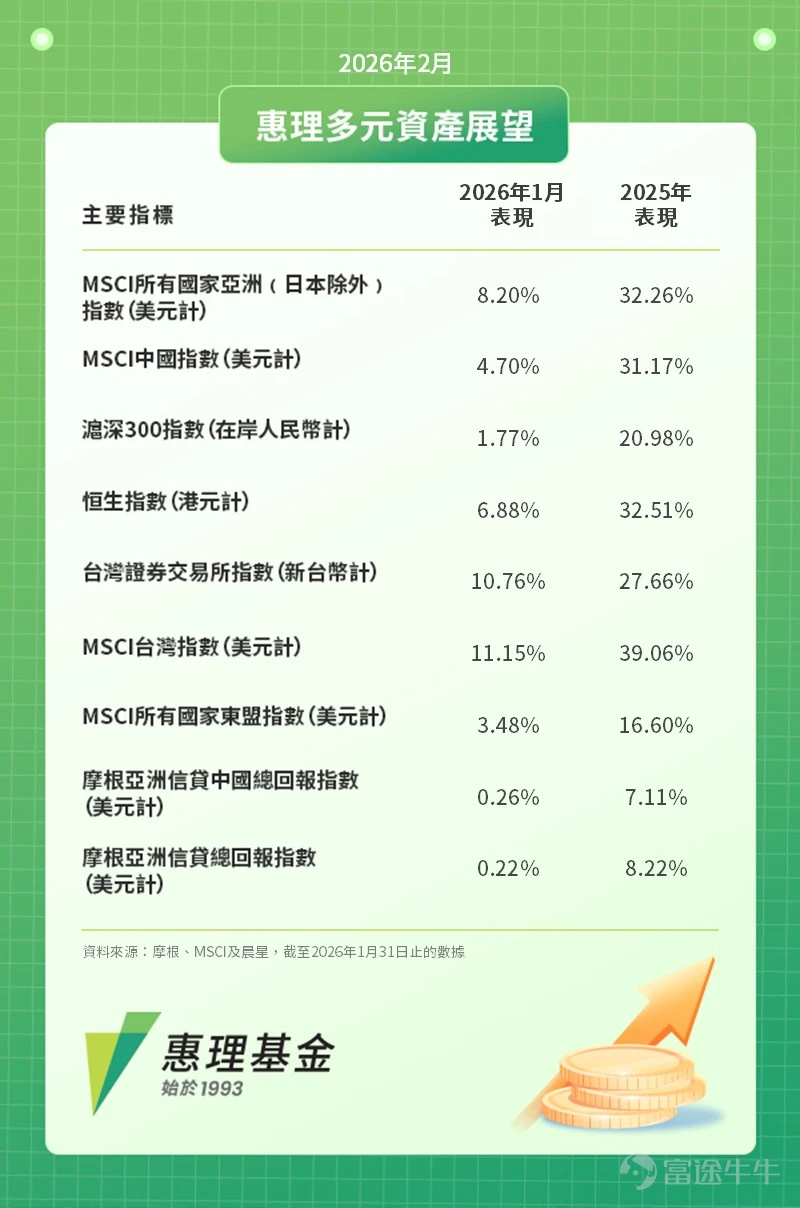
China / Hong Kong Stocks
– Market volatility has risen following Trump’s nomination of Kevin Warsh as the next Federal Reserve Chair. Known for his 'hawkish' stance on the balance sheet, less reliance on economic data in policymaking, and lower transparency in forward guidance, markets are concerned about increased uncertainty over future Fed policies.
– Moreover, Warsh supports reducing borrowing costs and improving access to credit for small and medium-sized enterprises. He believes the Fed's policy focus should shift from boosting asset prices to supporting productivity, wages, and real economic growth.
– Consequently, markets are beginning to rotate from the previously crowded tech sector towards traditional economic sectors. We believe rising market volatility will become the new norm, as a change in Fed chair often brings shifts in the policy framework.
– China’s macroeconomic data remains mixed, with consumption continuing to show weakness. The recent increase in VAT for the telecoms industry has dampened market risk sentiment and reignited concerns over potential tax hikes in other sectors, particularly internet and gaming.
– Influenced by changing trends in the US market, Hong Kong stocks and Chinese equities are also seeing a rotation from the tech sector to value-oriented sectors.
– As earnings season approaches, market focus will shift towards corporate profit outlooks. The market will likely need to see a bottoming out of profits before providing stronger support for subsequent upward movements.
China A-shares
– The renminbi continues to strengthen, mainly due to the People’s Bank of China allowing gradual appreciation to support domestic demand recovery.
– On the other hand, with overall valuations rising and the macro environment still weak, the previously strong-performing tech sector is starting to pull back, with market funds gradually rotating into financials and industrials.
– After the Lunar New Year, the market will start looking ahead to the March National People's Congress (NPC) meeting. Expectations for any specific policy announcements after the meeting are low, potentially leaving room for positive surprises.
Asia (ex-Japan) equities
– Growing divergence within the Asian markets; Taiwan and South Korean stock markets continue to outperform, while Southeast Asian markets remain relatively underperforming, though some catch-up movements have started to appear.
– Stocks in Taiwan and South Korea have been less impacted by the pullback in U.S. tech stocks as their tech industries are primarily hardware-focused and continue to benefit from substantial capital expenditures by U.S. cloud service providers (CSPs) and advancements in artificial intelligence infrastructure. Upward revisions in corporate earnings forecasts have also supported the market rally, although valuations have become increasingly stretched.
– There is also internal divergence in performance within Southeast Asia. The trade agreement between the U.S. and India to reduce tariffs to 15% has provided a positive signal for Indian stocks that had significantly retreated, attracting foreign capital inflows again. However, sentiment has turned cautious after a short-term rebound.
– The result of Thailand’s general election has positively impacted the market, with the unexpected victory of the royalist faction eliminating political uncertainty. Given that the local stock market valuation remains below historical averages, there is likely further upside potential for the overall market.
– Concerns over MSCI's free float on Indonesian stocks, as well as Moody's downgrade of Indonesia's rating outlook, have kept investors cautious about local equities.
Emerging markets (ex-Asia) equities
– Strong performance in Latin American markets has pushed valuations higher in emerging markets outside Asia. Positioning in these markets has become crowded, and rising commodity price volatility will exacerbate fluctuations in this region.
Japanese equities
– The Liberal Democratic Party’s overwhelming majority in the House of Representatives election boosted risk sentiment in the market. Prime Minister Sanae Takagi is expected to push forward fiscal expansion and structural reform measures with little resistance.
– The expectation of stimulus policies boosting Japan's economic growth has led both local and overseas investors to view the election results positively.
– However, market valuations are also gradually rising. With potential tax cuts and fiscal expansion policies being implemented, Japanese government bond yields may continue to rise, which could impact market liquidity and valuations in the long term.
Asian Investment Grade Bonds
– Credit spreads for Asian investment-grade bonds remain tight, while new bond issuance supply stays stable.
– Following Kevin Warsh’s nomination as the next Federal Reserve Chair, markets expect that while the Fed reduces its balance sheet, it will also push for interest rate cuts, potentially steepening the U.S. Treasury yield curve and increasing duration risk.
Asian High Yield Bonds
– Credit spreads for Asian high-yield bonds remain tight at levels far below historical averages, but they are still wider than those for U.S. high-yield bonds.
– Limited new bond supply in an environment of continued yield-chasing has led investors to focus on opportunities within the same batch of Asian high-yield bonds; despite elevated valuations, default rates for these bonds are expected to remain low as refinancing progress among Asian companies improves.
Emerging Market Bonds
– Credit spreads for these bonds have tightened further, with crowded positioning similar to emerging market equities, particularly concentrated in Latin America; in a low-yield environment, investors continue to chase returns within these bonds.
Gold
Speculative positions in the gold market have increased, leading to a significant rise in the volatility of precious metal prices, a situation rarely seen in decades; with the rise in leveraged trading by retail investors, increased gold volatility may become the new norm for the market.
On the other hand, central banks continue to increase their gold holdings to diversify away from reliance on US Treasuries; as for institutional investors, their current allocation to gold remains low but is expected to gradually increase in the future.
Multi-asset
Compared to single assets or traditional balanced portfolios, multi-asset strategies can offer lower volatility. However, the correlation between risky assets such as equities, corporate bonds, and commodities has significantly increased recently. Amid high levels of uncertainty in the current market environment, stable sources of income will be a key driver of investment returns.
Learn more about Value Partners' latest multi-asset outlook: Value Partners | Multi-Asset Outlook — February 2026
$VALUE PARTNERS (00806.HK)$$Value Partners Asian Income Fund MDis (HK0000352291.MF)$
Source: Bloomberg, as of January 31, 2026.
Learn more about Value Partners' latest multi-asset outlook: Value Partners | Multi-Asset Outlook — February 2026
$VALUE PARTNERS (00806.HK)$$Value Partners Asian Income Fund MDis (HK0000352291.MF)$
-
Investment involves risks, and past performance is not indicative of future returns. The above information is for reference only and does not constitute an offer to sell, an invitation to buy any securities, or a recommendation regarding any securities. This content has not been reviewed by the Hong Kong Securities and Futures Commission. Publisher: Value Partners Asset Management Hong Kong Limited.
Risk Disclaimer: The above content only represents the author's view. It does not represent any position or investment advice of Futu. Futu makes no representation or warranty.Read more

Comment (1)
to post a comment
3
1