
Tom Lee makes a heavyweight appearance at the Futu Investment Exhibition! What would you most like t

Earnings and Options Strategy | Circle, the leading stablecoin player, can it reverse its downturn with strong earnings?
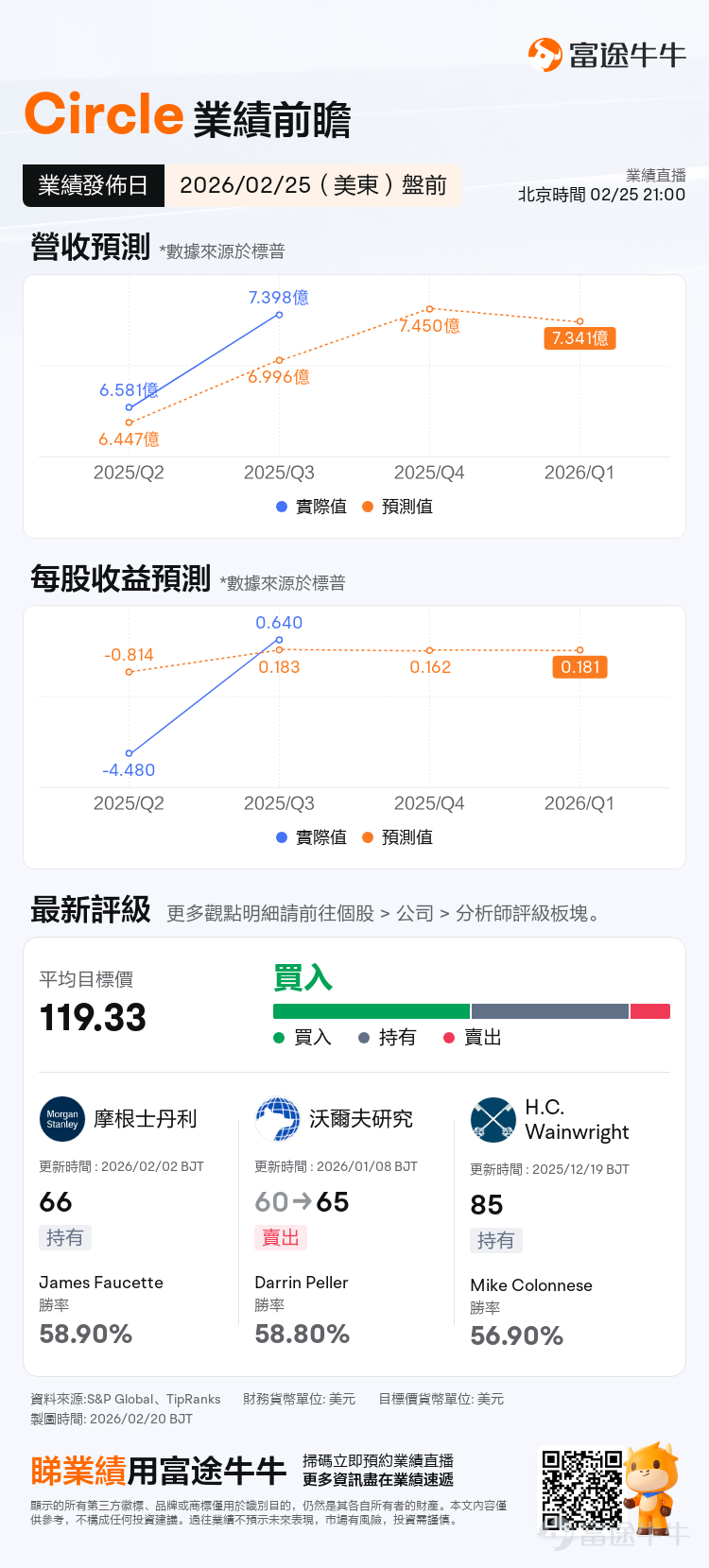
$Circle (CRCL.US)$ Circle will announce its Q4 and full-year 2025 results before the US stock market opens on February 25. For the crypto market, this is not an ordinary earnings report—it is more like a 'test sheet for the stablecoin business model': when the scale of USDC, regulatory developments, and the interest rate environment all change at the same time, how will Circle's profitability perform?
What are the key points the market is focusing on for this earnings report?
Market expectations this time are not complicated: everyone is mainly verifying three major logic trends for Circle—whether revenue can continue to grow, whether profit margins will be eroded by 'revenue-sharing costs,' and the future trend of the USDC scale.。
Based on the current consensus in the market, Circle’s revenue for this quarter is expected to be approximately $745 million, with earnings per share (EPS) around $0.162, meaning that the market expects steady growth from Circle rather than explosive performance.

Why are expectations leaning towards being 'stable'? Because Circle’s way of making money essentiallystill relies on 'interest rate spreads + scale'.In the previous earnings report, the company disclosed total revenue and reserve income amounting to $740 million, of which reserve income, at $711 million, was the main driver; meanwhile, Circle explicitly warned that reserve returns are affected by interest rates. In that quarter, the reserve return rate fell year-over-year by about 96 basis points to approximately 4.15%, indicating that changes in interest rates would directly impact revenue elasticity.
Therefore, this earnings report can be simply understood as follows: if the average scale of USDC continues to increase, even if interest rates slightly decrease, revenue may still be supported by scale; conversely,If the expected growth rate of USDC slows down, its revenue will be more susceptible to the impact of declining interest rates.This is also why stablecoin companies seem to behave 'like financial stocks,' with their performance being particularly sensitive to macro interest rates.
What is more easily overlooked but has a significant impact on stock prices is the cost side—especiallyrevenue sharing/channel feesCircle disclosed in Q3 that distribution, transaction, and other costs totaled approximately $448 million, with the year-over-year increase mainly coming from the rise in USDC scale and increased USDC holdings on the Coinbase platform leading to higher revenue-sharing expenses. Circle's largest distribution cost is the share it pays to Coinbase; the more USDC held on Coinbase, the more Circle's profits are likely to be eroded.
Recent stock price review: What are the major events?
The market’s interpretation of the previous quarter’s results was this: when the scale of USDC expanded significantly, Circle’s profit growth accelerated quickly, but it also made the company more likely to be viewed by the market asa 'dividend stock of the high-interest-rate era.'Looking back at the stock price performance since the last earnings report, the following key events have influenced Circle's stock price.
First, there are marginal changes in the scale of USDC. According to Circle’s official website, as of February 19, the circulation of USDC remained around $73.7 billion, with reserves at about $74 billion. If this figure holds broadly true for Q4, the market will naturally worry that this quarter’s revenue growth will depend more on 'interest rates' and 'channel structure' rather than a continued rapid expansion of USDC’s scale.

Moreover, what truly weighs on the share prices of Circle and a group of cryptocurrency stocks is that 'the wind of industry sentiment has shifted.' Since February, volatility in crypto assets has significantly increased: the persistent slump in Bitcoin prices has dampened overall market risk appetite, and this'bearish trend plus deleveraging' environment directly hits the valuation core of 'crypto stocks'—because the capital market is no longer willing to assign high multiples to growth stories related to cryptocurrencies, but instead focuses more on cash flow resilience and the ability to withstand downturns during cycles. Companies like Circle, even though their business nature is closer to a 'financial spread business,' can hardly completely escape the crypto beta. A decline in trading activity and contraction in risk appetite will affect stock prices through multiple channels.
In terms of regulation, what the market is currently 'trading' isthe progress of the CLARITY Act—which aims to address more fundamental 'rules of the game' such as the market structure and regulatory jurisdiction for crypto assets. Previous media reports indicated that the White House convened closed-door meetings with banks and the crypto industry to push for the CLARITY Act, but significant disagreements persisted over the issue of 'stablecoin yields/rewards,' preventing any breakthrough at the meeting; on February 13, Reuters cited Treasury Secretary Bessent urging Congress to advance the bill by spring 2026 to provide more certainty to the market.
For Circle's medium- to long-term performance trends, there are two key external variables:interest rates and competitive landscape。
Interest rates are easy to understand: Circle’s reserve income essentially comes from the returns on assets such as cash and short-duration US Treasuries. Changes in interest rate levels and return rates will directly impact revenue. This year, expectations for Fed rate cuts remain rather mixed, compounded by the upcoming change in Fed Chair mid-year, leaving this factor still facing considerable uncertainty.

As for the competitive landscape, what the market has recently been paying more attention to is that USDT's scale has reached approximately $184 billion, while some market voices have discussed issues regarding its transparency and the proportion of risky assets, prompting a re-examination of the quality of stablecoin reserves. For Circle, such events typically create a potential opportunity window: when the market favors compliance and transparency, USDC is more likely to capture institutional incremental demand; however, it also intensifies the 'channel and distribution battle,' which may not necessarily lead to better profit margins.
Options Strategy: How to Position in High Volatility
If planning to use options to participate in Circle's earnings report, the first consideration is whether the options during earnings week are expensive. This matters more than predicting the correct direction, especially given Circle’s inherently high stock price volatility and consistently elevated implied volatility.
From a volatility perspective, market data shows CRCLwith near-term implied volatility (IV) at around 85%, while historical volatility (HV) is approximately 82% — indicating that the market is psychologically prepared for post-earnings movement, and current option prices already reflect this expected volatility.

Based on the predicted volatility provided by the options market on earnings day, the stock price is expected to move about 10% after the earnings release. This expectation can serve as a rough anchor for market volatility. After last quarter's earnings release, Circle fell 12% in a single day, aligning with the lower end of the pre-earnings expectations. However, considering Circle has limited post-IPO earnings history, the historical reference value is relatively weak.

Under this pricing environment, the most suitable option strategies typically fall into three categories:
If you hold the underlying stock but don't want to endure overnight volatility during earnings night, a “rent-like” approach would be to execute a covered call:Using the relatively higher premiums before earnings to add a buffer to your position.The cost is also clear: if there is a significant rise after the earnings release, your upside gains will be capped by the strike price. However, as long as there is no unexpected surge, choosing out-of-the-money Calls still offers a favorable probability of success.

If you are bullish or bearish but worried that 'buying single-leg options is too expensive,' a more stable approach is to usespread strategies to express your view, such as using a bull call spread for bullish views or a bear put spread for bearish views. The advantage is that the cost is more controllable, and it is less sensitive to the common post-earnings implied volatility collapse (IV crush).

If you believe that 'realized volatility will be lower than the market's pricing,' selling strategies (such as selling wide strangles or iron condors) theoretically match better, but these strategies require high risk management, especially for assets like Circle, which are strongly correlated with crypto sentiment.Encountering 'regulatory/exchange/stablecoin' breaking news, gap risks are greater compared to traditional financial stocks—most individual investors are better suited to use limited-risk structures and avoid naked selling.

Summary: The key factors for this earnings report are 'scale, interest rates, and revenue sharing.'
For Circle’s earnings this time, the market won’t just focus on whether 'revenue reached $750 million' but will pay closer attention to:whether the marginal changes in USDC scale have reaccelerated, whether reserve yields have further declined, and most importantly—whether distribution share agreements and channel structures continue to pressure profit margins.In the previous quarter, the company clearly demonstrated that 'profits release quickly when scale increases,' but it also showed the reality that 'distribution costs rise accordingly.'
Finally, here's a small perk for everyone. If you're planning to trade options soon, feel free to claim it.Options Beginner's Package(*This event is only open to invited HK users, click to learn more)Event Details Rules >>). If you're still hesitant to trade, you canClick hereparticipate in the simulated trading challenge, with zero cost and zero risk, plus there are stock cash vouchers waiting for you!
Risk Disclaimer: The above content only represents the author's view. It does not represent any position or investment advice of Futu. Futu makes no representation or warranty.Read more


Comments (8)
to post a comment
79
54