
NVIDIA's Q4 earnings report was impressive, but why is the market not responding positively?

Earnings and Options Strategy | Under Global Spotlight! Can NVIDIA's Earnings Report Shatter the AI Bubble Theory?
$NVIDIA (NVDA.US)$ NVIDIA is set to announce its Q4 FY26 and full-year earnings, ending January 25, 2026, after the US stock market closes on Wednesday, February 25. Following the announcement, a conference call will be held. Without a doubt, this earnings release remains a globally anticipated heavyweight event and a major test for AI-related sectors worldwide. The reason is simple: the market no longer just cares about whether 'GPUs are still in short supply,' butis asking, 'When will the money spent on AI return to the profit statement?'
In an environment of 'high expectations + high volatility,' NVIDIA's performance hinges less on Q4 itself and more onnext-quarter guidance and Jensen Huang's response to concerns about AI demand, supply, and customer ROI.。
Earnings Outlook Analysis: What exactly is the market waiting for?
First, let's look at NVIDIA's own 'standard answer' from last quarter. In the previous earnings report, NVIDIA provided revenue guidance for FY26 Q4 at $65 billion (±2%), meaning it would likely fall within the range of approximately $63.7 billion to $66.3 billion. Additionally, the company projected that its GAAP/Non-GAAP gross margin for the current quarter would be around 74.8%/75.0% (±0.5 percentage points).
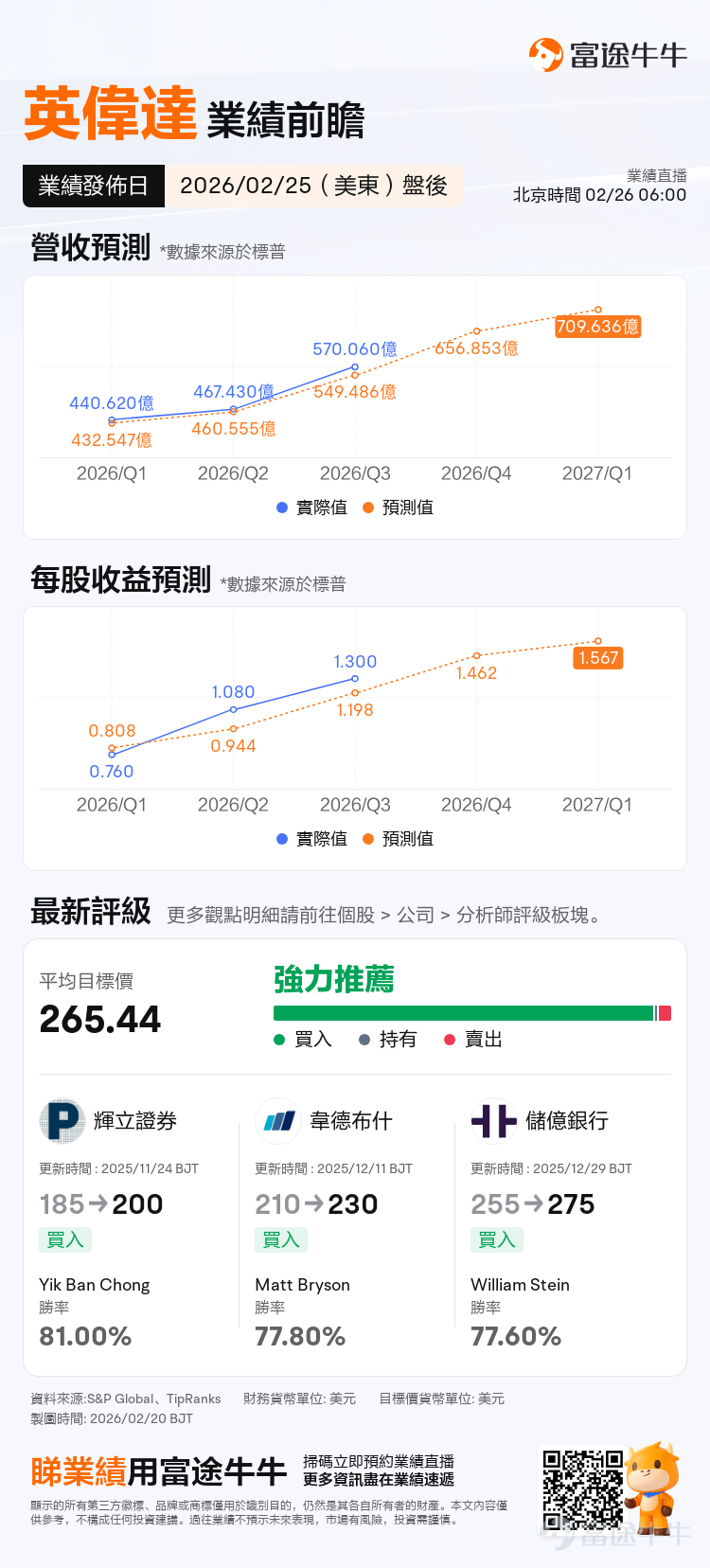
Now, let’s examine Wall Street's current consensus expectations. The mainstream market forecast is roughly as follows: FY26 Q4 revenue at about $65.7 billion, with earnings per share (EPS) at approximately $1.46.

Compared to the same period last year, the growth rate for this quarter remains extremely high. In the same period last year (FY25 Q4), NVIDIA's revenue was about $39.3 billion, with GAAP diluted EPS at approximately $0.89. This implies that market expectations reflect a very steep year-over-year growth trajectory,with consensus revenue growth at 67%.—The issue isn't the hyper-growth itself, but rather that everyone has already fully priced this growth into the stock price.
So, what kind of results are more likely to drive the stock price?
If it's just 'within the company’s guidance range, slightly above the market average,' it usually only counts as a pass. What truly makes the market bulls more active are two things combined:First, revenue should not only reach the 'central level' of $65 billion, but ideally also approach or even exceed the upper limit; second, the gross margin needs to stabilize around 75%, indicating that the delivery pace of the new generation of products and systems, supply ramp-up, and cost control have 'not dropped the ball.'
The third and more critical factor: the guidance for the next quarter (FY27 Q1). The market’s average expectation for the next quarter is roughly $70.9 billion in revenue, with EPS around $1.56. Overall, the Q4 report card issued this time determines 'how you’ve performed in the past,' but the Q1 guidance will decide'whether you can continue to accelerate going forward'—and acceleration is the fuel that drives high-valuation assets higher.。
Three key event drivers behind the stock price consolidation
Over the past few months, NVIDIA’s stock price has been consolidating between $170 and $195. Although there hasn’t been a significant upward movement in the share price, it doesn’t mean nothing has happened. On the contrary, the market seems to be compressing all the divergences into this super earnings night:Is it the continuation of the upward revision of the AI supercycle, or a typical case of 'buy the rumor, sell the news'?。

Main storyline one: Raising the bar higher last quarter
NVIDIA delivered revenue of $57 billion in FY26 Q3, including $51.2 billion from the data center segment, while providing guidance for $65 billion in revenue for FY26 Q4, which significantly exceeded market expectations.
From a trading perspective, NVIDIA didn't just 'submit an impressive report card,' but effectively announced to the entire market:The next quarter will be even strongerThis also explains why the market's reaction to NVIDIA's earnings reports has become increasingly 'picky'—because the bar has already been raised repeatedly by one better-than-expected earnings report and guidance after another. In an environment where 'everyone expects you to keep exceeding expectations,' being slightly better is often not enough—it has to be 'good enough to revise expectations upward again.'
Main storyline two: Major client Meta locks in orders again, strengthening demand visibility
On February 17, NVIDIA announced a multi-year agreement with Meta to supply 'millions' of existing and next-generation AI chips (including Blackwell and future Rubin), as well as Grace/Vera CPUs and other products. Although the amount was not disclosed, the significance of such news for sentiment lies in this: it tells the market that major clients are not 'hitting the brakes.'
This agreement happened during the peak period of the narrative that 'the market is worried that big tech companies developing their own ASICs will erode NVIDIA's market share.' Notably, while Meta is pushing forward with its self-developed AI chips, it is also discussing the possibility of using Google's TPUs; NVIDIA’s high-profile announcement of a cross-generational collaboration with Meta at this time is, to some extent, telling the market—Even if clients have their own development routes, large-scale clusters for cutting-edge training/inference still cannot do without NVIDIA's general-purpose platformAt least for the next few product cycles, 'the largest slice of the pie' is still more likely to remain in NVIDIA’s hands.

Main storyline three: OpenAI financing takes the 'AI arms race' to an even more exaggerated level
On February 20, media reports indicated that NVIDIA is close to finalizing a $30 billion investment in OpenAI; this round of OpenAI financing could exceed $100 billion and push OpenAI's valuation to around $830 billion. Setting aside controversies about where the money comes from and whether it might form a 'circular financing'—the most direct implication for the industry chain is: model factories and computing power factories still...Betting on computing power expansion with real money, and NVIDIA remains at the center of this chain.
At the same time, Reuters also mentioned that OpenAI plans to spend approximately $600 billion cumulatively on computing power by 2030, disclosing details such as an estimated revenue of $13 billion and expenses of $8 billion for 2025—these numbers will further amplify the market's dual sentiment about 'return on AI investment and cash flow pressure'.

Looking at these three points together: NVIDIA’s consolidation isn’t because demand has disappeared, but because the market is waiting for a clearer answer—'customers continuing to buy' is no longer enough to prove everything; everyone wants to know‘whether customers can make money faster after buying’, and this is currently the most crucial concern for the global AI sector market.
The next card after earnings: Can the GTC conference once again become a catalyst for the stock price?
After the earnings report, NVIDIA will soon face its next catalyst: GTC 2026, scheduled for March 16–19 in San Jose, USA. This is typically one of NVIDIA’s most important stages for showcasing product roadmaps, ecosystem progress, and industry narratives.
For trading purposes, this implies a very practical rhythm: if there is a 'post-earnings relief rally' on the earnings night, the market often immediately shifts its focus to the GTC—by then, any developments regarding Blackwell supply ramp-up, Rubin timing, inference demand explosion, or reinforcement of the 'AI factory/data center' narrative could trigger re-pricing.
Jensen Huang recently made direct comments, stating that he will unveil a new chip at the GTC.New chip that 'will amaze the world'—Such ‘mysterious previews’ naturally raise market expectations for GTC, but they also make short-term capital more concerned: if the new products aren’t impressive enough or the delivery schedule isn’t clear at the time, it could easily lead to profit-taking after the good news is exhausted.
Options Strategy: Betting on Volatility
The biggest pitfall of trading options during earnings week isn’t 'guessing the wrong direction,' but rather 'paying too much.' According to market data as of last Friday, the options market is pricing in about a 6% post-earnings move, whereas the actual volatility in the previous three quarters was within 4%. This suggests that simply 'buying volatility' might not be worth it.

When implementing an options strategy, the first consideration is what variable you’re using options to bet on—Are you holding for defense, expecting an increase in implied volatility, or aiming to earn the currently high premiums?。
If you currently hold the underlying stock and are concerned about fluctuations on earnings night, a covered call resembles 'collecting rent' rather than 'betting on upside.' The premiums tend to be higher before earnings; selling slightly out-of-the-money call options can cushion potential drawdowns. The trade-off is that if the stock surges post-earnings, your upside will be capped.

If you're bullish but don’t want to get 'ripped off' by overpriced options, using a bull call spread would be more prudent: buying a call option while simultaneously selling a call with a higher strike price reduces costs, allowing for participation with 'limited gains but controlled risk.' Conversely, if bearish, use a bear put spread to express 'expecting a decline without burning unlimited cash.'

If you’re optimistic long-term and care more about NVIDIA’s product cycle than just a single earnings report, a steadier approach often involves waiting until after the earnings release to observe the market and make decisions. Historically, NVIDIA has seen moments where 'strong numbers were followed by a stock dip' — when a 5%-10% pullback occurs, it's easier to employ longer-term strategies like buying long-dated call options to bet on the next catalyst, rather than stubbornly facing the pricing and volatility of earnings night.
Summary: Using performance to shatter doubts, can NVIDIA deliver a perfect report this time?
The market's expectations for NVIDIA's earnings report this time are no longer just 'continued growth,' but rather 'strong guidance for the next quarter on top of already robust growth,' alongside a strong response to current market skepticism about an AI bubble. The current earnings performance will determine whether the stock price can stabilize, while the Q1 guidance and management's tone will decide whether the market is willing to push valuations even higher.
Regardless of whether the stock rises or falls after the earnings report, don't forget: the GTC Conference from March 16th to 19th could very well be the next pivotal moment for sentiment and expectations, and should be closely watched.
Finally, here's a small perk for everyone. If you're planning to trade options soon, feel free to claim it.Options Beginner's Package(*This event is only open to invited HK users, click to learn more)Event Detailed Rules >>). If you're still hesitant to trade, you canClick hereparticipate in the simulated trading challenge, with zero cost and zero risk, plus there are stock cash vouchers waiting for you!
Risk Disclaimer: The above content only represents the author's view. It does not represent any position or investment advice of Futu. Futu makes no representation or warranty.Read more


Comments (19)
to post a comment
159
226