English
Back
Open Account
Big reveal of institutional holdings! What are the 'smart money' investors buying?

AceCamp本营
joined discussion · Feb 20 19:51

AceCamp Production | Moody's MCO.US: Buffett's Long-term Holding Misjudged by AI Concerns

This article was first published on February 19, 2026, on the AceCamp official website—fresh information, one step ahead!
MCO$Moody's (MCO.US)$ It is a long-term holding of Buffett, a high-ROE rent-collecting enterprise with an extremely deep moat. Its business is divided into two major segments:
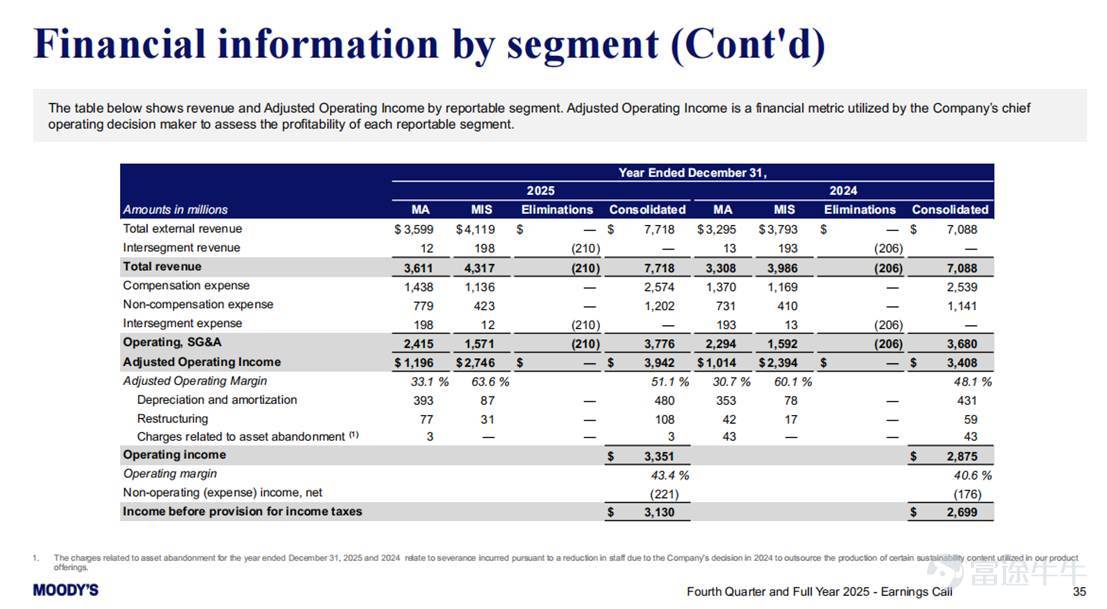
· MIS (Moody's Investors Service): Primarily engaged in credit rating services, regulated by the U.S. SEC, with dual moats of licensing and century-old reputation; revenue comes from both existing and incremental fixed-income securities, belonging to Buffett’s favorite rent-collecting type of business; the advantage is high profitability, accounting for 70% of MCO's adjusted operating income; the downside is that revenue fluctuates with the credit cycle.
· MA (Moody's Analytics): This is a relatively new business that provides financial data analysis and risk management services to financial institutions and government departments; its advantage lies in the SAAS subscription model, with little correlation to the credit cycle, offering more stable revenue and higher growth potential than MIS; the downside is lower profitability compared to MIS, accounting for 30% of MCO's adjusted operating income.
This article was first published on February 19, 2026, on the AceCamp official website—fresh information, one step ahead! MCO$Moody's (MCO.US)$MCO is Buffett's long-term holding, a high ROE rent-collection enterprise with an extremely deep moat. Its business is divided into two major segments: ·       MIS (Moody's Investors Service): Primarily engaged in credit rating services, regulated by the U.S. Securities and Exchange Commission (SEC), with dual moats of licensing and century-old reputation; revenue comes from existing and incremental fixed-income securities, belonging to Buffett’s favorite rent-collection type business; its advantage lies in high profit margins, accounting for 70% of MCO’s adjusted operating income; the downside is that revenue fluctuates with the credit cycle. ·       MA (Moody's Analytics): This is a relatively new segment providing financial data analysis and risk management services to financial institutions and government departments; its advantages include a SAAS subscription model, low correlation with the credit cycle, more stable revenue, and higher potential growth compared to MIS; its downside is lower profitability than the MIS segment, accounting for 30% of MCO’s adjusted operating income. The recent wave of sell-offs in software stocks driven by AI concerns caused MCO to drop 27% within a month — the market mainly fears that AI will impact MCO’s MA segment. The author believes that MA’s moat lies in MCO’s long-accumulated proprietary data (fixed...
The recent AI-driven sell-off in software stocks caused MCO to drop 27% in a month — the market's primary concern being that AI would impact MCO's MA business. The author believes that the moat of MA lies in the privately accumulated data over the years (the fixed-income market is much less transparent compared to equities), while algorithms have never been a moat. There are many global credit rating agencies, and their algorithms are largely similar. AI will not disrupt MCO but instead bring a dual benefit:
· The massive CAPEX spending on AI leads to a surge in debt, with FCF already depleted, and large-scale bond issuance starting from 2025, directly bringing incremental revenue to MCO.
· AI algorithms, including foundational models, cannot be patented and have no moat. MCO can acquire or purchase them, using AI to replace labor and reduce employee costs, further increasing MCO's profitability.
This article was first published on February 19, 2026, on the AceCamp official website—fresh information, one step ahead! MCO$Moody's (MCO.US)$MCO is Buffett's long-term holding, a high ROE rent-collection enterprise with an extremely deep moat. Its business is divided into two major segments: ·       MIS (Moody's Investors Service): Primarily engaged in credit rating services, regulated by the U.S. Securities and Exchange Commission (SEC), with dual moats of licensing and century-old reputation; revenue comes from existing and incremental fixed-income securities, belonging to Buffett’s favorite rent-collection type business; its advantage lies in high profit margins, accounting for 70% of MCO’s adjusted operating income; the downside is that revenue fluctuates with the credit cycle. ·       MA (Moody's Analytics): This is a relatively new segment providing financial data analysis and risk management services to financial institutions and government departments; its advantages include a SAAS subscription model, low correlation with the credit cycle, more stable revenue, and higher potential growth compared to MIS; its downside is lower profitability than the MIS segment, accounting for 30% of MCO’s adjusted operating income. The recent wave of sell-offs in software stocks driven by AI concerns caused MCO to drop 27% within a month — the market mainly fears that AI will impact MCO’s MA segment. The author believes that MA’s moat lies in MCO’s long-accumulated proprietary data (fixed...
After last night’s earnings beat, the stock price started rebounding as MCO's 2025 guidance and 2026 outlook both exceeded market expectations.
This article was first published on February 19, 2026, on the AceCamp official website—fresh information, one step ahead! MCO$Moody's (MCO.US)$MCO is Buffett's long-term holding, a high ROE rent-collection enterprise with an extremely deep moat. Its business is divided into two major segments: ·       MIS (Moody's Investors Service): Primarily engaged in credit rating services, regulated by the U.S. Securities and Exchange Commission (SEC), with dual moats of licensing and century-old reputation; revenue comes from existing and incremental fixed-income securities, belonging to Buffett’s favorite rent-collection type business; its advantage lies in high profit margins, accounting for 70% of MCO’s adjusted operating income; the downside is that revenue fluctuates with the credit cycle. ·       MA (Moody's Analytics): This is a relatively new segment providing financial data analysis and risk management services to financial institutions and government departments; its advantages include a SAAS subscription model, low correlation with the credit cycle, more stable revenue, and higher potential growth compared to MIS; its downside is lower profitability than the MIS segment, accounting for 30% of MCO’s adjusted operating income. The recent wave of sell-offs in software stocks driven by AI concerns caused MCO to drop 27% within a month — the market mainly fears that AI will impact MCO’s MA segment. The author believes that MA’s moat lies in MCO’s long-accumulated proprietary data (fixed...
For MCO, the real risks are commercial real estate blow-ups or the bursting of the AI bubble, leading to a collapse in the fixed-income market like in 2008, which would freeze its credit rating revenue for several years before recovery — currently, driven by AI-related CAPEX, the debt cycle continues upward, and MCO is actually still in a bull market phase.
This article was first published on February 19, 2026, on the AceCamp official website—fresh information, one step ahead! MCO$Moody's (MCO.US)$MCO is Buffett's long-term holding, a high ROE rent-collection enterprise with an extremely deep moat. Its business is divided into two major segments: ·       MIS (Moody's Investors Service): Primarily engaged in credit rating services, regulated by the U.S. Securities and Exchange Commission (SEC), with dual moats of licensing and century-old reputation; revenue comes from existing and incremental fixed-income securities, belonging to Buffett’s favorite rent-collection type business; its advantage lies in high profit margins, accounting for 70% of MCO’s adjusted operating income; the downside is that revenue fluctuates with the credit cycle. ·       MA (Moody's Analytics): This is a relatively new segment providing financial data analysis and risk management services to financial institutions and government departments; its advantages include a SAAS subscription model, low correlation with the credit cycle, more stable revenue, and higher potential growth compared to MIS; its downside is lower profitability than the MIS segment, accounting for 30% of MCO’s adjusted operating income. The recent wave of sell-offs in software stocks driven by AI concerns caused MCO to drop 27% within a month — the market mainly fears that AI will impact MCO’s MA segment. The author believes that MA’s moat lies in MCO’s long-accumulated proprietary data (fixed...

Buffett especially favors MCO, a high-ROE rent-collecting company. MCO requires almost no CAPEX, with all annual FCF used for dividends and buybacks — MCO’s ROE is significantly higher than SPGI, mainly due to two reasons:
· MCO’s business is simpler than SPGI’s, focusing on high-margin credit rating services; SPGI has more diversified operations, including indices and other relatively low-margin businesses. $S&P Global (SPGI.US)$
The acquisition of IHS Markit by SPGI has reduced profit margins and expanded the equity base; MCO’s FCF has been entirely used for dividends and buybacks, leading to a shrinking equity base.
This article was first published on February 19, 2026, on the AceCamp official website—fresh information, one step ahead! MCO$Moody's (MCO.US)$MCO is Buffett's long-term holding, a high ROE rent-collection enterprise with an extremely deep moat. Its business is divided into two major segments: ·       MIS (Moody's Investors Service): Primarily engaged in credit rating services, regulated by the U.S. Securities and Exchange Commission (SEC), with dual moats of licensing and century-old reputation; revenue comes from existing and incremental fixed-income securities, belonging to Buffett’s favorite rent-collection type business; its advantage lies in high profit margins, accounting for 70% of MCO’s adjusted operating income; the downside is that revenue fluctuates with the credit cycle. ·       MA (Moody's Analytics): This is a relatively new segment providing financial data analysis and risk management services to financial institutions and government departments; its advantages include a SAAS subscription model, low correlation with the credit cycle, more stable revenue, and higher potential growth compared to MIS; its downside is lower profitability than the MIS segment, accounting for 30% of MCO’s adjusted operating income. The recent wave of sell-offs in software stocks driven by AI concerns caused MCO to drop 27% within a month — the market mainly fears that AI will impact MCO’s MA segment. The author believes that MA’s moat lies in MCO’s long-accumulated proprietary data (fixed...
Risk Disclaimer: The above content only represents the author's view. It does not represent any position or investment advice of Futu. Futu makes no representation or warranty.Read more
Thumbs Up
7
Heart
4
Lol
2
101K Views
Report
Comment (1)
Write a Comment...
1
13
9