
How to view the post-holiday market trend in Hong Kong stocks?

Zijin Mining offers both offensive and defensive short-term strategies: call warrants bet on a breakout above 47 yuan, while put warrants hedge against a pullback to 41.6 yuan.
$ZIJIN MINING (02899.HK)$ Zijin Mining offers both offensive and defensive short-term strategies: call warrants bet on a breakout above 47 yuan, while put warrants hedge against a pullback to 41.6 yuan.
Zijin Mining (2899) closed at 44.7 yuan on February 12, up 2.67%, with significantly higher trading volume compared to the average of the past five trading days. The stock price has remained above the 10-day moving average of 41.53 yuan for three consecutive trading days since February 10 and once approached the resistance level of 47 yuan. This article analyzes Zijin's short-term trading perspective based on the latest technical data, the company’s long-term plans, and the distribution of warrants in the market.
Technical Aspect: Neutral signals dominate, with the shadow of a death cross still looming.
From a key price level perspective, the first short-term resistance for Zijin Mining is at 47 yuan, which represents the top of the sideways range since last quarter and is close to the high point after the sharp rise on February 6. If this level is successfully breached, the next resistance target will be 50.8 yuan. On the support side, the first line of defense lies at 41.6 yuan, a level that closely aligns with the 10-day moving average at 41.53 yuan, serving as the initial support zone in case of a short-term pullback. A breakdown below this could lead to a deeper test of support at 39.1 yuan, near the psychologically significant 30-day moving average at 40.58 yuan.
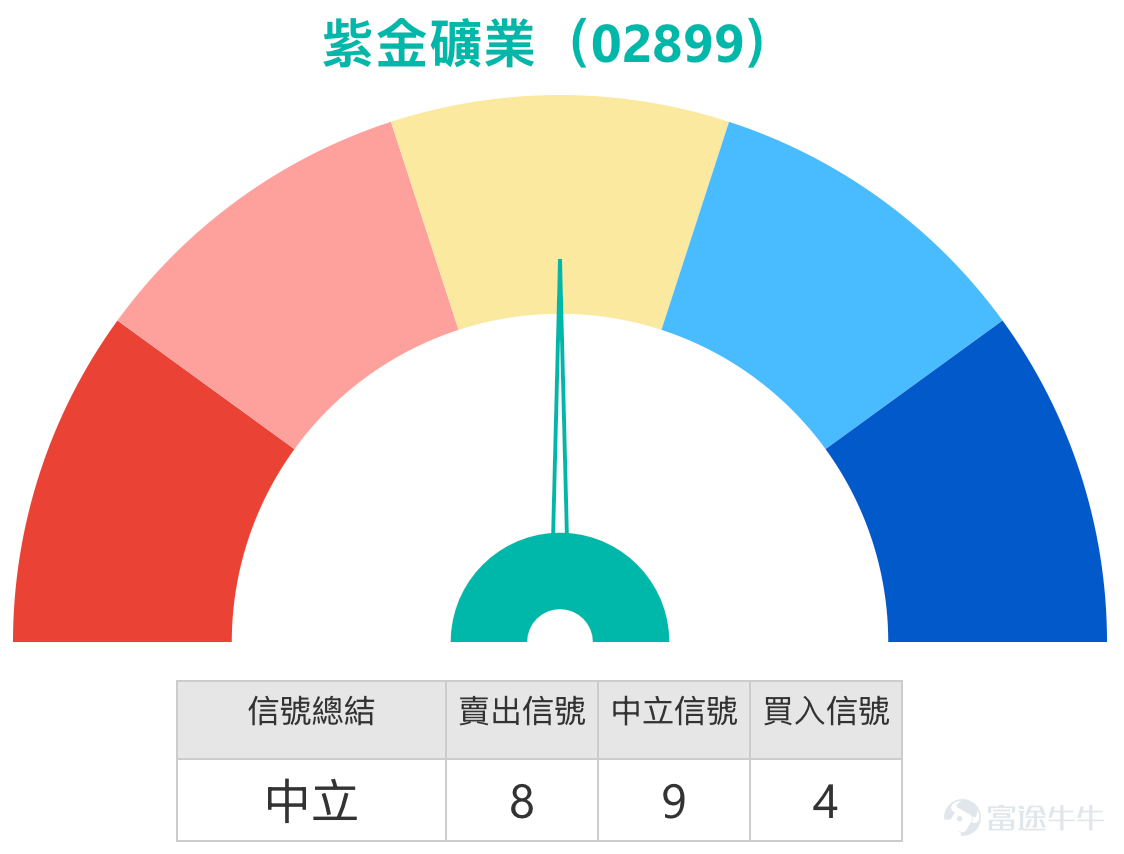
According to data from February 12, Zijin Mining’s technical indicators show a 'neutral' composite signal with a strength of 9. Various oscillation indicators present diverging signals: the Williams %R indicator is in overbought territory, issuing a sell signal, while the Stochastic Oscillator also indicates overbought conditions and a sell signal. The CCI remains neutral, and the RSI, at 62, still reflects a strong but not overheated position, suggesting room for short-term upside movement. However, the sell signal from the Stochastic Oscillator warrants caution. The Relative Strength Index (RSI) stands at 62, indicating strength without entering overbought territory, reflecting potential for further upward movement, though the overbought sell signal from the Stochastic Oscillator should not be ignored.
However, it is worth noting that Zijin Mining formed a 'death cross' bearish signal on February 11, where the 10-day moving average crossed below the 20-day moving average. Although the share price rebounded for two consecutive days afterward, recovering the 10-day moving average and attempting to repair the 20-day moving average, this technical pattern still creates psychological pressure for short-term investors—failure to quickly resolve the death cross often signals an extended consolidation period. The MACD maintains a sell signal, while Bollinger Bands suggest a buy, leaving the technical outlook in a critical tug-of-war between bulls and bears.

Major Planning Ignites: Long-Term Logic of Tripling Production in Three Years
In early February, Zijin Mining released its 'Three-Year Plan (2026–2028) for Key Mineral Products Output and Vision Goals for 2035,' setting a goal to rank among the top three global producers of copper and gold by 2028. According to the plan, copper production will increase from 1.09 million tons in 2025 to between 1.5 million and 1.6 million tons by 2028, representing a growth of 38% to 47%. Gold production will rise from 90 tons to approximately 130 to 140 tons, reflecting an increase of 44% to 56%. Even more ambitious is the expansion into new energy metals, with plans to boost lithium carbonate equivalent production from 25,000 tons in 2025 to between 270,000 and 320,000 tons by 2028, marking growth of 980% to 1,180%, with the aim of becoming one of the world's leading lithium producers.
Notably, this round of planning was the first long-term vision announced after founder Chen Jinghe passed the baton during a period of rising momentum. At a peak performance moment—the company forecasted net profits attributable to shareholders of approximately 51 to 52 billion yuan for 2025, representing year-over-year growth of 59% to 62%—management actively accelerated expansion, reflecting strategic judgment on reshaping the global mining landscape. Recent acquisitions, such as Canada's Allied Gold Corporation, and the commissioning of Phase II of the Julong Copper Mine provide concrete support for achieving these production targets.
However, the market reaction suggests that it is currently caught in a tug-of-war between 'expectation fulfillment' and 'valuation digestion.' After the release of the plan, Zijin Mining shares surged 6.19% in a single day, followed by consolidation between 44 and 46 yuan over the next two trading days, with trading volumes remaining active but failing to break through the resistance at 47 yuan.
Warrant Product Review: Two-Day Gains Highlight Tracking Efficiency
Reviewing the four Zijin Mining warrants and bull contracts mentioned on February 10, their subsequent two-day performance clearly demonstrated the tracking capability of derivative instruments. The China Securities call warrant (21922) recorded a 53% gain during the period, while the Bank of China call warrant (21590) rose by 45%. The HSBC bull contract (58916) $HS#ZIJINRC2610B.C (58916.HK)$ and the UBS Group bull contract (58739) $UB#ZIJINRC2610G.C (58739.HK)$ A 40% increase was observed. Compared to the underlying stock's 6.19% rise during the same period, callable bull/bear contracts provide investors with more flexible short-term trading tools through a fixed-leverage structure.

The core advantage of such products lies in the efficiency of capital allocation and the ability to independently choose risk parameters. Investors can participate in the movement of the underlying stock with relatively less principal. More importantly, based on their judgment of support and resistance levels, they can select terms with different strike prices, stop-loss levels, and expiration dates to precisely deploy directional views — those optimistic about support at 41.6 yuan can choose bull contracts with a stop-loss level below that level; those bearish about resistance at 47 yuan may deploy put warrants or bear contracts with a strike price above that level.
Product recommendation and term analysis for callable bull/bear contracts: A breakout bet behind the strike price of 51.04 yuan
Regarding Zijin Mining's short-term trend, the product terms available in the market are highly correlated with technical price levels. For call warrants, UBS Group call warrant (15933) $UBZIJIN@EC2604B.C (15933.HK)$ and Citi call warrant (13345) $CTZIJIN@EC2604B.C (13345.HK)$ both have the same strike price of 51.04 yuan, which is near the second resistance level at 50.8 yuan, making them slightly out-of-the-money terms. Among them, 13345 has the lowest premium and implied volatility among similar products, offering higher cost-effectiveness; while 15933 provides 8x leverage with an equally ideal implied volatility level. The design logic of both products is clear: if Zijin successfully breaks through the first resistance at 47 yuan, the next target will directly aim for the 50.8 yuan level, at which point the call warrant with a strike price of 51.04 yuan will transition from being out-of-the-money to in-the-money, with explosive potential.
It’s worth noting that according to an analysis of the market call warrant structure, the current deep out-of-the-money range (strike price between 48.02 and 70.99 yuan) has accumulated 148 million outstanding contracts, accounting for 75.4% of the total open interest, with an average implied volatility of 57.87%, which is relatively high. Although the concentration of open interest reflects market optimism, it also brings structural risks — if the underlying stock fails to break through the 47 yuan resistance, all out-of-the-money call warrants will face significant time decay pressure. In comparison, although the strike price of 51.04 yuan for 15933 and 13345 remains out-of-the-money, it maintains a reasonable distance from the 50.8 yuan resistance level, making the terms structurally balanced.
For bearish positions, J.P. Morgan put warrant (25363) $JPZIJIN@EP2706A.P (25363.HK)$ has a strike price of 42.88 yuan, below the first support level of 41.6 yuan, offering 1.6x leverage, which is the highest leverage option among similar products. If the share price tests the 41.6 yuan or even 39.1 yuan support, this out-of-the-money put warrant will play its role in tracking downside movement.
For bull/bear contract deployments, Societe Generale bull contract (59845) has a stop-loss level of 39.5 yuan, and UBS Group bull contract (58739) $UB#ZIJINRC2610G.C (58739.HK)$The recovery price is HK$39, lower than the second support level at HK$39.1, offering 6.4 to 6.5 times actual leverage. Among these, product code 58739 has the lowest premium, while 59845 offers higher actual leverage. On the bearish side, UBS Group's bear certificate (code 69187) has a recovery price of HK$53, above the second resistance level at HK$50.8, providing 5.5 times actual leverage, making it the highest-leveraged product in its category.

Interactive Q&A session:
Q1: Do you think Zijin Mining will first break through the resistance level at HK$47, or first retest the support level at HK$41.6?
A. First break HK$47
B. First test HK$41.6
C. Consolidate within the range of HK$42 to HK$46
Feel free to leave a comment sharing your choice and follow Jenny’s HK Stock Warrants for more product comparison insights!
#Zijin Mining #02899 #Technical Analysis #Support and Resistance Levels #Warrants #Bull and Bear Certificates #Street Stock Volume #Three-Year Plan #Death Cross #Hong Kong Stock Warrants Jenny
Risk Disclaimer: The above content only represents the author's view. It does not represent any position or investment advice of Futu. Futu makes no representation or warranty.Read more

Comments
to post a comment
5
9