
Options Trading in Focus | Significant Rebound in Tech Stocks! AI Hardware Leaders Stay Strong, Software Stocks Make a Comeback? New Investment Blueprint Under AI Market 2.0
This article comes from the 'Options Trend Insights' column, which strives to position itself at the forefront of investment trends, interpreting opportunities within these trends and teaching readers how to seize them using options. If you're interested, feel free to subscribe.Click hereUpon joining the learning platform, you will receive notifications when subsequent columns are updated.
*The following content is for investment education purposes only and does not constitute any investment advice. The information provided is time-sensitive, with data accurate as of the U.S. stock market open on February 10, 2026. Please exercise caution when evaluating.
After experiencing a heart-stopping sell-off in the previous week, the U.S. tech sector welcomed a significant rebound over the past two trading sessions.
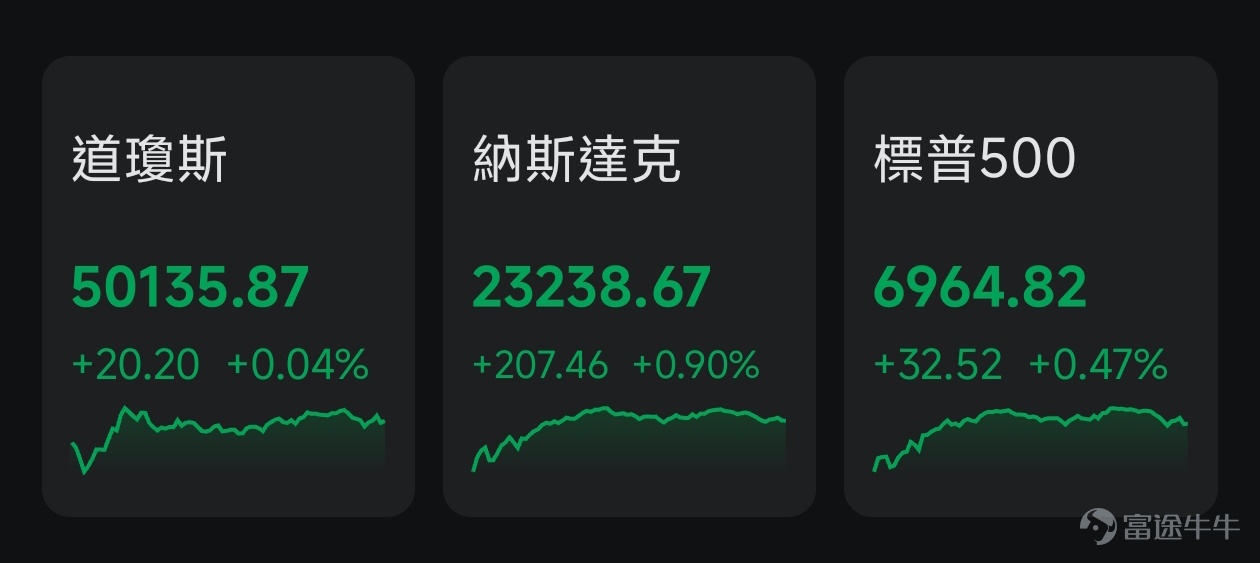
U.S. stocks extended their recovery momentum from last Friday on February 9 (Monday), with the three major indices closing higher. $Nasdaq Composite Index (.IXIC.US)$ Up by 0.90%, $S&P 500 Index (.SPX.US)$ Up by 0.47%, $Dow Jones Industrial Average (.DJI.US)$ And even after hitting a new all-time high on Friday, it remains above the 50,000-point mark.
![This article comes from the 'Options Trading in Focus' column, which aims to position itself at the forefront of investment trends, interpreting opportunities and teaching readers how to seize these opportunities using options. If you're interested, feel free to subscribe.[Share Link: Click here]Upon joining the learning platform, you will receive notifications when subsequent columns are updated. *The following content is for investment education purposes only and does not constitute any investment advice. The information provided is time-sensitive, with data accurate as of the opening of the US stock market on February 10, 2026. Please exercise caution when interpreting. After experiencing a heart-stopping sell-off last week, the US tech sector has seen a significant rebound over the past two trading sessions. On February 9 (Monday), the US stock market continued its recovery trend from the previous Friday, with all three major indexes closing higher. $Nasdaq Composite Index (.IXIC.US)$ Up by 0.90%, $S&P 500 Index (.SPX.US)$ Up by 0.47%, $Dow Jones Industrial Average (.DJI.US)$ and even after hitting a new all-time high on Friday, it remains above 50,000 points. In this rebound,AI hardware and semiconductor stocks led the rally, while previously battered software stocks also rebounded from their sharp declines.This reveals two clear main themes: AI hardware continues to dominate strongly, and software stocks mount a remarkable comeback. This is a correction to last week's excessive decline and reflects the overall market sentiment temporarily recovering from fears of an 'AI bubble' and 'software disruption theory.' Not...](https://nnqimage.futunn.com/sns_client_feed/999908/20260210/web-1770716070784-s7kMZgX2em.jpeg/big?area=2&is_public=true&imageMogr2/ignore-error/1/format/webp)
In this rebound, AI hardware and semiconductor stocks have been leading the charge, while previously battered software stocks are also showing signs of recovery from sharp declines,revealing two clear themes: the enduring strength of AI hardware and a fierce comeback by software stocks.
This is a correction to last week's excessive sell-off, reflecting a temporary recovery in overall market sentiment from fears of an 'AI bubble' and the 'software disruption theory.' However, whether long-term structural challenges have dissipated remains a key focus for the market.
1. AI Hardware Stocks: Capital Clustering Around High-Certainty Tracks
In this wave of rebound, AI hardware and chip stocks remain the steadfast pillars of the market, acting as the core driver of the tech sector’s recovery. This is mainly due to optimism around AI capital expenditures and a healthy alignment between individual stock performance and valuation.
$NVIDIA (NVDA.US)$ As the absolute core of AI computing, NVIDIA's share price rose by 7.87% on Friday and continued to climb by about 2.5% on Monday. Although there are concerns that high earnings expectations have already been priced in, the stock still shows strong performance. Looking at recent trends, NVIDIA began rebounding gradually after hitting a low of $171.03 on February 5, with cumulative gains exceeding 10% over two trading days, partially recovering previous losses.
![This article comes from the 'Options Trading in Focus' column, which aims to position itself at the forefront of investment trends, interpreting opportunities and teaching readers how to seize these opportunities using options. If you're interested, feel free to subscribe.[Share Link: Click here]Upon joining the learning platform, you will receive notifications when subsequent columns are updated. *The following content is for investment education purposes only and does not constitute any investment advice. The information provided is time-sensitive, with data accurate as of the opening of the US stock market on February 10, 2026. Please exercise caution when interpreting. After experiencing a heart-stopping sell-off last week, the US tech sector has seen a significant rebound over the past two trading sessions. On February 9 (Monday), the US stock market continued its recovery trend from the previous Friday, with all three major indexes closing higher. $Nasdaq Composite Index (.IXIC.US)$ Up by 0.90%, $S&P 500 Index (.SPX.US)$ Up by 0.47%, $Dow Jones Industrial Average (.DJI.US)$ and even after hitting a new all-time high on Friday, it remains above 50,000 points. In this rebound,AI hardware and semiconductor stocks led the rally, while previously battered software stocks also rebounded from their sharp declines.This reveals two clear main themes: AI hardware continues to dominate strongly, and software stocks mount a remarkable comeback. This is a correction to last week's excessive decline and reflects the overall market sentiment temporarily recovering from fears of an 'AI bubble' and 'software disruption theory.' Not...](https://nnqimage.futunn.com/sns_client_feed/999908/20260210/web-1770716080169-SFlXEMzK0P.png/big?area=2&is_public=true&imageMogr2/ignore-error/1/format/webp)
$Broadcom (AVGO.US)$ and $Advanced Micro Devices (AMD.US)$ Broadcom and AMD rose by approximately 3.31% and 3.63%, respectively, on Monday, continuing the upward momentum from the previous trading day. This indicates that demand for connectivity chips (Broadcom's role) and second-source suppliers (AMD's role), beyond GPUs, remains robust.
The market seems to be starting to reabsorb a core fact: the tech giants’ AI capital expenditures, which amount to hundreds of billions of dollars, are not a speculative gamble but a substantive bet on future computing power needs. These investments will directly translate into orders for the AI hardware and semiconductor supply chain, creating predictable revenue streams.
Therefore,Even though valuations are already high, capital continues to cluster around the track with the strongest certainty., resulting in a pattern of sustained strength within the AI hardware sector.
2. Software stocks: Short-term recovery shows internal divergence
Compared to the strong performance of hardware stocks, the rebound in software stocks leans more towards technical recovery.
This sector experienced panic selling the previous week due to market concerns that "AI Agent and similar technologies could disrupt the traditional SaaS business model", $iShares Expanded Tech-Software Sector ETF (IGV.US)$ with a pullback of about 28% from its recent high. Over the last two trading sessions, however, it has seen a sharp recovery, with the iShares Tech Software ETF rebounding 3.5% on Friday and continuing with a 3.15% rally on Monday.
![This article comes from the 'Options Trading in Focus' column, which aims to position itself at the forefront of investment trends, interpreting opportunities and teaching readers how to seize these opportunities using options. If you're interested, feel free to subscribe.[Share Link: Click here]Upon joining the learning platform, you will receive notifications when subsequent columns are updated. *The following content is for investment education purposes only and does not constitute any investment advice. The information provided is time-sensitive, with data accurate as of the opening of the US stock market on February 10, 2026. Please exercise caution when interpreting. After experiencing a heart-stopping sell-off last week, the US tech sector has seen a significant rebound over the past two trading sessions. On February 9 (Monday), the US stock market continued its recovery trend from the previous Friday, with all three major indexes closing higher. $Nasdaq Composite Index (.IXIC.US)$ Up by 0.90%, $S&P 500 Index (.SPX.US)$ Up by 0.47%, $Dow Jones Industrial Average (.DJI.US)$ and even after hitting a new all-time high on Friday, it remains above 50,000 points. In this rebound,AI hardware and semiconductor stocks led the rally, while previously battered software stocks also rebounded from their sharp declines.This reveals two clear main themes: AI hardware continues to dominate strongly, and software stocks mount a remarkable comeback. This is a correction to last week's excessive decline and reflects the overall market sentiment temporarily recovering from fears of an 'AI bubble' and 'software disruption theory.' Not...](https://nnqimage.futunn.com/sns_client_feed/999908/20260210/web-1770716091877-VnuAmAEVNR.png/big?area=2&is_public=true&imageMogr2/ignore-error/1/format/webp)
The leader of this software stock rebound is $Oracle (ORCL.US)$ , whose share price surged 9.64% in a single day (at one point rising by about 12%). The trigger came from a key report by investment firm D.A. Davidson. Analyst Gil Luria upgraded the stock from 'Neutral' to 'Buy', making a bold statement: 'Software is not dead'.
The analyst pointed out that companies’ core databases and mission-critical systems have extremely strong stickiness, which cannot be easily replaced by a few lines of AI-generated code. This reaffirmation of their competitive moats instantly ignited market enthusiasm for going long.
$Applovin (APP.US)$ Benefiting from institutional optimism, its share price soared 13.19%, making it one of the leaders in the software stock rebound. $Microsoft (MSFT.US)$ Despite being downgraded twice within a week by institutions over concerns about its high AI-related expenditures and inability to convert them into profits through Copilot, it still managed a robust rebound of 3.11% thanks to its vast ecosystem advantage, proving investor recognition of this tech giant at lower levels.
However, not all software stocks are benefiting equally, as there is some internal differentiation. For example, the HR software giant $Workday (WDAY.US)$ fell against the trend by 5%. In addition to the uncertainty brought about by the announcement of a CEO transition, the market remains deeply concerned that its standardized HR processes could easily be automated by AI. Some generic software companies with stronger homogeneity also saw relatively limited rebounds. This indicates thatwhile investors are buying into software stocks, their selection process has become more discerning.
3. Deep博弈 between bullish and bearish forces: Temporary balance & unresolved concerns
The rebound in tech stocks this timeappears on the surface to be driven by technical oversold recovery and easing market sentiment, but at a deeper level reflects a temporary balance between bullish and bearish forces.
Bullish forces have gradually risen to become the core catalyst driving the rebound:
First, NVIDIA's Jensen Huang made positive comments about AI investment returns, strengthening market confidence in the long-term development of the AI industry;
Second, Wall Street analysts have corrected overly pessimistic views, such as D.A. Davidson’s rating adjustment for Oracle, alleviating market panic over the software industry;
Third, massive AI capital expenditures by tech giants have created expectations of real demand, particularly boosting the AI hardware supply chain, giving investors confidence to go long.
The fourth factor is the healthy trend of the three major indices: the Dow Jones hitting a record high and the Nasdaq continuing its recovery, further boosting market sentiment.
![This article comes from the 'Options Trading in Focus' column, which aims to position itself at the forefront of investment trends, interpreting opportunities and teaching readers how to seize these opportunities using options. If you're interested, feel free to subscribe.[Share Link: Click here]Upon joining the learning platform, you will receive notifications when subsequent columns are updated. *The following content is for investment education purposes only and does not constitute any investment advice. The information provided is time-sensitive, with data accurate as of the opening of the US stock market on February 10, 2026. Please exercise caution when interpreting. After experiencing a heart-stopping sell-off last week, the US tech sector has seen a significant rebound over the past two trading sessions. On February 9 (Monday), the US stock market continued its recovery trend from the previous Friday, with all three major indexes closing higher. $Nasdaq Composite Index (.IXIC.US)$ Up by 0.90%, $S&P 500 Index (.SPX.US)$ Up by 0.47%, $Dow Jones Industrial Average (.DJI.US)$ and even after hitting a new all-time high on Friday, it remains above 50,000 points. In this rebound,AI hardware and semiconductor stocks led the rally, while previously battered software stocks also rebounded from their sharp declines.This reveals two clear main themes: AI hardware continues to dominate strongly, and software stocks mount a remarkable comeback. This is a correction to last week's excessive decline and reflects the overall market sentiment temporarily recovering from fears of an 'AI bubble' and 'software disruption theory.' Not...](https://nnqimage.futunn.com/sns_client_feed/999908/20260210/web-1770715976670-kWE75Tm6RG.png/big?area=2&is_public=true&imageMogr2/ignore-error/1/format/webp)
However, concerns on the bearish side have not yet dissipated, with the market's long-term worries about the technology sector still unresolved. The core issues are concentrated in two areas:
On one hand, although valuations in the software industry have dropped to multi-year lows, doubts remain over the sustainability of their traditional business models amid the impact of AI agents. The software sector as a whole faces the pressure of either transforming or facing elimination. Therefore, the sustainability of the software sector’s rebound will depend on whether companies can demonstrate clear AI monetization capabilities or new growth logic.
On the other hand, some technology companies, in order to ramp up AI investments, have significantly increased capital expenditures or fundraising activities, which could trigger market concerns over their future cash flow and financial pressures, thereby restricting the upside potential for stock prices.
Overall,the current market is in a state of equilibrium where it is rebounding but concerns remain, with the tug-of-war between bulls and bears set to continue. During this rebound, fluctuations and volatility are highly likely, making it difficult to form a one-sided trend in the short term.
For investors,investments in AI hardware and software stocks require focusing on different key points.:
For AI hardware stocks, the focus should be on the pace of tech giants' AI capital expenditure implementation, order and earnings performance of key chip markers, and changes in the supply-demand dynamics of chips, while being cautious of the risk of pullbacks due to overvaluation.
For software stocks, differentiation must be made based on individual companies’ moats and AI monetization capabilities. Key attention should be given to the progress of AI integration among companies with core data or industry barriers, while avoiding homogenized firms that are easily replaceable by AI and lack earnings support. Additionally, watch out for fluctuations caused by sudden factors such as management changes.
4. From the 'Core-Satellite' Strategy to the Art of ETF Positioning
In the current situation, investment may have ushered ina new logic for positioning: pursuing certainty in the hardware sector and value reevaluation in the software sector.This requires investors to abandon the strategy of chasing gains and cutting losses, evolving into more refined opportunity identification and risk management capabilities.
![This article comes from the 'Options Trading in Focus' column, which aims to position itself at the forefront of investment trends, interpreting opportunities and teaching readers how to seize these opportunities using options. If you're interested, feel free to subscribe.[Share Link: Click here]Upon joining the learning platform, you will receive notifications when subsequent columns are updated. *The following content is for investment education purposes only and does not constitute any investment advice. The information provided is time-sensitive, with data accurate as of the opening of the US stock market on February 10, 2026. Please exercise caution when interpreting. After experiencing a heart-stopping sell-off last week, the US tech sector has seen a significant rebound over the past two trading sessions. On February 9 (Monday), the US stock market continued its recovery trend from the previous Friday, with all three major indexes closing higher. $Nasdaq Composite Index (.IXIC.US)$ Up by 0.90%, $S&P 500 Index (.SPX.US)$ Up by 0.47%, $Dow Jones Industrial Average (.DJI.US)$ and even after hitting a new all-time high on Friday, it remains above 50,000 points. In this rebound,AI hardware and semiconductor stocks led the rally, while previously battered software stocks also rebounded from their sharp declines.This reveals two clear main themes: AI hardware continues to dominate strongly, and software stocks mount a remarkable comeback. This is a correction to last week's excessive decline and reflects the overall market sentiment temporarily recovering from fears of an 'AI bubble' and 'software disruption theory.' Not...](https://nnqimage.futunn.com/sns_client_feed/999908/20260210/web-1770715969546-Yx52FQIywx.png/big?area=2&is_public=true&imageMogr2/ignore-error/1/format/webp)
Here are a few tips:
First, consider holding AI hardware leaders with the highest earnings visibility and the most stable industry position as 'core' holdings, aiming for beta returns from industry trends. At the same time, select software stocks with specific catalysts or recovery potential as 'satellite' holdings, seeking alpha returns. However, this should be based on in-depth research into the fundamentals of major stocks.
Second, consider using industry ETFs to smooth out individual stock risks. The QQQ ETF, which tracks the Nasdaq 100 Index, can diversify individual stock risks within the tech sector and capture overall sector rebound opportunities; the iShares Technology Software ETF, focused on the software sector, has seen its valuation reach a reasonable range after significant pullbacks, offering short-term deep correction recovery opportunities, but beware of pullback risks after a rebound.
Third, focus on matching valuations with technical positions. In the current market, both valuation levels and technical positions need to be considered when allocating assets. For targets whose valuations are already at historical highs, even if the trend is upward, be wary of short-term pullback risks; for targets whose fundamentals have not deteriorated but are technically oversold, their recovery rallies could be more elastic. Dynamically balancing assets with different valuations and technical statuses helps manage overall portfolio volatility.
5. Options Strategies: Tactics for 3 Major Scenarios, Securing Profits While Preventing Losses
In the current volatile equilibrium market, simply buying and holding may face severe fluctuations. Options may be an efficient tool for transforming the above stock views into refined strategies, managing risks, and enhancing returns. Below are three scenarios with corresponding options strategies.
A. Income Enhancement and Downside Protection Strategy for 'Core Hardware Stocks'
For core holdings like NVIDIA and Broadcom, which have high valuations and greater volatility but strong fundamentals, consider the following:
1) Covered Call - Sell a covered call option:
While holding the underlying stock, sell an out-of-the-money (strike price higher than the current market price) call option. This strategy can enhance returns and reduce the cost basis of the stock by collecting premiums in a sideways or mildly rising market.
If the stock price does not reach the option's strike price by expiration, you keep the premium; if the stock price exceeds the strike price, the stock may be called away, but this locks in total profits from both the share price increase and the premium. This is suitable for situations where you are optimistic about the long-term trend but believe the probability of a short-term surge is low.
The profit and loss characteristics at expiration can be referenced in the figure below. The displayed design image is for illustrative purposes only and does not constitute any investment advice or guarantee.
![This article comes from the 'Options Trading in Focus' column, which aims to position itself at the forefront of investment trends, interpreting opportunities and teaching readers how to seize these opportunities using options. If you're interested, feel free to subscribe.[Share Link: Click here]Upon joining the learning platform, you will receive notifications when subsequent columns are updated. *The following content is for investment education purposes only and does not constitute any investment advice. The information provided is time-sensitive, with data accurate as of the opening of the US stock market on February 10, 2026. Please exercise caution when interpreting. After experiencing a heart-stopping sell-off last week, the US tech sector has seen a significant rebound over the past two trading sessions. On February 9 (Monday), the US stock market continued its recovery trend from the previous Friday, with all three major indexes closing higher. $Nasdaq Composite Index (.IXIC.US)$ Up by 0.90%, $S&P 500 Index (.SPX.US)$ Up by 0.47%, $Dow Jones Industrial Average (.DJI.US)$ and even after hitting a new all-time high on Friday, it remains above 50,000 points. In this rebound,AI hardware and semiconductor stocks led the rally, while previously battered software stocks also rebounded from their sharp declines.This reveals two clear main themes: AI hardware continues to dominate strongly, and software stocks mount a remarkable comeback. This is a correction to last week's excessive decline and reflects the overall market sentiment temporarily recovering from fears of an 'AI bubble' and 'software disruption theory.' Not...](https://nnqimage.futunn.com/sns_client_feed/999908/20260210/web-1770716111985-dqRtUxgOmj.jpeg/big?area=2&is_public=true&imageMogr2/ignore-error/1/format/webp)
2) Protective Put - Buy a protective put option:
Purchase an out-of-the-money put option as insurance for your core holdings. This is equivalent to paying a premium to set a clear stop-loss line, protecting against sudden black swan events that could lead to significant losses, especially useful before earnings season or other major events.
The profit and loss characteristics at expiration can be referenced in the figure below (excluding the stock portion, showing only the option portion’s P&L). The displayed design image is for illustrative purposes only and does not constitute any investment advice or guarantee.
![This article comes from the 'Options Trading in Focus' column, which aims to position itself at the forefront of investment trends, interpreting opportunities and teaching readers how to seize these opportunities using options. If you're interested, feel free to subscribe.[Share Link: Click here]Upon joining the learning platform, you will receive notifications when subsequent columns are updated. *The following content is for investment education purposes only and does not constitute any investment advice. The information provided is time-sensitive, with data accurate as of the opening of the US stock market on February 10, 2026. Please exercise caution when interpreting. After experiencing a heart-stopping sell-off last week, the US tech sector has seen a significant rebound over the past two trading sessions. On February 9 (Monday), the US stock market continued its recovery trend from the previous Friday, with all three major indexes closing higher. $Nasdaq Composite Index (.IXIC.US)$ Up by 0.90%, $S&P 500 Index (.SPX.US)$ Up by 0.47%, $Dow Jones Industrial Average (.DJI.US)$ and even after hitting a new all-time high on Friday, it remains above 50,000 points. In this rebound,AI hardware and semiconductor stocks led the rally, while previously battered software stocks also rebounded from their sharp declines.This reveals two clear main themes: AI hardware continues to dominate strongly, and software stocks mount a remarkable comeback. This is a correction to last week's excessive decline and reflects the overall market sentiment temporarily recovering from fears of an 'AI bubble' and 'software disruption theory.' Not...](https://nnqimage.futunn.com/sns_client_feed/999908/20260210/web-1770716122366-Bjrrg65ijC.jpeg/big?area=2&is_public=true&imageMogr2/ignore-error/1/format/webp)
B. Limited Risk Participation Strategy for 'High Volatility/High-Risk Stocks'
For highly volatile stocks (e.g., AMD) or rebounding software stocks (e.g., Oracle), if investors want to participate in their high-elasticity rebounds while controlling risk, they can consider the Bull Call Spread strategy.
Simultaneously buy an at-the-money (strike price equals current stock price) or slightly in-the-money (strike price slightly higher than the current stock price) call option, and sell a higher strike price out-of-the-money call option, with both having the same expiration date.
This strategy reduces premium costs by selling options, allowing for limited, known maximum losses (only net premium expenses), aiming for gains when the stock price rises to the target range. It is cheaper than directly buying call options and more suitable for capturing short-term rebounds.
The profit and loss characteristics of this strategy at expiration can be referenced in the figure below. The displayed design image is for illustrative purposes only and does not constitute any investment advice or guarantee.
![This article comes from the 'Options Trading in Focus' column, which aims to position itself at the forefront of investment trends, interpreting opportunities and teaching readers how to seize these opportunities using options. If you're interested, feel free to subscribe.[Share Link: Click here]Upon joining the learning platform, you will receive notifications when subsequent columns are updated. *The following content is for investment education purposes only and does not constitute any investment advice. The information provided is time-sensitive, with data accurate as of the opening of the US stock market on February 10, 2026. Please exercise caution when interpreting. After experiencing a heart-stopping sell-off last week, the US tech sector has seen a significant rebound over the past two trading sessions. On February 9 (Monday), the US stock market continued its recovery trend from the previous Friday, with all three major indexes closing higher. $Nasdaq Composite Index (.IXIC.US)$ Up by 0.90%, $S&P 500 Index (.SPX.US)$ Up by 0.47%, $Dow Jones Industrial Average (.DJI.US)$ and even after hitting a new all-time high on Friday, it remains above 50,000 points. In this rebound,AI hardware and semiconductor stocks led the rally, while previously battered software stocks also rebounded from their sharp declines.This reveals two clear main themes: AI hardware continues to dominate strongly, and software stocks mount a remarkable comeback. This is a correction to last week's excessive decline and reflects the overall market sentiment temporarily recovering from fears of an 'AI bubble' and 'software disruption theory.' Not...](https://nnqimage.futunn.com/sns_client_feed/999908/20260210/web-1770716132446-i77stz68ky.jpeg/big?area=2&is_public=true&imageMogr2/ignore-error/1/format/webp)
C. A flexible position-building strategy for 'bullish but hoping to build positions at lower levels'
Investors who are optimistic about undervalued stocks but hope to buy them at a lower price can adopt the Cash-secured Put strategy.
Sell an out-of-the-money (strike price below the current stock price) put option while reserving corresponding cash in the account. If the stock price does not fall to the strike price by expiration, the premium is earned; if the stock price falls below the strike price, the stock will be purchased at that strike price (i.e., the target price), achieving a 'discounted position.'
This is an active strategy expressing a moderately bullish view, generating cash flow in a volatile market, or waiting for an ideal entry point.
The profit and loss characteristics of this strategy at expiration can be referenced in the figure below. The displayed design image is for illustrative purposes only and does not constitute any investment advice or guarantee.
![This article comes from the 'Options Trading in Focus' column, which aims to position itself at the forefront of investment trends, interpreting opportunities and teaching readers how to seize these opportunities using options. If you're interested, feel free to subscribe.[Share Link: Click here]Upon joining the learning platform, you will receive notifications when subsequent columns are updated. *The following content is for investment education purposes only and does not constitute any investment advice. The information provided is time-sensitive, with data accurate as of the opening of the US stock market on February 10, 2026. Please exercise caution when interpreting. After experiencing a heart-stopping sell-off last week, the US tech sector has seen a significant rebound over the past two trading sessions. On February 9 (Monday), the US stock market continued its recovery trend from the previous Friday, with all three major indexes closing higher. $Nasdaq Composite Index (.IXIC.US)$ Up by 0.90%, $S&P 500 Index (.SPX.US)$ Up by 0.47%, $Dow Jones Industrial Average (.DJI.US)$ and even after hitting a new all-time high on Friday, it remains above 50,000 points. In this rebound,AI hardware and semiconductor stocks led the rally, while previously battered software stocks also rebounded from their sharp declines.This reveals two clear main themes: AI hardware continues to dominate strongly, and software stocks mount a remarkable comeback. This is a correction to last week's excessive decline and reflects the overall market sentiment temporarily recovering from fears of an 'AI bubble' and 'software disruption theory.' Not...](https://nnqimage.futunn.com/sns_client_feed/999908/20260210/web-1770716142980-9hYdwsSikZ.jpeg/big?area=2&is_public=true&imageMogr2/ignore-error/1/format/webp)
6. Conclusion: Standing at the forefront, don't rely solely on luck.
Overall, the recent rebound in tech stocks is both a technical correction to earlier excessive panic and a watershed moment for the market to recalibrate the value of the AI industry chain.
Investors need to clearly recognize that the current market is in a temporary balance between bullish and bearish forces, and the path of the rebound will inevitably be accompanied by fluctuations. While AI hardware stocks have solid fundamentals, their valuations are already high, making pullback risks不容忽视; although software stocks have fallen to attractive levels, the pressure from business model transitions remains unresolved, and the sustainability of the rebound depends on verifying AI monetization capabilities.
In this volatile and balanced market, the traditional strategy of simply buying and holding will face severe tests, while options tools can precisely transform directional judgments into refined risk-reward solutions.
Whether it’s protecting core hardware positions with protective puts, harvesting time value through covered calls in a sideways market, participating in high-elasticity stock rebounds with limited risk using bullish spreads, or patiently waiting for ideal entry points with cash-secured puts — the essence of options strategies lies in building certainty amidst uncertainty and creating returns from volatility.
The market will never move in a straight line, but seasoned investors can always find their rhythm amid ups and downs. Wishing you not only a firm footing but also the ability to ride the waves in the next phase of the AI revolution.
Alright, that's it for today. Welcome.Click hereJoin the learning journey, and you’ll receive notifications when subsequent columns are updated. If you have specific content suggestions, your input is highly welcomed!
Finally, here’s a small perk for fellow investors. Welcome to claim it!Options Beginner's Package(*This event is exclusively for HK invited users. Click to learn more.Detailed event rules>>)
Risk Disclaimer: The above content only represents the author's view. It does not represent any position or investment advice of Futu. Futu makes no representation or warranty.Read more


Comments (4)
to post a comment
135
18