
How to view the post-holiday market trend in Hong Kong stocks?

Global Weekly Review | US January manufacturing PMI unexpectedly showed strong expansion, with Mexico and India's stock markets leading globally
United States: January manufacturing PMI unexpectedly expanded strongly, non-manufacturing expansion slowed, non-farm payroll release delayed
Last week, the performance of the US manufacturing and non-manufacturing sectors diverged, with concerns emerging about the recovery trend.In the manufacturing sector, the ISM Manufacturing PMI surged significantly from 47.9 to 52.6, far exceeding expectations and marking the fastest expansion since 2022.The final S&P Global Manufacturing PMI rose to 52.4, with strong performances in new orders and production indexes, along with an increase in export orders and the first expansion in order backlogs. However, this rebound may have been driven by post-holiday restocking and advance purchases ahead of tariff implementation. S&P also noted that output growth far outpaced order growth, showing the largest divergence since the financial crisis. Insufficient demand could pose risks of a production slowdown, while cost pressures on manufacturers remain unresolved.In the non-manufacturing sector, the ISM Non-Manufacturing PMI came in at 52.8, significantly lower than expected and the previous reading, reflecting a slowdown in expansion momentum primarily due to high inflation and rising interest rates.This highlights the instability of economic growth. Additionally, the U.S. Bureau of Labor Statistics stated that due to the partial shutdown of the federal government, the January employment report originally scheduled for release on the 6th and the December 2025 Job Openings report originally set for release on Tuesday will both be delayed. The bureau has suspended data collection, processing, and publication.This marks the second time critical economic data has been delayed due to funding interruptions, following the record 43-day government shutdown last fall.
China: January PMI across the board retreats, manufacturing returns to contraction zone, but new momentum sectors still show resilience.
In China, all three major PMI indices retreated in January.Manufacturing returned to the contraction zone as business sentiment levels declined due to the off-season and insufficient demand.However, new momentum sectors maintained positive trends, with price indexes showing encouraging changes.The January Manufacturing PMI fell by 0.8 percentage points to 49.3%, the Non-Manufacturing Business Activity Index dropped by 0.8 percentage points to 49.4%, and the Composite PMI Output Index decreased by 0.9 percentage points to 49.8%, indicating an overall slowdown in corporate production and business activities.In the manufacturing sector, the production index remained in the expansion zone, but the drop in the new orders index was larger, becoming the main reason for the PMI's decline. The new export orders index also fell simultaneously.Both price indices rebounded, with the ex-factory price index standing above the boom-bust line for the first time in nearly 20 months, indicating an improvement in market price levels. Structurally, the PMI for large enterprises remains in the expansion zone, continuing to play a supportive role. The PMI for high-tech manufacturing reached 52.0%, and the equipment manufacturing PMI hit 50.1%, with the new momentum sectors continuing to lead the way.The PMIs for medium and small enterprises both declined, showing weaker sentiment, but overall business operation expectations remained optimistic.
In terms of the equity market
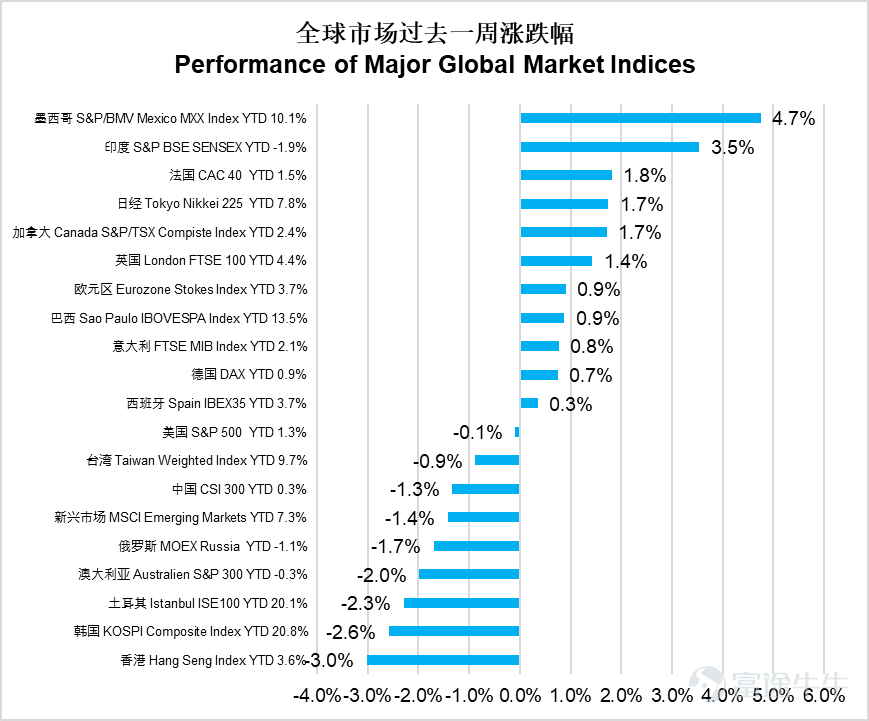
Last week, global markets performed unevenly, with the Mexican MXX Index surging 4.7% to lead globally, while the Indian Sensex 30 rose by 3.5%.European markets showed steady performance, with France's CAC 40 rising 1.8% and Japan's Nikkei 225 climbing 1.7%. Asian markets generally fell, with Hong Kong's Hang Seng Index dropping 3.0%, South Korea’s KOSPI falling 2.6%, and China's CSI 300 declining 1.3%. Turkey's ISE 100 dropped 2.3%, and emerging markets as a whole fell by 1.4%.The US S&P 500 edged down 0.1%, reflecting overall cautious market sentiment.

The US consumer staples sector soared 6.0%, performing the best, followed by the industrial sector which rose 4.7% and the energy sector increasing 4.3%.The materials sector gained 3.5%, healthcare rose 1.9%, and real estate climbed 1.6%. The financial sector increased by 1.5%, and utilities inched up 0.2%. However, consumer discretionary plummeted 4.6%, communication services dropped 4.3%, and information technology fell by 1.4%.The market displayed a clear pattern of defensive sectors leading the gains.

The Hong Kong stock market's information technology sector plummeted 7.8%, performing the worst; the Hang Seng Tech Index fell 6.5%, and the raw materials sector dropped 6.2%.Non-essential consumption fell by 4.5%, the financial sector declined by 2.1%, and healthcare dropped by 1.4%. In contrast, essential consumption rose by 3.7%, showing strong performance; the industrial sector increased by 1.7%, conglomerates were up by 1.1%. Utilities rose by 1.0%, real estate and construction edged down by 0.1%, and the energy sector slightly decreased by 0.4%.The market showed a divergence characterized by defensive consumer sectors leading gains and technology growth sectors leading declines.

In the bond market,
Global bond markets experienced a slight pullback over the past week, with U.S. and Chinese offshore dollar bonds performing well. The global aggregate index fell by 0.22%, while the U.S. aggregate index rose by 0.28%, U.S. investment-grade corporate bonds increased by 0.26%, and U.S. high-yield corporate bonds gained 0.11%. The emerging market dollar bond composite index rose by 0.22%, and the Chinese offshore credit bond index climbed by 0.22%.

On the interest rate front, U.S. Treasury yields moved lower across the curve. The 2-year Treasury yield fell by 2 basis points from last week to 3.50%, while the 10-year Treasury yield dropped by 3 basis points to 4.21%.

Market Outlook
– In the short term, the U.S. stock market will remain in a phase of sentiment digestion and validation of AI substitution expectations.
Recently, the overall tech sector in the U.S. stock market has weakened, with the Nasdaq experiencing a significant correction. The software and SaaS sectors faced concentrated panic selling, becoming the hardest-hit area of the broader market adjustment.Relevant industry indexes and software ETFs plunged sharply over the week, with the sector's market value evaporating rapidly.Amazon, Microsoft, Google, and other leading cloud providers' capital expenditure plans for 2026 significantly exceeded expectations, reaching a record combined scale.Completely invested in AI computing power, data centers, and other infrastructure sectors, but this increased AI investment did not boost sector sentiment. Instead, it heightened market concerns over earnings dilution, prolonged capital investment return cycles, and reduced efficiency due to excessive competition in computing power. The core reason for this round of the software stock plunge stems from the commercial launch of Anthropic's enterprise AI agent product.This triggered market anxiety over the core issue of traditional software subscription models being replaced by AI.Coupled with the ongoing high-interest-rate environment suppressing high-valuation growth stocks, corporate IT budgets shifting towards AI infrastructure squeezed demand for traditional software. On the trading side, passive fund sell-offs and deleveraging formed a negative feedback loop, further amplifying the adjustment magnitude.In the short term, the sector will remain in a phase of sentiment digestion and validation of AI substitution expectations.Volatility is highly likely to persist.In the medium term, the sector will see deep differentiation, with AI-native companies, those with high barriers in vertical fields, proactive implementation of AI empowerment, and robust cash flow expected to recover first.Generic, low-barrier software stocks that have yet to complete their AI transformation will continue to face pressure. The efficiency of cloud vendors' capital expenditures and the pace of profit realization will become key variables in observing the sector’s subsequent recovery.
Key economic data and events this week
On Monday, China will release January's social financing and loan data.
On Wednesday, China will release January's CPI and PPI data, while the US will announce January's employment data, which was delayed due to the government shutdown.
The US will release January PPI data on Thursday;
The US will release January CPI data on Friday.
Disclaimer: The issuer of this report is E Fund Asset Management (Hong Kong) Co., Ltd. This report does not constitute an invitation or recommendation to invest in fund units. Investment involves risks, and fund prices may rise or fall. Past performance is not indicative of future results. Before investing, investors should carefully read the fund prospectus (including the “Risk Factors” section) for investment risks related to the fund. This report may only be distributed within certain jurisdictions. In any jurisdiction where the distribution of such information or the making of any invitation or recommendation is prohibited, or where distributing this report or making an invitation or recommendation to any person constitutes a violation of the law, this report does not constitute such distribution, invitation, or recommendation. This document has been exempted from prior review and approval by the Hong Kong Securities and Futures Commission (SFC) and has not been reviewed by the SFC. SFC recognition does not imply a recommendation or endorsement of this plan, nor is it a guarantee of the commercial merits or performance of the plan, nor does it indicate that the plan is suitable for all investors, or endorse its suitability for any particular investor or category of investors. All rights reserved © 2026. E Fund Asset Management (Hong Kong) Co., Ltd.
Risk Disclaimer: The above content only represents the author's view. It does not represent any position or investment advice of Futu. Futu makes no representation or warranty.Read more

Comments
to post a comment
6
2