
How to view the post-holiday market trend in Hong Kong stocks?

Xiaomi Group's stock price has stabilized above the RMB35 mark, with short-term technical signals showing divergence. How should investors position themselves in call warrants, bull contracts, and bear contracts?
$XIAOMI-W (01810.HK)$ Xiaomi Group's stock price has stabilized above the RMB35 mark, with short-term technical signals showing divergence. How should investors position themselves in terms of call warrants and bull/bear certificates?
Southbound capital has aggressively accumulated over RMB50 billion in just three days, with Xiaomi Group ranking among the top purchased stocks. The logic behind this contrarian buying is thought-provoking.
Recently, Xiaomi Group's stock price has been oscillating around the RMB35 level, closing at RMB35.18 as of February 6th.
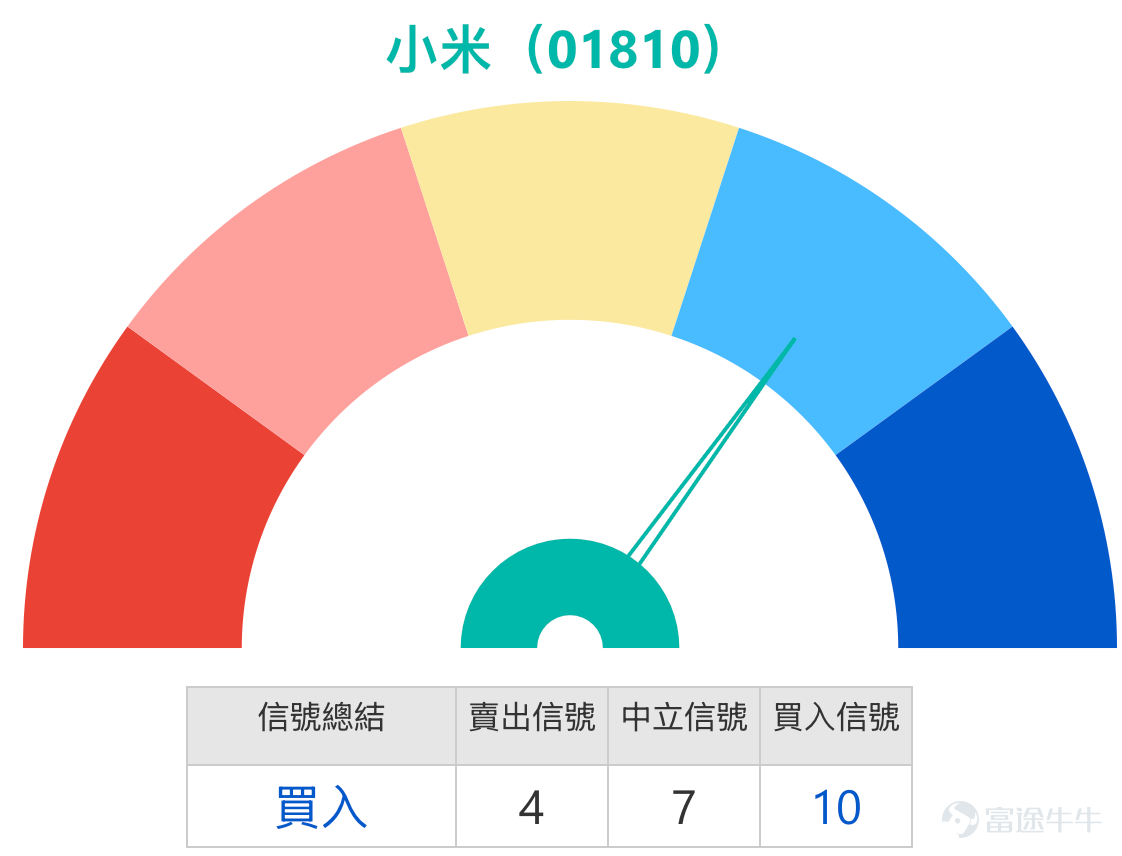
Technical indicators are showing divergent signals: while several oscillation indicators suggest selling, the rate-of-change indicator shows a bottom divergence, indicating a possible bottoming process.
As a component of the Hang Seng Tech Index, Xiaomi is also influenced by overall market sentiment. Notably, despite pressure on major indices, southbound capital has shown strong contrarian buying intent. Data shows that during the three trading days from February 4th to February 6th, net southbound purchases reached RMB53.209 billion, marking the first time since August 15, 2025, that daily net inflows exceeded RMB10 billion for three consecutive days.
In terms of specific targets, tech stocks have become a key focus for southbound capital. Since the beginning of 2026, Xiaomi Group and Tencent have received net purchases of RMB12.132 billion and RMB12.884 billion, respectively. This indicates that despite adjustments in Xiaomi’s stock price this year, long-term capital is utilizing the market correction period to make strategic investments.
Bullish vs. Bearish Technical Analysis
Today (February 9th), Xiaomi's stock price is currently finding support near the RMB35 level, trading at RMB35.24. However, overall technical indicators present clear divergence. This interweaving of bullish and bearish signals reflects the current contradictory market sentiment.
On one hand, multiple indicators suggest continued pressure. From the moving average system perspective, the stock price has broken below several key moving averages. Both MA10 (RMB35.29) and MA30 (RMB37) are acting as resistance levels. On the other hand, some indicators are starting to show positive signs. The rate-of-change indicator is signaling a bottom divergence, suggesting weakening downward momentum; the Ichimoku Cloud also points to potential bottom formation.
In terms of key levels, immediate resistance is around RMB36.8. If it can break through effectively, the price may further rise towards RMB38.1. Support levels are at RMB33.9 and RMB32.6, respectively.
Market Views and Strategy Analysis
In the Hong Kong stock podcast on February 6, market analysts discussed the short-term trend of Xiaomi Group. Host Simon pointed out that although the stock price rose, trading volume decreased compared to the previous trading day, showing insufficient market participation. Currently, there are two opposing views in the market: some investors believe Xiaomi has conditions for a short-term rebound; others remain cautious, choosing to hedge by purchasing put warrants at the day's high. For bullish investors, the focus is on whether the stock price can effectively break through the resistance level at HKD 36.8. Bearish investors, on the other hand, are watching the effectiveness of the support level at HKD 33.9, with a potential further drop to HKD 32.6 if breached. In the warrant market, some investors chose to buy put warrants near HKD 35. These products have strike prices around HKD 35.16, offering actual leverage of over 6 times. As most expire in April this year, time value decay is relatively fast.
Review of Warrant and Bull/Bear Certificate Performance
According to performance data of the warrant and bull/bear certificate products mentioned on February 4 over the following two days, we can clearly see the leverage effect of derivatives amid market volatility. With the underlying stock rising by 3.59%, various derivatives showed notable divergences. The bull certificate products had the most significant gains, with UBS Group's bull certificate and Bank of China’s bull certificate recording increases of 44% and 41%, respectively. In terms of call warrants, HSBC's call warrant (22791) gained 14% over two days, while Bank of China's call warrant (13186) rose by 10%. This performance was significantly lower than that of bull certificates, mainly because call warrants include time value decay, whereas bull certificates perform closer to the underlying stock. In terms of product characteristics, bull certificates, due to their forced recall mechanism, show price movements closer to changes in the underlying stock; warrant products, however, are more affected by implied volatility and time value.

Current Market Product Recommendation Analysis
Considering Xiaomi Group's current technical position and market environment, the following warrant and bull/bear certificate products are worth noting:
For bullish direction products, UBS Group's call warrant (25676) $UBXIAMI@EC2605F.C (25676.HK)$ has a strike price of HKD 40.02, offering actual leverage of 7.8 times, making it one of the higher-leverage choices among similar products. Bank of China's call warrant (22824) has a strike price of HKD 40, with actual leverage of 8.1 times. Its premium and implied volatility are the lowest among similar products, making it suitable for investors optimistic about a breakout. For investors favoring bull certificates, HSBC's bull certificate (69041) $HS#XIAMIRC2608J.C (69041.HK)$ and Societe Generale's bull certificate (59209) both have recall prices of HKD 31 and offer actual leverage of 6.9 times. These two products have relatively low premiums and a safety margin of about 12% between the recall price and the current price.
Among bearish direction products, UBS Group's put warrant (23061) $UBXIAMI@EP2605A.P (23061.HK)$The call warrant from BOC (13235) has a strike price of 31.88 HKD and an actual leverage of 5.6 times. Both products have the lowest premium and implied volatility in their category. For bear contracts, the JP Morgan bear contract (55682)$JP#XIAMIRP2810D.P (55682.HK)$and the UBS Group bear contract (69732) both have a recovery price of 40 HKD, with actual leverage of 8 times and 8.2 times respectively. Among them, the UBS Group bear contract has the lowest premium.
The contrarian inflow of Southbound funds and the battle at key technical levels make Xiaomi's short-term stock direction uncertain. At the 35 HKD level, the market will test the confidence of long-term investors against the impulse of short-term speculation. As the stock price continues to fluctuate between the resistance level of 36.8 HKD and the support level of 33.9 HKD, the derivatives market is set to become the prime stage for leveraged trading.


Do you think Xiaomi’s stock price will break upwards past 36.8 HKD, or test the downside support at 33.9 HKD? In derivative investments, do you prefer CBBCs or warrants? Feel free to share your thoughts in the comment section.
Friendly reminder: This article does not constitute any investment advice.
This article is for reference only and does not constitute any investment advice. The market data, opinions, and analysis contained herein may change at any time without prior notice. We are not responsible for any loss or damage caused by reliance on the information in this article. Technical analysis only shows whether certain technical conditions are met; a comprehensive assessment of asset performance should be conducted using additional data. Decisions to trade should not be based solely on this article. Please note that past performance is not indicative of future results.
#Xiaomi Group #Technical Analysis #Warrants #Bull and Bear Certificates #Southbound Capital #Hong Kong Stocks #Support and Resistance Levels #Derivatives #Leverage #Risk Management
Risk Disclaimer: The above content only represents the author's view. It does not represent any position or investment advice of Futu. Futu makes no representation or warranty.Read more
Comments
to post a comment
10