
Another earnings miss? AMD plunges over 17% post-results!

Beginner's Guide to Options Trading with AMD as an Example: Behind the 17% Stock Price Plunge and 14x Surge in Options, What Should Newcomers Understand?
Hello fellow investor! I've noticed that many investors face bottlenecks when investing in stocks and feel lost when considering a move to options. Therefore, to help option beginners cultivate the right mindset, enhance their understanding, and seize opportunities through hands-on practice, I have created the 'Option Newbie Gold Rush Companion' column. I hope to accompany you on a path of continuous improvement. If you're interested, you're welcome to join.Click hereUpon joining the learning platform, you will receive notifications when subsequent columns are updated.
*The following content is for investment education purposes only and does not constitute any investment advice. Data as of before the US stock market open on February 6.
During this period, many well-known individual stocks have experienced significant fluctuations.
For example, after the market closed on February 3, $Advanced Micro Devices (AMD.US)$ AMD released its earnings report. While the latest results were better than expected, the company’s revenue guidance for the next quarter fell short of analysts' expectations. This disappointment triggered a massive sell-off on February 4, causing the stock price to plummet by 17.31%, wiping out a significant portion of its market value.
However, on the other side, some of AMD's put options (Put Option) expiring on February 6 saw astonishing price spikes. Some contracts surged over 1400% in a single day — or more than 14 times their value.
![Hello fellow investor! I've noticed that many investors face bottlenecks when investing in stocks and feel lost when considering a move to options. Therefore, to help option beginners cultivate the right mindset, enhance their understanding, and seize opportunities through hands-on practice, I have created the 'Option Newbie Gold Rush Companion' column. I hope to accompany you on a path of continuous improvement. If you're interested, you're welcome to join.[Share Link: Click here]Upon joining the learning platform, you will receive notifications when subsequent columns are updated. *The following content is for investment education purposes only and does not constitute any investment advice. Data as of before the US stock market open on February 6. During this period, many well-known individual stocks have experienced significant fluctuations. For example, after the market closed on February 3, $Advanced Micro Devices (AMD.US)$ AMD released its earnings report. While the latest results were better than expected, the company’s revenue guidance for the next quarter fell short of analysts' expectations. This disappointment triggered a massive sell-off on February 4, causing the stock price to plummet by 17.31%, wiping out a significant portion of its market value. However, on the other side, some of AMD's put options (Put Option) expiring on February 6 saw astonishing price spikes. Some contracts surged over 1400% in a single day — or more than 14 times their value. While stockholders suffered heavy losses, holders of these put options reaped incredible returns. Why did this happen? How was this magical 14x gain generated? For beginners, this...](https://nnqimage.futunn.com/sns_client_feed/999908/20260206/web-1770370745044-r2wdVNIZtl.webp/big?area=2&is_public=true&imageMogr2/ignore-error/1/format/webp)
While stockholders suffered heavy losses, holders of these put options reaped incredible returns.
Why did this happen? How was this magical 14-fold increase generated? For beginners, is this an opportunity or a trap? This article will use AMD as an example to break down the underlying logic of options trading.
1. Where did the 14-fold increase come from?
To understand why 'stock prices fall, but Put Options rise,' you first need to grasp the two basic types of options: Call Options and Put Options.
![Hello fellow investor! I've noticed that many investors face bottlenecks when investing in stocks and feel lost when considering a move to options. Therefore, to help option beginners cultivate the right mindset, enhance their understanding, and seize opportunities through hands-on practice, I have created the 'Option Newbie Gold Rush Companion' column. I hope to accompany you on a path of continuous improvement. If you're interested, you're welcome to join.[Share Link: Click here]Upon joining the learning platform, you will receive notifications when subsequent columns are updated. *The following content is for investment education purposes only and does not constitute any investment advice. Data as of before the US stock market open on February 6. During this period, many well-known individual stocks have experienced significant fluctuations. For example, after the market closed on February 3, $Advanced Micro Devices (AMD.US)$ AMD released its earnings report. While the latest results were better than expected, the company’s revenue guidance for the next quarter fell short of analysts' expectations. This disappointment triggered a massive sell-off on February 4, causing the stock price to plummet by 17.31%, wiping out a significant portion of its market value. However, on the other side, some of AMD's put options (Put Option) expiring on February 6 saw astonishing price spikes. Some contracts surged over 1400% in a single day — or more than 14 times their value. While stockholders suffered heavy losses, holders of these put options reaped incredible returns. Why did this happen? How was this magical 14x gain generated? For beginners, this...](https://nnqimage.futunn.com/sns_client_feed/999908/20260206/web-1770370753154-ZwM30X6MFx.png/big?area=2&is_public=true&imageMogr2/ignore-error/1/format/webp)
A Call Option gives the buyer the right to purchase the underlying asset at a predetermined price (strike price) before expiration. When the stock price rises, the value of the Call typically increases because you have the right to buy shares at a lower price.
A Put Option gives the buyer the right to sell the underlying asset at a predetermined price (strike price) before expiration. When the stock price falls, the value of the Put generally rises because you have the right to sell shares at a higher price.
So you can think of a Call as a "lottery ticket for a stock rise" and a Put as a "lottery ticket/insurance for a stock fall." The sharp drop in AMD's stock price naturally made Puts more valuable. So where does the astonishing leverage of 14 times come from?
The leverage of options comes from using a small amount of capital (the premium) to control stocks with much higher value.Take AMD as an example:
AMD’s closing price on February 3 was $242.11.
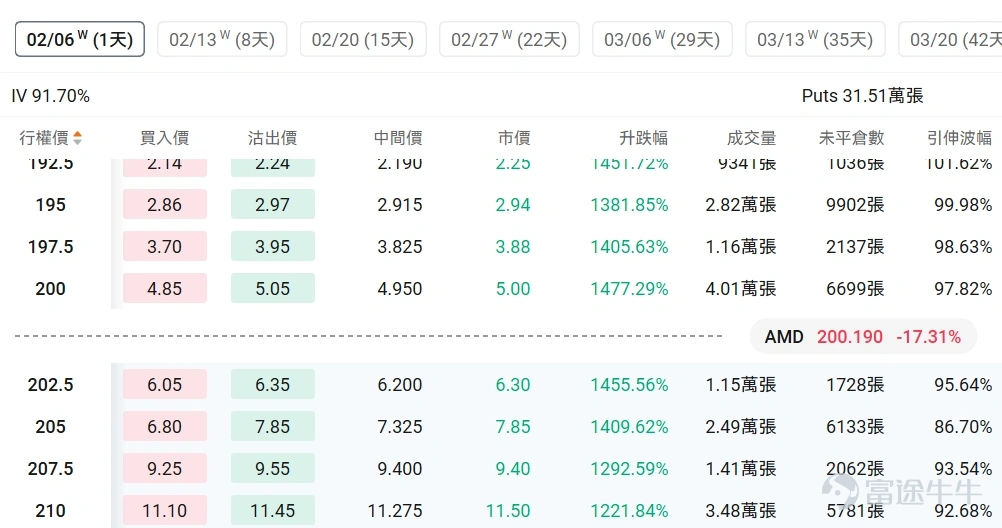
At that time, a Put option with a strike price of $205 and an expiration date of February 6 might only cost $0.53 (controlling 100 shares, total cost $53).
After the earnings announcement, the stock price plummeted by 17.31% to about $200.19. At this point, the 'intrinsic value' of this Put instantly becomes: strike price $205 - stock market price $200.19 = $4.81.
*Note: You can think of the intrinsic value of an option as the value obtained if exercised immediately, which is greater than or equal to zero. The intrinsic value of a Call = stock market price - strike price, and the intrinsic value of a Put = strike price - stock market price. In addition to intrinsic value, options also have a time value component, which decays as time decreases, and is related to implied volatility (IV) — an indicator reflecting expectations of future price fluctuations of the underlying asset.
Because of the remaining time value, the price of this option at the close on February 3 was $7.85, representing an increase of (7.85 - 0.53) / 0.53 = 1381.13%, fully showcasing the ultra-high leverage effect.
With just $53 of principal, a return of over $700 was achieved, which is the core appeal of options.
![Hello fellow investor! I've noticed that many investors face bottlenecks when investing in stocks and feel lost when considering a move to options. Therefore, to help option beginners cultivate the right mindset, enhance their understanding, and seize opportunities through hands-on practice, I have created the 'Option Newbie Gold Rush Companion' column. I hope to accompany you on a path of continuous improvement. If you're interested, you're welcome to join.[Share Link: Click here]Upon joining the learning platform, you will receive notifications when subsequent columns are updated. *The following content is for investment education purposes only and does not constitute any investment advice. Data as of before the US stock market open on February 6. During this period, many well-known individual stocks have experienced significant fluctuations. For example, after the market closed on February 3, $Advanced Micro Devices (AMD.US)$ AMD released its earnings report. While the latest results were better than expected, the company’s revenue guidance for the next quarter fell short of analysts' expectations. This disappointment triggered a massive sell-off on February 4, causing the stock price to plummet by 17.31%, wiping out a significant portion of its market value. However, on the other side, some of AMD's put options (Put Option) expiring on February 6 saw astonishing price spikes. Some contracts surged over 1400% in a single day — or more than 14 times their value. While stockholders suffered heavy losses, holders of these put options reaped incredible returns. Why did this happen? How was this magical 14x gain generated? For beginners, this...](https://nnqimage.futunn.com/sns_client_feed/999908/20260206/web-1770370759830-ttwbfPi6Mp.png/big?area=2&is_public=true&imageMogr2/ignore-error/1/format/webp)
Behind this leverage, let me explain two more Greek letters to you: Delta and Gamma, which are constantly changing dynamically, determining the specific leverage in real-time.
Delta measures how much the option price changes when the stock price moves by $1. For put options, Delta is negative (between 0 and -1). Suppose before AMD's sharp drop, a Put option that was out-of-the-money (strike price below the market price) had a Delta of -0.1. This means that for every $1 drop in the stock price, the option would only rise by $0.1. At this point, it doesn’t seem very impressive.
Gamma measures the rate at which Delta changes with respect to stock price movements, akin to acceleration. As AMD began to plummet and the stock price rapidly approached your strike price, Gamma surged quickly, causing Delta to rise sharply from -0.1 to -0.5, or even close to -1.0.
This explains the 14x return: In the early stages of the crash, your option was not worth much. However, as the stock price collapsed, Delta increased rapidly, and the option price started to accelerate upwards.The leverage effect of options is most powerful during the transition from 'out-of-the-money' to 'in-the-money.'AMD’s plunge directly transformed what were essentially worthless out-of-the-money Puts into highly valuable in-the-money Puts, showcasing the immense power of leverage.
2. Market Warning: Reading Sentiment Through Data
Many beginners focus only on whether stock prices go up or down, ignoringthe data within the options market, which may already contain hidden indications of market sentiment and capital movements—acting as an auxiliary signal for predicting market trends.
Using the AMD case as an example, we can break down three important metrics: options trading volume, the ratio of put-to-call volume, and implied volatility (IV).
![Hello fellow investor! I've noticed that many investors face bottlenecks when investing in stocks and feel lost when considering a move to options. Therefore, to help option beginners cultivate the right mindset, enhance their understanding, and seize opportunities through hands-on practice, I have created the 'Option Newbie Gold Rush Companion' column. I hope to accompany you on a path of continuous improvement. If you're interested, you're welcome to join.[Share Link: Click here]Upon joining the learning platform, you will receive notifications when subsequent columns are updated. *The following content is for investment education purposes only and does not constitute any investment advice. Data as of before the US stock market open on February 6. During this period, many well-known individual stocks have experienced significant fluctuations. For example, after the market closed on February 3, $Advanced Micro Devices (AMD.US)$ AMD released its earnings report. While the latest results were better than expected, the company’s revenue guidance for the next quarter fell short of analysts' expectations. This disappointment triggered a massive sell-off on February 4, causing the stock price to plummet by 17.31%, wiping out a significant portion of its market value. However, on the other side, some of AMD's put options (Put Option) expiring on February 6 saw astonishing price spikes. Some contracts surged over 1400% in a single day — or more than 14 times their value. While stockholders suffered heavy losses, holders of these put options reaped incredible returns. Why did this happen? How was this magical 14x gain generated? For beginners, this...](https://nnqimage.futunn.com/sns_client_feed/999908/20260206/web-1770370747092-iHq1AH3zoy.jpeg/big?area=2&is_public=true&imageMogr2/ignore-error/1/format/webp)
On February 3rd, the total options trading volume for AMD was 598,600 contracts (338,700 call options + 259,900 put options). Among these, put options trading volume increased significantly by about 74% compared to the previous day (February 2nd), while call options trading volume grew by approximately 36%. This caused the daily put/call ratio (Put/Call Ratio) to rise to 0.77, higher than the previous day's (February 2nd) ratio of 0.60.
For growth stocks like AMD,Put/Call RatioIt is quite normal for the Put/Call Ratio to remain below 1 over the long term, as investors tend to be bullish. However,An increase in this ratio is often regarded as one of the signals that market hedging or bearish sentiment is strengthening, especially when the ratio rises in tandem with total options trading volume.
This indicates more capital is positioning itself in Put options, either to hedge against stock holding risks, or speculating directly on a downturn, with market participants preparing for a potential drop. It acts like an emotional pressure gauge — before any real price volatility occurs, the needle has already pointed towards the stress zone. It’s telling you: the market is pricing in a potential downward storm; buckle up.
Looking at the latest data from February 5th, we can see that the total options trading volume expanded further compared to before earnings season, reaching 1.194 million contracts, with the Put/Call Ratio jumping to 1.47. This could reflect that the market expects AMD's downtrend to continue.
Additionally, examining the Implied Volatility (IV) data, we observe that on the eve of earnings release (February 3rd), AMD's option IV stood at 65.35%, a relatively high level recently (reflecting a higher IV percentile). Compared to the historical volatility (HV) of 50.53% on that day, the IV was significantly higher.A high IV typically means that the options market has already priced in expectations of significant stock price fluctuations triggered by the earnings announcement event.
And as of February 5th, this figure was still at a relatively high level, indicating that the market’s expectations for AMD’s future volatility remain elevated.
*Note: Generally speaking, IV tends to spike just before a company releases its earnings or other major events, and then sharply declines afterward as uncertainty dissipates, leading to an 'IV crush'.Since implied volatility (IV) is closely related to the time value of options, a sharp drop in IV can lead to a rapid decline in option prices. Therefore, everyone should pay special attention to this data.
![Hello fellow investor! I've noticed that many investors face bottlenecks when investing in stocks and feel lost when considering a move to options. Therefore, to help option beginners cultivate the right mindset, enhance their understanding, and seize opportunities through hands-on practice, I have created the 'Option Newbie Gold Rush Companion' column. I hope to accompany you on a path of continuous improvement. If you're interested, you're welcome to join.[Share Link: Click here]Upon joining the learning platform, you will receive notifications when subsequent columns are updated. *The following content is for investment education purposes only and does not constitute any investment advice. Data as of before the US stock market open on February 6. During this period, many well-known individual stocks have experienced significant fluctuations. For example, after the market closed on February 3, $Advanced Micro Devices (AMD.US)$ AMD released its earnings report. While the latest results were better than expected, the company’s revenue guidance for the next quarter fell short of analysts' expectations. This disappointment triggered a massive sell-off on February 4, causing the stock price to plummet by 17.31%, wiping out a significant portion of its market value. However, on the other side, some of AMD's put options (Put Option) expiring on February 6 saw astonishing price spikes. Some contracts surged over 1400% in a single day — or more than 14 times their value. While stockholders suffered heavy losses, holders of these put options reaped incredible returns. Why did this happen? How was this magical 14x gain generated? For beginners, this...](https://nnqimage.futunn.com/sns_client_feed/999908/20260206/web-1770370745209-ZYd0Hn9wws.jpeg/big?area=2&is_public=true&imageMogr2/ignore-error/1/format/webp)
Of course, there are many other important data points in options trading, and we'll discuss them slowly when we have the chance. Additionally, each piece of data can only serve as an auxiliary reference and does not represent a clear market signal. So, everyone should combine it with fundamental analysis and other indicators for a comprehensive judgment.
3. Practical Guide: What You Need to Know Before Buying Puts
If you're considering buying puts as a directional bearish strategy or to hedge against the risk of holding stocks, there are some things you need to be aware of.
First, choosing the right entry timing: It's best to anticipate, and never chase declines.
The best timing is to position yourself before the market price has fully reflected potential risks but when you have strong logical reasoning about future outcomes.For example, before earnings announcements, if your analysis suggests that the company’s earnings or guidance may carry significant downside risks, buying puts at this point would reflect risk pricing.
The worst timing would be buying puts after a sharp drop like AMD experienced, driven by emotional impulses. At such times, the risk-reward ratio is very poor, and you might end up paying a high price for a story that has already unfolded.
Another reminder: When buying options,try to avoid periods of high implied volatility (IV).At that time, the premium was more expensive. Even if you were correct on the direction, a sharp drop in implied volatility (IV) could significantly reduce the time value of the option, leading to an overall decline in the option's price and lowering the probability of success.
Let’s still take AMD as an example. If you are bearish or want to hedge against downside risk, you might consider taking a position about two weeks before earnings when IV hasn’t spiked yet—this is known as a contrarian trade. However, if you prefer momentum trading, you can wait until the stock price stabilizes somewhat before entering, at which point IV will have retreated and the cost of the option will be more reflective of its true value.
Additionally, it can also be helpful to consider the other two options data points mentioned earlier, such asWhen the put-to-call ratio continues to rise, options trading volume gradually increases, but the stock price has not yet fallen sharply, this could also be a good opportunity to buy puts.
Here, I’d like to make a special recommendation:When you’re optimistic about your long-term holdings but worry about a short-term decline in the stock price,and anticipate that it may enter a very difficult and potentially prolonged phase,you might consider spending a small amount to purchase downside protection for yourself.This improves your holding experience while mitigating potential losses from a declining stock price.
Secondly, selecting the strike price: You need to balance cost, leverage, and the probability of success.
Let's first discuss the characteristics of three types of Puts.
In-the-money Put: Strike price is higher than the current stock price. High intrinsic value, large absolute Delta value (usually exceeding -0.7). Pros: Strong correlation with stock price movements. Cons: Higher cost, lower leverage.
At-the-money Put: Strike price is near the current stock price. Maximum Gamma effect, high proportion of time value in option price. Pros: Higher leverage, sensitive to stock price fluctuations. Cons: Significant impact from time decay, strongly affected by implied volatility (IV).
Out-of-the-money Put: Strike price is lower than the current stock price. Pure time value, low cost. Pros: Potential returns could be surprisingly high. Cons: Intrinsic value only occurs if the stock price falls sharply below the strike price, low probability of success, similar to a lottery ticket.
If you are new to options,you can start by trying slightly out-of-the-money or at-the-money options, and avoid buying deep out-of-the-money 'lottery tickets'. This allows for a balance between cost, leverage, and a certain margin of safety.
![Hello fellow investor! I've noticed that many investors face bottlenecks when investing in stocks and feel lost when considering a move to options. Therefore, to help option beginners cultivate the right mindset, enhance their understanding, and seize opportunities through hands-on practice, I have created the 'Option Newbie Gold Rush Companion' column. I hope to accompany you on a path of continuous improvement. If you're interested, you're welcome to join.[Share Link: Click here]Upon joining the learning platform, you will receive notifications when subsequent columns are updated. *The following content is for investment education purposes only and does not constitute any investment advice. Data as of before the US stock market open on February 6. During this period, many well-known individual stocks have experienced significant fluctuations. For example, after the market closed on February 3, $Advanced Micro Devices (AMD.US)$ AMD released its earnings report. While the latest results were better than expected, the company’s revenue guidance for the next quarter fell short of analysts' expectations. This disappointment triggered a massive sell-off on February 4, causing the stock price to plummet by 17.31%, wiping out a significant portion of its market value. However, on the other side, some of AMD's put options (Put Option) expiring on February 6 saw astonishing price spikes. Some contracts surged over 1400% in a single day — or more than 14 times their value. While stockholders suffered heavy losses, holders of these put options reaped incredible returns. Why did this happen? How was this magical 14x gain generated? For beginners, this...](https://nnqimage.futunn.com/sns_client_feed/999908/20260206/web-1770370762142-2AuSnWHqU4.png/big?area=2&is_public=true&imageMogr2/ignore-error/1/format/webp)
Third is the choice of expiration date: Allow sufficient time for market movement to develop.
For options within one month, time decay accelerates rapidly, requiring precise timing for entry, suitable for short-term directional bets with significant risk, especially for options expiring within a week. Unless you're engaging in professional 'endgame' trading, it’s better to allow more room for error in your trades.
For beginners, options with one to three months until expiration might be a more reasonable choice.It gives the market enough time to develop, slowing down the daily decay of time value, and also allows more time for your judgment to be validated by the market.
For options lasting several months or longer, their time value is high and the cost is expensive, making them more suitable for long-term strategic positioning. They are especially recommended for a buy-call strategy.
Fourth, other important considerations: control position size, don't be greedy, and only trade with idle funds.
The last two essential principles for beginners are also key to avoiding losses:
① Control position size:The capital used to purchase a single put option should not exceed 1-5% of your total idle funds. Even if your prediction turns out wrong, it won’t affect your normal life, avoiding heavy betting.
② Don’t be greedy:Don't chase extreme returns like 'a 14x surge,' which are rare exceptions during special market conditions. The core purpose for beginners buying put options should be hedging the risk of held stocks, rather than speculating for quick profits. If you achieve a return of 10%-50%, consider cashing out to avoid turning gains into losses due to excessive greed.
③ Only trade with idle funds:The risks associated with options are much greater than stocks. Never use living expenses or retirement savings for trading, as losses could impact your normal life.
Alright, that's it for today. Welcome.Click hereJoin the learning group, and you will receive notifications when new updates to the column are published. We also strongly welcome any specific content suggestions!
Finally, here's a small perk for everyone. If you're planning to trade options soon, feel free to claim it.Options Beginner's Package(*This event is only open to invited HK users, click to learn more)Detailed event rules>>). If you're still hesitant to trade, you canClick hereparticipate in the simulated trading challenge, with zero cost and zero risk, plus there are stock cash vouchers waiting for you!
Risk Disclaimer: The above content only represents the author's view. It does not represent any position or investment advice of Futu. Futu makes no representation or warranty.Read more


Comments (198)
to post a comment
369
248