
Learn investing from the experts | PayPal’s earnings disaster! Pelosi and Cathie Wood’s precise pre-earnings sell-off: What did the smart money smell?
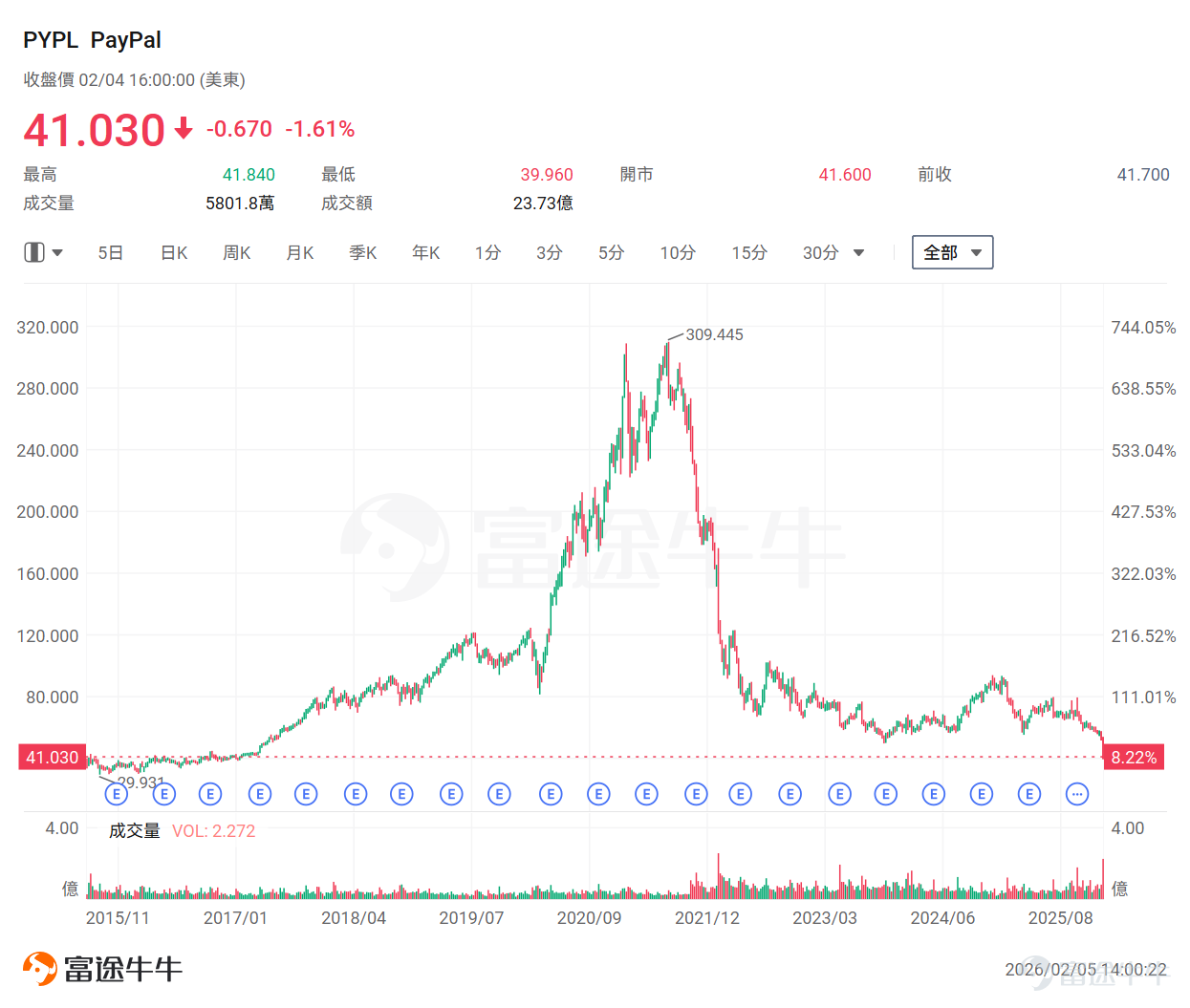
On Tuesday, PayPal’s stock price plummeted to 2017 levels overnight due to weaker-than-expected earnings and the sudden resignation of its CEO.
![The global digital payments giant $PayPal (PYPL.US)$ is going through its darkest moment. On Tuesday, due to worse-than-expected earnings and the sudden resignation of its CEO, PayPal's stock price plummeted overnight to levels not seen since 2017. And before this chaos unfolded, 'Capitol Hill guru' Pelosi and 'Tech Queen' Cathie Wood coincidentally sold off their shares just before the earnings report. Such 'prescient' moves inevitably raise questions: What exactly is wrong with PayPal's fundamentals? 1. The Scent of Smart Money: Why are big players rushing to exit? Just before the earnings announcement, the winds of the capital market had quietly shifted. Pelosi and Cathie Wood's preemptive sell-offs were no coincidence but a collective vote by top-tier investors in the capital market signaling a collapse in PayPal’s fundamental logic. For institutions, PayPal has long been stuck in an awkward 'in-between zone' — as a growth stock, its growth rate is no longer attractive; as a value stock, its moat isn’t deep enough, and it faces fierce competition from giants like Apple Pay. The big players’ dumping essentially confirms the breakdown of PayPal's investment thesis. We can break this down into two key dimensions: 1. Pelosi's Logic: The Canary in the Macroeconomic Coal Mine From[Share Link: The article 'Politician Portfolio Tracker | Dissecting Nancy Pelosi's Top Strategy: Swapping Stocks for Long-term Options, Doubling Down on the Four Tech Giants—Is This a Strategy Worth Following?'] shows that Pelosi...](https://nnqimage.futunn.com/sns_client_feed/948888/20260205/web-1770277796974-nM2RcExvVn.png/big?area=1&is_public=true&imageMogr2/ignore-error/1/format/webp)
Before this chaos unfolded, ‘Hill Stock Guru’ Pelosi and ‘Tech Queen’ Cathie Wood coincidentally sold their shares just before the earnings report. Such ‘prescient’ actions inevitably lead us to reconsider: What exactly is wrong with PayPal's fundamentals?
1. The Scent of Smart Money: Why Are the Big Players Rushing to Exit?
Just before the earnings announcement, the winds of the capital market had quietly shifted. Pelosi and Cathie Wood’s preemptive sell-offs were no coincidence but rather a collective vote by top-tier investors in the capital market regarding the ‘collapse of PayPal's underlying logic.’
For institutions, PayPal has long been stuck in an extremely awkward ‘in-between zone’—as a growth stock, its growth rate is no longer attractive; as a value stock, its moat isn’t deep enough, and it is facing severe competition from giants like Apple Pay. The big players’ dumping essentially confirms the breakdown of PayPal’s investment thesis. We can break this down further into two dimensions:
1. Pelosi Logic: The 'Canary' of the Macroeconomy
FromPolitician Portfolio Tracker | Decoding Congresswoman Pelosi’s Top Strategies: Swapping Stocks for Long-term Options, Doubling Down on Four Tech Giants — Is This a Strategy Worth Following? We can see that Pelosi sold 5,000 shares of PayPal at the end of last year, and since the end of December, the stock price has fallen nearly 30%.
The trading records of the Pelosi family have always been considered a barometer of U.S. political and economic trends. Her sale of PayPal is not only an indication of her lack of confidence in this company but also reflects concerns about the macro consumption capacity in the U.S.
Direct victims of consumer downgrade: PayPal is purely a transaction volume-driven company. As inflation remains sticky in the U.S., and excess household savings are depleted, consumer purchasing power naturally declines. Pelosi's exit hints that she anticipates continued weakness in U.S. retail data. The earnings report mentions “weak retail demand among middle- and low-income consumers in the U.S.,” which verifies this macroeconomic prediction.
Crowded payment sector: As an investor who closely monitors regulation and policy, Pelosi is well aware of the regulatory pressures and competitive landscape within the payments sector. While Apple Pay capitalizes on its monopoly advantage through iOS, and antitrust regulators delay enforcement, PayPal, as a ‘third-party app’ without operating system (OS) support, finds itself at a disadvantage in this zero-sum competition.
Significance of the signal: Her retreat is a message to the market — 'Don't linger in a sector facing macro headwinds and lacking a policy moat.'
2. Wood's logic: The 'abandoned piece' of disruptive innovation
And from‘Tracking Wood’s Big Moves: Buying Spree Activated! Purchases in Robinhood, Google, CoreWeave, and 21 Other Companies’This article reveals that,On February 2nd, Ms. Wood significantly sold 140,000 shares of PayPal, just before the company’s earnings release.
![The global digital payments giant $PayPal (PYPL.US)$ is going through its darkest moment. On Tuesday, due to worse-than-expected earnings and the sudden resignation of its CEO, PayPal's stock price plummeted overnight to levels not seen since 2017. And before this chaos unfolded, 'Capitol Hill guru' Pelosi and 'Tech Queen' Cathie Wood coincidentally sold off their shares just before the earnings report. Such 'prescient' moves inevitably raise questions: What exactly is wrong with PayPal's fundamentals? 1. The Scent of Smart Money: Why are big players rushing to exit? Just before the earnings announcement, the winds of the capital market had quietly shifted. Pelosi and Cathie Wood's preemptive sell-offs were no coincidence but a collective vote by top-tier investors in the capital market signaling a collapse in PayPal’s fundamental logic. For institutions, PayPal has long been stuck in an awkward 'in-between zone' — as a growth stock, its growth rate is no longer attractive; as a value stock, its moat isn’t deep enough, and it faces fierce competition from giants like Apple Pay. The big players’ dumping essentially confirms the breakdown of PayPal's investment thesis. We can break this down into two key dimensions: 1. Pelosi's Logic: The Canary in the Macroeconomic Coal Mine From[Share Link: The article 'Politician Portfolio Tracker | Dissecting Nancy Pelosi's Top Strategy: Swapping Stocks for Long-term Options, Doubling Down on the Four Tech Giants—Is This a Strategy Worth Following?'] shows that Pelosi...](https://nnqimage.futunn.com/sns_client_feed/948888/20260205/web-1770277935535-zoSvHwc3Wc.webp/big?area=1&is_public=true&imageMogr2/ignore-error/1/format/webp)
If Pelosi focuses on the 'now,' then Ms. Wood looks at the 'future.' ARK Invest’s core philosophy revolves around investing in 'disruptive innovation,' and PayPal no longer fits that definition.
From 'disruptor' to 'defender': A decade ago, PayPal was a pioneer disrupting the banking industry; today, it has become part of the 'traditional fintech' that needs to be disrupted. In Ms. Wood’s eyes, true innovation belongs to Block’s Cash App (integrated with Bitcoin and the Lightning Network), to DeFi (decentralized finance), and to Stripe’s geek ecosystem. PayPal now resembles more of a 'digital bank' earning profits through inertia rather than a tech company.
Deterioration in growth quality: Cathie Wood strongly dislikes the narrative of 'beautifying profits through cost-cutting.' Over the past year, PayPal has focused more on 'cost reduction and efficiency improvement' and 'stock buybacks,' rather than 'user growth' or 'technological breakthroughs.' When a fintech company’s earnings report highlights only 'expense control,' it automatically gets removed from ARK's high-growth core portfolio.
The tail end of the S-curve:According to the diffusion of innovation theory, PayPal has entered the flattening tail of the S-curve. For ARK Fund, which seeks exponential growth, capital must be withdrawn from 'past winners' like PayPal to make room for positions in next-generation 'exponential sectors' such as AI, robotics, or blockchain.
Second, the hard hit to performance: a 'sudden brake' on the growth engine
What first triggered panic was this subpar Q4 earnings report.
In Q4 2025, PayPal reported earnings per share (EPS) of $1.53, significantly higher than analysts’ forecast of $1.29 and last year’s $1.11. However, quarterly revenue came in at only $8.7 billion, below market expectations of $8.79 billion,with a year-over-year increase of just 4%.
Full-year data shows that PayPal achieved EPS of $5.41, slightly above analysts’ expectations of $5.36, while annual revenue of $33.2 billion also fell slightly short of the expected $33.27 billion.Although the company raised its profit guidance twice during the year, it ultimately failed to meet the adjusted full-year EPS expectations range.
Macquarie analyst Paul Golding stated in a research note to clients: This earnings performance is disappointing. In the context of a weak macroeconomic environment, intensifying competition and poor execution jointly contributed to the decline in performance.Company management specifically pointed out in the conference call that middle-class users are the core group of the PayPal brand, and consumer spending within this group has been particularly weak.Golding noted that challenges facing branded checkout services, frequent operational and deployment issues, weak retail demand from middle- and low-income consumers in the U.S., slower growth in the German market, and declining growth rates in categories such as travel, cryptocurrency, gaming, and ticketing collectively led to the Q4 results falling short of expectations.
Three, the valuation killer: a 'cliff-like' decline in core business.
If the current weak performance is still tolerable, the core business data disclosed by the company is the last straw that breaks the stock price’s back.
The crown jewel of PayPal is its 'Branded Checkout' business – where users specifically choose the PayPal button at checkout. This is the source of its brand premium and high profit margins. However, the data is alarming:
Risk of zero growth:The transaction volume growth rate of this business has plummeted from 6% a year ago to 1%. This indicates that PayPal's core brand moat is rapidly drying up.
![The global digital payments giant $PayPal (PYPL.US)$ is going through its darkest moment. On Tuesday, due to worse-than-expected earnings and the sudden resignation of its CEO, PayPal's stock price plummeted overnight to levels not seen since 2017. And before this chaos unfolded, 'Capitol Hill guru' Pelosi and 'Tech Queen' Cathie Wood coincidentally sold off their shares just before the earnings report. Such 'prescient' moves inevitably raise questions: What exactly is wrong with PayPal's fundamentals? 1. The Scent of Smart Money: Why are big players rushing to exit? Just before the earnings announcement, the winds of the capital market had quietly shifted. Pelosi and Cathie Wood's preemptive sell-offs were no coincidence but a collective vote by top-tier investors in the capital market signaling a collapse in PayPal’s fundamental logic. For institutions, PayPal has long been stuck in an awkward 'in-between zone' — as a growth stock, its growth rate is no longer attractive; as a value stock, its moat isn’t deep enough, and it faces fierce competition from giants like Apple Pay. The big players’ dumping essentially confirms the breakdown of PayPal's investment thesis. We can break this down into two key dimensions: 1. Pelosi's Logic: The Canary in the Macroeconomic Coal Mine From[Share Link: The article 'Politician Portfolio Tracker | Dissecting Nancy Pelosi's Top Strategy: Swapping Stocks for Long-term Options, Doubling Down on the Four Tech Giants—Is This a Strategy Worth Following?'] shows that Pelosi...](https://nnqimage.futunn.com/sns_client_feed/948888/20260205/web-1770277797172-II7wqDn2oZ.png/big?area=1&is_public=true&imageMogr2/ignore-error/1/format/webp)
Worsening competitive landscape:Under the seamless integration push from Apple Pay and Google Pay, PayPal’s 'Branded Checkout' is losing its status as the preferred choice for users.
Profit margin under pressure:As the proportion of high-margin branded business declines, PayPal has had to rely on low-margin non-branded processing businesses (such as Braintree), directly leading to the deterioration of the overall profit margin structure.
IV. Weak Guidance and Leadership Shake-Up
At a sensitive time when performance is slowing and the business is under pressure, PayPal’s future guidance and leadership changes have completely shattered investors' last line of defense.
Gloomy Outlook for 2026:Management was straightforward, forecasting a mid-single-digit percentage decline in earnings per share for the fiscal year 2026; excluding special items, profits could see a low single-digit decline or slight growth. This conservative guidance further heightened investor concerns about the company’s slowing growth engine.
CEO Transition at a Critical Juncture: The sudden departure of current CEO Alex Chriss introduces significant uncertainty. Although Enrique Lores, former CEO of HP Inc, will take over with CFO Jamie Miller overseeing the transition, changing leadership during such a pivotal transformation often signals internal strategic disagreements or failures in earlier reforms.
Evercore ISI analyst Adam Frisch noted that while this CEO transition was expected, it occurred earlier than anticipated. Despite the incoming executive's impressive track record and strong reputation,the market's core concern lies in whether he will build a strong payments business team to kickstart another multi-year corporate transformation, or begin evaluating options for divesting PayPal’s strategic assets.
V. Investment Insights: Opportunity or Trap?
PayPal is currently going through a typical phase of 'valuation compression' + 'earnings contraction.' Perhaps the right time to position for a rebound will only come when the new CEO can provide a clear strategy and the core Total Payment Volume (TPV) growth rate picks up again.
Thomas Hayes, Chairman of Great Hill Capital, believes that while the market was initially somewhat surprised by Enrique Lores' appointment, the long-term outlook is promising. Despite external doubts about PayPal’s lack of 'tangible' new products, Hayes contends thatThe 'unflashy but highly profitable' strategy that Lores implemented at HP Inc is exactly what PayPal needs right now.
Under Lores’ leadership, HP Inc did not rush to launch innovative products but instead enhanced the value of its remaining shares by aggressively buying back stock. By cutting the number of shares in half, HP theoretically doubled the value of each share. Hayes believes thatPayPal’s new management may replicate the same playbook—taking advantage of investor panic selling to repurchase its own shares at low prices. Hayes described it as 'Enrique Lores might bring noticeable changes.'
At current levels, PayPal generates approximately $6 billion in free cash flow annually and plans to use nearly all of it for share repurchases. At the current price, PayPal could theoretically buy back and retire around 15% of its shares over the next 12 months.
Additionally, PayPal holds about $14 billion in cash, which Hayes describes as a 'war chest' giving the company multiple options, whether cutting costs, improving profit margins, or continuing share buybacks until the stock price is 'forced' upward. PayPal's strategic flexibility far exceeds that of smaller competitors.
Hayes pointed out that this is not the first time he has witnessed a shunned stock eventually turning into a 'gold mine.' He compared the current market’s lukewarm attitude toward PayPal with the time Chinese e-commerce giant Alibaba once became the 'least popular' tech stock. Investors who decisively bought during regulatory scrutiny and market volatility ultimately reaped significant returns.
Risk Disclaimer: The above content only represents the author's view. It does not represent any position or investment advice of Futu. Futu makes no representation or warranty.Read more


Comments (6)
to post a comment
45
49