Mech Mind and SHEIN are in the midst of hot IPOs! Approximately 80% of new listings saw first-day ga

IPO Outlook | Zhongxin Home: Profit Rollercoaster, Continuous Decline in Gross Margin, Can 'Vietnam Production Capacity' Be the Solution?
Recently, Zhongxin Home, a hidden champion in China's PVC flooring manufacturing sector, officially submitted its listing application to the Hong Kong Stock Exchange, drawing market attention. This nearly two-decade-old company has become another typical case of Chinese manufacturing going global with its leading position in the SPC (Stone Plastic Composite) flooring niche and highly internationalized business layout.
However, behind its impressive export rankings and market share lie multiple risks such as sharp profit fluctuations, over-concentration in certain markets, and a continuously narrowing gross margin.
A Hidden Champion in a Niche Market: Rollercoaster-like Profits and Continuously Pressured Gross Margins
The prospectus shows that Zhongxin Home is an export manufacturer focused on the design, development, production, and sales of PVC flooring products. According to a report by industry consulting firm Frost & Sullivan, based on global PVC flooring sales area in 2024, Zhongxin Home ranks eighth among numerous Chinese export manufacturers, with a market share of approximately 0.61%. Though seemingly small, this figure is sufficient to place the company among the industry leaders, reflecting the highly fragmented competitive landscape of the PVC flooring export market.
What truly sets Zhongxin Home apart is its performance in the SPC flooring niche. As a new type of eco-friendly flooring made primarily from limestone powder and polyvinyl chloride (PVC), SPC flooring offers advantages such as zero formaldehyde, water resistance, moisture resistance, and wear stability, leading to rapid demand growth in the global market, particularly in Europe and the US. It is in this high-growth segment that Zhongxin Home leads among Chinese export manufacturers, with a market share of 1.02%, establishing its position as a 'segment leader'.
Nearly two decades of industry expertise have enabled the company to accumulate extensive experience in product development and production technology. Its products are widely used in residential, commercial, and industrial settings, with customers spread across the globe, especially in developed markets like North America and Europe.
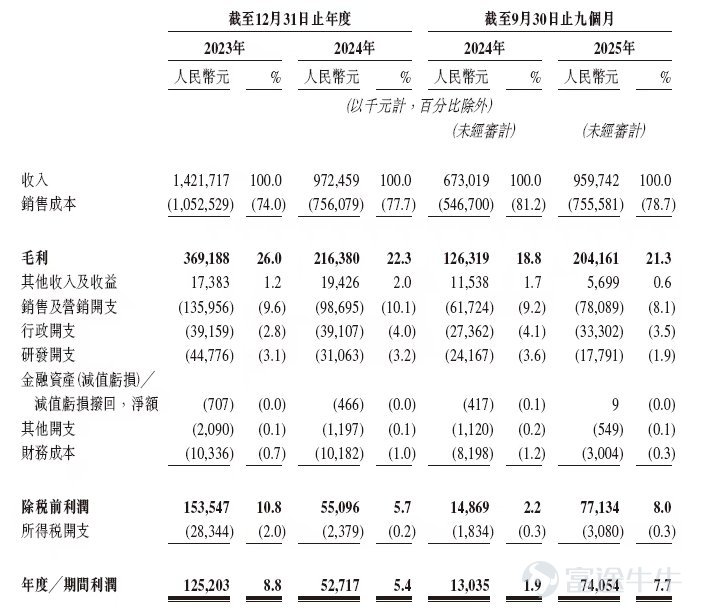
The financial data disclosed in the prospectus clearly outlines Zhongxin Home's fluctuating business trajectory in recent years: first, net profit has been highly volatile. In 2023, the company reported a net profit of approximately 125 million RMB, which was decent. However, in 2024, net profit plummeted to 52.7 million RMB, a year-over-year drop of 57.9%, akin to riding a 'roller coaster.' Entering 2025, conditions improved; as of September 30, net profit for the first three quarters rebounded to 74.1 million RMB. The 2024 profit 'halving' was mainly due to revenue decline coupled with fixed costs such as depreciation and labor tied to capacity expansion, which eroded profit margins. The recovery in 2025 can be attributed to economies of scale brought by increased capacity utilization at the Vietnam production base and the recovery of market orders.
More concerning is the continuous downward trend in gross margin over the past few years. In 2023, the company's gross margin was 26.0%; in 2024, it dropped by 3.7 percentage points to 22.3%, and in the first three quarters of 2025, it further declined to 21.3%. Over three years, the cumulative decline amounted to 4.7 percentage points. The persistent contraction in gross margin is the result of multiple pressures. On one hand, cost pressures—rising market prices of key raw materials like polyvinyl chloride (PVC) and limestone powder directly pushed up production costs. On the other hand, pricing pressures—intensified competition in the global PVC flooring market forced average selling prices down to maintain market share.

This profit model reveals a common dilemma faced by manufacturing export companies: limited bargaining power in the supply chain makes it difficult to fully pass upstream cost increases onto downstream customers, while needing to compete in a fiercely contested market by lowering prices to gain market share, squeezing profitability.
Internationalization and Capacity Layout: Strategic Choices Under a Double-Edged Sword
To address changes in the trade environment and seek cost optimization, Zhongxin Home implemented a dual production base strategy of 'China + Vietnam'.
The production base in Changzhou, China, is its traditional stronghold. Meanwhile, the Vietnam production base officially commenced operations in July 2023, with planned annual production capacity reaching 24.1 million square meters. The strategic significance of the Vietnam base is threefold: first, avoiding trade barriers. In recent years, major markets like the US have imposed additional tariffs on certain goods originating from China. Moving production to Vietnam effectively avoids such trade risks, ensuring stable supply and price competitiveness for American customers. Second, cost advantage: Vietnam may offer comparative advantages in labor, land, and taxation, helping reduce long-term operational costs. Third, proximity to the market. Optimizing global supply chain layout improves logistics efficiency.
This layout is directly reflected in its revenue structure. The company’s revenue exhibits a highly internationalized, even singular, characteristic: from 2023 to the first three quarters of 2025, overseas revenue climbed from 96.0% to 99.4%, almost entirely reliant on exports. Among this, revenue contribution from the US market accounted for 79.6%, 68.5%, and 81.2%, respectively. Although the proportion dipped slightly in 2024, the US market remains an 'absolute mainstay,' with an unshakable position.

This strategy of deeply tying itself to a single market allows the company to enjoy the benefits of market growth, but also brings significant risks: fluctuations in the US real estate market, changes in consumer preferences, or sudden adjustments in import policies (such as anti-dumping and countervailing duty investigations) could all have a major impact on the company’s operations.
Accompanying this high market concentration is an extremely high level of customer concentration. The performance of Zhongxin Home heavily relies on a few major clients.
During the reporting period, revenue from the top five clients accounted for as much as 80.5%, 73.1%, and 71.7%, respectively. Although the percentage has been slowly declining, it remains at a high level. Particularly noteworthy is its largest client, MSI in the United States, which contributed 63.3% of the company's total revenue in 2023, with the proportion dropping to 45.3% in 2024, but rebounding to 53.9% in the first three quarters of 2025. This means the company’s fate is closely tied to MSI’s purchasing decisions.
The prospectus mentions that management will inevitably consider 'expanding the customer base and reducing concentration' as one of its future strategies, but this process is easier said than done and will require time and resource investment.
As a leader in SPC flooring exports, the company has secured a favorable position in the fiercely competitive market thanks to nearly two decades of experience and a keen international production capacity layout (China + Vietnam). However, the business model, which overly depends on a single market (the US) and a major client (such as MSI), is like a 'Sword of Damocles' hanging over the company, making its performance highly vulnerable to fluctuations in the external environment, as evidenced by the 'halving' drop in profits in 2024. Meanwhile, the continuously declining gross margin reveals the cost transfer difficulties and intense pricing pressures faced within the supply chain.
This IPO undoubtedly represents a critical leap forward for Zhongxin Home. The proceeds will help further expand production capacity, enhance R&D, and optimize operations. However, what the capital markets scrutinize are not only past market share and scale but also future growth potential and risk resistance capabilities.
Risk Disclaimer: The above content only represents the author's view. It does not represent any position or investment advice of Futu. Futu makes no representation or warranty.Read more
Comments
to post a comment