
Key Level Battle: Tencent's Short-Term Decision at the Support Level of 546 and Resistance Level of 594
On February 4, Tencent closed at 563 HKD, down 3.18%, with an intraday low of 558 HKD, hitting a new six-month low. After months of consecutive declines, Tencent’s stock price has breached multiple key integer levels in a short period, plunging market sentiment into extreme pessimism. This article will comprehensively analyze Tencent’s current situation and potential short-term path from the latest technical perspective, market news, and insights from the *HKEX Podcast*.
Technical Analysis: The Struggle Between Deep Oversold Signals and Key Support Levels
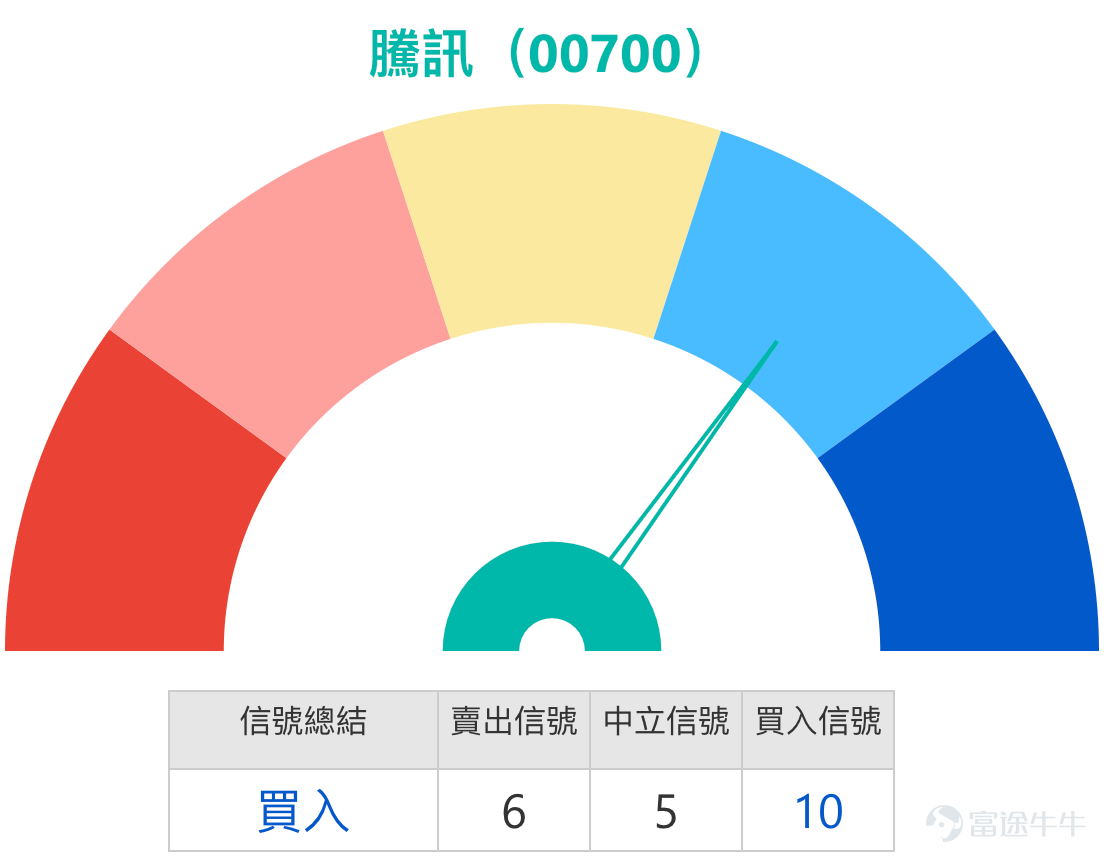
From a purely technical perspective, Tencent’s chart simultaneously shows warning red flags and green lights signaling a potential reversal, reflecting the fierce battle between bulls and bears. On one hand, trend indicators clearly illustrate the stock's weak pattern. The current price has fallen significantly below all major moving averages—10-day, 30-day, and 60-day—with these averages showing a bearish alignment, while the MACD indicator continues to flash sell signals, confirming that the medium- and short-term downtrend remains ongoing.
On the other hand, multiple critical technical indicators have issued strong 'oversold' or even 'divergence' signals, suggesting that short-term downward momentum may be waning. Most notably, the Relative Strength Index (RSI) has dropped to 28, entering deeply oversold territory. Meanwhile, momentum oscillators indicate that the stock is in an 'oversold, possibly bottom-building' state, and more advanced bull-bear power metrics have flashed clear 'buy' signals. This significant divergence between 'downward trends' and 'oversold indicators' usually implies the market may be approaching a short-term sentiment low, with technical rebound opportunities building up.
Support and Resistance Analysis: Focus on Two Key Battlefields
In the complex market sentiment and technical signals, identifying key support and resistance levels is the first step in establishing clear roadmaps for short-term trading.
* Core Support Zones: RMB 546 and RMB 517
The first psychological defense line in the current market lies near RMB 546. If this position breaks, more critical technical support will shift down to RMB 517. This zone not only represents a crucial point on the long-term chart but will also become an important litmus test to determine whether this adjustment qualifies as a 'mid-term weakening'.
* Key Resistance Zones: RMB 594 and RMB 622
For any potential rebound, the first hurdle is RMB 594. This position is close to previous high trading density zones and short-term moving averages, marking the first defensive line for bears. Should the rebound continue, stronger resistance awaits at RMB 622, where multiple mid-term moving averages converge, making it much harder to break through. It can be viewed as the critical watershed for whether the short-term trend can reverse.

Market View Consolidation: The Tug-of-War Between Sentiment-Driven 'Overcorrection' and Institutional Confidence
To understand Tencent's recent plunge, one needs to separate sudden news, market sentiment, and institutional perspectives. On February 3rd, an unverified rumor about a possible increase in VAT on internet services spread rapidly in the market, compounded by concerns over high AI investment and short-term profit mismatches, triggering panic selling. Some analyses suggest that the over 6% intraday drop included elements of 'technical stampede,' such as forced selling from quant funds and stop-loss orders.
Review of Warrants and Bull/Bear Contracts: Efficient Risk Management and Trend Following
In volatile markets like Tencent’s sharp one-sided fluctuations caused by unexpected events, warrants and bull/bear contracts offer investors efficient tools for risk management or trend following. Their core advantage lies in helping investors deploy limited capital with leverage to target specific directions (upward or downward) clearly, thus seeking more precise opportunities amid market volatility.
Looking back at the product performance mentioned on February 2, this advantage was fully demonstrated: against the backdrop of Tencent's share price falling by 6.18% over the following two days, the bearish products achieved significant gains. UBS Group’s bear certificate (69628) $UB#TENCTRP2812H.P (69628.HK)$ rose sharply by 122%, Bank of China’s put warrant (23122) $BITENCT@EP2606A.P (23122.HK)$ surged 74%, and Bank of China’s bear certificate (60959) $BI#TENCTRP2812A.P (60959.HK)$ climbed 75%. UBS Group’s put warrant (21984) also recorded a 63% increase. These products successfully amplified the downside movement of the underlying stock via leverage, providing effective returns for investors with a bearish outlook.

Current Product Terms Analysis and Related Deployment
Considering that Tencent’s share price is currently in deep oversold territory and faces a key support level, we have outlined the following product strategies for investors with different perspectives:
Bullish strategy: Betting on a technical rebound from oversold conditions
If investors believe that negative sentiment has been excessively released and the stock price may find support in the range of HKD 546–517 and stage a technical rebound, they can consider the following products. For instance, HSBC call warrants (15275) and Societe Generale call warrants (14958) both offer approximately 8x effective leverage and are characterized by 'relatively low premiums,' making them suitable for betting on a rebound towards the first resistance level at HKD 594. For investors seeking higher leverage and willing to bear the risk of forced recall, J.P. Morgan bull certificates (63481) and UBS Group bull certificates (61949) have their recall prices set at HKD 541 and HKD 540 respectively, very close to the first support level at HKD 546, offering more than 20x actual leverage. However, it is important to closely monitor their recall risks.

Bearish strategy: Betting on the continuation of the downward trend
If investors think market sentiment remains unstable and the stock price might continue to decline, testing lower support levels, they can look into bearish products. For example, UBS Group’s put warrants (21984) and Bank of China’s put warrants (23122), both with an exercise price of HKD 499.8, provide around 8x leverage and are suitable for hedging or following trends. For bearish investors, UBS Group’s bear certificate (57455) has its recall price set at HKD 630, far above the current stock price and the second resistance level of HKD 622, offering relatively high safety buffer and about 9.8x actual leverage.

Interaction and Reminder
In light of Tencent's deep oversold technical signals near the support level of HKD 546 and the complex market sentiment, which strategy do you prefer?
A. Bet on a rebound, trust in technical recovery
B. Expect adjustments, wait for sentiment to fully release
C. Stay on the sidelines for now, wait for clear direction before deciding
Feel free to share your letter choice or specific thoughts in the comments section; let’s discuss and explore together!
Lastly, another reminder: Warrants and bull/bear certificates are complex financial derivatives with significant price volatility that could lead to total investment loss. Before making any investment decision, carefully read the relevant product’s listing documents to ensure full understanding of its features and risks.
#Tencent Holdings #Technical Analysis #Support and Resistance Levels #Warrants #Bull and Bear Certificates #In-the-Money and Out-of-the-Money #Hong Kong Stocks Short-term #Technology Stocks #Oversold Rebound #Derivatives
For analysis of Hong Kong stock warrants and bull/bear contracts, this is Jenny, see you again next time!
Risk Disclaimer: The above content only represents the author's view. It does not represent any position or investment advice of Futu. Futu makes no representation or warranty.Read more

Comments
to post a comment
2
5