
Meme stocks are heating up again! Bubble or opportunity?

Options Trading Strategies | Is GME Making a Comeback? CEO Bets Big on $100 Billion Market Cap, How to Use Options in High Volatility
This article comes from the 'Options Market Insights' column, which aims to position itself at the forefront of investment trends, providing readers with insights into market opportunities and teaching them how to seize these opportunities using options. If you are interested, feel free to subscribe.Click hereUpon joining the learning platform, you will receive notifications when subsequent columns are updated.
*The following content is for investment education purposes only, does not represent any investment advice, and the information is time-sensitive. Data is as of before the US stock market opened on February 4th. Please exercise caution.*
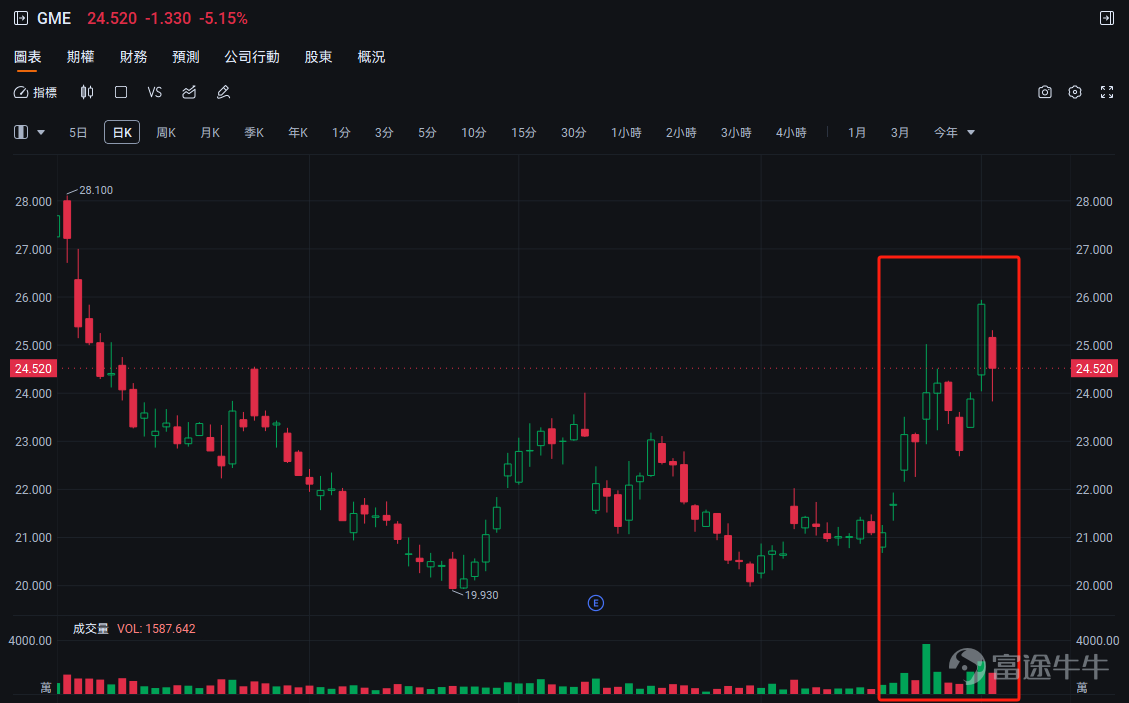
In a volatile market, $GameStop (GME.US)$ GameStop has once again become the focus. Over the past month, GME's stock price has experienced significant rebounds and fluctuations.
The stock price was trading in a narrow range between $20.16 and $22.02 in early January, with relatively light trading volume.
However, starting from January 21, the stock price began an upward trend and saw noticeable increases on January 22, January 26, January 30, and February 2. On February 2, the stock price surged by 8.25%, closing at $25.85, marking the highest closing price in recent times. The trading volume also significantly expanded, drawing heightened market attention. During this period, the cumulative increase exceeded 20%.
However, on February 3, the stock price experienced a significant pullback, dropping by 5.15% to close at $24.52. That day, there was a clear net outflow of funds, particularly with large orders showing notable outflows.
![This article comes from the 'Options Market Insights' column, which aims to position itself at the forefront of investment trends, providing readers with insights into market opportunities and teaching them how to seize these opportunities using options. If you are interested, feel free to subscribe.[Share Link: Click here]Upon joining the learning platform, you will receive notifications when subsequent columns are updated. *The following content is for investment education purposes only, does not represent any investment advice, and the information is time-sensitive. Data is as of before the US stock market opened on February 4th. Please exercise caution.* In a volatile market, $GameStop (GME.US)$ GameStop has once again become the focus. Over the past month, GME's stock price has experienced significant rebounds and fluctuations. The stock price was trading in a narrow range between $20.16 and $22.02 in early January, with relatively light trading volume. However, starting from January 21, the stock price began an upward trend and saw noticeable increases on January 22, January 26, January 30, and February 2. On February 2, the stock price surged by 8.25%, closing at $25.85, marking the highest closing price in recent times. The trading volume also significantly expanded, drawing heightened market attention. During this period, the cumulative increase exceeded 20%. However, on February 3, the stock price experienced a significant pullback, dropping by 5.15% to close at $24.52. That day, there was a clear net outflow of funds, particularly with large orders showing notable outflows. Behind this might be news-driven factors or shifts in market sentiment...](https://nnqimage.futunn.com/sns_client_feed/999908/20260204/web-1770185485564-EKYal7zzu4.png/big?area=2&is_public=true&imageMogr2/ignore-error/1/format/webp)
Behind this, it might be the result of combined factors such as news-driven catalysts, shifts in market sentiment, and changes in capital flows. Below, we will conduct a detailed breakdown of this company to examine the opportunities and risks involved.
1. Resonance in News: CEO's $100 Billion Goal + Major Investors Increasing Positions, Acquisition Expectations Ignite Market
At the beginning of January, the company announced a hefty performance-based stock option incentive plan tied to CEO Ryan Cohen. This plan set nine tiered exercise conditions requiring the company to achieve specific market capitalization and cumulative EBITDA targets simultaneously. The lowest tier requires a market cap of $20 billion and EBITDA of $2 billion; the highest tier demands a market cap of $100 billion and EBITDA of $10 billion.
*Note: EBITDA stands for Earnings Before Interest, Taxes, Depreciation, and Amortization. Its full Chinese name is 'Earnings Before Interest, Taxes, Depreciation, and Amortization.' Simply put, it is the profit of a company before deducting interest, income tax, depreciation, and amortization.
CEO Ryan Cohen revealed in an interview thatthe company is planning a transformative acquisition targeting a very large publicly traded consumer goods company.Cohen stated,This move could potentially bring the company's valuation to hundreds of billions of dollars.He said, "If it succeeds, it’s a stroke of genius. If it doesn’t, it’s utterly foolish."
Cohen has not yet disclosed the name of his target company, but he outlined specific criteria: an undervalued stock with solid fundamentals and a "sluggish" management team. He aims to leverage his capital and operational expertise to enhance the efficiency of the acquired business.
Moreover$GameStop (GME.US)$ In January, the company transferred its entire inventory of 4,710 BTC to Coinbase Prime. This action caught the attention of cryptocurrency traders and analysts, sparking market speculation that the company might sell its Bitcoin assets, possibly indicating a shift in its Bitcoin investment strategy. (*Note: The current value of the company’s Bitcoin holdings is approximately $360 million, down from the original cost of $428 million.)
This news significantly fueled market imagination, triggering widespread speculation and discussion about a fundamental transformation of the company’s business.
Additionally, Cohen recently used personal funds amounting to approximately $21.36 million to purchase 1 million shares of the company’s stock. Following this, directors such as Alain Attal and Lawrence Cheng also bought shares. Insider buying, especially by the CEO,is seen as a direct reflection of strong confidence in the company’s future prospects,boosting market buying sentiment.
Renowned investor Michael Burry recently publicly stated that he has started accumulating GME shares again. He believes that the stock is currently trading at nearly double its tangible book value, mentioning the CEO’s long-term capital strategy. (*Note: Tangible book value represents the value shareholders may recover in case of liquidation, which might be why Burry views the company) "Floor price."
It is worth mentioning that Burry was one of the earliest well-known investors to support GameStop's transformation in 2019. He entered as an activist shareholder, purchasing a large number of shares and sending open letters, directly urging the company to repurchase shares, reduce debt, and streamline operations. This laid the foundation for GameStop’s early upward momentum before the 2021 MEME stock craze.
This might also explainwhy Burry's recent re-entry into buying GameStop shares has been taken seriously by the market — because he is not simply following the MEME stock trend, but had already identified the company’s overlooked value recovery opportunities years ago, and personally drove the change.
2. Dual performance: Behind the revenue decline, a cash giant with $9 billion
To understand$GameStop (GME.US)$To understand its present and future, it is necessary to see the changes happening in its business and financial condition.
GameStop has traditionally been a retailer of gaming hardware and software, but its business structure has been continuously adjusted in recent years. The latest earnings report (for the third quarter of fiscal year 2026) shows that its revenue composition has changed to: hardware and accessories (44.75%), collectibles (31.19%), and software (24.06%).
The proportion of collectibles (including trendy toys, etc.) business has significantly increased. This segment usually has higher profit margins than low-margin hardware, which helps improve the company's overall profitability. However, whether this business can sufficiently offset the decline of the original core business remains to be verified in subsequent reports.
GameStop’s financial picture presents a stark contrast:Revenue declines, but cash is abundant, and profitability has significantly improved.
Net sales in the third quarter of 2026 were $821 million, a year-over-year decline. Core hardware and accessories sales fell by 12% year-over-year, reflecting structural adjustments in its traditional retail business and the strategic closure of some stores.
However, through previous equity financing and convertible bond issuance, the company has accumulated a very substantial cash position. As of the end of the third quarter, its total cash, cash equivalents, and marketable securities amounted to $8.8 billion. Additionally, the company holds a significant amount of Bitcoin as a reserve asset (currently valued at approximately $360 million). This strong cash position keeps its short-term debt repayment ability at a high level, with nearly zero long-term debt, forming a solid financial safety net.
Therefore, despite the decline in revenue, aggressive cost control (a reduction of $1.8 billion in expenses in Q3) and substantial interest income from its large cash reserves have resulted in robust net profit growth. Net profit reached $77.1 million, far exceeding last year's $1,740 in the same period. The net profit margin reached 9.39%, a year-over-year increase of 364.31%. Earnings per share (EPS) also achieved a 500% year-over-year growth, jumping from $0.04 to $0.24.
GameStop is transforming from a traditional retailer into a cash cow company with a strong balance sheet, profitability achieved through cost control, and a large cash reserve seeking transformation opportunities.The CEO’s proposal to seek transformative acquisition targets is based on this financial situation.
3. Narrative Shift: From Community Sentiment Confrontation to Seeking Fundamental Value Solutions
Understand$GameStop (GME.US)$ It is also necessary to revisit its role in the once epic MEME stock rally.
First, let's explain what MEME stocks are. MEME stocks are those hyped by retail investors on social media, which may experience sharp price changes in a short period.
These stock price fluctuations often have no direct relationship with the company's fundamentals. These stocks may have been heavily shorted by institutional investors previously. However, as retail investors jump in or the company experiences a turnaround story, the stock price can rise quickly from being undervalued, followed by market overheating and eventual pullback.
Another important point: Due to the intense short-term volatility, it could trigger a short squeeze. That is, as the stock price rises rapidly, investors who have shorted the stock may be forced to cover their positions (i.e., buy the stock to cut losses), further driving up the stock price.
At the beginning of 2021, retail investors collectively took action through social media platforms such as Reddit's WallStreetBets forum, massively buying GameStop (GME) stock that had been heavily shorted by institutions. This led to an unprecedented short squeeze, causing the stock price to soar dozens of times in a short period (from $20/share to $40/share, then further pushed to a historical high of $483/share, triggering 17 trading halts).
Short-selling institutions suffered enormous losses during this period. Additionally, this battle drew the attention of government agencies, leading to restrictions on retail trading and a subsequent decline in the stock price to lower levels.
![This article comes from the 'Options Market Insights' column, which aims to position itself at the forefront of investment trends, providing readers with insights into market opportunities and teaching them how to seize these opportunities using options. If you are interested, feel free to subscribe.[Share Link: Click here]Upon joining the learning platform, you will receive notifications when subsequent columns are updated. *The following content is for investment education purposes only, does not represent any investment advice, and the information is time-sensitive. Data is as of before the US stock market opened on February 4th. Please exercise caution.* In a volatile market, $GameStop (GME.US)$ GameStop has once again become the focus. Over the past month, GME's stock price has experienced significant rebounds and fluctuations. The stock price was trading in a narrow range between $20.16 and $22.02 in early January, with relatively light trading volume. However, starting from January 21, the stock price began an upward trend and saw noticeable increases on January 22, January 26, January 30, and February 2. On February 2, the stock price surged by 8.25%, closing at $25.85, marking the highest closing price in recent times. The trading volume also significantly expanded, drawing heightened market attention. During this period, the cumulative increase exceeded 20%. However, on February 3, the stock price experienced a significant pullback, dropping by 5.15% to close at $24.52. That day, there was a clear net outflow of funds, particularly with large orders showing notable outflows. Behind this might be news-driven factors or shifts in market sentiment...](https://nnqimage.futunn.com/sns_client_feed/999908/20260204/web-1770185485675-wck6SWg2K2.png/big?area=2&is_public=true&imageMogr2/ignore-error/1/format/webp)
In May and June 2024, Keith Gill (also known as 'Roaring Kitty'), the leader of the U.S. retail investors who drove the 2021 retail vs. Wall Street battle and fueled the GameStop stock frenzy, returned after three years. He posted screenshots of his GME holdings on Reddit, reigniting a MEME-driven rally for GME.
This has tiedGME to labels such as 'retail investor power,' 'adversarial trading sentiment,' and 'high volatility.' Even with poor underlying business performance, its stock price can experience sharp fluctuations in the short term due to community sentiment, online discussions, or short squeeze potential.This creates its unique risk and speculative appeal.
Compared to the earlier relatively pure 'retail vs. institution' sentiment confrontation, the investment logic of GME may have undergone significant changes at present.
With cost reductions and cash reserves, GameStop is attempting to tell a transformation story. Now, substantial cash holdings and the CEO's aggressive option plan provide a new narrative framework with certain financial grounding for company valuation. This cash-rich company is seeking more opportunities, aligning management and shareholder interests more closely, and significantly raising the ceiling of its narrative.
Therefore, although the recent volatility is not entirely free from sentiment-driven factors, it clearly differs from 2021, now supported by more substantive insider actions and value investor endorsements.
However, all of this still requires future actions, such as acquisitions, to materialize.Whether this round of market rally can be sustained depends on the specific progress and details of the acquisition plan.If there is subsequent substantial positive progress, the volatility may continue; if the news becomes平淡 or falls short of expectations, the market may experience a technical回调 or剧烈震荡 amid high波动性.。
4. Market Signal Breakdown: Intensified Bull-Bear Battle, Risks and Opportunities Behind High Volatility
After a rapid rise in stock price,$GameStop (GME.US)$ the stock price is approaching the upper Bollinger Band, indicating a large short-term increase. The MACD remains above the zero axis, showing that the trend is intact, but the contraction of the histogram combined with other short-term momentum indicators (such as KDJ and RSI indicating overbought conditions) suggests that prices may need time to consolidate gains or face a technical correction after the sharp rise.
![This article comes from the 'Options Market Insights' column, which aims to position itself at the forefront of investment trends, providing readers with insights into market opportunities and teaching them how to seize these opportunities using options. If you are interested, feel free to subscribe.[Share Link: Click here]Upon joining the learning platform, you will receive notifications when subsequent columns are updated. *The following content is for investment education purposes only, does not represent any investment advice, and the information is time-sensitive. Data is as of before the US stock market opened on February 4th. Please exercise caution.* In a volatile market, $GameStop (GME.US)$ GameStop has once again become the focus. Over the past month, GME's stock price has experienced significant rebounds and fluctuations. The stock price was trading in a narrow range between $20.16 and $22.02 in early January, with relatively light trading volume. However, starting from January 21, the stock price began an upward trend and saw noticeable increases on January 22, January 26, January 30, and February 2. On February 2, the stock price surged by 8.25%, closing at $25.85, marking the highest closing price in recent times. The trading volume also significantly expanded, drawing heightened market attention. During this period, the cumulative increase exceeded 20%. However, on February 3, the stock price experienced a significant pullback, dropping by 5.15% to close at $24.52. That day, there was a clear net outflow of funds, particularly with large orders showing notable outflows. Behind this might be news-driven factors or shifts in market sentiment...](https://nnqimage.futunn.com/sns_client_feed/999908/20260204/web-1770185485591-2AZHTEvR6B.png/big?area=2&is_public=true&imageMogr2/ignore-error/1/format/webp)
In terms of options, the recent trading volume of Call options far exceeds Put options, with the latest Put/Call ratio at just 0.2, indicating that option traders' short-term speculative direction is concentrated on bullish bets. Unusual option activity also shows that on February 3rd, there were significant buy orders for Calls, mainly bets on medium- to long-term strike prices of $27 and $30.
![This article comes from the 'Options Market Insights' column, which aims to position itself at the forefront of investment trends, providing readers with insights into market opportunities and teaching them how to seize these opportunities using options. If you are interested, feel free to subscribe.[Share Link: Click here]Upon joining the learning platform, you will receive notifications when subsequent columns are updated. *The following content is for investment education purposes only, does not represent any investment advice, and the information is time-sensitive. Data is as of before the US stock market opened on February 4th. Please exercise caution.* In a volatile market, $GameStop (GME.US)$ GameStop has once again become the focus. Over the past month, GME's stock price has experienced significant rebounds and fluctuations. The stock price was trading in a narrow range between $20.16 and $22.02 in early January, with relatively light trading volume. However, starting from January 21, the stock price began an upward trend and saw noticeable increases on January 22, January 26, January 30, and February 2. On February 2, the stock price surged by 8.25%, closing at $25.85, marking the highest closing price in recent times. The trading volume also significantly expanded, drawing heightened market attention. During this period, the cumulative increase exceeded 20%. However, on February 3, the stock price experienced a significant pullback, dropping by 5.15% to close at $24.52. That day, there was a clear net outflow of funds, particularly with large orders showing notable outflows. Behind this might be news-driven factors or shifts in market sentiment...](https://nnqimage.futunn.com/sns_client_feed/999908/20260204/web-1770185485732-O3HMssDE28.png/big?area=2&is_public=true&imageMogr2/ignore-error/1/format/webp)
![This article comes from the 'Options Market Insights' column, which aims to position itself at the forefront of investment trends, providing readers with insights into market opportunities and teaching them how to seize these opportunities using options. If you are interested, feel free to subscribe.[Share Link: Click here]Upon joining the learning platform, you will receive notifications when subsequent columns are updated. *The following content is for investment education purposes only, does not represent any investment advice, and the information is time-sensitive. Data is as of before the US stock market opened on February 4th. Please exercise caution.* In a volatile market, $GameStop (GME.US)$ GameStop has once again become the focus. Over the past month, GME's stock price has experienced significant rebounds and fluctuations. The stock price was trading in a narrow range between $20.16 and $22.02 in early January, with relatively light trading volume. However, starting from January 21, the stock price began an upward trend and saw noticeable increases on January 22, January 26, January 30, and February 2. On February 2, the stock price surged by 8.25%, closing at $25.85, marking the highest closing price in recent times. The trading volume also significantly expanded, drawing heightened market attention. During this period, the cumulative increase exceeded 20%. However, on February 3, the stock price experienced a significant pullback, dropping by 5.15% to close at $24.52. That day, there was a clear net outflow of funds, particularly with large orders showing notable outflows. Behind this might be news-driven factors or shifts in market sentiment...](https://nnqimage.futunn.com/sns_client_feed/999908/20260204/web-1770185485575-9kQJN2WOw4.png/big?area=2&is_public=true&imageMogr2/ignore-error/1/format/webp)
Additionally, the current implied volatility (IV) of options is about 66.11%, at the 42nd percentile historically, which, while not extremely high, is still significantly higher than many traditional stocks, reflecting market expectations of potentially large future stock price swings.
It’s also important to watch short-selling data. GameStop's short interest remains very high, with active short trades during previous stock surges. The significant divergence between bulls and bears creates a source of potential volatility.
![This article comes from the 'Options Market Insights' column, which aims to position itself at the forefront of investment trends, providing readers with insights into market opportunities and teaching them how to seize these opportunities using options. If you are interested, feel free to subscribe.[Share Link: Click here]Upon joining the learning platform, you will receive notifications when subsequent columns are updated. *The following content is for investment education purposes only, does not represent any investment advice, and the information is time-sensitive. Data is as of before the US stock market opened on February 4th. Please exercise caution.* In a volatile market, $GameStop (GME.US)$ GameStop has once again become the focus. Over the past month, GME's stock price has experienced significant rebounds and fluctuations. The stock price was trading in a narrow range between $20.16 and $22.02 in early January, with relatively light trading volume. However, starting from January 21, the stock price began an upward trend and saw noticeable increases on January 22, January 26, January 30, and February 2. On February 2, the stock price surged by 8.25%, closing at $25.85, marking the highest closing price in recent times. The trading volume also significantly expanded, drawing heightened market attention. During this period, the cumulative increase exceeded 20%. However, on February 3, the stock price experienced a significant pullback, dropping by 5.15% to close at $24.52. That day, there was a clear net outflow of funds, particularly with large orders showing notable outflows. Behind this might be news-driven factors or shifts in market sentiment...](https://nnqimage.futunn.com/sns_client_feed/999908/20260204/web-1770185485717-fvAKxNrMdo.jpeg/big?area=2&is_public=true&imageMogr2/ignore-error/1/format/webp)
Attention should also be paid to GameStop’s over $4 billion in convertible notes (maturing in 2030/2032), which allow holders to buy GameStop shares at $32 per share. Hedge funds holding these notes might sell GameStop stock to hedge their risk, potentially creating selling pressure near $32, which could suppress upward momentum.
Moreover, if these bonds are converted into shares on a large scale in the future, they will increase the company's number of outstanding shares, potentially diluting existing shareholders' equity.
In summary,GME is currently in a state of intense long-short博弈 (battle): the technical indicators show short-term overbought pressure conflicting with a medium-term upward trend, the options market reflects dominant bullish sentiment but implies high volatility risk, while the large convertible bond position and high short-selling ratio constitute potential sources of two-way volatility.
So how should we price GME now? As of the US stock market opening on February 4th, GME had a total market value of $10.985 billion, a P/E ratio (TTM) of 27.86 times (in the middle range of its historical levels), and a P/B ratio of 2.07 times (on the lower side of its historical range). However, considering the structural challenges faced by its traditional retail business, this valuation is not cheap, as the market has already priced in optimistic expectations for future transformation.
Value investors like Michael Burry focus on the downside protection offered by tangible book value, while the CEO Cohen’s $10 billion market cap option goal paints a vast想象空间 (imagination space) for valuation. Its valuation heavily relies on whether the acquisition plans can be fulfilled; before the news becomes clear, the stock price will continue to reflect this预期博弈 (expectation game).
5, Practical Strategy: Under Uncertainty, Three Simple Option Strategies for Easy Deployment
At present,$GameStop (GME.US)$ It has transitioned from a pure MEME stock to a cash-rich + transformation target, with advantages including ample cash reserves, insider buying, and backing from value investors; risks are concentrated around acquisition uncertainty, severe short-term volatility, and continued revenue decline pressures. The short-term trend depends on key support levels and market sentiment, while long-term value hinges on the success of acquisitions and business transformation.
For conservative investors, GME may not be an ideal investment target; it suits those with high-risk tolerance, familiarity with options tools, and the ability to withstand significant short-term fluctuations—especially active investors and speculators who are sensitive to acquisition and transformation themes, willing to bear the uncertainty of expectation fulfillment, and capable of using strategies to avoid one-sided risks. Value investors might consider entering only after acquisition details become clearer or when valuations retreat to safer levels.
Given GME’s characteristics of high volatility, clear event-driven expectations, and significant long-short分歧 (disagreements), here are a few relatively straightforward option strategies.
1) Bull Call Spread – A bullish strategy using call options at different strike prices
Applicable scenario: When you have a mildly bullish outlook, believing that the stock price will rise driven by catalysts, but expect resistance above, making it difficult for a one-sided surge. This strategy trades potential partial upside for lower costs and higher odds, balancing cost and risk.
Simultaneously buy a call option with a strike price near the current stock price, while selling another call option with a higher strike price and the same expiration date.Call. This combination'sThe net cost of this combination is much lower than buying a call option alone, and the maximum loss is limited to the premium paid.
If the stock price rises due to acquisition news as a catalyst, you can profit while controlling risk; if the stock price cannot break through resistance, this strategy also mitigates the impact of time value decay.
The profit and loss characteristics at expiration of this strategy can be referenced in the diagram below, for educational purposes only and not representative of any investment advice.
![This article comes from the 'Options Market Insights' column, which aims to position itself at the forefront of investment trends, providing readers with insights into market opportunities and teaching them how to seize these opportunities using options. If you are interested, feel free to subscribe.[Share Link: Click here]Upon joining the learning platform, you will receive notifications when subsequent columns are updated. *The following content is for investment education purposes only, does not represent any investment advice, and the information is time-sensitive. Data is as of before the US stock market opened on February 4th. Please exercise caution.* In a volatile market, $GameStop (GME.US)$ GameStop has once again become the focus. Over the past month, GME's stock price has experienced significant rebounds and fluctuations. The stock price was trading in a narrow range between $20.16 and $22.02 in early January, with relatively light trading volume. However, starting from January 21, the stock price began an upward trend and saw noticeable increases on January 22, January 26, January 30, and February 2. On February 2, the stock price surged by 8.25%, closing at $25.85, marking the highest closing price in recent times. The trading volume also significantly expanded, drawing heightened market attention. During this period, the cumulative increase exceeded 20%. However, on February 3, the stock price experienced a significant pullback, dropping by 5.15% to close at $24.52. That day, there was a clear net outflow of funds, particularly with large orders showing notable outflows. Behind this might be news-driven factors or shifts in market sentiment...](https://nnqimage.futunn.com/sns_client_feed/999908/20260204/web-1770185486077-Tv4vsBeEy6.jpeg/big?area=2&is_public=true&imageMogr2/ignore-error/1/format/webp)
2) Cash-secured Put
Applicable scenario: When you are long-term bullish on the company’s value, but don’t want to chase highs, hoping to use market fluctuations or pullbacks to gradually build positions in the underlying stock at a target price lower than the current price. This is an income-enhancing and position-building strategy based on being 'bullish but patiently waiting for better prices.'
If you are confident in GME’s long-term transformation story and are willing to buy the stock at a lower price, this strategy can serve as a disciplined tool to accumulate shares at favorable levels. You can sell a put option with a strike price around a key support level.
If the stock price is above the strike price at expiration, the premium collected is pure profit; if the stock price falls below the strike price, you are obligated to buy the stock at the strike price, effectively building a position at your desired price, with the previously collected premium reducing the actual cost basis of holding the stock.
The profit and loss characteristics at expiration of this strategy can be referenced in the diagram below, for educational purposes only and not representative of any investment advice.
![This article comes from the 'Options Market Insights' column, which aims to position itself at the forefront of investment trends, providing readers with insights into market opportunities and teaching them how to seize these opportunities using options. If you are interested, feel free to subscribe.[Share Link: Click here]Upon joining the learning platform, you will receive notifications when subsequent columns are updated. *The following content is for investment education purposes only, does not represent any investment advice, and the information is time-sensitive. Data is as of before the US stock market opened on February 4th. Please exercise caution.* In a volatile market, $GameStop (GME.US)$ GameStop has once again become the focus. Over the past month, GME's stock price has experienced significant rebounds and fluctuations. The stock price was trading in a narrow range between $20.16 and $22.02 in early January, with relatively light trading volume. However, starting from January 21, the stock price began an upward trend and saw noticeable increases on January 22, January 26, January 30, and February 2. On February 2, the stock price surged by 8.25%, closing at $25.85, marking the highest closing price in recent times. The trading volume also significantly expanded, drawing heightened market attention. During this period, the cumulative increase exceeded 20%. However, on February 3, the stock price experienced a significant pullback, dropping by 5.15% to close at $24.52. That day, there was a clear net outflow of funds, particularly with large orders showing notable outflows. Behind this might be news-driven factors or shifts in market sentiment...](https://nnqimage.futunn.com/sns_client_feed/999908/20260204/web-1770185486256-OhDtzaKenK.jpeg/big?area=2&is_public=true&imageMogr2/ignore-error/1/format/webp)
3) Long Straddle - Buy straddle combination
Suitable scenario: When you anticipate significant stock price fluctuations but are unsure about the specific direction. This is a pure strategy betting on increased volatility.
Consider simultaneously buying call options and put options with the same strike price and expiration date. The profit or loss of this strategy does not depend on the direction of the stock price but rather on the magnitude of the fluctuation.
As long as there is a sharp one-sided movement in the stock price (whether up or down), surpassing the cost range of the combination, profits can be made. However, note that if the stock price continues to consolidate and the fluctuation in either direction is insufficient, the erosion of time value will result in a loss of principal.
The profit and loss characteristics at expiration of this strategy can be referenced in the diagram below, for educational purposes only and not representative of any investment advice.
![This article comes from the 'Options Market Insights' column, which aims to position itself at the forefront of investment trends, providing readers with insights into market opportunities and teaching them how to seize these opportunities using options. If you are interested, feel free to subscribe.[Share Link: Click here]Upon joining the learning platform, you will receive notifications when subsequent columns are updated. *The following content is for investment education purposes only, does not represent any investment advice, and the information is time-sensitive. Data is as of before the US stock market opened on February 4th. Please exercise caution.* In a volatile market, $GameStop (GME.US)$ GameStop has once again become the focus. Over the past month, GME's stock price has experienced significant rebounds and fluctuations. The stock price was trading in a narrow range between $20.16 and $22.02 in early January, with relatively light trading volume. However, starting from January 21, the stock price began an upward trend and saw noticeable increases on January 22, January 26, January 30, and February 2. On February 2, the stock price surged by 8.25%, closing at $25.85, marking the highest closing price in recent times. The trading volume also significantly expanded, drawing heightened market attention. During this period, the cumulative increase exceeded 20%. However, on February 3, the stock price experienced a significant pullback, dropping by 5.15% to close at $24.52. That day, there was a clear net outflow of funds, particularly with large orders showing notable outflows. Behind this might be news-driven factors or shifts in market sentiment...](https://nnqimage.futunn.com/sns_client_feed/999908/20260204/web-1770185486083-VoTCo7QjGo.jpeg/big?area=2&is_public=true&imageMogr2/ignore-error/1/format/webp)
If you want more inspiration regarding options strategies, you can easily get it on the mobile app or the new desktop version by following these steps!
![This article comes from the 'Options Market Insights' column, which aims to position itself at the forefront of investment trends, providing readers with insights into market opportunities and teaching them how to seize these opportunities using options. If you are interested, feel free to subscribe.[Share Link: Click here]Upon joining the learning platform, you will receive notifications when subsequent columns are updated. *The following content is for investment education purposes only, does not represent any investment advice, and the information is time-sensitive. Data is as of before the US stock market opened on February 4th. Please exercise caution.* In a volatile market, $GameStop (GME.US)$ GameStop has once again become the focus. Over the past month, GME's stock price has experienced significant rebounds and fluctuations. The stock price was trading in a narrow range between $20.16 and $22.02 in early January, with relatively light trading volume. However, starting from January 21, the stock price began an upward trend and saw noticeable increases on January 22, January 26, January 30, and February 2. On February 2, the stock price surged by 8.25%, closing at $25.85, marking the highest closing price in recent times. The trading volume also significantly expanded, drawing heightened market attention. During this period, the cumulative increase exceeded 20%. However, on February 3, the stock price experienced a significant pullback, dropping by 5.15% to close at $24.52. That day, there was a clear net outflow of funds, particularly with large orders showing notable outflows. Behind this might be news-driven factors or shifts in market sentiment...](https://nnqimage.futunn.com/sns_client_feed/999908/20260204/web-1770185487321-QNITjvKFJA.png/big?area=2&is_public=true&imageMogr2/ignore-error/1/format/webp)
Alright, that's it for today. Welcome.Click hereJoin the learning group, and you will receive notifications when new updates to the column are published. We also strongly welcome any specific content suggestions!
Finally, here’s a small perk for fellow investors. Welcome to claim it!Options Beginner's Package(*This event is exclusively for HK invited users. Click to learn more.Detailed event rules>>)
Risk Disclaimer: The above content only represents the author's view. It does not represent any position or investment advice of Futu. Futu makes no representation or warranty.Read more


Comments
to post a comment
54
19