
Waller's new policy measures are in the works! How should investors respond?

Learning from history! How will the Fed's 'changing of the guard' impact U.S. stocks? A detailed analysis of the risks and opportunities in the Kevin Warsh era
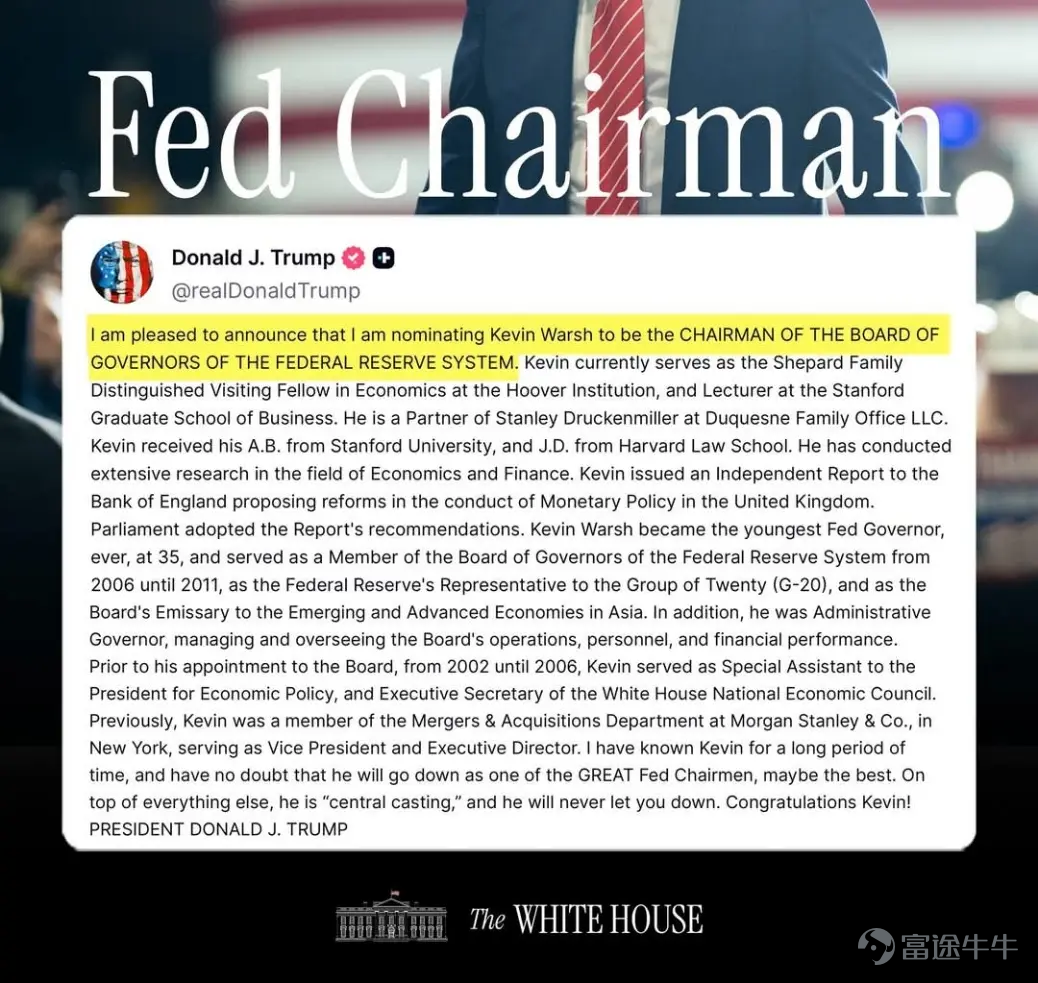
The Federal Reserve’s power transition is about to unfold — former governor Kevin Warsh has been nominated by the president and is expected to take over from Jerome Powell in May, pending Senate approval.

What impact will each Federal Reserve transition have on U.S. stocks? Who exactly is this new leader? How will he shape the next phase of monetary policy? And what kind of shocks and re-evaluations will he bring to global asset prices? As the market holds its breath, this article will lead fellow investors to explore these questions and identify potential strategic opportunities ahead of time.
What kind of 'Warsh shock' will U.S. stocks face?
Warsh has long been considered the most 'hawkish' candidate, causing an epic collapse in the precious metals market following this appointment decision.
Historical data shows that a 'new leader taking office' often acts as a catalyst for volatility in U.S. stocks.According to Barclays, since 1930, whenever a new Federal Reserve chair takes office, U.S. stocks have typically faced severe tests in the subsequent six months: average pullbacks for the first month, first quarter, and half-year periods were 5%, 12%, and 16%, respectively. These declines far exceed the average fluctuations seen during regular years.

Analysts at Wedbush Securities stated that President Trump's choice of Warsh as the next Federal Reserve chair could disrupt markets in the short term, with clarity not expected until later in the year. The firm emphasized that the transition period will be bumpy.From now until May, if negative momentum persists, the firm believes the stock market faces "greater downside risk than upside potential."This is because investors will reassess allocations in high-beta stocks and shift towards companies with sustainable, real growth.
However, looking further out, a Federal Reserve leadership change might just be short-term noise.Looking back at history, from August 1979 to the present, there have been five Federal Reserve Chairs: Volcker, Greenspan, Bernanke, Yellen, and Powell.
Reviewing the performance of past Fed Chairs: Greenspan created a myth with a 290% increase over nearly 20 years; while Powell, despite facing the double impact of pandemic-related market crashes and high inflation, still delivered an impressive 147% return, showing no inferior annualized performance.This demonstrates that even in a macro environment with significant interest rate fluctuations, US stocks still possess strong resilience and recovery capabilities.

Who exactly is this 'new leader'?
According to Hua Chuang Securities research, in terms of identity and background,Warsh is a former Federal Reserve Governor, a triple-threat elite, and one of Trump’s 'own people'.
1) A Jewish individual, holding a Juris Doctor degree (non-economics major).
2) Spanning across government, business, and academia, he served in the George W. Bush administration and became the youngest Federal Reserve governor in history at 35. He is an expert on financial crises (having participated in rescue and decision-making during the 2008 financial crisis); he also has a Wall Street background, having served as a senior executive in Morgan Stanley's mergers & acquisitions and capital markets division, and worked for years as a researcher and lecturer at Stanford University.
3) Trump has publicly praised Warsh multiple times, and Warsh’s father-in-law is a long-time friend of Trump and an important Republican donor.
In terms of policy inclination, Warsh is more of a flexible pragmatist, a critic of excessive QE (supporting balance sheet reduction), and a reformist within the Fed.
First, he is relatively flexible on the issue of inflation.Warms was once known as an 'inflation hawk,' but in recent years has argued that post-pandemic inflation stems from the Federal Reserve's excessive money printing and fiscal over-spending (with a monetarist hue). He believes that current productivity gains brought by AI and deregulation can promote non-inflationary growth, viewing tariffs as a one-off price shock, and supports faster rate cuts without worrying about a rebound in inflation.
Second, he has been a consistent critic of excessive QE since the financial crisis and supports balance sheet reduction.Warms believes that QE has caused the Fed to take on a fiscal role. He calls for a new agreement between the Treasury Department and the Federal Reserve to better coordinate the balance sheet and reduce federal debt costs. Shrinking the balance sheet will pave the way for rate cuts while avoiding excessive inflation.
Third, he is a reformist within the Fed, advocating that the Fed should be smaller, more focused and specialized, and have a more strategic economic perspective.He criticizes the Fed for gradually evolving from a 'professional central bank' into an 'omnipotent government agency.' Each expansion of intervention leads to an accumulation of debt, misallocation of capital, blurred institutional boundaries, and forces even more aggressive intervention next time. Overstepping into social issues such as climate, equality, and societal topics is inefficient. The Fed's 'data dependency' lacks practical value, being obsessed with short-term forecasts, overly reliant on 'forward guidance,' trying to influence markets through public opinion, which is detrimental to policy prudence and achieving its core mission.

How will Warms’ three major changes impact the market?
Huachuang Securities believes that compared to the current Fed decision-making system,For the market, Warms brings three very important changes: a shift in the Fed’s decision-making mechanism, a new inflation theory, and opposition to excessive QE along with support for balance sheet reduction.
1. Changes in the Fed’s decision-making mechanism
Wash criticizes the current 'data dependence + forward guidance' framework, arguing that data dependence is overly retrospective, and forward guidance attempts to influence markets through public opinion, which undermines policy prudence and flexibility. He may reduce communication and shift to a more strategically forward-looking framework, formulating policies based on assessments of long-term economic trends (such as AI-driven productivity booms and deregulation leading to non-inflationary growth).
Short-term impact:The market has become 'addicted' to the Fed’s forward communication. In the absence of forward guidance acting as a buffer or verbal reassurance, before adapting to this change, fluctuations in economic data could increase market volatility.
Medium-term impact:Without being constrained by the 'forward guidance trap,' the Fed’s actions may become more flexible (for example, the delayed start of the interest rate hike cycle due to the temporary inflation narrative in 2021). If the market gradually adapts and weans itself off the Fed's rhetoric and predictions, policy at that time will be more predictable (based on actual actions rather than words, avoiding confusion like 'dovish action/hawkish stance or hawkish action/dovish stance'), potentially reducing market volatility.
II. A New Inflation Theory
Wash believes tariffs are one-off price shocks and won’t lead to sustained inflation. The productivity boom driven by AI and deregulation will enhance growth potential, allowing for non-inflationary growth, supporting faster rate cuts without worrying about inflation rebounds. This narrative could also become part of Wash's forward-looking strategic framework. While the Fed has reached a consensus on the former, there is no definitive conclusion yet on the latter.
Short-term impact: Minimal; the probability of significant rate cuts this year is low.First, while Wash supports 'faster rate cuts,' he has not expressed support for significant near-term cuts. Second, at the beginning of his term, facing a divided Fed that relies on data, without further evidence of weakening employment (a decline in new non-farm payrolls or rising unemployment), Wash may find it challenging to convince other FOMC 'hawkish' members and the market (the productivity boom narrative needs time to be validated) while maintaining his image of upholding the Fed's independence with professionalism. Third, after Wash’s nomination, expectations of rate cuts only moderately increased, with two rate cuts still anticipated this year.
Medium-term impact:If Kevin Warsh leads the Fed to reach a consensus under this narrative, based on his judgment of the major trend that 'lower interest rates are permissible without triggering inflation',it will further open up room for interest rate cuts.The impact depends on whether the U.S. productivity boom transitions from 'narrative' to 'reality.' If gradually proven true, high growth + low inflation in the U.S. could provide the Fed with room to reduce its balance sheet. More importantly, the narrative around U.S. fiscal deficits will also reverse (with an expanded tax base and reduced safety-net spending), which would be positive for U.S. dollar assets in the medium to long term.If disproven, this narrative is no different in essence from Powell's 2021 assertion that inflation was transitory.
Third, opposing excessive QE while supporting balance sheet reduction.
Warsh opposes excessive QE and its use as a regular tool but does not completely reject QE (he supported QE1 during the financial crisis, viewing it as a 'crisis-response innovation,' but opposed QE2). He supports balance sheet reduction but has not specified doing so at the current moment.
Short-term impact:There may currently be no room to resume balance sheet reduction. As fluctuations in U.S. money market rates intensified and broke through the upper limit of the interest rate corridor in Q4 last year, the Fed stopped reducing its balance sheet in December and restarted 'reserve management purchases' to maintain reserves at adequate levels, thereby increasing liquidity in the money markets and easing volatility in money market rates. Restarting balance sheet reduction now would most likely trigger a liquidity crisis in the money markets (as seen in 2019) and lead to an increase in long-term interest rates (driven by rising term premiums).
Medium-term impact:Under normal circumstances, the scope for further balance sheet reduction depends on additional interest rate cuts under the productivity boom narrative. In the event of a crisis, QE will likely still be a necessary option, but with less intensity and shorter duration compared to previous rounds.
What should we focus on next?
Dongwu Securities stated,The 'Warsh trade' may continue until May when Warsh officially takes office and reverses.Since Warsh will maintain an independent 'face' before officially assuming office, the current 'Warsh trade' may extend from February to April. The market will truly recognize Warsh's 'hawkish in appearance but dovish in reality' stance only after he officially becomes the Federal Reserve Chair.
However, according to procedure, Warsh’s nomination will first be submitted to the Senate Banking Committee for a hearing, where his testimony should allow investors to better understand his priorities as the Federal Reserve Chair.

Invesco's Chief Global Market Strategist Brian Levitt stated in a report,Warsh's testimony will also provide market participants with an opportunity to gain deeper insight into his potential policy priorities and how his approach differs from Powell’s.We believe Warsh’s hawkish stance will not be as strong as the market expects, nor as rigid as his past actions have suggested.
Wells Fargo & Co Investment Institute’s Global Equity Strategist Doug Bace stated in a report: If Warsh is confirmed as the Federal Reserve Chair, he will not focus on lowering interest rates but will continue advocating for reducing the Federal Reserve's balance sheet (QT), which could lead to closer cooperation between the Fed and the Treasury Department.
Risk Disclaimer: The above content only represents the author's view. It does not represent any position or investment advice of Futu. Futu makes no representation or warranty.Read more


Comments (4)
to post a comment
77
237