
Tech giants boost Capex again! What's the outlook for future stock prices?

OptionSir dissects hot topics: Apple becomes a safe haven for capital. After the rebound, has Apple entered a high-probability secondary deployment zone?
Since hitting a record high of $288 in early December last year, $Apple (AAPL.US)$ After eight consecutive weeks of decline, Apple appeared relatively lackluster amidst the booming trends in storage and precious metals. Recently, signs of a bottom rebound have emerged in Apple's stock price, with a significant 4% surge on February 2, contributing important momentum to the index’s rise. After the rebound, has Apple entered a high-probability secondary deployment zone?
There were two boosting factors on the news front last night:
First, Bloomberg's well-known Apple reporter Mark Gurman stated that Apple is developing a 'square, clamshell-style' foldable iPhone (internally unofficially called the iPhone Flip), aiming to compete with Samsung's Galaxy Z Flip 7.
Second, the Indian government announced on Sunday that it will allow foreign companies to provide machinery to their contract manufacturers in specific regions for a period of five years without any tax risks, with Apple being the biggest winner of this policy.
India gives Apple the green light
In recent years, Apple’s business in India has continued to grow. According to Counterpoint Research, since 2022, Apple’s manufacturing share in the Indian market has quadrupled to 25%.
A concern regarding Apple's investment in India in the past wasnamely, if Apple purchases expensive assembly equipment and provides these machines to its contract manufacturers, under Indian law it might be considered as so-called commercial presence, resulting in Apple having to pay taxes on the profits of the contract manufacturing enterprises. Apple has continuously lobbied New Delhi in the past, hoping to adjust the income tax regulations to avoid being taxed on income due to providing advanced iPhone manufacturing equipment to Indian contract manufacturers.
And today, this issue has finally been resolved by the authorities.The Indian government stated that in order to promote electronics contract manufacturing, it will revise regulations to clearly stipulate: simply owning equipment by foreign companies does not equate to conducting business in India, and thus will not be taxed.
However, the new regulations also come with certain conditions:
– Valid until the 2030-2031 tax year
– Only applicable to factories established in 'bonded areas'
– Products sold domestically within India will still be subject to import duties; thus, these factories remain primarily export-oriented
This will alleviate the upfront capital pressure on contract manufacturers and significantly lower the threshold for Apple and other international brands entering India's manufacturing sector。Brands can directly assume the high upfront costs of expensive equipment, accelerating production expansion and investment timelines
Is it time to build a position in Apple? Is the market overly concerned about the issue of memory price increases?
The recent rebound happened right after the earnings reportAlthough the earnings report itself was quite impressive not long ago, Apple’s after-hours performance was lackluster. The Nasdaq fell by 1.2% that day, while Apple closed up +0.5%. The core issue remains the market’s concern that rising memory prices could erode Apple’s gross margin going forward
From the earnings report, both revenue and gross margin performed better than market expectationsThis is mainly driven by the new iPhone 17 series, a tariff reduction in the Chinese market, and the depreciation of the US dollar.iPhone achieved its best quarterly performance ever. Although the iPhone 17 series did not introduce many innovations, the strategy of 'more features without a price hike' yielded positive results.
Notably, while rising memory prices will have a greater impact on gross margins next quarter, the company's guidance still indicates a stable to slightly increasing trend, with an expected gross margin of 48-49% for the next quarter. Therefore, Apple’s core business remains solid, and for a company with high gross margins like Apple,the memory issue exists but may not be as severe.
1. Has the 'chasing goods mode' started, with demand expected to remain strong?
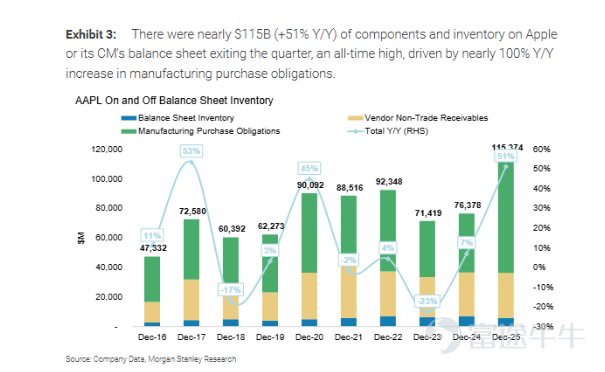
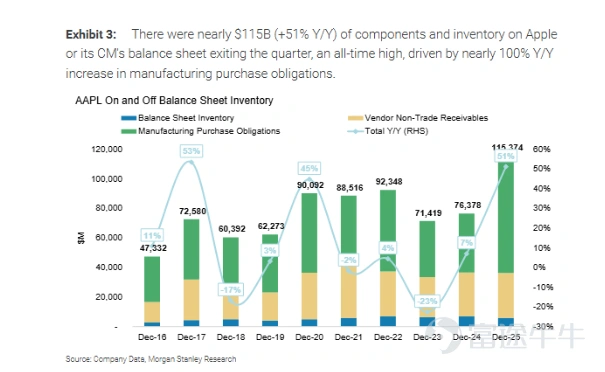
Apple expects second-quarter revenue to grow by 13% to 16%, surpassing Wall Street's projected 10% increase. According to Morgan Stanley's research data, Apple's book inventory at the end of the December quarter fell 7% sequentially, marking the largest seasonal decline in three years, implying extremely high product turnover and 'sell-out upon arrival' robust demand; meanwhile, its 'Manufacturing Purchase Obligations' – future pickup commitments signed with contract manufacturers – rose against the trend by 11% to $79.1 billion, far exceeding the average three-year seasonal decline of 25%.
This contrast between 'clearing the books and locking orders off the balance sheet'may indicate that Apple is in a 'state of aggressively replenishing inventory,' amid tight supplies of 3-nanometer wafers and memory.Apple's total inventory reserve scale has now climbed to a record high of $115 billion (a year-on-year increase of 51%). This level of stockpiling has only occurred twice in the past decade, corresponding to the 2017 supercycle of memory chips and the 2020 5G smartphone upgrade wave.
This might suggest that Apple’s current intensity of stockpiling hints at strong internal forecasts for robust demand in the coming quarters.The risk lies in Apple potentially paying a high price to lock in production capacity, which could squeeze future gross margins.
2. The much-criticized issue of AI adoption—could it finally be arriving this time?
The market has consistently criticized Apple for not being as aggressive as Microsoft or Google in capital expenditure (Capex) on AI. In the December quarter, R&D spending as a percentage of revenue reached an all-time high,7.6%mainly due to incremental investments in AI infrastructure, human resources, and new device prototype development. This portion represents explicit R&D expenses.
As for implicit infrastructure investments, although Apple has not disclosed detailed cooperation specifics with Google, its 'other purchase obligations' surged nearly 140% quarter-on-quarter to $35 billion. While it cannot be fully attributed, some market views suggest thatit may have significant ties to AI-related investments, such as its partnership with Google.。
On January 12, Apple and $Alphabet-C (GOOG.US)$$Alphabet-A (GOOGL.US)$ jointly announced a statement that they will enter into a multi-year, deep cooperation agreement. Apple's next-generation foundational model will be directly built on Google’s Gemini models and cloud technology, which will enhance Apple’s AI capabilities, including a more personalized Siri expected to launch later this year.
The market is now more focused on the company’s progress in the AI field, particularly the upcoming upgrade of Siri, which is considered one of the most important developments.Market expectations suggest that the new generation of Siri powered by Google’s Gemini could debut as early as mid-to-late February on the iOS 26.4 beta, with an official rollout planned between March and April.
Options strategy
As of February 2, Apple's share price was $270, following a substantial single-day increase.The current share price reflects strong technical conditions. Amidst weakness in software and tech stocks, Apple has become a safe haven for capital.The medium- and long-term moving averages (MA) are aligned in a bullish arrangement, and the MACD indicator shows a golden cross continuing. In the short term, there is technical resistance near previous highs and the upper Bollinger Band, while below, a series of dynamic moving averages form a support zone, especially the 5-day, 10-day, and 20-day moving averages. If it can effectively break through $270-273, further upside is expected, with the next resistance level at the $278-280 mark.
In terms of option signals,the options market reveals a positive bullish sentiment.The Put/Call Ratio stands at 0.43, indicating that trading sentiment in the options market is skewed towards bullishness; the current implied volatility (IV) is 24.36%, which is at a relatively low historical percentile (IV percentile is 14%),suggesting that option prices are relatively 'cheap'.The market does not anticipate extreme volatility in the short term.
On February 2nd,a notable unusual option activity was observed in the market.Buy the call option expiring in May 2026 with a strike price of $240, as part of a deep-in-the-money LEAP call strategy. This indicates that the investor may have a long-term bullish view and does not want to tie up significant cash by purchasing the underlying stock directly. Instead, they use the high delta of options to achieve nearly a 1:1 profit from upward movements.
– Upside factors: Include better-than-expected performance of iPhone 17, higher-than-expected adoption rate of Apple Intelligence, and gross margin exceeding expectations.
– Downside risks: Weak consumer spending limiting iPhone upgrades, rising costs of components such as memory, limited progress in AI functionality, and increased regulatory scrutiny on the App Store.
Based on the background of 'solid fundamentals + strong technicals but short-term overbought conditions + cheap option prices,' here are strategies for different types of investors:
1. Aggressive speculative type: Buy call options
Directly buy call options. Suitable for investors who are highly optimistic and wish to gain large exposure with minimal capital.The current favorable condition in the options market is that implied volatility (IV) is at an extremely low percentile of 14%. This means the 'time value' and 'volatility premium' embedded in the option contracts are very inexpensive. In scenarios where the fundamental outlook is extremely positive, directly buying calls becomes the optimal tool to capture upside potential or 'elasticity' in share prices.
The risk of direct entry lies in the possibility that if the stock price consolidates or slightly retraces over the next 3-5 days (reverting to the 24-day moving average), short-term options will suffer significant time decay (Theta erosion).Therefore, timing-wise, it is necessary to wait for an entry point of 'mean reversion', wait for the stock price to fall back to near the support level, and buy after confirming the support, which will improve the risk-reward ratio of this options trade.
2. Long-term bulls: Follow the whales, actively go long
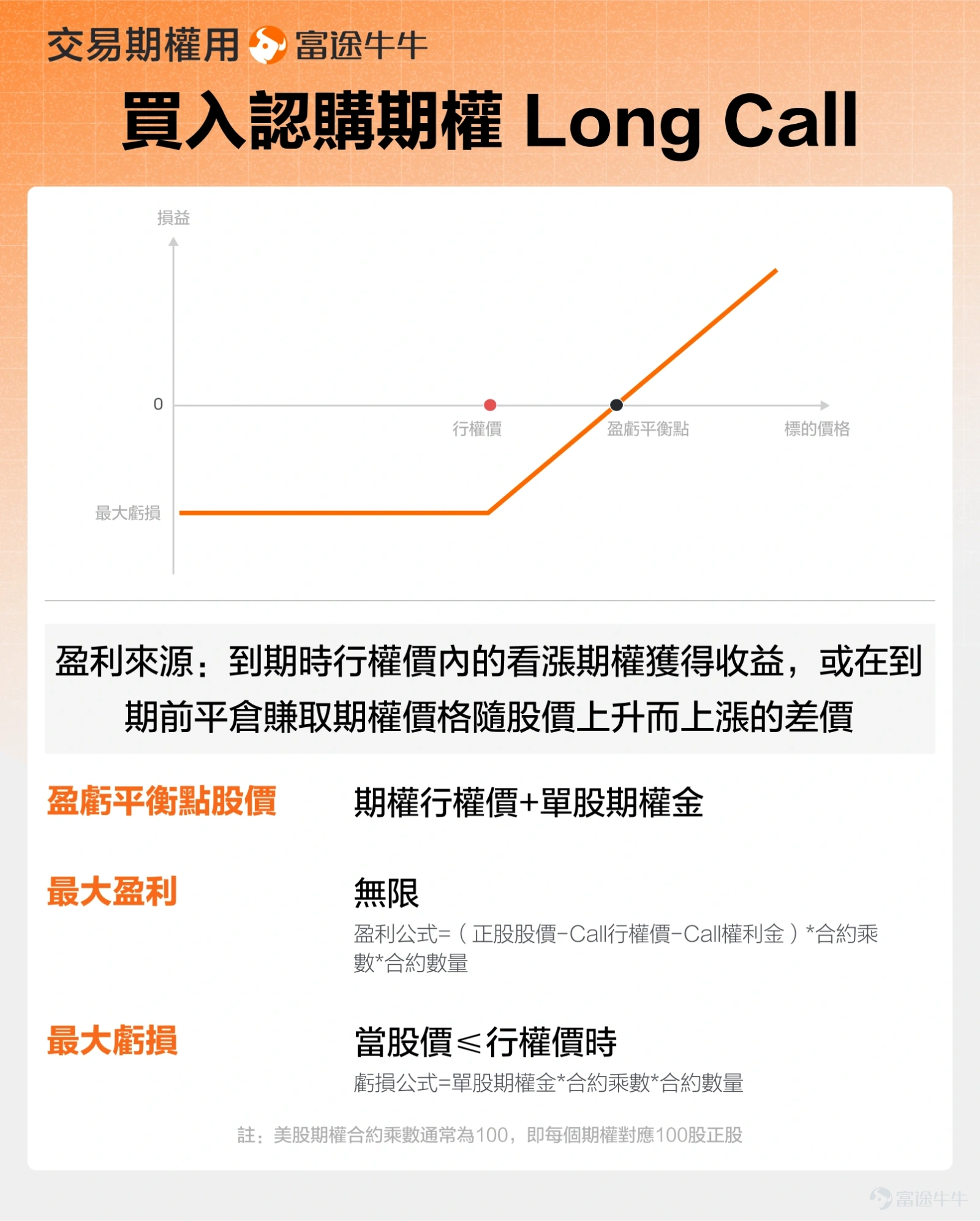
Deep in-the-money call options (Deep ITM Call / LEAPS). This strategy is suitable forinvestors who are optimistic in the long term, want to improve capital efficiency or have limited capital and are willing to hold for more than one year.
Simply put, a LEAPS CALL is a longer-term CALL. It comes with leverage and, since it is in-the-money, time value decay (Theta) is minimal, so even if the stock price experiences short-term pullbacks, this long call won't drop to zero, offering strong risk resistance. The main advantage is high capital efficiency; there's no need to fully purchase the underlying stock, just pay a smaller premium compared to the stock price. Moreover, the risk is limited, with the maximum risk and loss being the premium paid at purchase.
3. Conservative investors: Low-cost 'insurance buying'
Long Collar Strategy. If investors hold Apple but are concerned about downside risks following short-term overbuying, they can use the Long Collar strategy, where while holding the underlying stock, they hedge against potential declines by 'buying puts.' Using the income from 'selling calls' offsets part of the cost of buying puts, thereby achieving low-cost hedging.
If the underlying stock rises, the 'sold call' portion may be exercised, which will limit overall profit potential. If the underlying stock falls, the 'bought put' portion will profit, helping to cap the maximum loss.

Finally, here's a small perk for fellow investors. Fellow investors are welcome to claim it.Options Beginner's Package
*This event is exclusively for HK invited users. Click to learn more.Detailed event rules>>
Major upgrade to the US stock options mechanism! Weekly Monday and Wednesday options added for nine major stocks including Tesla and Nvidia. A step-by-step guide to profiting from end-of-term options using the Bull Tools >>

Disclaimer
This content does not constitute any offer, solicitation, recommendation, opinion, or guarantee regarding any securities, financial products, or tools. The risk of loss in trading options can be significant. In some cases, the losses you incur may exceed the initial margin deposit. Even if you set contingency orders such as “stop-loss” or “limit” orders, these may not necessarily prevent losses. Market conditions may render these orders unexecutable. You may be required to deposit additional margin within a short period. If you fail to provide the required amount within the specified time, your open positions may be liquidated. However, you will still be responsible for any deficits in your account. Therefore, before trading, you should research and understand options and carefully consider whether such trading suits your financial situation and investment objectives. If you trade options, you should familiarize yourself with the procedures related to exercising options and the expiration of options, as well as your rights and obligations when exercising options and upon their expiration.
Risk Disclaimer: The above content only represents the author's view. It does not represent any position or investment advice of Futu. Futu makes no representation or warranty.Read more

Comments
to post a comment
24
13