English
Back
Open Account
Another earnings miss? AMD plunges over 17% post-results!

Futubull Options Sir
joined discussion ·

Performance‑Based Equity Options Guide | AMD's Q4 2025 Earnings Preview: Dual Growth Drivers in Servers and AI, with Growth Under Cost Pressures

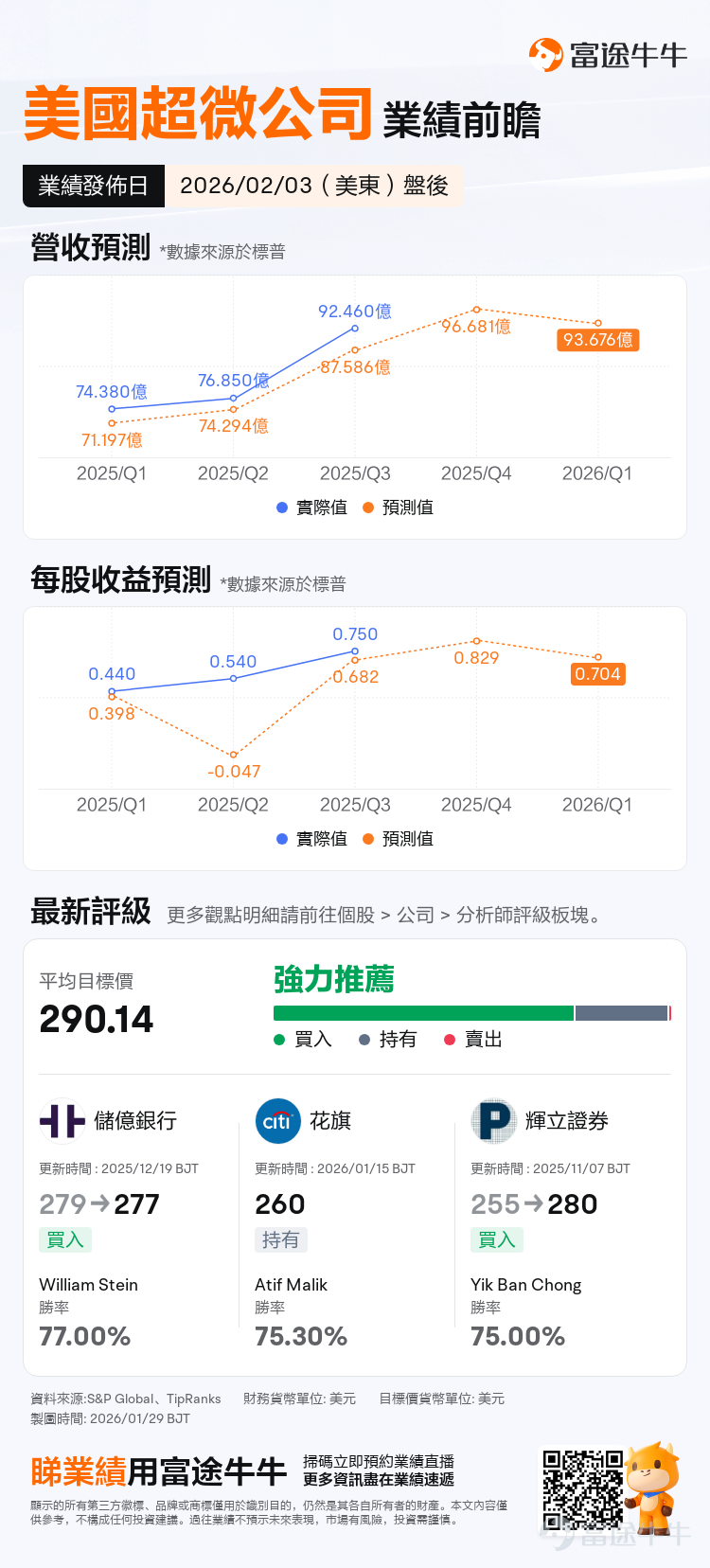
AMD will release its Q4 2025 financial results after the market close on February 3, 2026 (Eastern Time), with revenue expected to reach $9.668 billion, up 26.25% year over year.
Earnings per share are expected to be $0.829, up 185.76% year over year.
The accounting standards used for the above data are US GAAP.
AMD will release its Q4 2025 financial results after the market close on February 3, 2026 (Eastern Time), with revenue expected to reach $9.668 billion, up 26.25% year over year. Earnings per share are expected to be $0.829, up 185.76% year over year. The accounting standards used for the above data are US GAAP. Judging from recent institutional research reports and industry trends, this quarter's performance is marked by both bright spots and challenges: the growing market share of its server CPU business and the progress in deploying AI applications will serve as key drivers, while soaring memory‑chip costs leading to GPU price hikes and weak PC‑market demand could weigh on short-term results. This article, drawing on analyses from institutions such as Wells Fargo & Co. and GF Securities, as well as actual industry trends, breaks down several key areas in this earnings report that deserve attention. Starting with the overall earnings outlook, institutions have high expectations for the data center business. Wells Fargo & Co. currently forecasts that AMD's fourth-quarter data center revenue will reach $5.02 billion, with server CPU revenue accounting for approximately $2.58 billion. However, they believe this is still not the ceiling—if, by 2025, server shipments grow year over year by 10% and the ratio of server CPU revenue to server shipments stands at 1.85 (a figure lower than the average of 2.14 since 2021, making it a relatively conservative assumption), AMD's server CPU revenue could even have the potential to surge...
Judging from recent institutional research reports and industry trends, this quarter's performance is marked by both bright spots and challenges: the growing market share of its server CPU business and the progress in deploying AI applications will serve as key drivers, while soaring memory-chip costs leading to GPU price hikes and weak PC-market demand could weigh on short-term results.
This article, drawing on analyses from institutions such as Wells Fargo & Co. and GF Securities, as well as actual industry trends, breaks down several key areas in this earnings report that deserve attention.
Starting with the overall earnings outlook, institutions have high expectations for the data center business.
Wells Fargo & Co. currently forecasts that AMD's fourth-quarter data center revenue will reach $5.02 billion, with server CPU revenue accounting for approximately $2.58 billion.
However, they believe this is still not the ceiling—if, by 2025, server shipments grow year over year by 10% and the ratio of server CPU revenue to server shipments stands at 1.85 (a more conservative assumption than the average of 2.14 since 2021), AMD's server CPU revenue could even surpass $3 billion.
Previous quarterly data also reveal a clear trend: in the third quarter of 2025, AMD's data center revenue reached $4.341 billion, up 34% quarter over quarter, underscoring that robust demand for its server business remains unabated.
The growth of server-CPU revenue is driven, on the one hand, by underlying market demand: under the impetus of AI, the general-purpose server market continues to expand, with ultra-large enterprises maintaining steady demand for computing power. On the other hand, AMD's own product competitiveness is improving; for instance, the share of its Turin EPYC processors has already reached 34%, and data from Mercury Research show that Turin's average selling price is more than 50% higher than that of the previous-generation Genoa—both factors contributing to stronger overall revenue and gross margins for server CPUs.
In addition, AMD's inventory and purchase obligations at the end of the third quarter increased significantly—inventory stood at $7.313 billion, up 10% quarter over quarter, while purchase obligations totaled $12.125 billion, a 28% increase from the previous quarter, for a combined $19.4 billion. This further underscores the company's preparations to fulfill upcoming orders, with solid support from the supply chain.
AI-related business is the highlight of this earnings report and the growth driver that institutional investors are most focused on.
Guangfa Securities noted that AMD's AI revenue is primarily supported by its MI455X and MI325 products.
In the short term, MI325's supply chain plans to produce 160,000–180,000 units in the first half of 2026; if the Chinese market approves its import and sales, there is further upside potential in the second quarter.
Over the long term, total AI revenue is projected to reach US$17.8 billion in 2026, nearly tripling from US$6.3 billion in 2025.
The most critical factor here is customer progress—OpenAI's 1GW project has already committed to using the MI455X, and the subsequent order placements from major clients such as Oracle, Meta, and Microsoft will directly impact the growth trajectory of the AI business.
Moreover, Meta's earlier ASIC project, Iris, was removed from its earnings guidance due to the complexity of its design and mass production, leaving only the high-end test‑oriented Iris Plus. This could, in turn, enable AMD to capture a larger share of Meta's compute‑power procurement—potentially a pleasant surprise.
The cost pressures on AI hardware also cannot be ignored.
At CES 2026, Wells Fargo & Co. saw AMD showcase the Helios rack system, which packs four MI455X GPUs—each boasting 320 billion transistors and 12 HBM4 memory stacks—alongside the next-generation EPYC Venice CPU. While its performance is impressive—delivering 2.9 exaFLOPS of AI compute per rack—the cost of high-end memory like HBM4 has been steadily rising. Going forward, how AMD balances performance, production capacity, and gross margins will be a key issue it must address in its earnings reports.
AMD will release its Q4 2025 financial results after the market close on February 3, 2026 (Eastern Time), with revenue expected to reach $9.668 billion, up 26.25% year over year. Earnings per share are expected to be $0.829, up 185.76% year over year. The accounting standards used for the above data are US GAAP. Judging from recent institutional research reports and industry trends, this quarter's performance is marked by both bright spots and challenges: the growing market share of its server CPU business and the progress in deploying AI applications will serve as key drivers, while soaring memory‑chip costs leading to GPU price hikes and weak PC‑market demand could weigh on short-term results. This article, drawing on analyses from institutions such as Wells Fargo & Co. and GF Securities, as well as actual industry trends, breaks down several key areas in this earnings report that deserve attention. Starting with the overall earnings outlook, institutions have high expectations for the data center business. Wells Fargo & Co. currently forecasts that AMD's fourth-quarter data center revenue will reach $5.02 billion, with server CPU revenue accounting for approximately $2.58 billion. However, they believe this is still not the ceiling—if, by 2025, server shipments grow year over year by 10% and the ratio of server CPU revenue to server shipments stands at 1.85 (a figure lower than the average of 2.14 since 2021, making it a relatively conservative assumption), AMD's server CPU revenue could even have the potential to surge...
In the GPU business, which is more familiar to the market, the most talked‑about topic in the industry lately has been "price hikes."
The root cause is the surging demand for GDDR6 and GDDR7 memory in AI data centers, which has driven prices up several-fold over the past few months. As a result, memory costs have risen sharply, becoming the fastest‑growing component of the bill of materials.
According to information from Kbench and Runto, both AMD and NVIDIA plan to implement phased GPU price hikes starting in the first quarter of 2026. AMD may initiate the increases as early as January, with NVIDIA following in February, and further minor adjustments could be made each subsequent month.
Specifically, AMD's Radeon RX series will be directly affected, while NVIDIA's situation is even more pronounced—prices for flagship RTX GPUs have surged. Even more noteworthy is that NVIDIA is considering cutting production capacity for its mid-range GPUs (such as the RTX 5070 and RTX 5060 Ti) by 30% to 40%, prioritizing high-margin AI accelerators. This could indirectly ease competitive pressure on AMD in the mid‑range GPU market; however, AMD itself will still face pricing challenges stemming from rising memory costs, as squeezed profit margins at the board‑level inevitably get passed on to end‑user prices.
On the other end of the CPU business—the PC segment—the outlook is far less optimistic.
Affected by rising memory prices, PC demand has remained sluggish, putting downward pressure on consumer‑grade CPU performance as well.
However, industry sources report that AMD plans to raise prices on its new PC CPUs by roughly 10% to 15%, primarily to offset cost pressures stemming from substrate shortages and tight wafer‑fabrication capacity. This move may be reflected in the company's earnings report, which could also outline the specific timeline for implementation.
Fortunately, AMD maintains a robust long-term technology pipeline; for instance, mass production of its first 2nm‑process Venice CPU is progressing smoothly. Leveraging the N2 process and CoWoS packaging, this CPU's average selling price is expected to rise further. Meanwhile, analysts predict that by 2028, Intel may outsource server‑grade CPU manufacturing to TSMC using the 14nm‑class process, helping to ease the tight supply of wafers. Details on capacity planning for this segment are precisely the kind of information the market hopes to glean from the earnings report.
From the perspective of financial‑statement consistency, AMD's third quarter of 2025 has already laid a solid foundation: revenue reached $9.246 billion, up 35.59% year over year, while net profit attributable to shareholders totaled $1.243 billion, with a year‑over‑year growth rate of 61.22%. Compared with first‑quarter revenue of $7.438 billion and second‑quarter revenue of $7.685 billion, the third quarter's growth momentum has clearly accelerated.
If this momentum continues in the fourth quarter, coupled with growth in the server and AI businesses, it is plainly feasible for total revenue to surpass $9.5 billion and even approach $10 billion.
However, it's worth noting that weakness in the PC segment could weigh on overall growth. After all, global PC shipments in the fourth quarter of 2025 were essentially flat quarter-over-quarter, falling below pre-pandemic seasonal norms, while Taiwan's ODM notebook shipments even declined 7% sequentially. Demand for consumer‑grade chips remains decidedly subdued.
What are the risk factors and catalysts?
Beyond the drag from the PC market, cost pressures pose an even more immediate challenge: prices for graphics memory, substrates, and wafers are all rising. How the company will manage its gross margin—and whether it will revise down its 2026 gross margin outlook in its earnings report—will be key areas to watch.
Moreover, although the AI business appears bustling, its only publicly disclosed major client at present is OpenAI. Whether it can secure more heavyweight clients like Oracle and Meta will directly determine whether AI revenue can meet the annual target of $17.8 billion.
Moreover, on the valuation front, AMD's forward P/E ratio for 2026 stands at around 35 times, higher than NVIDIA's. If its earnings report fails to provide clear guidance on its AI business, or if its server market share growth falls short of expectations, it could trigger a short-term valuation correction.
The market will undoubtedly be closely watching AMD's full-year guidance for 2026, particularly whether its data center business can deliver the previously pledged "compound growth rate of over 60%." Details such as the progress of customer contracts for the MI455X, the ramp-up schedule for the Venice 2nm CPU, and capacity-planning assumptions will directly shape institutional investors' outlook on long-term growth. Additionally, the company's specific measures to address cost pressures—beyond the already confirmed price hikes for GPUs and PC CPUs—will be scrutinized: for instance, whether it plans to reallocate resources across product lines. All of these factors could serve as catalysts for subsequent stock-price volatility.
Summary
This earnings call will serve as a litmus test for AMD's growth trajectory—whether the strength of its server and AI businesses can offset cost pressures and the drag from the PC market, and whether its 2026 growth roadmap remains on track, will all become clear in the February 3 results. For investors, it's crucial not only to assess whether short-term performance meets expectations but also to closely monitor the pace at which the company's long-term growth thesis is being realized.
Options signals
The put-to-call ratio has continued to rise ahead of the earnings report, putting some pressure on the market.
AMD will release its Q4 2025 financial results after the market close on February 3, 2026 (Eastern Time), with revenue expected to reach $9.668 billion, up 26.25% year over year. Earnings per share are expected to be $0.829, up 185.76% year over year. The accounting standards used for the above data are US GAAP. Judging from recent institutional research reports and industry trends, this quarter's performance is marked by both bright spots and challenges: the growing market share of its server CPU business and the progress in deploying AI applications will serve as key drivers, while soaring memory‑chip costs leading to GPU price hikes and weak PC‑market demand could weigh on short-term results. This article, drawing on analyses from institutions such as Wells Fargo & Co. and GF Securities, as well as actual industry trends, breaks down several key areas in this earnings report that deserve attention. Starting with the overall earnings outlook, institutions have high expectations for the data center business. Wells Fargo & Co. currently forecasts that AMD's fourth-quarter data center revenue will reach $5.02 billion, with server CPU revenue accounting for approximately $2.58 billion. However, they believe this is still not the ceiling—if, by 2025, server shipments grow year over year by 10% and the ratio of server CPU revenue to server shipments stands at 1.85 (a figure lower than the average of 2.14 since 2021, making it a relatively conservative assumption), AMD's server CPU revenue could even have the potential to surge...
Observing options signals, the post-earnings price fluctuation is ±8.36%.
AMD will release its Q4 2025 financial results after the market close on February 3, 2026 (Eastern Time), with revenue expected to reach $9.668 billion, up 26.25% year over year. Earnings per share are expected to be $0.829, up 185.76% year over year. The accounting standards used for the above data are US GAAP. Judging from recent institutional research reports and industry trends, this quarter's performance is marked by both bright spots and challenges: the growing market share of its server CPU business and the progress in deploying AI applications will serve as key drivers, while soaring memory‑chip costs leading to GPU price hikes and weak PC‑market demand could weigh on short-term results. This article, drawing on analyses from institutions such as Wells Fargo & Co. and GF Securities, as well as actual industry trends, breaks down several key areas in this earnings report that deserve attention. Starting with the overall earnings outlook, institutions have high expectations for the data center business. Wells Fargo & Co. currently forecasts that AMD's fourth-quarter data center revenue will reach $5.02 billion, with server CPU revenue accounting for approximately $2.58 billion. However, they believe this is still not the ceiling—if, by 2025, server shipments grow year over year by 10% and the ratio of server CPU revenue to server shipments stands at 1.85 (a figure lower than the average of 2.14 since 2021, making it a relatively conservative assumption), AMD's server CPU revenue could even have the potential to surge...
Prior to the earnings report, implied volatility has been rising steadily, trading roughly 20% above historical volatility; currently, option premiums are pricing in relatively high potential volatility.
AMD will release its Q4 2025 financial results after the market close on February 3, 2026 (Eastern Time), with revenue expected to reach $9.668 billion, up 26.25% year over year. Earnings per share are expected to be $0.829, up 185.76% year over year. The accounting standards used for the above data are US GAAP. Judging from recent institutional research reports and industry trends, this quarter's performance is marked by both bright spots and challenges: the growing market share of its server CPU business and the progress in deploying AI applications will serve as key drivers, while soaring memory‑chip costs leading to GPU price hikes and weak PC‑market demand could weigh on short-term results. This article, drawing on analyses from institutions such as Wells Fargo & Co. and GF Securities, as well as actual industry trends, breaks down several key areas in this earnings report that deserve attention. Starting with the overall earnings outlook, institutions have high expectations for the data center business. Wells Fargo & Co. currently forecasts that AMD's fourth-quarter data center revenue will reach $5.02 billion, with server CPU revenue accounting for approximately $2.58 billion. However, they believe this is still not the ceiling—if, by 2025, server shipments grow year over year by 10% and the ratio of server CPU revenue to server shipments stands at 1.85 (a figure lower than the average of 2.14 since 2021, making it a relatively conservative assumption), AMD's server CPU revenue could even have the potential to surge...
Given that the stock price has risen in the earlier period, but Put/Call option open interest has increased and premiums remain relatively high, taking a short options position would be more advantageous at this juncture.
AMD will release its Q4 2025 financial results after the market close on February 3, 2026 (Eastern Time), with revenue expected to reach $9.668 billion, up 26.25% year over year. Earnings per share are expected to be $0.829, up 185.76% year over year. The accounting standards used for the above data are US GAAP. Judging from recent institutional research reports and industry trends, this quarter's performance is marked by both bright spots and challenges: the growing market share of its server CPU business and the progress in deploying AI applications will serve as key drivers, while soaring memory‑chip costs leading to GPU price hikes and weak PC‑market demand could weigh on short-term results. This article, drawing on analyses from institutions such as Wells Fargo & Co. and GF Securities, as well as actual industry trends, breaks down several key areas in this earnings report that deserve attention. Starting with the overall earnings outlook, institutions have high expectations for the data center business. Wells Fargo & Co. currently forecasts that AMD's fourth-quarter data center revenue will reach $5.02 billion, with server CPU revenue accounting for approximately $2.58 billion. However, they believe this is still not the ceiling—if, by 2025, server shipments grow year over year by 10% and the ratio of server CPU revenue to server shipments stands at 1.85 (a figure lower than the average of 2.14 since 2021, making it a relatively conservative assumption), AMD's server CPU revenue could even have the potential to surge...
If, after the earnings report, even a strong performance is expected but upside potential remains limited, or if hedging against post‑report downside pressure would be burdensome, a covered call strategy may be worth considering.
AMD will release its Q4 2025 financial results after the market close on February 3, 2026 (Eastern Time), with revenue expected to reach $9.668 billion, up 26.25% year over year. Earnings per share are expected to be $0.829, up 185.76% year over year. The accounting standards used for the above data are US GAAP. Judging from recent institutional research reports and industry trends, this quarter's performance is marked by both bright spots and challenges: the growing market share of its server CPU business and the progress in deploying AI applications will serve as key drivers, while soaring memory‑chip costs leading to GPU price hikes and weak PC‑market demand could weigh on short-term results. This article, drawing on analyses from institutions such as Wells Fargo & Co. and GF Securities, as well as actual industry trends, breaks down several key areas in this earnings report that deserve attention. Starting with the overall earnings outlook, institutions have high expectations for the data center business. Wells Fargo & Co. currently forecasts that AMD's fourth-quarter data center revenue will reach $5.02 billion, with server CPU revenue accounting for approximately $2.58 billion. However, they believe this is still not the ceiling—if, by 2025, server shipments grow year over year by 10% and the ratio of server CPU revenue to server shipments stands at 1.85 (a figure lower than the average of 2.14 since 2021, making it a relatively conservative assumption), AMD's server CPU revenue could even have the potential to surge...
If you believe the earnings report will fall short of expectations, are prepared to bet on a short position, and are not concerned about potential losses stemming from declining volatility, you can adopt a put‑buy strategy.
AMD will release its Q4 2025 financial results after the market close on February 3, 2026 (Eastern Time), with revenue expected to reach $9.668 billion, up 26.25% year over year. Earnings per share are expected to be $0.829, up 185.76% year over year. The accounting standards used for the above data are US GAAP. Judging from recent institutional research reports and industry trends, this quarter's performance is marked by both bright spots and challenges: the growing market share of its server CPU business and the progress in deploying AI applications will serve as key drivers, while soaring memory‑chip costs leading to GPU price hikes and weak PC‑market demand could weigh on short-term results. This article, drawing on analyses from institutions such as Wells Fargo & Co. and GF Securities, as well as actual industry trends, breaks down several key areas in this earnings report that deserve attention. Starting with the overall earnings outlook, institutions have high expectations for the data center business. Wells Fargo & Co. currently forecasts that AMD's fourth-quarter data center revenue will reach $5.02 billion, with server CPU revenue accounting for approximately $2.58 billion. However, they believe this is still not the ceiling—if, by 2025, server shipments grow year over year by 10% and the ratio of server CPU revenue to server shipments stands at 1.85 (a figure lower than the average of 2.14 since 2021, making it a relatively conservative assumption), AMD's server CPU revenue could even have the potential to surge...
If you are particularly bullish on post‑earnings volatility and expect a significant upward move, yet implied volatility is trending lower, then as an options buyer, if the realized volatility after the earnings release falls below the range currently projected by implied volatility, there is a strong likelihood of a stock price rally. However, this could also expose you to the risk of declining volatility post‑earnings, which would drag down option premiums. If you remain very confident that post‑earnings volatility will exceed the market's current implied‑volatility forecast, you might opt to purchase call options outright—adopting a straightforward long‑call strategy.
AMD will release its Q4 2025 financial results after the market close on February 3, 2026 (Eastern Time), with revenue expected to reach $9.668 billion, up 26.25% year over year. Earnings per share are expected to be $0.829, up 185.76% year over year. The accounting standards used for the above data are US GAAP. Judging from recent institutional research reports and industry trends, this quarter's performance is marked by both bright spots and challenges: the growing market share of its server CPU business and the progress in deploying AI applications will serve as key drivers, while soaring memory‑chip costs leading to GPU price hikes and weak PC‑market demand could weigh on short-term results. This article, drawing on analyses from institutions such as Wells Fargo & Co. and GF Securities, as well as actual industry trends, breaks down several key areas in this earnings report that deserve attention. Starting with the overall earnings outlook, institutions have high expectations for the data center business. Wells Fargo & Co. currently forecasts that AMD's fourth-quarter data center revenue will reach $5.02 billion, with server CPU revenue accounting for approximately $2.58 billion. However, they believe this is still not the ceiling—if, by 2025, server shipments grow year over year by 10% and the ratio of server CPU revenue to server shipments stands at 1.85 (a figure lower than the average of 2.14 since 2021, making it a relatively conservative assumption), AMD's server CPU revenue could even have the potential to surge...
Finally, here's a little bonus for fellow investors. You're welcome to claim it.Options Beginner Package
*This promotion is exclusively for HK-invited users. Click to learn more.Detailed Rules of the Event>>
Major upgrade to U.S. stock options! Nine major underlying assets, including Tesla and NVIDIA, now offer Monday and Wednesday options. Step-by-step guidance on using the NiuNiu tool to capitalize on end-of-month options >>
AMD will release its Q4 2025 financial results after the market close on February 3, 2026 (Eastern Time), with revenue expected to reach $9.668 billion, up 26.25% year over year. Earnings per share are expected to be $0.829, up 185.76% year over year. The accounting standards used for the above data are US GAAP. Judging from recent institutional research reports and industry trends, this quarter's performance is marked by both bright spots and challenges: the growing market share of its server CPU business and the progress in deploying AI applications will serve as key drivers, while soaring memory‑chip costs leading to GPU price hikes and weak PC‑market demand could weigh on short-term results. This article, drawing on analyses from institutions such as Wells Fargo & Co. and GF Securities, as well as actual industry trends, breaks down several key areas in this earnings report that deserve attention. Starting with the overall earnings outlook, institutions have high expectations for the data center business. Wells Fargo & Co. currently forecasts that AMD's fourth-quarter data center revenue will reach $5.02 billion, with server CPU revenue accounting for approximately $2.58 billion. However, they believe this is still not the ceiling—if, by 2025, server shipments grow year over year by 10% and the ratio of server CPU revenue to server shipments stands at 1.85 (a figure lower than the average of 2.14 since 2021, making it a relatively conservative assumption), AMD's server CPU revenue could even have the potential to surge...
Disclaimer
This material does not constitute an offer, solicitation, recommendation, opinion, or any guarantee with respect to any securities, financial products, or instruments. The risk of loss in options trading can be substantial. In certain circumstances, your losses may exceed the initial margin you posted. Even if you place contingent orders such as stop-loss or limit orders, these may not necessarily prevent losses, as market conditions could render such orders unexecutable. You may also be required to post additional margin within a short period. Failure to provide the required amount by the specified deadline could result in the liquidation of your open options positions. Nevertheless, you will remain liable for any resulting debit balance in your account. Therefore, before engaging in options trading, you should thoroughly research and understand options and carefully assess whether such trading is suitable for you based on your financial situation and investment objectives. If you trade options, you should familiarize yourself with the procedures for exercising options and for handling option expirations, as well as with your rights and obligations in connection with exercise and expiration.
Risk Disclaimer: The above content only represents the author's view. It does not represent any position or investment advice of Futu. Futu makes no representation or warranty.Read more
Thumbs Up
10
274K Views
Report
Comments
Write a Comment...
10
18