
Musk's 'Space Empire': SpaceX Applies to Deploy One Million Satellites + Annual Profit of ~$8 Billion—What Investment Opportunities Lie Within This Grand Strategy?
SpaceX has been extremely active recently!
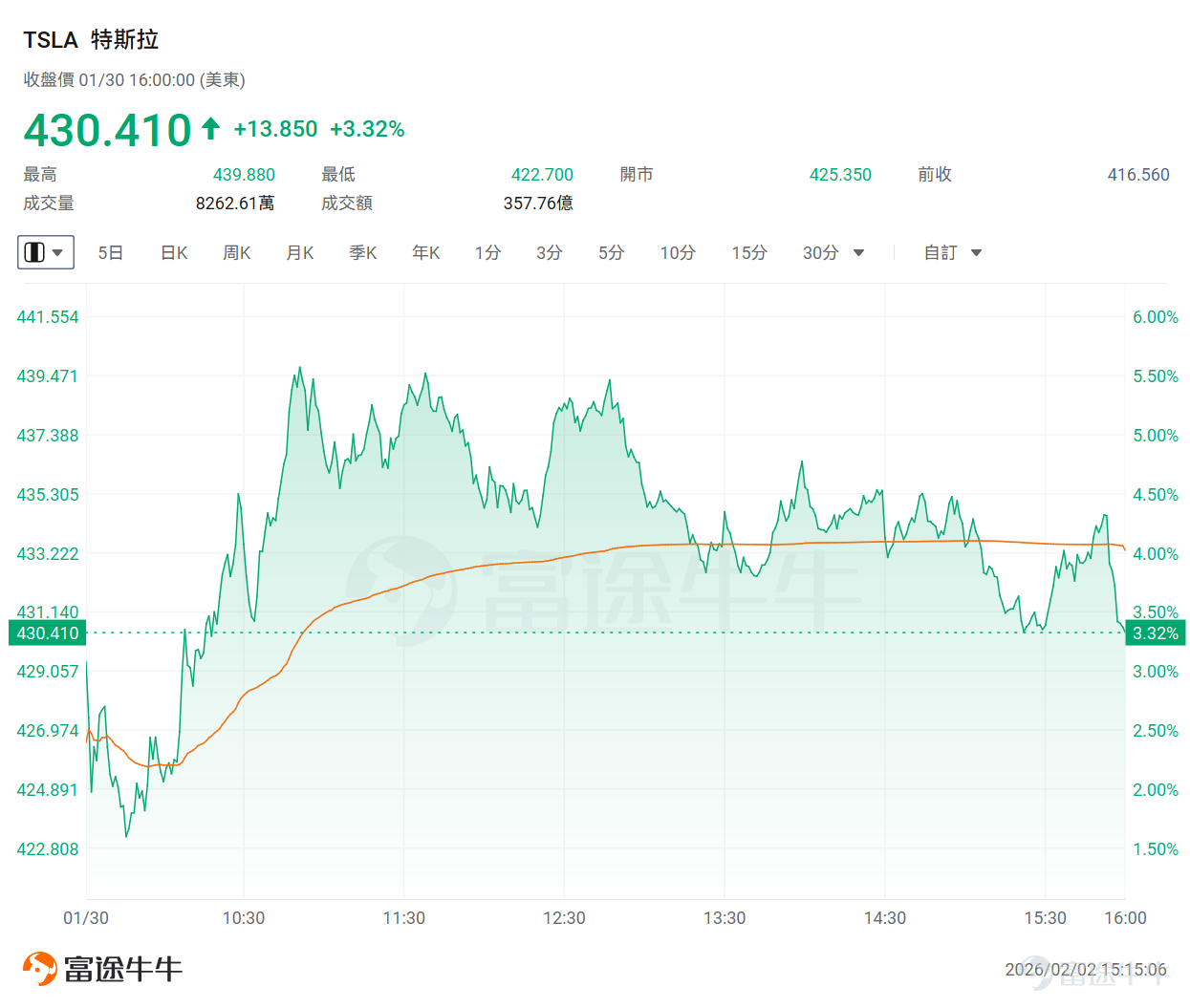
First, according to reports,SpaceX is considering a potential merger with $Tesla (TSLA.US)$and is also evaluating another option—integration with AI company xAI.Although the plan is still in its early stages,However, the synergies within the 'Musk Empire' have already sparked heated market discussions.This news also propelled Tesla to rise more than 3% last Friday, bucking the broader market trend.

Meanwhile, SpaceX has demonstrated its grand technological ambition by formally applying to U.S. regulators to launch one million satellites, aiming to build the world’s first 'orbital data center.'The plan intends to leverage solar energy resources and natural cooling advantages in space to fundamentally transform data processing models.
Most exciting for investors is the newly disclosed financial data:SpaceX generated revenue of $15–16 billion last year, with EBITDA profit of approximately $8 billion. This impressive performance not only reveals its strong monetization capabilities but also opens vast imagination for its potential IPO valuation.
Some banks currently estimate that SpaceX could be valued at over $1.5 trillion at IPO, with a fundraising size potentially exceeding $50 billion—making it one of the largest IPOs in history.
Beyond SpaceX, NASA is taking a critical step toward its first crewed lunar mission in over fifty years. The Artemis II mission—the first crewed lunar flyby under the Artemis program—has made new progress, with NASA commencing a two-day simulated countdown to prepare for fueling its next-generation Moon rocket.
Overall, 2026 is poised to be a pivotal year for the aerospace industry’s transition from 'concept hype' to 'commercial monetization.' SpaceX’s validated business model undoubtedly serves as a powerful catalyst for the entire sector.
This article will provide an in-depth breakdown:
🔍 Strategic Deep Dive: Decoding the 'Commercial Closed Loop' Logic Behind SpaceX's Recent Intense Moves
💰 Investment Guide: Key Listed Stocks in SpaceX’s Supply Chain Worth Positioning In
What is the logic behind SpaceX’s recent flurry of activities?
① Why is Musk considering merging SpaceX with Tesla or xAI?
Over the past few days,Rumors about a major consolidation among Musk’s companies have been swirling intensely.According to informed sources, Musk is evaluating the possibility of merging SpaceX, Tesla, and xAI, though discussions remain in an early stage.
In reality,This indicates that Elon Musk, the world’s richest person, is weighing how to integrate his vast business empire.Analysts note that if these moves materialize, they would integrate rocket launches, the Starlink satellite network, electric vehicles, social media platforms, and generative AI technologies,forming a 'super ecosystem' in the global tech sector.
Specifically,SpaceX is more than just a company; through its Starlink network, it enables seamless data transmission between space and Earth,achieving full-stack integration spanning rocket launches, satellite communications, energy acquisition, and AI applications.

SpaceX's business model forms a continuously reinforcing and expanding closed-loop ecosystem.Within SpaceX’s ecosystem, the rocket launch business has evolved beyond merely being a 'pick-and-shovel' provider—it now serves as SpaceX’s strategic cornerstone and value amplifier, formingthe first driving force behind the cycle of“low-cost access to space → scalable space-based services → interplanetary exploration.”

Overall, Bloomberg notes that one of Elon Musk’s grand visions for SpaceX is to send data centers into space to perform complex AI computing tasks. Different merger or integration scenarios could each serve distinct components of this vision.
② Why is SpaceX undertaking such an extensive satellite launch initiative this time?
According to reports, SpaceX is planning a satellite network dubbed the “Orbital Data Center system,” for which it has applied to launch and operate a constellation of up to one million satellites. These satellites would operate across multiple orbital shells ranging from 500 km to 2,000 km in altitude.
This unprecedented plan is not mere speculation; its implementation logic is tightly aligned with SpaceX’s core capabilities:
Starship: Such high-frequency, large-scale launches must rely on SpaceX’s more powerful Starship system, whose low cost and high payload capacity provide the only viable foundation for deploying a million satellites.
Capital markets: According to media reports, SpaceX is preparing for an initial public offering (IPO), one of whose core purposes is to raise funds for its highly capital-intensive 'space data center' project.
According to Guolian Minsheng Overseas Research,The primary reason behind SpaceX’s current large-scale satellite deployment plan lies in the limited availability of low Earth orbit (LEO) space.Statistics show that since Starlink ignited the LEO constellation race, over 300 constellation proposals have been submitted globally, potentially deploying more than a million satellites—making space increasingly 'crowded.' Considering the minimum safe separation distance of 50 kilometers between satellites both within and across orbital planes, the LEO region between 300 and 2,000 kilometers can accommodate only 175,000 satellites.This clearly defined upper limit on orbital capacity gives the satellite industry an end-state supply certainty akin to that of precious metals.
Against this backdrop,‘(First-mover) time equals space, and space equals resources’This industry development perspective influences every participant in the aerospace market.Beyond racing for orbital allocations, the expanding AI industry wave—and the resulting demand for computing power—is another key driver fueling satellite business growth.
In its application, SpaceX stated that energy costs for terrestrial AI data centers are continuously rising, making orbital data centers the most efficient solution to meet the growing demand for AI computing power. Additionally, the company indicated it will deploy space-based data centers capable of rapid launch via SpaceX’s more powerful Starship vehicle—a capability critical for upgrading the Starlink system with next-generation satellites. In terms of power, these satellites will utilize space-based photovoltaic technology and operate in sun-synchronous orbits at altitudes of 500 to 2,000 kilometers with a 30-degree inclination. These orbital data centers will also connect to Starlink via 'optical links' or lasers, routing traffic to ground users through the existing satellite internet infrastructure.
③ What do SpaceX's financial figures reveal?
Citing two informed sources, Reuters reported that Elon Musk’s SpaceX generated revenue of $15–16 billion last year, with EBITDA profit of approximately $8 billion.
This rare disclosure of financial datahas given the market its first clear view of SpaceX’s 'profit-generating capability,'and quickly fueled speculation about the scale of its upcoming IPO. Sources indicate the company plans to go public later this year,with a target date around Musk’s 55th birthday (June 28).
From a business structure perspective,SpaceX’s profitability is heavily concentrated in Starlink.According to insiders, Musk’s satellite internet system, Starlink, has become the company’s dominant revenue driver, contributing roughly 50% to 80% of total revenue. The stable cash flow generated by Starlink not only supports commercial expansion but also serves as the core funding source for SpaceX’s ongoing development of its heavy-lift rocket, Starship.
Additionally, Musk expects Starship to begin executing commercial payload launches this year, following 11 test flights since 2023.In the longer term, Starship is envisioned for deploying space-based AI data centers,This concept is highly relevant to the proposed merger between SpaceX and xAI, but it remains in an early, high-risk stage.
Which opportunities are worth watching?
SpaceX's largest long-term investors include venture capital firms such as Peter Thiel's Founders Fund, 137 Ventures, and Valor Equity Partners. Fidelity Investments and Google are also significant investors.
In early September, SpaceX acquired the AWS-4 and H-block spectrum licenses—used for satellite and mobile communications—from EchoStar Communications for up to $8.5 billion in cash and up to $8.5 billion worth of SpaceX stock.Due to the stock-swap agreement, buying EchoStar Communications effectively equates to holding SpaceX shares.
NiuNiu has also compiled a list of SpaceX-related stocks for investor reference:

 Musk's 'Empire of Holdings'
$Tesla (TSLA.US)$and SpaceX are the 'twin stars' of Musk’s business empire,In previous interviews, Musk hinted at launching a new initiative called 'Galaxy Mind,' aimed at integratingSpaceX, Tesla, and xAIThe core capabilities of these three companiesenable the deployment of solar-powered AI satellites into deep space.Specifically, realizing this blueprint relies on clear division of labor and collaboration among the three companies:
SpaceX: Provides mature rocket launch and spacecraft manufacturing capabilities, responsible for deploying AI satellites into deep-space orbits.
Tesla: Leveraging its expertise in solar energy and battery technology to deliver efficient and long-lasting power solutions for the satellites.
xAI: Responsible for developing cutting-edge artificial intelligence models capable of large-scale operation onboard the satellites.
Core competitorsAs SpaceX's valuation rises, its competitors may benefit from increased 'sector heat' in the short term, but over the medium to long term, the scarcity value of these companies could diminish—especially if SpaceX goes public, potentially drawing capital away from$Rocket Lab (RKLB.US)$ and$AST SpaceMobile (ASTS.US)$ and redirecting it toward SpaceX.
$Rocket Lab (RKLB.US)$ :Widely recognized by the market as the 'mini SpaceX' and nicknamed 'Little Rocket' by investors, it is currently one of only two private aerospace companies globally capable of achievingroutine, high-frequency successful launches; not only has it secured a solid foothold with its highly reliable small-lift rocket Electron, but it has also successfully transformed into anend-to-end service provider integrating satellite manufacturing, software, and launch services through its 'Space Systems' business, making it the onlyspace-sector leader in the U.S. stock market with strong financial execution and the clearest scarcity value as a 'SpaceX alternative'. Its medium-lift, reusable rocket currently under development, Neutron , is viewed as the key contender poised to challenge SpaceX's Falcon 9 dominance in the future.
$AST SpaceMobile (ASTS.US)$:It is regarded by the market as the 'AT&T of space'orThe leader in the 'direct-to-cell satellite' race, with a core vision to build the world's firstspace-based cellular broadband network, using massive constellations of low-Earth orbit satellites as 'space base stations,' enabling ordinary smartphones on the groundto connect directly to satellite signals without hardware modifications or specialized equipment(such as dish antennas); despite facing intense competition from SpaceX’s Starlink, it has become the pure-play, high-upside (yet highly volatile) bet in the U.S. equity market for the trillion-dollar communications revolution aimed at 'eliminating dead zones.' AT&T, Verizon, Vodafone, and Google through deep partnerships with industry giants and strong patent barriers.
$Firefly Aerospace (FLY.US)$:It is currently a standout dark horse in the commercial space sector—ranked just behind the top two players (SpaceX/Rocket Lab)—having gained recognition through its successfully orbital-class small launch vehicle Alpha in the U.S. Department of Defense’s 'Tactically Responsive Space Launch' missions; unlike single-service launch providers, it has built a high-barrier 'Earth-Moon ecosystem,'with its Blue Ghost lunar lander securing major NASA commercial payload contracts; the company is also collaborating with defense giant Northrop Grumman to develop a medium-lift vehicle (MLV) to fill a critical market gap.。
PartnersSpaceX's IPO is a 'shot in the arm' for its partners, signaling greater cash reserves and stronger contractual performance capability.
$EchoStar (ECHO.US)$:In September 2025, SpaceX acquired EchoStar's AWS-4 and H-band spectrum licenses for satellite and mobile communications. The deal featured a unique payment structure, including up to $8.5 billion in cash and $8.5 billion worth of SpaceX stock. At the time, with SpaceX valued at approximately $400 billion, this equity stake represented roughly 2% of SpaceX’s total shares. Additionally, SpaceX agreed to assume EchoStar’s debt interest obligations of approximately $2 billion through November 2027.
$Planet Labs PBC (PL.US)$:The relationship between Planet Labs and SpaceX can be summed up as a 'long-term and deeply integrated passenger-driver partnership.' Planet Labs operates the world’s largest fleet of Earth-imaging satellites (hundreds in number), which have relatively short lifespans (about 3–5 years) and require frequent replenishment and upgrades. Planet Labs is one of SpaceX’s most loyal commercial launch customers, and its business continuity heavily depends on SpaceX’s timely rocket launches.
$Amazon (AMZN.US)$:Amazon’s collaboration with SpaceX marks a dramatic strategic pivot. As the parent company of Blue Origin, Amazon had long been viewed as SpaceX’s primary rival in the commercial space sector. However, due to delays in Blue Origin’s New Glenn rocket development, Amazon was forced to adjust its strategy and, in 2025, commissioned SpaceX to launch 24 Kuiper satellites.
Starlink-related business$T-Mobile US (TMUS.US)$: Starlink’s 'top commercial ally' and pioneer in market deployment,T-Mobile is SpaceX’s most critical telecom partner for its 'Direct to Cell' service. The two companies signed a historic agreement called 'Coverage Above and Beyond,' whose core breakthrough is that it requires 'no phone replacement'—leveraging T-Mobile’s existing 5G spectrum to use Starlink satellites directly as 'space-based cell towers.' This not only helps T-Mobile address terrestrial coverage dead zones but also opens a massive consumer market for SpaceX, representing a key monetization pathway for Starlink as it transitions from a 'niche broadband provider' to a 'mass-market telecom player.'
$Qualcomm (QCOM.US)$: The 'foundational technology enabler' bridging terrestrial and space-based communications If T-Mobile provides the 'road' (spectrum and users), Qualcomm provides the 'engine' (chips). As the global leader in communications chips, Qualcomm is engaging in deep collaboration with SpaceX to optimize the 5G NTN (Non-Terrestrial Network) standardSpaceX needs Qualcomm's smartphone modem and RF front-end technology to ensure future smartphones can efficiently and low-power 'understand' satellite signals. Qualcomm is a key hardware enabler in standardizing satellite communications and making satellite capabilities a standard smartphone feature.
$flyExclusive (FLYX.US)$:The company previously announced it has signed an authorized distribution agreement with Starlink, officially becoming a certified distributor and installation provider for its high-speed, low-latency in-flight connectivity system.
Investment company1. $Alphabet-A (GOOGL.US)$& $Bank of America (BAC.US)$: Google is one of SpaceX's most important early strategic shareholders (holding approximately 7%), with deep integration between the two companies in cloud and edge computing; meanwhile,Bank of Americaparticipated in SpaceX’s financing rounds.
If SpaceX goes public:For Google, this represents a massive 'revaluation of assets'—its $900 million investment could now be worth dozens of times more, significantly boosting investment gains on its financial statements. For BAC, it means earning substantial IPO underwriting fees and mitigating debt exposure. Both are vested beneficiaries who stand to win effortlessly.
2. $Destiny Tech100 (DXYZ.US)$ & $Entrepreneur Private-Public Crossover ETF (XOVR.US)$: These two fundsare currently the only 'premium channels' through which individual investors can gain secondary market exposure to SpaceX. Their business model involves hoarding scarce private equity stakes and reselling them to individual investors at a markup.
If SpaceX goes public:This would be a devastating 'valuation-killing' blow for them. Although share prices may spike due to speculation right before the IPO, once SpaceX officially lists, investors will be able to buy the stock directly, and no one will be willing to pay the current >100% premium on DXYZ shares. At that point, DXYZ’s share price will undergo a sharp correction (falling from its premium back to net asset value), losing its scarcity appeal.
Summary
Looking at the big picture, SpaceX’s recent flurry of moves—from its ambitious filing for an 'orbital data center,'the cross-sector integration of xAI and Tesla, to its impressivefinancial results being revealed for the first time—all clearly signal that Musk’s business empire is transitioning from single-point breakthroughs toward a 'full-stack closed-loop' ecosystem.
SpaceX’s success is not just a victory for the company itself, but alsosets a benchmark for valuation for later entrants such as Rocket Lab and AST SpaceMobile.For investors, this convergence represents a powerful confluence of four major trends: technology, energy, communications, and artificial intelligence. In the new blue ocean of the space economy, whoever achieves the first truly integrated 'space-to-ground' closed-loop system will hold the 'galactic key' to global competitiveness over the next decade.
Risk Disclaimer: The above content only represents the author's view. It does not represent any position or investment advice of Futu. Futu makes no representation or warranty.Read more


Comments (8)
to post a comment
57
164