
Inflation heats up, central banks turn hawkish! Is the wind changing for gold prices?

A Comprehensive Guide: Key Differences Between Gold, Gold ETFs, and Gold Mining Stock ETFs
In the past few days, the gold market has experienced significant volatility. Many investors have been caught off guard by the roller-coaster-like price movements, with emotions fluctuating alongside sharp rises and falls in gold prices. In fact, short-term volatility is common in any investment market, and in such extreme situations, it is even more crucial to remain calm and respond rationally. When investing in the gold market, it is essential to distinguish between different gold investment instruments to make better decisions.
As a traditional safe-haven asset, gold has always been an important allocation choice for investors. However, physical gold, gold ETFs, and gold mining stock ETFs, while seemingly related, differ greatly in investment logic, risks, and returns. Many investors confuse the three and misjudge investment risks. This article breaks down their core differences in simple terms to help you accurately match your investment needs.
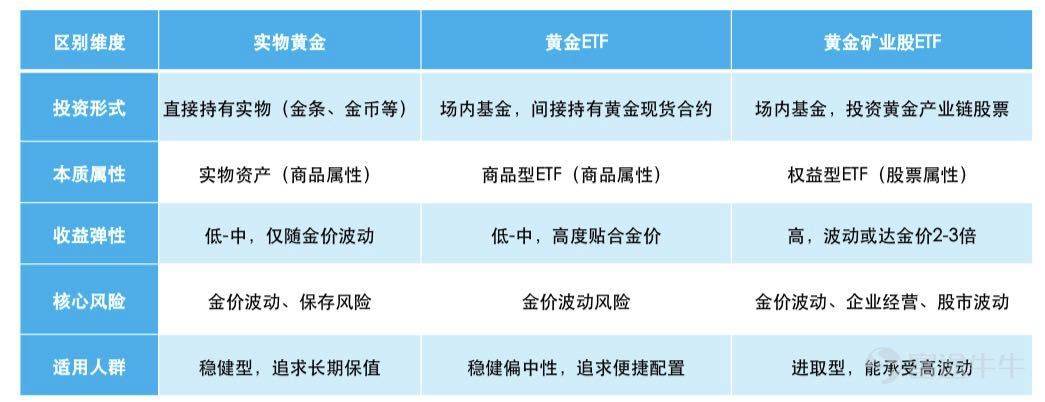
1. Investment Form: From 'Physical Holding' to 'Indirect Allocation'
The most intuitive difference among the three lies in the variations in investment forms and holding methods.
– Physical gold, which includes the well-known gold bars, gold coins, and gold jewelry, allows investors to directly hold gold itself, making it essentially a 'physical asset.' Its advantage is that it can be directly controlled, suitable for long-term value preservation. However, its disadvantages are obvious: it requires bearing storage and transportation costs, has cumbersome liquidation processes, high transaction fees, and cannot achieve small-scale flexible allocation.
– Gold ETFs are exchange-traded funds that track gold prices, essentially 'commodity-type ETFs.' They do not directly hold physical gold; instead, investors buy and sell through securities accounts, which is equivalent to 'indirectly holding gold.' Their core advantage is convenience and efficiency, low transaction costs, accessibility for small amounts of capital, no need to worry about storage issues, and their performance closely aligns with international gold prices.
– Gold mining stock ETFs are also exchange-traded funds but are fundamentally 'equity-type ETFs.' They do not invest in gold itself but rather in stocks of companies within the gold industry chain (primarily gold mining and smelting enterprises), tracking gold industry indices. Investors indirectly invest in gold-related companies in the stock market, rather than in gold itself.
2. Core Differences: Attributes, Returns, and Risks
The essential differences in their attributes determine variations in their sources of returns and levels of risk, which are critical factors in investment decision-making.
1. Essential Attributes: Physical gold and gold ETFs possess a 'commodity attribute,' with their core value determined by international gold prices, independent of corporate operations or stock market sentiment. In contrast, gold mining stock ETFs have a 'stock attribute,' with their value influenced by multiple factors such as the performance of invested companies, fluctuations in gold prices, and stock market conditions.
2. Sources of Returns: The returns from physical gold and gold ETFs come solely from price increases in gold, resulting in lower return elasticity and stable fluctuations. On the other hand, returns from gold mining stock ETFs stem not only from rising gold prices boosting company profits but also from the companies’ own growth and dividends, offering higher return elasticity. They act as 'amplifiers of gold volatility,' with potential gains or losses reaching 2-3 times that of gold price movements during periods of fluctuation.
3. Risk Levels: Physical gold and gold ETFs primarily face risks associated with fluctuations in gold prices. Gold mining stock ETFs carry relatively higher risks, including exposure to operational risks of companies and stock market volatility, leading to significantly higher volatility compared to the former two.
III. Influencing Factors: Different Focus Areas
For the three investment options, the market signals to focus on are entirely different; avoid blindly following trends.
For physical gold and gold ETFs, the key focus is on macro factors: international gold prices, US dollar movements (a stronger dollar usually leads to lower gold prices), inflation expectations, geopolitical conflicts, and global central bank gold-buying behavior – these factors directly determine gold price movements.
For gold mining stock ETFs, in addition to the above macro factors, it is also important to focus on micro-level aspects: production volume of gold mining companies, cost control, management capabilities, and overall market sentiment in the stock market.
IV. Suitable Investors: Match with Risk Tolerance
There is no optimal investment, only the most suitable choice. These three options cater to investors with different risk preferences:
- Physical Gold: Suitable for conservative investors seeking long-term value preservation, not concerned about the complexity of liquidation, used to diversify extreme market risks.
- Gold ETFs: Suitable for moderately conservative investors who want convenient allocation of gold while avoiding the hassle of holding physical assets, used for asset diversification and risk hedging.
- Gold Mining Stock ETFs: Suitable for aggressive investors who can tolerate high volatility, are optimistic about the gold market, and are willing to bet on corporate growth returns.
In summary: Physical gold emphasizes value preservation, gold ETFs emphasize convenience, and gold mining stock ETFs emphasize earnings elasticity. Investors need to clarify their investment objectives and risk tolerance to avoid confusing the three, thereby achieving rational allocation.

The information provided in this report, including any funds or products managed by E Fund Asset Management (Hong Kong) Co., Ltd., does not constitute an offer, solicitation, invitation, promotion, inducement, or any representation or recommendation of any kind to enter into any transaction.
Investment involves risks, including the loss of principal. Past performance is not indicative of future results and should not be considered as a guide to future performance or returns. Before deciding whether an investment is suitable, investors should review the sales documents of the relevant fund or product to obtain further details, including the features and risk factors associated with the fund or product.
This document does not constitute a forecast, research, or investment advice on future events, nor should it be regarded as a recommendation to buy or sell any securities or adopt any investment strategy. Any opinions contained in this document reflect the judgment of the company as of the date of publication and may be subject to change due to subsequent conditions.
The information and opinions contained in this document are derived from sources that E Fund Asset Management (Hong Kong) Co., Ltd. believes to be reliable. These analyses and information have not been independently verified, and no guarantee is given as to their accuracy. The data, opinions, and projections contained in this document reflect the judgment of the company as of the publication date and may be changed at any time without prior notice.
The plans or products mentioned in this report may not be authorized by the Securities and Futures Commission in Hong Kong or may not be available to the public in Hong Kong.
This report is intended for your reference only and must not be copied or distributed without the written consent of E Fund Asset Management (Hong Kong) Co., Ltd.
E Fund Asset Management (Hong Kong) Co., Ltd. has endeavored to ensure the accuracy and reliability of this report but assumes no responsibility for the accuracy, completeness, or effectiveness of any part of its content. In case of any errors or omissions, E Fund Asset Management (Hong Kong) Co., Ltd. shall not be liable. E Fund Asset Management (Hong Kong) Co., Ltd. has no obligation to update the information or correct any errors that may subsequently arise.
This report is not an advertisement. The information and content provided in this report have not been reviewed by any regulatory authority in Hong Kong or other jurisdictions.
© 2026 E Fund Asset Management (Hong Kong) Co., Ltd. All rights reserved.
Risk Disclaimer: The above content only represents the author's view. It does not represent any position or investment advice of Futu. Futu makes no representation or warranty.Read more

Comments (8)
to post a comment
14
23