
Waller's new policy measures are in the works! How should investors respond?

Options Trading in Action | A single nomination shook the market, causing silver to plummet over 17%! If Kevin Warsh takes the helm at the Fed, how might it reshape your wallet?
This article comes from the 'Options Market Insights' column, which aims to position itself at the forefront of investment trends, providing readers with insights into market opportunities and teaching them how to seize these opportunities using options. If you are interested, feel free to subscribe.Click hereUpon joining the learning platform, you will receive notifications when subsequent columns are updated.
*The following content is for investment education purposes only, does not represent any investment advice, and the information has timeliness. Data as of before the US stock market open on January 30; please exercise caution.*
As Trump announced he will reveal his nomination for the Federal Reserve Chair, the financial markets have entered a critical observation period.
![This article comes from the 'Options Market Insights' column, which aims to position itself at the forefront of investment trends, providing readers with insights into market opportunities and teaching them how to seize these opportunities using options. If you are interested, feel free to subscribe.[Share Link: Click here]Upon joining the learning platform, you will receive notifications when subsequent columns are updated. *The following content is for investment education purposes only, does not represent any investment advice, and the information has timeliness. Data as of before the US stock market open on January 30; please exercise caution.* As Trump announced he will reveal his nomination for the Federal Reserve Chair, the financial markets have entered a critical observation period. The latest data from Polymarket shows that the probability of Warsh being nominated by Trump as the new Federal Reserve Chair has surged to 93%, making him the overwhelming favorite. The root of market anxiety lies in the fact that this reformist leader’s policy approach will directly shape the monetary environment for the coming years, thereby reshaping the pricing logic of global assets, which naturally also impacts our wallets. 1. Who is Warsh? Warsh is not a traditional academic official but rather someone with a diverse background: he served as a Federal Reserve Governor (2006-2011), was deeply involved in addressing the financial crisis, and brings both Wall Street experience and political connections. The market considers him to possess professionalism, political influence, and sharp market intuition. He is also an external critic of the current system, representing disruptive change that could bring fundamental shifts. Moreover, he wouldn’t go to extremes…](https://nnqimage.futunn.com/sns_client_feed/999908/20260130/web-1769762913849-d8kmN3ySY5.png/big?area=2&is_public=true&imageMogr2/ignore-error/1/format/webp)
The latest data from Polymarket shows that the probability of Warsh being nominated by Trump as the new Federal Reserve Chair has surged to 93%, making him the overwhelming favorite.
![This article comes from the 'Options Market Insights' column, which aims to position itself at the forefront of investment trends, providing readers with insights into market opportunities and teaching them how to seize these opportunities using options. If you are interested, feel free to subscribe.[Share Link: Click here]Upon joining the learning platform, you will receive notifications when subsequent columns are updated. *The following content is for investment education purposes only, does not represent any investment advice, and the information has timeliness. Data as of before the US stock market open on January 30; please exercise caution.* As Trump announced he will reveal his nomination for the Federal Reserve Chair, the financial markets have entered a critical observation period. The latest data from Polymarket shows that the probability of Warsh being nominated by Trump as the new Federal Reserve Chair has surged to 93%, making him the overwhelming favorite. The root of market anxiety lies in the fact that this reformist leader’s policy approach will directly shape the monetary environment for the coming years, thereby reshaping the pricing logic of global assets, which naturally also impacts our wallets. 1. Who is Warsh? Warsh is not a traditional academic official but rather someone with a diverse background: he served as a Federal Reserve Governor (2006-2011), was deeply involved in addressing the financial crisis, and brings both Wall Street experience and political connections. The market considers him to possess professionalism, political influence, and sharp market intuition. He is also an external critic of the current system, representing disruptive change that could bring fundamental shifts. Moreover, he wouldn’t go to extremes…](https://nnqimage.futunn.com/sns_client_feed/999908/20260130/web-1769762911508-QOmRReN5pk.jpeg/big?area=2&is_public=true&imageMogr2/ignore-error/1/format/webp)
The root of market anxiety lies in the fact that this reformist leader’s policy approach will directly shape the monetary environment for the coming years, thereby reshaping the pricing logic of global assets, which naturally also impacts our wallets.
1. Who is Warsh?
Warsh is not a traditional academic official but rather someone with a diverse background: he served as a Federal Reserve Governor (2006-2011), was deeply involved in addressing the financial crisis, and brings both Wall Street experience and political connections. The market considers him to possess professionalism, political influence, and sharp market intuition.
He is also an external critic of the current system, representing disruptive change that could bring fundamental shifts. He is viewed as a balanced choice since he won't aggressively cut interest rates nor be overly conservative, while upholding the independence of the Federal Reserve.
He proposed a unique policy approach: creating room for interest rate cuts by accelerating balance sheet reduction. This may lead to an unconventional policy mix of simultaneous rate cuts and balance sheet contraction.
However, analyses from institutions like Deutsche Bank point out that the implementation of such policies requires coordination with banking regulatory reforms to reduce reserve requirements, making its short-term feasibility questionable.
Moreover, this leadership change at the Federal Reserve goes far beyond a routine personnel shift. It occurs against the backdrop of tensions between Trump and Powell, with the White House seeking greater policy influence. The Trump administration has shown intentions to intervene in Fed decisions through legal probes, fiscal policy pressure, public commentary, and appointments of loyal officials, potentially undermining the Fed's traditional independence. This political context will be a real constraint all candidates must face upon taking office.
And ultimately, whoever takes over, their core challenge will be finding a new balance between fighting inflation, supporting economic growth, and maintaining the Federal Reserve’s independence. The outcome of this balancing act will spill over globally, profoundly affecting the future direction of major asset classes.
![This article comes from the 'Options Market Insights' column, which aims to position itself at the forefront of investment trends, providing readers with insights into market opportunities and teaching them how to seize these opportunities using options. If you are interested, feel free to subscribe.[Share Link: Click here]Upon joining the learning platform, you will receive notifications when subsequent columns are updated. *The following content is for investment education purposes only, does not represent any investment advice, and the information has timeliness. Data as of before the US stock market open on January 30; please exercise caution.* As Trump announced he will reveal his nomination for the Federal Reserve Chair, the financial markets have entered a critical observation period. The latest data from Polymarket shows that the probability of Warsh being nominated by Trump as the new Federal Reserve Chair has surged to 93%, making him the overwhelming favorite. The root of market anxiety lies in the fact that this reformist leader’s policy approach will directly shape the monetary environment for the coming years, thereby reshaping the pricing logic of global assets, which naturally also impacts our wallets. 1. Who is Warsh? Warsh is not a traditional academic official but rather someone with a diverse background: he served as a Federal Reserve Governor (2006-2011), was deeply involved in addressing the financial crisis, and brings both Wall Street experience and political connections. The market considers him to possess professionalism, political influence, and sharp market intuition. He is also an external critic of the current system, representing disruptive change that could bring fundamental shifts. Moreover, he wouldn’t go to extremes…](https://nnqimage.futunn.com/sns_client_feed/999908/20260130/web-1769762915103-4sH5Vf9wE7.png/big?area=2&is_public=true&imageMogr2/ignore-error/1/format/webp)
2. What impact do Warsh's policy proposals have on various asset classes?
Warsh’s unique policy approach of 'simultaneous rate cuts and balance sheet reduction,' along with his market-labeled 'hawkish' stance, is triggering a significant reevaluation of global assets.
The market performance during the Asian session today (January 30) has preliminarily confirmed this impact.Market reactions indicate that investors are preparing for a potentially more cautious and less dovish Fed.
1) The US dollar received support.The 'tightening easing' policy (cutting interest rates while accelerating balance sheet reduction) that Wash might implement could support the US dollar in the medium to long term. This is because accelerating balance sheet reduction means withdrawing dollar liquidity from the financial system, which has a different effect from simply cutting interest rates. During today's Asian session, the US Dollar Index strengthened rapidly. $USD (USDindex.FX)$
![This article comes from the 'Options Market Insights' column, which aims to position itself at the forefront of investment trends, providing readers with insights into market opportunities and teaching them how to seize these opportunities using options. If you are interested, feel free to subscribe.[Share Link: Click here]Upon joining the learning platform, you will receive notifications when subsequent columns are updated. *The following content is for investment education purposes only, does not represent any investment advice, and the information has timeliness. Data as of before the US stock market open on January 30; please exercise caution.* As Trump announced he will reveal his nomination for the Federal Reserve Chair, the financial markets have entered a critical observation period. The latest data from Polymarket shows that the probability of Warsh being nominated by Trump as the new Federal Reserve Chair has surged to 93%, making him the overwhelming favorite. The root of market anxiety lies in the fact that this reformist leader’s policy approach will directly shape the monetary environment for the coming years, thereby reshaping the pricing logic of global assets, which naturally also impacts our wallets. 1. Who is Warsh? Warsh is not a traditional academic official but rather someone with a diverse background: he served as a Federal Reserve Governor (2006-2011), was deeply involved in addressing the financial crisis, and brings both Wall Street experience and political connections. The market considers him to possess professionalism, political influence, and sharp market intuition. He is also an external critic of the current system, representing disruptive change that could bring fundamental shifts. Moreover, he wouldn’t go to extremes…](https://nnqimage.futunn.com/sns_client_feed/999908/20260130/web-1769762911340-w3l4JnOm3C.png/big?area=2&is_public=true&imageMogr2/ignore-error/1/format/webp)
2) The yield curve in the bond market faces upward pressure.The market’s biggest concern is that if Wash aggressively reduces the balance sheet, it would weaken the implicit support of the Federal Reserve as the ultimate buyer in the Treasury bond market. Long-term bonds, due to their longer durations, are most sensitive to this kind of liquidity contraction, potentially causing upward pressure on long-end Treasury yields to compensate for inflation risks and reduced liquidity premiums. $U.S. 30-Year Treasury Bonds Yield (US30Y.BD)$$U.S. 10-Year Treasury Notes Yield (US10Y.BD)$
Following the rise in nomination expectations, the 30-year and 10-year US Treasury yields increased rapidly, while short-term yields saw little change, causing the spread between long and short-term rates to widen quickly.
![This article comes from the 'Options Market Insights' column, which aims to position itself at the forefront of investment trends, providing readers with insights into market opportunities and teaching them how to seize these opportunities using options. If you are interested, feel free to subscribe.[Share Link: Click here]Upon joining the learning platform, you will receive notifications when subsequent columns are updated. *The following content is for investment education purposes only, does not represent any investment advice, and the information has timeliness. Data as of before the US stock market open on January 30; please exercise caution.* As Trump announced he will reveal his nomination for the Federal Reserve Chair, the financial markets have entered a critical observation period. The latest data from Polymarket shows that the probability of Warsh being nominated by Trump as the new Federal Reserve Chair has surged to 93%, making him the overwhelming favorite. The root of market anxiety lies in the fact that this reformist leader’s policy approach will directly shape the monetary environment for the coming years, thereby reshaping the pricing logic of global assets, which naturally also impacts our wallets. 1. Who is Warsh? Warsh is not a traditional academic official but rather someone with a diverse background: he served as a Federal Reserve Governor (2006-2011), was deeply involved in addressing the financial crisis, and brings both Wall Street experience and political connections. The market considers him to possess professionalism, political influence, and sharp market intuition. He is also an external critic of the current system, representing disruptive change that could bring fundamental shifts. Moreover, he wouldn’t go to extremes…](https://nnqimage.futunn.com/sns_client_feed/999908/20260130/web-1769762911032-62NZvVnIbT.png/big?area=2&is_public=true&imageMogr2/ignore-error/1/format/webp)
3) Precious metals faced significant immediate selling pressure.Non-interest-bearing assets like gold and silver are extremely sensitive to real interest rates and the movement of the US dollar. Wash’s hawkish reputation and potential tightening liquidity policies have pushed Treasury yields higher and strengthened the dollar, directly pressuring precious metal prices. Additionally, easing concerns about the Federal Reserve’s independence have also weakened gold's safe-haven demand. Spot gold prices plunged over 4% intraday, with silver suffering even greater declines. $XAU/USD (XAUUSD.CFD)$$XAG/USD (XAGUSD.FX)$$SPDR Gold ETF (GLD.US)$$iShares Silver Trust (SLV.US)$
However, despite the sharp sell-off triggered by the Fed chair nomination in the short term, the long-term core logic supporting gold remains unshaken. This sharp decline mainly reflects the market’s instant pricing of candidate Warsh's 'hawkish' reputation and potential tightening liquidity policy bias. However, multiple institutions and market analysis viewpoints suggest that this is more likely a violent technical correction within a bull market rather than a reversal of trend.
![This article comes from the 'Options Market Insights' column, which aims to position itself at the forefront of investment trends, providing readers with insights into market opportunities and teaching them how to seize these opportunities using options. If you are interested, feel free to subscribe.[Share Link: Click here]Upon joining the learning platform, you will receive notifications when subsequent columns are updated. *The following content is for investment education purposes only, does not represent any investment advice, and the information has timeliness. Data as of before the US stock market open on January 30; please exercise caution.* As Trump announced he will reveal his nomination for the Federal Reserve Chair, the financial markets have entered a critical observation period. The latest data from Polymarket shows that the probability of Warsh being nominated by Trump as the new Federal Reserve Chair has surged to 93%, making him the overwhelming favorite. The root of market anxiety lies in the fact that this reformist leader’s policy approach will directly shape the monetary environment for the coming years, thereby reshaping the pricing logic of global assets, which naturally also impacts our wallets. 1. Who is Warsh? Warsh is not a traditional academic official but rather someone with a diverse background: he served as a Federal Reserve Governor (2006-2011), was deeply involved in addressing the financial crisis, and brings both Wall Street experience and political connections. The market considers him to possess professionalism, political influence, and sharp market intuition. He is also an external critic of the current system, representing disruptive change that could bring fundamental shifts. Moreover, he wouldn’t go to extremes…](https://nnqimage.futunn.com/sns_client_feed/999908/20260130/web-1769762911094-2x0Cq4v2fb.png/big?area=2&is_public=true&imageMogr2/ignore-error/1/format/webp)
![This article comes from the 'Options Market Insights' column, which aims to position itself at the forefront of investment trends, providing readers with insights into market opportunities and teaching them how to seize these opportunities using options. If you are interested, feel free to subscribe.[Share Link: Click here]Upon joining the learning platform, you will receive notifications when subsequent columns are updated. *The following content is for investment education purposes only, does not represent any investment advice, and the information has timeliness. Data as of before the US stock market open on January 30; please exercise caution.* As Trump announced he will reveal his nomination for the Federal Reserve Chair, the financial markets have entered a critical observation period. The latest data from Polymarket shows that the probability of Warsh being nominated by Trump as the new Federal Reserve Chair has surged to 93%, making him the overwhelming favorite. The root of market anxiety lies in the fact that this reformist leader’s policy approach will directly shape the monetary environment for the coming years, thereby reshaping the pricing logic of global assets, which naturally also impacts our wallets. 1. Who is Warsh? Warsh is not a traditional academic official but rather someone with a diverse background: he served as a Federal Reserve Governor (2006-2011), was deeply involved in addressing the financial crisis, and brings both Wall Street experience and political connections. The market considers him to possess professionalism, political influence, and sharp market intuition. He is also an external critic of the current system, representing disruptive change that could bring fundamental shifts. Moreover, he wouldn’t go to extremes…](https://nnqimage.futunn.com/sns_client_feed/999908/20260130/web-1769762911215-byFfaXmj88.png/big?area=2&is_public=true&imageMogr2/ignore-error/1/format/webp)
4) Global stock markets face a complex, mixed outlook of optimism and pessimism.The US stock market faces short-term volatility; expectations of interest rate cuts support growth stocks and valuations, but the expectation of accelerated balance sheet reduction leading to tighter liquidity will create downward pressure. At the same time, uncertainty regarding policy direction could increase market volatility. From the trading data, major US index futures have pulled back under the influence of recent news.
Hong Kong stocks may face dual pressures. On one hand, a strong US dollar typically pressures emerging market assets; on the other hand, a shift in global liquidity expectations may also impact foreign capital risk appetite. Today, both the Hang Seng Index and the Hang Seng Tech Index fell significantly. $E-mini NASDAQ 100 Futures (SEP6) (NQmain.US)$$E-mini Dow Futures (SEP6) (YMmain.US)$$E-mini S&P 500 Futures (SEP6) (ESmain.US)$$Dow Jones Industrial Average (.DJI.US)$$Nasdaq Composite Index (.IXIC.US)$$S&P 500 Index (.SPX.US)$$Hang Seng Index (800000.HK)$$Hang Seng TECH Index (800700.HK)$
![This article comes from the 'Options Market Insights' column, which aims to position itself at the forefront of investment trends, providing readers with insights into market opportunities and teaching them how to seize these opportunities using options. If you are interested, feel free to subscribe.[Share Link: Click here]Upon joining the learning platform, you will receive notifications when subsequent columns are updated. *The following content is for investment education purposes only, does not represent any investment advice, and the information has timeliness. Data as of before the US stock market open on January 30; please exercise caution.* As Trump announced he will reveal his nomination for the Federal Reserve Chair, the financial markets have entered a critical observation period. The latest data from Polymarket shows that the probability of Warsh being nominated by Trump as the new Federal Reserve Chair has surged to 93%, making him the overwhelming favorite. The root of market anxiety lies in the fact that this reformist leader’s policy approach will directly shape the monetary environment for the coming years, thereby reshaping the pricing logic of global assets, which naturally also impacts our wallets. 1. Who is Warsh? Warsh is not a traditional academic official but rather someone with a diverse background: he served as a Federal Reserve Governor (2006-2011), was deeply involved in addressing the financial crisis, and brings both Wall Street experience and political connections. The market considers him to possess professionalism, political influence, and sharp market intuition. He is also an external critic of the current system, representing disruptive change that could bring fundamental shifts. Moreover, he wouldn’t go to extremes…](https://nnqimage.futunn.com/sns_client_feed/999908/20260130/web-1769762911031-3c2nXOgQ66.png/big?area=2&is_public=true&imageMogr2/ignore-error/1/format/webp)
![This article comes from the 'Options Market Insights' column, which aims to position itself at the forefront of investment trends, providing readers with insights into market opportunities and teaching them how to seize these opportunities using options. If you are interested, feel free to subscribe.[Share Link: Click here]Upon joining the learning platform, you will receive notifications when subsequent columns are updated. *The following content is for investment education purposes only, does not represent any investment advice, and the information has timeliness. Data as of before the US stock market open on January 30; please exercise caution.* As Trump announced he will reveal his nomination for the Federal Reserve Chair, the financial markets have entered a critical observation period. The latest data from Polymarket shows that the probability of Warsh being nominated by Trump as the new Federal Reserve Chair has surged to 93%, making him the overwhelming favorite. The root of market anxiety lies in the fact that this reformist leader’s policy approach will directly shape the monetary environment for the coming years, thereby reshaping the pricing logic of global assets, which naturally also impacts our wallets. 1. Who is Warsh? Warsh is not a traditional academic official but rather someone with a diverse background: he served as a Federal Reserve Governor (2006-2011), was deeply involved in addressing the financial crisis, and brings both Wall Street experience and political connections. The market considers him to possess professionalism, political influence, and sharp market intuition. He is also an external critic of the current system, representing disruptive change that could bring fundamental shifts. Moreover, he wouldn’t go to extremes…](https://nnqimage.futunn.com/sns_client_feed/999908/20260130/web-1769762912646-LoCWNv1VUP.png/big?area=2&is_public=true&imageMogr2/ignore-error/1/format/webp)
![This article comes from the 'Options Market Insights' column, which aims to position itself at the forefront of investment trends, providing readers with insights into market opportunities and teaching them how to seize these opportunities using options. If you are interested, feel free to subscribe.[Share Link: Click here]Upon joining the learning platform, you will receive notifications when subsequent columns are updated. *The following content is for investment education purposes only, does not represent any investment advice, and the information has timeliness. Data as of before the US stock market open on January 30; please exercise caution.* As Trump announced he will reveal his nomination for the Federal Reserve Chair, the financial markets have entered a critical observation period. The latest data from Polymarket shows that the probability of Warsh being nominated by Trump as the new Federal Reserve Chair has surged to 93%, making him the overwhelming favorite. The root of market anxiety lies in the fact that this reformist leader’s policy approach will directly shape the monetary environment for the coming years, thereby reshaping the pricing logic of global assets, which naturally also impacts our wallets. 1. Who is Warsh? Warsh is not a traditional academic official but rather someone with a diverse background: he served as a Federal Reserve Governor (2006-2011), was deeply involved in addressing the financial crisis, and brings both Wall Street experience and political connections. The market considers him to possess professionalism, political influence, and sharp market intuition. He is also an external critic of the current system, representing disruptive change that could bring fundamental shifts. Moreover, he wouldn’t go to extremes…](https://nnqimage.futunn.com/sns_client_feed/999908/20260130/web-1769762911245-W4cwG9rH6r.png/big?area=2&is_public=true&imageMogr2/ignore-error/1/format/webp)
5) Cryptocurrencies plunged amid a reversal in liquidity expectations.In recent years, some investors have viewed crypto assets as a hedge against excessive global liquidity. Wash's advocacy for reducing the Federal Reserve’s balance sheet leads to market expectations of marginally tighter global dollar liquidity, which poses a negative impact on cryptocurrencies. Bitcoin prices continued to fall today, briefly touching near $82,300, marking a significant pullback from its all-time high. $Bitcoin (BTC.CC)$$Ethereum (ETH.CC)$
![This article comes from the 'Options Market Insights' column, which aims to position itself at the forefront of investment trends, providing readers with insights into market opportunities and teaching them how to seize these opportunities using options. If you are interested, feel free to subscribe.[Share Link: Click here]Upon joining the learning platform, you will receive notifications when subsequent columns are updated. *The following content is for investment education purposes only, does not represent any investment advice, and the information has timeliness. Data as of before the US stock market open on January 30; please exercise caution.* As Trump announced he will reveal his nomination for the Federal Reserve Chair, the financial markets have entered a critical observation period. The latest data from Polymarket shows that the probability of Warsh being nominated by Trump as the new Federal Reserve Chair has surged to 93%, making him the overwhelming favorite. The root of market anxiety lies in the fact that this reformist leader’s policy approach will directly shape the monetary environment for the coming years, thereby reshaping the pricing logic of global assets, which naturally also impacts our wallets. 1. Who is Warsh? Warsh is not a traditional academic official but rather someone with a diverse background: he served as a Federal Reserve Governor (2006-2011), was deeply involved in addressing the financial crisis, and brings both Wall Street experience and political connections. The market considers him to possess professionalism, political influence, and sharp market intuition. He is also an external critic of the current system, representing disruptive change that could bring fundamental shifts. Moreover, he wouldn’t go to extremes…](https://nnqimage.futunn.com/sns_client_feed/999908/20260130/web-1769762911581-ikQBBe2JOA.png/big?area=2&is_public=true&imageMogr2/ignore-error/1/format/webp)
3. Market Outlook: Short-term volatility, long-term potential repricing
As the nomination approaches, the market has already engaged in intense expectation trading over Warsh’s potential policy path.Looking ahead, the market focus will shift from 'guessing who' to 'evaluating the specific details, feasibility, and political resistance of his policies,' with volatility transitioning from event-driven to policy-driven.
1) Short-term:Volatility is expected to remain high. When the nomination news is officially announced, there could be a 'buy the rumor, sell the fact' scenario, where the market corrects its overreaction after the news materializes.
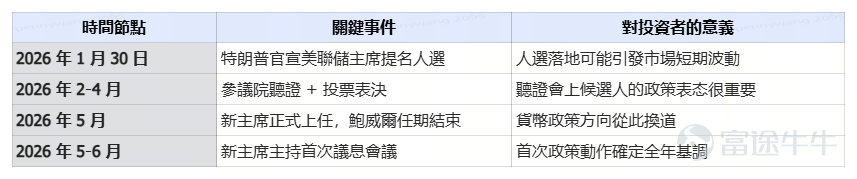
The key point to watch is Wash's nomination hearing, where his specific elaboration on 'balance sheet reduction in exchange for rate cuts' will determine the market's next direction. The contradiction between his historical hawkish reputation and recent dovish public remarks could also become a source of market divergence and volatility.
2) Medium-term (policy implementation phase after taking office):The real test lies in whether Wash can translate his policy stance into collective decision-making at the Fed. His combination of 'balance sheet reduction in exchange for rate cuts' faces technical complexities and potential internal divisions within the Fed. The market will closely monitor whether he can unite the committee and whether his policies might lead to fractures within the Fed’s decision-making layer.
During this phase, the market's core task is to reassess equilibrium interest rates and risk premiums. If Wash demonstrates stronger-than-expected policy momentum, the US dollar and long-term Treasury yields may receive sustained support; conversely, if his proposals encounter obstacles in practice, the market may reprice, potentially benefiting risk assets.
3) Long-term:Wash's nomination marks a more critical trend—a possible reshaping of the US monetary policy framework, with the core being the balance between the Fed's independence and political pressures. Regardless of the final path, a more uncertain policy environment may prompt investors to demand higher risk compensation, fundamentally impacting valuation models for all assets.
![This article comes from the 'Options Market Insights' column, which aims to position itself at the forefront of investment trends, providing readers with insights into market opportunities and teaching them how to seize these opportunities using options. If you are interested, feel free to subscribe.[Share Link: Click here]Upon joining the learning platform, you will receive notifications when subsequent columns are updated. *The following content is for investment education purposes only, does not represent any investment advice, and the information has timeliness. Data as of before the US stock market open on January 30; please exercise caution.* As Trump announced he will reveal his nomination for the Federal Reserve Chair, the financial markets have entered a critical observation period. The latest data from Polymarket shows that the probability of Warsh being nominated by Trump as the new Federal Reserve Chair has surged to 93%, making him the overwhelming favorite. The root of market anxiety lies in the fact that this reformist leader’s policy approach will directly shape the monetary environment for the coming years, thereby reshaping the pricing logic of global assets, which naturally also impacts our wallets. 1. Who is Warsh? Warsh is not a traditional academic official but rather someone with a diverse background: he served as a Federal Reserve Governor (2006-2011), was deeply involved in addressing the financial crisis, and brings both Wall Street experience and political connections. The market considers him to possess professionalism, political influence, and sharp market intuition. He is also an external critic of the current system, representing disruptive change that could bring fundamental shifts. Moreover, he wouldn’t go to extremes…](https://nnqimage.futunn.com/sns_client_feed/999908/20260130/web-1769762913206-jBiqDNncHM.png/big?area=2&is_public=true&imageMogr2/ignore-error/1/format/webp)
4. Options strategy: Managing uncertainty rather than simply betting on direction
In the current environment of high volatility and unclear policy paths, options are an excellent tool for managing risks and building flexible strategies. At this time,it may be advisable to avoid making one-sided trend bets and instead shift toward strategies aimed at profiting from volatility or hedging tail risks.Below are three examples of options strategies.
1) Risk hedging for assets directly affected by policy changes
● Hedging against downside risk in US stocks:Investors holding risky assets such as tech stocks can buy out-of-the-money Put options on the index as insurance. To reduce costs, a Bear Put Spread strategy (buying a Put option with a higher strike price while selling another Put option with a lower strike price) can be used to lower the hedging cost.
![This article comes from the 'Options Market Insights' column, which aims to position itself at the forefront of investment trends, providing readers with insights into market opportunities and teaching them how to seize these opportunities using options. If you are interested, feel free to subscribe.[Share Link: Click here]Upon joining the learning platform, you will receive notifications when subsequent columns are updated. *The following content is for investment education purposes only, does not represent any investment advice, and the information has timeliness. Data as of before the US stock market open on January 30; please exercise caution.* As Trump announced he will reveal his nomination for the Federal Reserve Chair, the financial markets have entered a critical observation period. The latest data from Polymarket shows that the probability of Warsh being nominated by Trump as the new Federal Reserve Chair has surged to 93%, making him the overwhelming favorite. The root of market anxiety lies in the fact that this reformist leader’s policy approach will directly shape the monetary environment for the coming years, thereby reshaping the pricing logic of global assets, which naturally also impacts our wallets. 1. Who is Warsh? Warsh is not a traditional academic official but rather someone with a diverse background: he served as a Federal Reserve Governor (2006-2011), was deeply involved in addressing the financial crisis, and brings both Wall Street experience and political connections. The market considers him to possess professionalism, political influence, and sharp market intuition. He is also an external critic of the current system, representing disruptive change that could bring fundamental shifts. Moreover, he wouldn’t go to extremes…](https://nnqimage.futunn.com/sns_client_feed/999908/20260130/web-1769762915947-EjBRHVaqP7.jpeg/big?area=2&is_public=true&imageMogr2/ignore-error/1/format/webp)
● Hedging against rising US bond interest rates:If you're concerned that Volcker-style quantitative tightening could push long-term interest rates up more than expected (causing bond prices in your portfolio to fall), consider buying $iShares 20+ Year Treasury Bond ETF (TLT.US)$ (20+ Year Treasury Bond ETF) Put options.
● Hedging cryptocurrency volatility:The crypto market is extremely sensitive to liquidity expectations. If holding related assets, potential liquidity tightening risks can also be hedged by purchasing $Bitcoin (BTC.CC)$ Put options on relevant ETFs or stocks.
2) Long Straddle or Long Strangle strategies for major indices (e.g., SPY/QQQ)
● Strategy Logic:The short-term market direction is highly uncertain. Unexpected comments during nomination hearings or changes in policy expectations triggered by subsequent economic data could lead to sharp one-sided market fluctuations. This strategy does not predict rises or falls but instead bets on an increase in volatility.
● Specific Operations:Simultaneously buy a call option and a put option with the same (Long Straddle) or similar strike prices (Long Strangle), ensuring both have the same expiration date.
● Applicable Scenarios:Position before major events such as hearings or Federal Reserve meetings. As long as the underlying asset experiences a sufficiently large one-sided move (whether up or down) before expiration, profits will cover the cost of both options and generate gains.
![This article comes from the 'Options Market Insights' column, which aims to position itself at the forefront of investment trends, providing readers with insights into market opportunities and teaching them how to seize these opportunities using options. If you are interested, feel free to subscribe.[Share Link: Click here]Upon joining the learning platform, you will receive notifications when subsequent columns are updated. *The following content is for investment education purposes only, does not represent any investment advice, and the information has timeliness. Data as of before the US stock market open on January 30; please exercise caution.* As Trump announced he will reveal his nomination for the Federal Reserve Chair, the financial markets have entered a critical observation period. The latest data from Polymarket shows that the probability of Warsh being nominated by Trump as the new Federal Reserve Chair has surged to 93%, making him the overwhelming favorite. The root of market anxiety lies in the fact that this reformist leader’s policy approach will directly shape the monetary environment for the coming years, thereby reshaping the pricing logic of global assets, which naturally also impacts our wallets. 1. Who is Warsh? Warsh is not a traditional academic official but rather someone with a diverse background: he served as a Federal Reserve Governor (2006-2011), was deeply involved in addressing the financial crisis, and brings both Wall Street experience and political connections. The market considers him to possess professionalism, political influence, and sharp market intuition. He is also an external critic of the current system, representing disruptive change that could bring fundamental shifts. Moreover, he wouldn’t go to extremes…](https://nnqimage.futunn.com/sns_client_feed/999908/20260130/web-1769762914089-tpwtrnGCxN.jpeg/big?area=2&is_public=true&imageMogr2/ignore-error/1/format/webp)
Another approach is to go long $CBOE Volatility S&P 500 Index (.VIX.US)$ , either by purchasing related call options or adopting a Bull Call Spread strategy to reduce the cost of betting on upward movements.
![This article comes from the 'Options Market Insights' column, which aims to position itself at the forefront of investment trends, providing readers with insights into market opportunities and teaching them how to seize these opportunities using options. If you are interested, feel free to subscribe.[Share Link: Click here]Upon joining the learning platform, you will receive notifications when subsequent columns are updated. *The following content is for investment education purposes only, does not represent any investment advice, and the information has timeliness. Data as of before the US stock market open on January 30; please exercise caution.* As Trump announced he will reveal his nomination for the Federal Reserve Chair, the financial markets have entered a critical observation period. The latest data from Polymarket shows that the probability of Warsh being nominated by Trump as the new Federal Reserve Chair has surged to 93%, making him the overwhelming favorite. The root of market anxiety lies in the fact that this reformist leader’s policy approach will directly shape the monetary environment for the coming years, thereby reshaping the pricing logic of global assets, which naturally also impacts our wallets. 1. Who is Warsh? Warsh is not a traditional academic official but rather someone with a diverse background: he served as a Federal Reserve Governor (2006-2011), was deeply involved in addressing the financial crisis, and brings both Wall Street experience and political connections. The market considers him to possess professionalism, political influence, and sharp market intuition. He is also an external critic of the current system, representing disruptive change that could bring fundamental shifts. Moreover, he wouldn’t go to extremes…](https://nnqimage.futunn.com/sns_client_feed/999908/20260130/web-1769762914661-g45aLBX6X0.jpeg/big?area=2&is_public=true&imageMogr2/ignore-error/1/format/webp)
3) Directional spread strategies targeting specific policy paths
If investors have a clear judgment about policy outcomes, this strategy can be used to express their views at a lower cost.
If anticipating that hawkish tightening will dominate (strong US dollar, rising interest rates), consider bullish options on the US Dollar Index or bearish options on bond prices (i.e., betting on rising yields). If expecting rate cut expectations to dominate (favoring growth stocks), construct bullish spread options on broader market indices to capture rebounds while controlling costs.
During the current period of policy uncertainty, the primary goal of options strategies is to control downside risks and leverage volatility rather than pursue high-leverage returns.Investors should choose appropriate hedging or volatility trading tools based on their own positions and risk tolerance to prepare for various potential policy scenarios.
If you want more inspiration regarding options strategies, you can easily get it on the mobile app or the new desktop version by following these steps!
![This article comes from the 'Options Market Insights' column, which aims to position itself at the forefront of investment trends, providing readers with insights into market opportunities and teaching them how to seize these opportunities using options. If you are interested, feel free to subscribe.[Share Link: Click here]Upon joining the learning platform, you will receive notifications when subsequent columns are updated. *The following content is for investment education purposes only, does not represent any investment advice, and the information has timeliness. Data as of before the US stock market open on January 30; please exercise caution.* As Trump announced he will reveal his nomination for the Federal Reserve Chair, the financial markets have entered a critical observation period. The latest data from Polymarket shows that the probability of Warsh being nominated by Trump as the new Federal Reserve Chair has surged to 93%, making him the overwhelming favorite. The root of market anxiety lies in the fact that this reformist leader’s policy approach will directly shape the monetary environment for the coming years, thereby reshaping the pricing logic of global assets, which naturally also impacts our wallets. 1. Who is Warsh? Warsh is not a traditional academic official but rather someone with a diverse background: he served as a Federal Reserve Governor (2006-2011), was deeply involved in addressing the financial crisis, and brings both Wall Street experience and political connections. The market considers him to possess professionalism, political influence, and sharp market intuition. He is also an external critic of the current system, representing disruptive change that could bring fundamental shifts. Moreover, he wouldn’t go to extremes…](https://nnqimage.futunn.com/sns_client_feed/999908/20260130/web-1769762912797-GICHqvuE09.webp/big?area=2&is_public=true&imageMogr2/ignore-error/1/format/webp)
Alright, that's it for today. Welcome.Click hereJoin the learning group, and you will receive notifications when new updates to the column are published. We also strongly welcome any specific content suggestions!
Finally, here’s a small perk for fellow investors. Welcome to claim it!Options Beginner's Package(*This event is exclusively for HK invited users. Click to learn more.Detailed event rules>>)
Risk Disclaimer: The above content only represents the author's view. It does not represent any position or investment advice of Futu. Futu makes no representation or warranty.Read more


Comments (4)
to post a comment
90
101