How to view the post-holiday market trend in Hong Kong stocks?

Hang Seng Index Challenges 28,000 Points: Who is Supporting the New High? These Four AI Themes in Hong Kong Stocks are Worth Collecting!
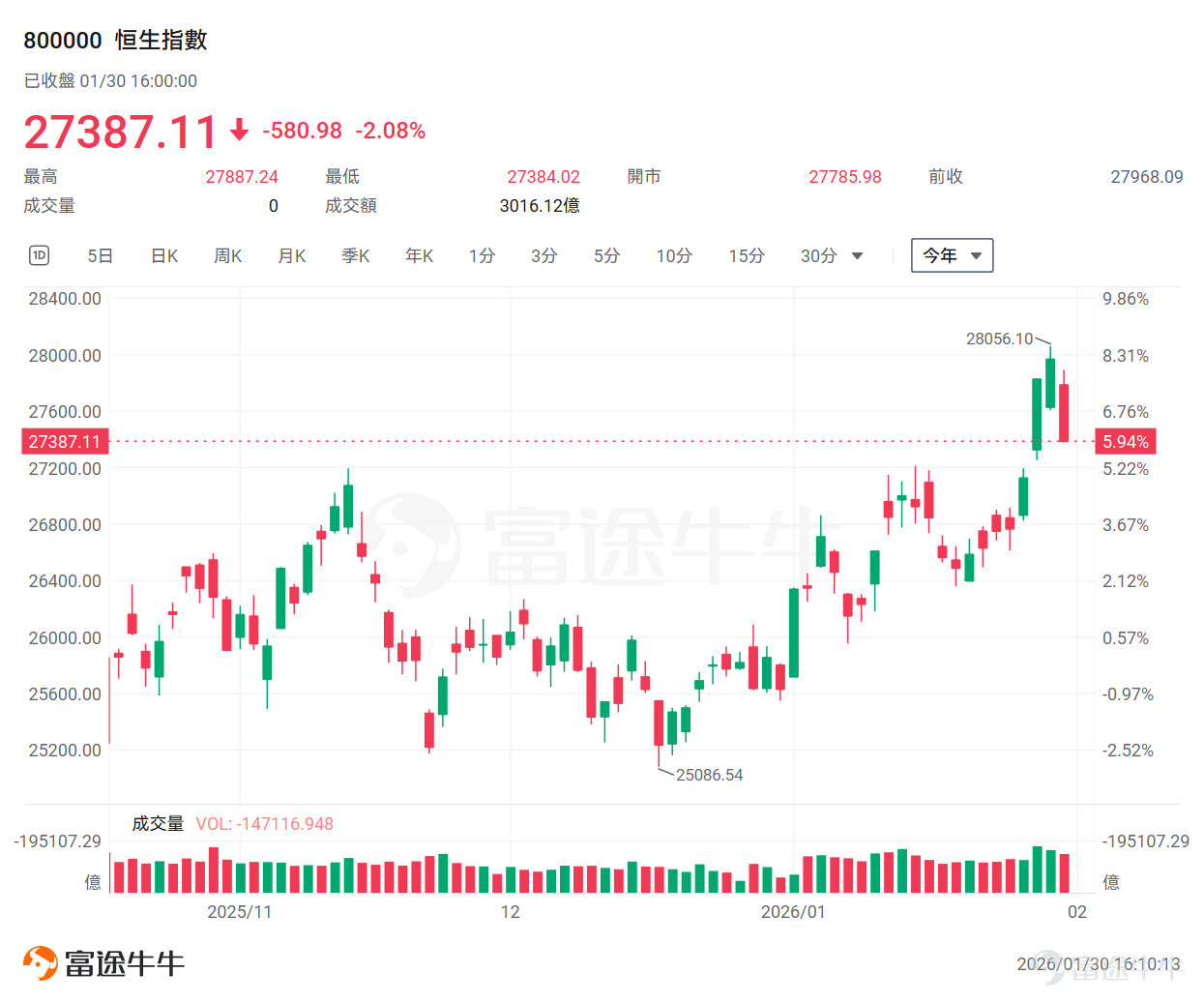
Since the start of this year, $Hang Seng Index (800000.HK)$ it has surged strongly, even breaking through 28,000 points yesterday, reaching a new high not seen in nearly four and a half years since July 2021.

--
--
--
Many investors may have this question: Why has the Hang Seng Index outperformed the Hang Seng Tech Index in the AI era? Which companies have contributed the most to this phase of new highs in Hong Kong stocks? And with more AI companies planning to IPO in Hong Kong, what kind of new landscape will the Hong Kong stock market face?
Which companies have supported the Hang Seng Index's phase of new highs?
Looking at the performance of Hong Kong stocks this year, the Hang Seng Index has risen by nearly 7%, while the Hang Seng Tech Index has only gained about 3%. In fact,the strong performance of the Hang Seng Index can be attributed to its diversified and balanced industry distribution:Of which, the financial sector accounts for approximately 33.6%, discretionary consumption about 21.8%, and information technology about 17.2%. Compared to the Hang Seng Tech Index, the Hang Seng Index's "three-pillar" weighting structure better reflects the overall picture of the Hong Kong stock market. In other words, the movement of the Hang Seng Index serves as a "barometer" of the macroeconomic environment, where its fluctuations depend on the overall recovery of economic fundamentals rather than the short-term boom of a single industry.
Reviewing the year-to-date gains of the Hang Seng Index,the market has demonstrated a significant 'multi-faceted' trend: Traditional sectors have regained vitality, $SHK PPT (00016.HK)$ and $CHINA LIFE (02628.HK)$ with increases of over 30% and 29%, respectively; technology and new consumer sectors advanced in tandem, $KUAISHOU-W (01024.HK)$ 、 $BABA-W (09988.HK)$ 、 $BIDU-W (09888.HK)$ with gains ranging from 18% to 29%, $POP MART (09992.HK)$ also surging more than 23%; at the same time, resource-based cyclical stocks performed notably, $ZIJIN MINING (02899.HK)$ 、 $CHINAHONGQIAO (01378.HK)$ 、 $CNOOC (00883.HK)$ all showing double-digit growth, while leading innovative drug companies $WUXI APPTEC (02359.HK)$ rebounded by over 17%.This fully confirms that capital is not concentrated in a single track but has implemented comprehensive positioning.

--
--
--
What new dynamics will the Hong Kong stock market welcome?
Against the backdrop of escalating Sino-US tech rivalry, the Hong Kong stock market is playing the role of a "buffer zone," becoming a key node connecting Chinese AI companies with global capital.
Entering 2026, the gong at the Hong Kong Stock Exchange has been frequently rung by Chinese artificial intelligence (AI) companies: on the hardware side, GPU leaders Biren Technology and TianShu Intelligence have successively listed, filling a void in core computing power assets in the Hong Kong market; on the software side, large model newcomers Zhipu and MiniMax have made a strong debut.
According to the Securities Times, the rush of AI companies going public is expected to drive the Hong Kong stock market towards becoming a "high ground for hard tech financing." Currently, there are already more than 40 Hong Kong-listed companies with strong ties to artificial intelligence, which can be grouped into four "AI fronts," includingAI computing power industry chain、AI software end, including large AI models、AI hardware end, including smartphones, automobiles, and robots、Internet giants。
Based on this, Niuniu Side has compiled a list of relevant concept stocks for investors' reference:

--
--
--
Specifically:
The first "front" is the AI computing power industry chain.At the beginning of the year, $BIREN TECH (06082.HK)$、 $ILUVATAR COREX (09903.HK)$successively listed on the Hong Kong Stock Exchange, filling the gap in core computing power in the Hong Kong market. Among them, Biren Technology focuses on high-end general-purpose GPUs and large-scale data center computing platforms, becoming a significant representative of domestic general-purpose GPUs in the 'cloud large computing power' direction. TianShu ZhiXin is the first company in China to achieve mass production of general-purpose GPUs.
Additionally,The leader in A-share storage chips, $GIGADEVICE (03986.HK)$going public in Hong Kong also caught up with this wave of enthusiasm, this company is a semiconductor enterprise focusing on chip design business, with products covering Flash, niche DRAM, MCU, analog chips, and sensor chips, applied in multiple terminal fields such as consumer electronics and industrial control.
In addition to these enterprises, there are also companies like $SMIC (00981.HK)$ the leading integrated circuit wafer foundry in the Hong Kong stock market. Additionally, Huahong Semiconductor and companies in the optical communication industry $CIG (06166.HK)$ 、 $YOFC (06869.HK)$ 、 $TIME INTERCON (01729.HK)$ 、 $FIT HON TENG (06088.HK)$ have all benefited from this wave of AI.
Among them, Changfei Fiber Optic Cables has surged more than 60% year-to-date. This company is a global leader in fiber optic preforms, fibers, cables, and integrated solutions providers. With rapid growth in data communication business and breakthroughs in hollow-core fiber technology, Changfei Fiber Optic Cables’ profitability is gradually recovering. Hollow-core fiber uses air as the transmission medium, providing two main advantages: lower latency and reduced loss, making it a key product for future AI data center interconnection. The company’s optical interconnect component businesses, such as MPO, AOC, and high-speed copper cables, developed through its subsidiary Changxin Bochuang, have benefited from the construction of North American AI data centers, and overseas business expansion is proceeding smoothly.
In addition, the Hong Kong stock market also includes $HORIZONROBOT-W (09660.HK)$ 、 $BLACK SESAME (02533.HK)$ 、 $OMNIVISION (00501.HK)$ and similar automotive and specialized chip companies, as well as $SICC (02631.HK)$ 、 $INNOSCIENCE (02577.HK)$ and other semiconductor packaging, testing, and materials companies. Additionally, there are firms focused on computing power infrastructure and communications such as $ZTE (00763.HK)$ and GDS Holdings.
More exciting is that 'China's largest PCB dedicated equipment manufacturer' $HANS CNC (03200.HK)$ and the global leader in memory interface chips $MONTAGE TECH (06809.HK)$ are both in the midst of their IPOs and are expected to list on the Hong Kong Stock Exchange in early February.
Dahua CNC is a leading Chinese provider of solutions for PCB dedicated production equipment, primarily engaged in the R&D, manufacturing, and sales of such equipment.
Montage Technology is a globally leading fabless IC design company, focusing on high-performance interconnect chip solutions for cloud computing and artificial intelligence fields.
Further reading:
From the底层的晶圆制造 (bottom-level wafer manufacturing) to顶层的芯片设计 (top-level chip design), Hong Kong-listed stocks are accelerating the集结 (gathering) of core AI assets, and a globally competitive closed-loop算力产业链 (computing power industrial chain) has already taken shape.
The second 'frontline' includes the AI software end, which encompasses large AI models.
At the beginning of the year, major model companies $Z.AI (02513.HK)$ 、 $MINIMAX-W (00100.HK)$ successively listed on the Hong Kong Stock Exchange, with their strong upward momentum drawing significant investor attention. Zhipu and MiniMax represent two typical paradigms of AI commercialization in China:
– Zhipu (ToB): Business revolves around institutional clients, adopting the Model-as-a-Service (MaaS) model, with two specific business models: one is helping clients locally customize exclusive AI models, and the other is assisting clients in building AI solutions in the cloud.
– MiniMax (ToC): Core focus is on C-end applications and traffic monetization.Its valuation logic emphasizes Monthly Active Users (MAU). Financial reports show that its native AI product has reached 1.77 million paying users, with approximately 2,500 enterprise institutional clients.
In addition to the much-anticipated new AI players, Hong Kong's software sector also has $MEITU (01357.HK)$、 $MOBVISTA (01860.HK)$ long-standing 'industry veterans' such as {terminology} anchoring the space.Unlike the money-burning model of general large models, these companies have leveraged their long-term accumulation in specific fields to precisely position themselves in vertical AI tracks (such as image design, advertising and marketing), taking the lead in running through the commercial closed loop from 'technology' to 'profit', and are now facing new opportunities for value reassessment.
The third 'frontline' includes AI hardware such as mobile phones, automobiles, and robots, which are also the main carriers for the large-scale implementation of AI technology.
In the Hong Kong stock market, there are consumer electronics companies including $XIAOMI-W (01810.HK)$ 、 $LENOVO GROUP (00992.HK)$ , and it has been reported that Transsion Holdings has submitted its prospectus to the Hong Kong Stock Exchange, planning to list on the Hong Kong Main Board.
In the automotive field, there are whole vehicle manufacturing enterprises such as BYD and XPeng Motors. In the robotics sector, companies like Ubtech Robotics and Dobot are prominent players.
The fourth 'frontline' is represented by major internet companies.
With the advent of the AI era, $BABA-W (09988.HK)$ 、 $TENCENT (00700.HK)$ 、 $KUAISHOU-W (01024.HK)$ major internet companies have accelerated their AI strategies, achieving breakthroughs in computing power, chips, large models, and applications. For example, Alibaba has clearly outlined its 'Cloud+AI+Chip' strategy; Pingtouge's Zhenwu PPU shipments have reached hundreds of thousands, surpassing Cambricon, making it a top-tier domestic GPU manufacturer. Kuaishou's video generation large model, Kelin AI, surpassed 12 million monthly active users (MAU) in January this year. By 2025, Kelin’s annual revenue is projected to reach $140 million, far exceeding Kuaishou’s initial target of $60 million set at the beginning of 2025.
Summary
Overall, from foundational computing power, core models, to smart hardware and application ecosystems, Hong Kong-listed companies have established a complete AI industrial chain. These four segments support and evolve together, transforming the Hong Kong stock market beyond being merely a 'financing platform' into a key hub for observing and driving China's AI industry development.
However, the path of transformation is not without obstacles. Although the gathering of leaders in niche sectors has effectively optimized market structure, potentially reshaping the valuation system centered on 'technological scarcity' and 'long-term growth potential,' and attracting global capital inflow, the Hong Kong stock market still needs to confront multiple challenges to achieve this 'elegant transformation.'
Risk Disclaimer: The above content only represents the author's view. It does not represent any position or investment advice of Futu. Futu makes no representation or warranty.Read more


Comment (1)
to post a comment
42
80