
How to view the post-holiday market trend in Hong Kong stocks?

Short-term Analysis of Xiaomi Group: Rebound and Divergence from an Oversold Bottom
$XIAOMI-W (01810.HK)$Short-term Analysis of Xiaomi Group: Rebound and Divergence from an Oversold Bottom
Xiaomi Group (01810.HK) is currently at a typical market divergence point. On one side, the stock has been consistently weak since the beginning of the year, significantly underperforming the broader market, and facing pressure due to concerns that rising memory costs may impact profitability. On the other side, as the stock price has fallen to a key technical support area, strong signals of an oversold rebound have emerged alongside contrarian positioning by some funds. As of January 30, the stock price was at HKD 35.62, standing at a critical juncture with intense tug-of-war between bulls and bears. This article will analyze Xiaomi's current short-term landscape using the latest technical data, market news, and institutional perspectives.
I. Technical Analysis: The Battle Between Oversold Signals and Trend Pressure
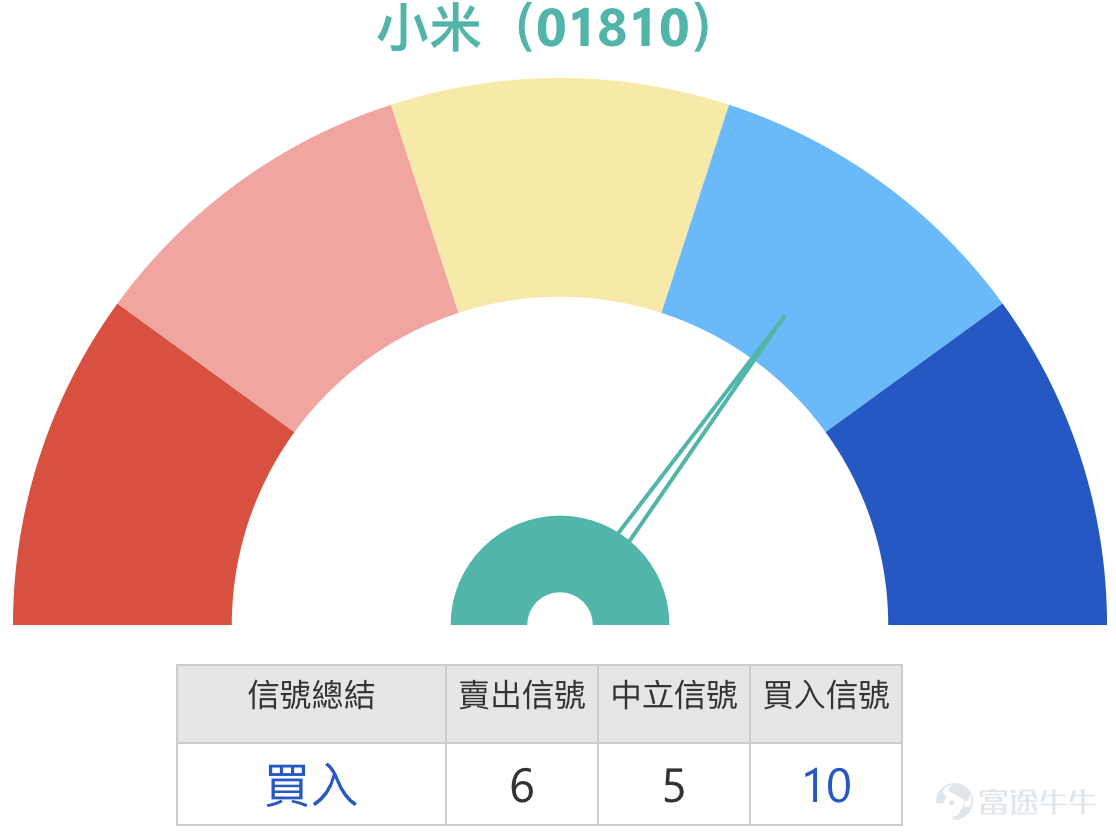
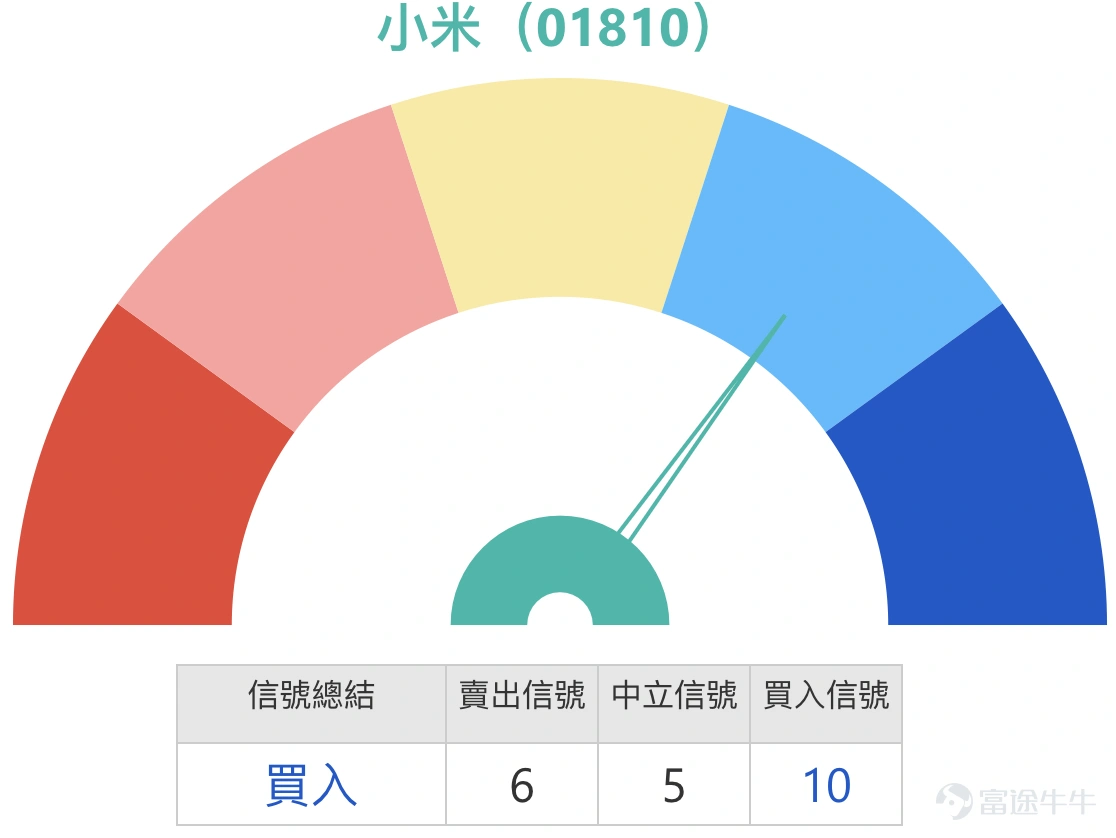
From a technical chart perspective, Xiaomi Group's stock price is experiencing a direct confrontation between 'oversold rebound momentum' and 'downward trend pressure.' Currently, the stock price is significantly below all key moving averages such as the 10-day, 30-day, and 60-day lines, with the moving average system showing a bearish alignment, clearly indicating that the short-term trend remains weak with layers of resistance above. The technical indicator summary signal is 'buy,' but multiple oscillation indicators are showing 'sell' signals. This internal contradiction reflects market hesitation.
However, several key indicators are sending strong oversold and bottom-building signals, which are currently the most noteworthy focal points. The 14-day Relative Strength Index (RSI) is only at 38, firmly in the oversold territory. More notably, the 'Bull-Bear Power Indicator,' reflecting the degree of market overselling, shows 'severely oversold, potentially bottoming out, buy.' Additionally, the momentum oscillator has shown a classic 'bottom divergence' signal, typically an early technical indication of waning downward momentum and the potential for a short-term bottom to form in the stock price. Overall, the technical picture presents a situation of 'weak short-term trends, but an increasingly urgent need for a rebound after deep overselling.'
II. Key Support and Resistance: Defining the Path of Rebound and Decline
In the process of the stock price seeking a bottom, clear key price levels provide signposts for judging short-term direction.
* On the upside resistance, the first hurdle is at HKD 37.6, close to the 10-day moving average position, serving as the first litmus test for whether the oversold rebound can translate into an effective recovery. If it breaks through, the next stronger resistance is near HKD 39.4, a position close to the lower Bollinger Band and previous support level, where significant technical pressures converge, acting as the critical watershed for trend reversal.
* On the downside support, HKD 34.8 is the first line of defense in the near term. A more critical support lies at HKD 32.6, a position not only being a prior significant low area but also identified by various technical analyses as a potential bottom-building region, expected to have strong psychological and technical support.
III. Market Dynamics Integration: The Tug-of-War Between Fundamental Headwinds and Contrarian Positioning
Recent fundamental news has intensified market divergence. On the negative side, the ongoing rise in memory (DRAM) prices has become a widespread concern affecting profitability for tech hardware companies. Industry giants have warned that rising memory costs are starting to erode profits, directly impacting Xiaomi Group, whose primary revenue source is smartphones. In a research report released on January 29, Citi downgraded Xiaomi’s adjusted net profit forecast for 2025-2027 and lowered its target price from HKD 50 to HKD 43, although maintaining a 'Buy' rating. UBS Group also noted headwinds from the memory industry, assigning a target price of HKD 46 with a 'Neutral' rating. January 23rd [Hong Kong Stock Podcast] Hang Seng Index, Meituan, Trip.Com, Ganfeng Lithium, Zhaojin Mining, Xiaomi
However, the market isn’t entirely pessimistic. In the January 23 episode of [HK Stock Podcast], host Simon observed that despite overall weak stock performance, trading volume increased slightly during minor stock rallies—a short-term bullish signal. He explicitly pointed out that current technical signals slightly favor 'buy,' but any rebound should be assessed step-by-step, with the primary goal being breaking through the HKD 38 resistance. This view aligns with some capital movements: in the warrant market, funds have started slowly buying Xiaomi’s call warrants amidst continuous stock declines, taking contrarian positions. This indicates that some investors see the current low point as a potential opportunity for medium-to-long-term positioning, especially considering Xiaomi's growth story in emerging areas like smart IoT (e.g., smart toilets) and electric vehicles (the SU7 model once surpassed Tesla Model 3 sales in China).
4. Warrants and Bull/Bear Certificates: Review, Term Analysis, and Strategy Selection
Amidst heightened market volatility and diverging directions, CBBCs (Callable Bull/Bear Contracts) and Warrants provide investors tools to express bullish or bearish views on specific price ranges with limited capital. These products cap maximum losses within the initial investment amount, facilitating precise risk management.
1. Recent Product Performance Review
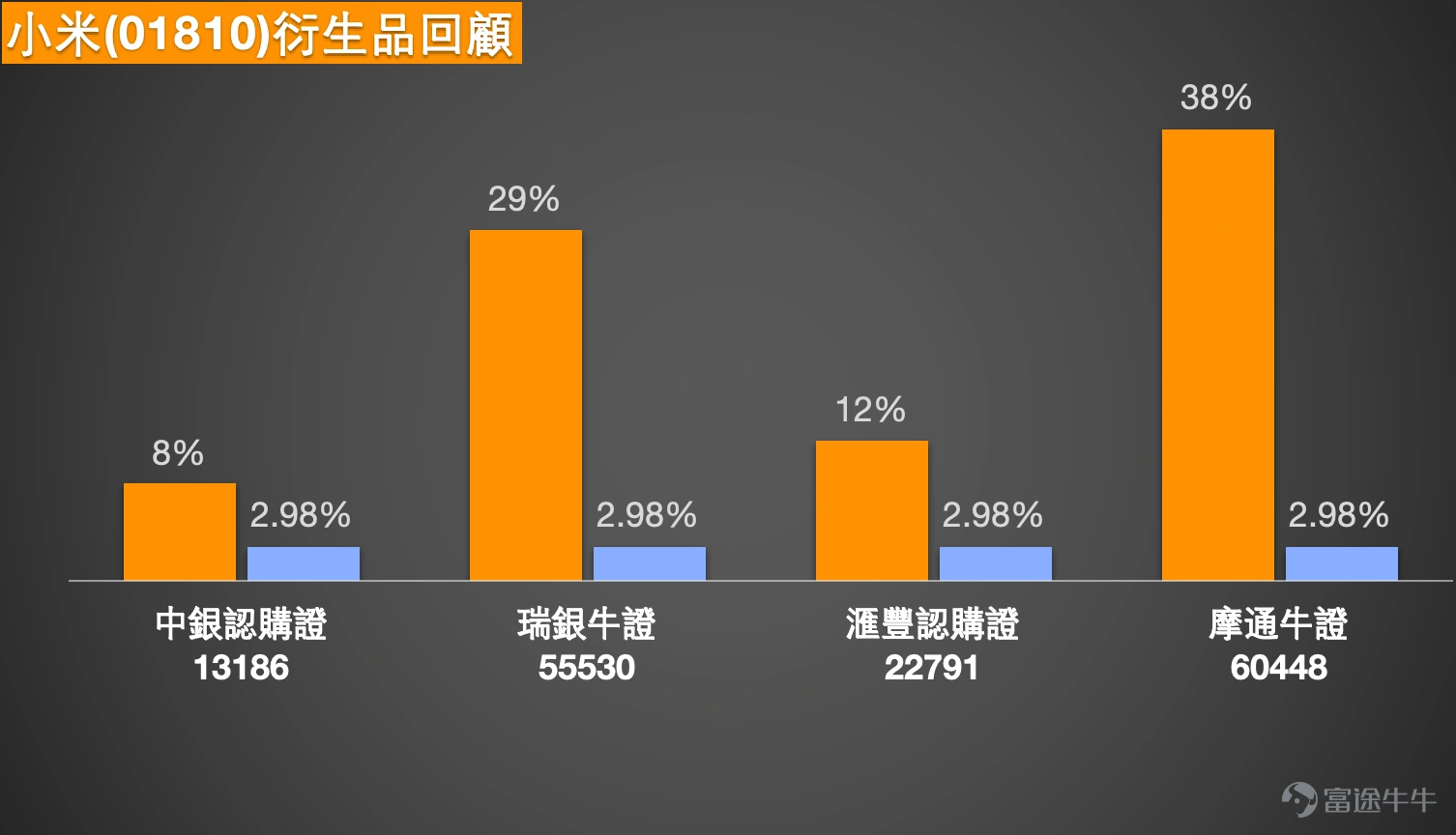
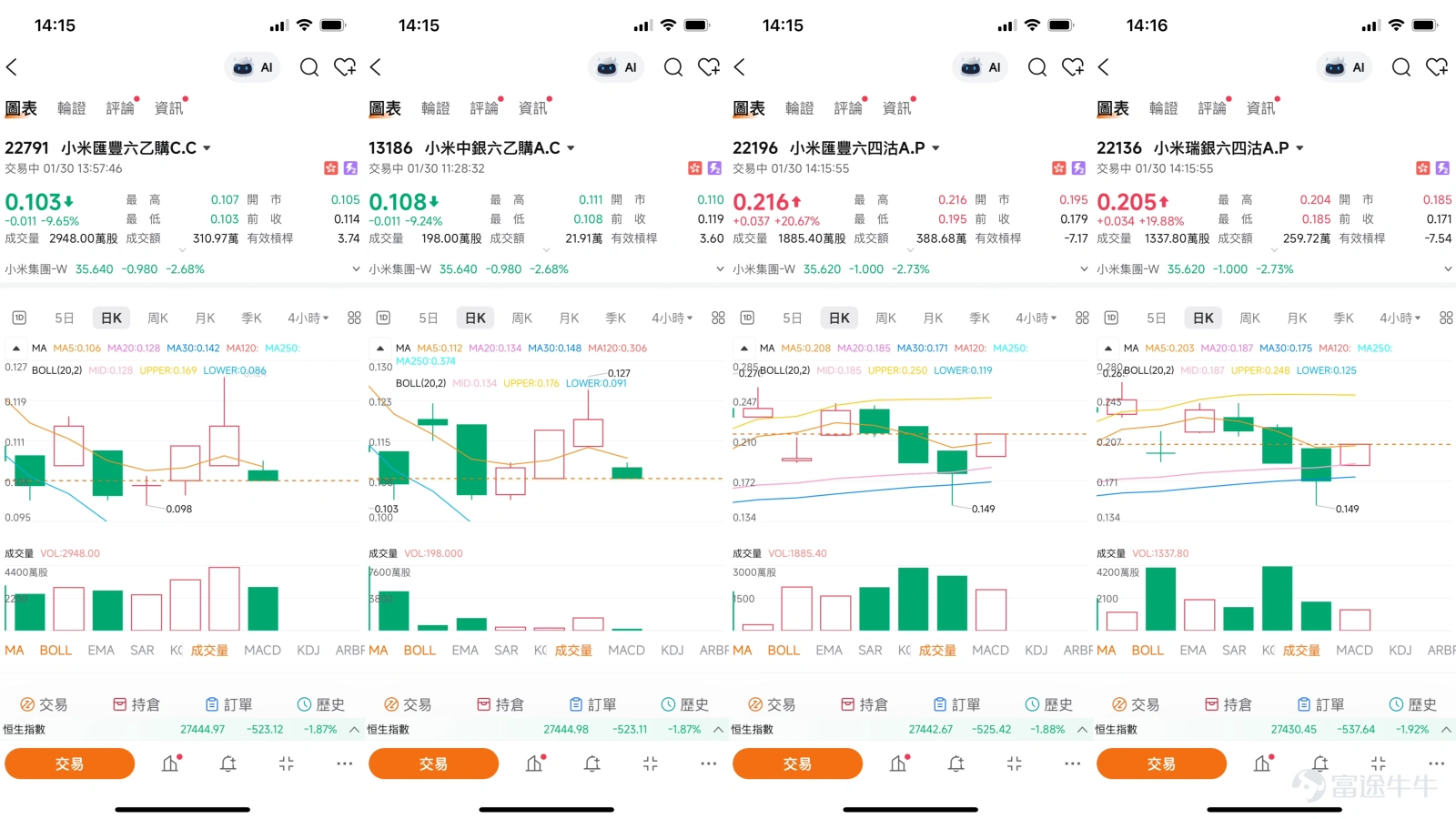
Reviewing the bullish warrants mentioned on January 27, their performance over the following two days fully demonstrated the amplification effect of leveraged products when the underlying stock rises. During those two days, Xiaomi Group's stock rose by 2.98%, while the gains in related derivatives were even more significant: J.P. Morgan bull certificate (60448) surged 38%, UBS bull certificate increased by 29%, and two call warrants (HSBC call warrant 22791, BOC call warrant 13186) recorded respective gains of 12% and 8%.
2. In-depth Analysis of Selected Product Terms
When selecting warrants, it is essential to link their core terms—especially the strike price or recall price—with the key technical price levels mentioned above to formulate a balanced offensive and defensive strategy.
* Bullish choices (call warrants and bull certificates):
* HSBC call warrant (22791) and BOC call warrant (13186): The strike prices for these two products are HKD 37.12 and HKD 37.15, respectively. This price almost coincides with the first resistance level at HKD 37.6. These terms imply that they are tools designed for speculating that the share price will reach and break through the HKD 37.6 resistance, qualifying them as slightly out-of-the-money warrants. If the stock price rebounds to this area but fails to surpass it, their time value will face erosion. As reminded in [HKEX Podcast], such terms carry less risk than deep out-of-the-money products with excessively high strike prices (e.g., above HKD 40), offering better correlation with stock prices.
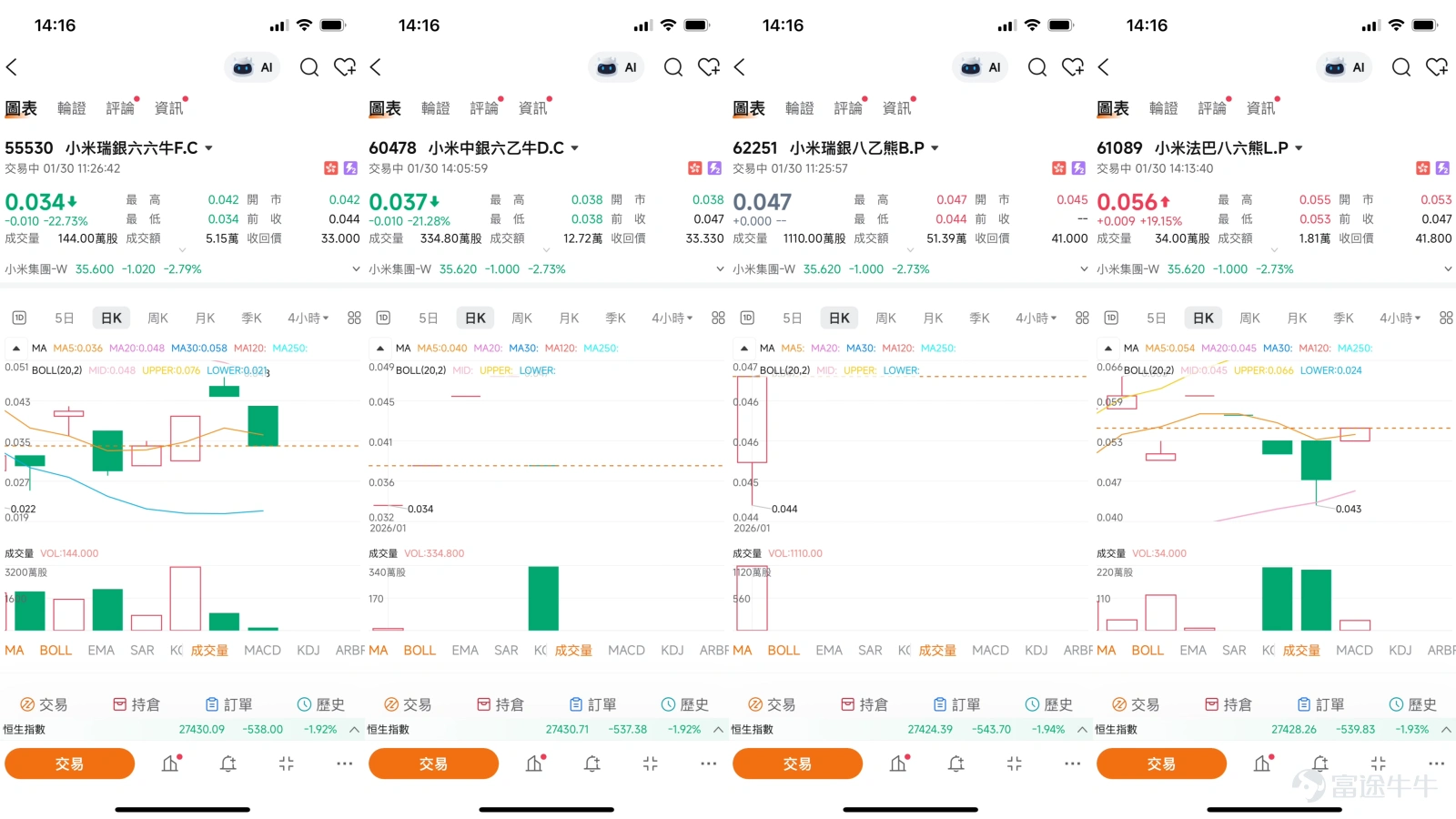
* UBS bull certificate (55530) and BOC bull certificate (60478): The recall prices for these two bull certificates are set at HKD 33 and HKD 33.33, respectively. These levels are below the first support at HKD 34.8 but far above the critical strong support at HKD 32.6. This design allows room for normal fluctuations around the support level, aiming to prevent forced recall due to short-term volatility, making them suitable for investors who believe in the effectiveness of the HKD 34.8 support and wish to leverage higher gearing for a rebound.
* Bearish/hedging options (put warrants and bear certificates):
* UBS bear certificate (62251) $UB#XIAMIRP2812B.P (62251.HK)$ and BNP Paribas bear certificate (61089) $BP#XIAMIRP2806L.P (61089.HK)$ : The recall prices for these two bear certificates are set at HKD 41 and HKD 41.8, respectively. These levels are much higher than the current stock price and significantly above the second resistance at HKD 39.4. This indicates that they are prepared for investors anticipating any rebound to be short-lived, with the stock price unable to break through multiple resistances and possibly retreating again. High gearing implies high risk; if the stock price experiences a strong rebound, there is a possibility of the product being recalled.
* HSBC put warrant (22196) $HSXIAMI@EP2604A.P (22196.HK)$ and UBS put warrant (22136): The strike prices for these two put warrants are both HKD 35.16. This strike price is very close to the current stock price and slightly higher than the initial support at HKD 34.8. This means they are relatively near-the-money bearish instruments aimed at capturing short-term opportunities if the stock price fails to hold the HKD 34.8 support and continues to seek a bottom, showing higher sensitivity to declines in the underlying stock.
V. Interactive Session: Key Decision
Given Xiaomi's narrow range-bound movement between the support at 34.8 and resistance at 37.6, which direction do you think it will break out to first?
A. Rebound Upwards: Believing in the power of an oversold bounce, it may first challenge 37.6.
B. Continue Consolidation: Expecting a tug-of-war between buyers and sellers, remaining range-bound in this zone.
C. Test Downward: Worrying about trend pressure, it might first retest the 34.8 support level.
Is your choice A, B, or C? Come discuss your thoughts in the comments section and let’s spark some intellectual exchange!
A final gentle reminder: Warrants and bull/bear certificates are complex leveraged derivative investment products with expiration timeframes. Their prices can go up or down, and investors may lose their entire principal. Before investing, fully understand the product characteristics, including risks such as forced recall mechanisms, time decay, and implied volatility fluctuations. If you have any questions about product terms, seek professional advice. For more daily in-depth analysis on Hong Kong stocks and derivatives, follow “Hong Kong Stocks Warrants Jenny.”
#Xiaomi Group# #Technical Analysis# #Oversold Rebound# #Warrants# #Bull and Bear Certificates# #Support and Resistance Levels# #Hong Kong Stock Podcast# #Short-term Speculation#
Risk Disclaimer: The above content only represents the author's view. It does not represent any position or investment advice of Futu. Futu makes no representation or warranty.Read more
Comments
to post a comment
7