
Alibaba releases Qwen flagship model! Continue to stay bullish?

Short-term Analysis of Alibaba: Technical Dynamics and Warrant Choices Amid Favorable Conditions
$BABA-W (09988.HK)$ Alibaba (09988.HK), as a core technology leader in the Hong Kong stock market, has seen its share price performance draw significant attention recently. After steadily climbing from the HKD 140 level at the start of the year to near HKD 173, the stock is now facing a crucial technical juncture. Currently, multiple fundamental positives are intertwined with complex technical signals, offering investors a rich perspective on market observation. This article will combine the latest technical analysis, market dynamics, and authoritative insights to outline Alibaba's potential short-term trajectory. Today (on the 30th), the stock followed the broader market correction, closing at HKD 168.4, down 2.83%.
I. Technical Analysis: Short-term Divergence Within a Strong Trend
From the daily chart perspective, Alibaba's overall technical structure leans positive. Recently, its 10-day moving average successfully crossed above the 20-day moving average, forming the classic 'Golden Cross' technical pattern, which is typically viewed as a mid-term bullish signal indicating a possible strengthening trend. A more positive sign is that the stock price has shown a 'Cup-and-Handle upward breakout' formation on the daily chart, suggesting the market has digested previous selling pressure and may begin a new uptrend. The stock price is also currently stable above key medium-to-long term moving averages such as the 30-day and 60-day lines, providing foundational support for an upward trend.
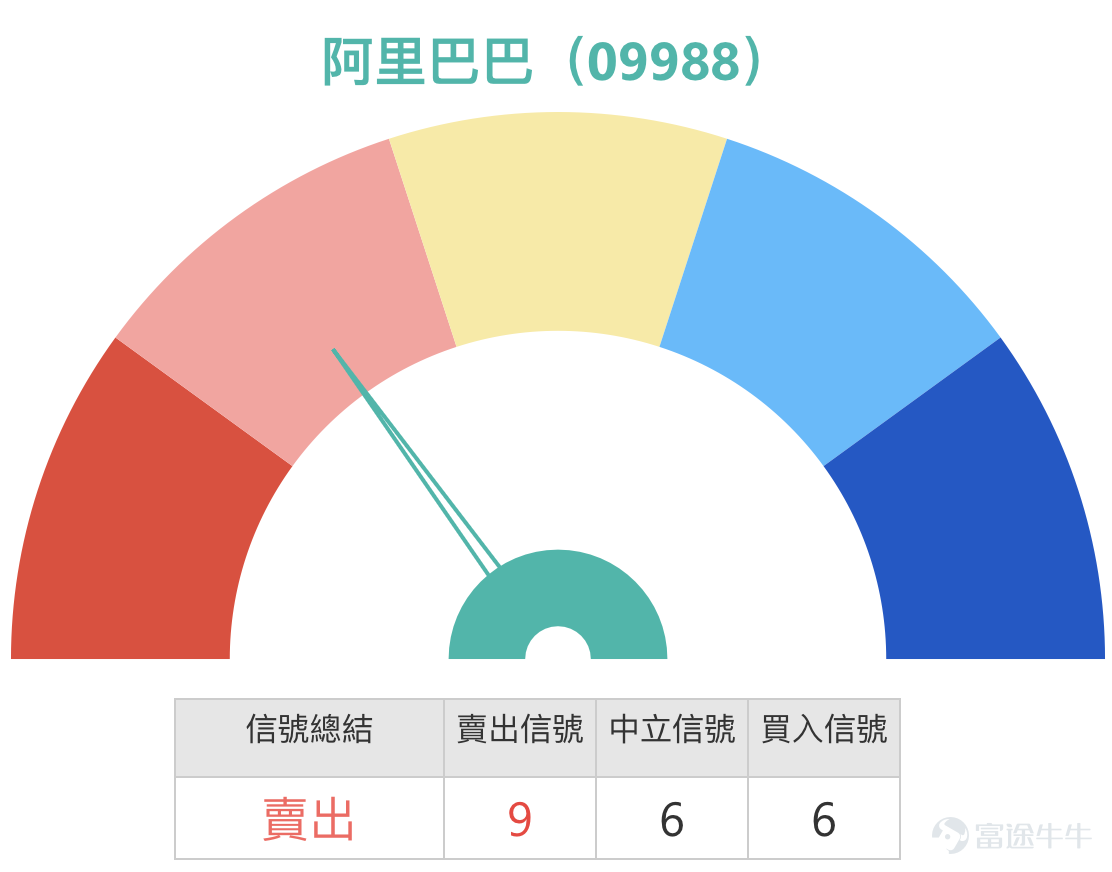
However, short-term technical indicators show some divergence and signs of overheating. The 14-day Relative Strength Index (RSI) stands at 67, not yet entering extreme overbought territory but already within a strong zone, implying that buying power may have been largely exhausted in the short term. Meanwhile, stochastic indicators and Williams %R also signal overbought conditions, indicating that after consecutive gains, the stock may face some profit-taking pressure or a need for technical consolidation. Overall, the technical chart presents a dual characteristic of 'positive mid-term trend' alongside 'short-term indicators requiring digestion.'

2. Key Support and Resistance: Defining the Short-term Fluctuation Framework
When the stock price is at a sensitive position for directional selection, clear key price levels help define the trading range and assess risk.
* On the upper resistance side, the primary test is the 174.4 level. This position has been tested multiple times recently without an effective breakthrough; if it can be successfully surpassed with volume support, the next target will point to the more critical 190.7 area.
* On the lower support side, 162.3 is the first important line of defense in the near term, combined with the upward-moving short-term moving average, forming initial support. A more crucial support level is at 153.3, which is not only near the 200-day long-term moving average but also a previously significant breakout platform, expected to provide strong buying power.

3. Market Dynamics Integration: Resonance Between Fundamental Positives and Technical Signals
Recently, positive news from Alibaba's business operations has resonated with bullish patterns on the technical side. Alibaba is outlining a more promising growth outlook through a series of strategic initiatives. On one hand, the company plans to spin off its semiconductor business for listing, which could unlock undervalued business segments and allow the group's valuation system to better reflect its complete 'Cloud + AI + Chip' layout. On the other hand, Alibaba's merger of its autonomous driving business with external firm Zelos demonstrates a strategy focused on core operations and optimizing cutting-edge business arrangements through collaboration, gaining positive market interpretation.
More importantly, the position of AI as a core growth engine becomes increasingly clear. Recently, market sources indicate that Alibaba is about to release a new generation of large AI models, signaling its continued deep investment in artificial intelligence. Its Qwen large model has already been integrated into core applications such as Fliggy and AutoNavi, presenting promising commercial prospects. These moves collectively strengthen the market’s expectation for improvement in the company's medium- to long-term fundamentals.
Regarding market sentiment, the [BOC Guest Appearance] segment provides direct observations. Niki, Director of BOC International, clearly stated on the January 28 broadcast that Alibaba's fundamentals are "relatively positive," expressing optimism about the role of AI business in driving future growth. She noted that the significant rise in stock price since the beginning of the year reflects market recognition, and the current focus is whether it can achieve a breakout around the 173 yuan level. Earlier on January 22, although some investors were concerned about a potential pullback to 155 yuan while holding put warrants, the program analysis also pointed out that the market generally believes there would be support near 156.3 yuan if a pullback occurs, showing overall rationality despite anticipation of a breakout alongside short-term volatility.
4. Warrants and Bull/Bear Certificates: Tool Review and In-depth Clause Analysis
Amid expectations of potentially heightened market volatility, warrants (call/put options) and bull/bear certificates offer investors another way to participate. The advantage of these products lies in allowing investors to leverage their positions to deploy potential directional views with less capital, while the maximum loss is capped at the initially invested principal, facilitating precise risk budget management.
1. Recent Product Performance Review
Reviewing the several bullish derivative products mentioned on January 27, their performance in the following two days fully demonstrated the amplification effect of leverage products on returns when the underlying stock experienced a moderate rise. During that time, Alibaba’s stock rose by 2.00% over two days, while related derivatives recorded even more significant gains: UBS Group bull certificates surged 32%, Societe Generale bull certificates (55803) rose 26%, and UBS Group call warrants (21356) increased by 16%. This clearly shows that when market direction is correctly predicted, these tools can effectively enhance capital efficiency.

2. Selected product terms correlation analysis
When selecting derivatives, it's crucial to closely align their core terms—especially the strike price or knock-out price—with key technical levels of the underlying stock. This is essential for risk control and precise positioning.
* Bullish options (call warrants and bull certificates):
* UBS Group call warrants (22492) and Bank of China call warrants (22984) $BIALIBA@EC2604D.C (22984.HK)$ : The exercise price for both products is 207.19. This price is significantly higher than the current stock price and also exceeds the second resistance level of 190.7. This design indicates that they are aggressive instruments suitable for investors who strongly believe Alibaba will initiate a substantial upward movement, breaking through multiple resistance levels consecutively. Their actual leverage of approximately 7.8 to 7.9 times offers higher potential return elasticity.
* UBS Group bull certificate (59537) $UB#ALIBARC2707B.C (59537.HK)$ and J.P. Morgan bull certificate (58043) $JP#ALIBARC2707I.C (58043.HK)$ : The knock-out prices for these two bull certificates are set at 160 and 160.5, respectively. These levels are slightly below the first support level of 162.3 but far above the critical strong support at 153.3. This design provides some buffer space for normal technical pullbacks in stock prices, aiming to avoid the risk of forced knockout due to short-term fluctuations. They are suitable for investors who favor medium- to long-term trends, wish to utilize leverage, but still prefer relatively stable investments.

* Bearish/hedging options (put warrants and bear certificates):
* Societe Generale bear certificate (61344) and UBS Group bear certificate (61991): The recovery price for both of these bear certificates is set at 180. This level is slightly higher than the current stock price and significantly above the first resistance level of 174.4. This means they are short-term trading tools designed for investors who anticipate that the stock price will struggle to break through its current high and may soon experience a pullback. With more than 20 times actual leverage, they are highly sensitive to fluctuations, but also carry relatively higher recovery risk.
* Bank of China put warrant (20718) $BIALIBA@EP2603A.P (20718.HK)$ and HSBC put warrant (21046) $HSALIBA@EP2603D.P (21046.HK)$ : The exercise price for these two put warrants is 142.78. This exercise price is already significantly below the second support level of 153.3, indicating they are not designed for betting on minor adjustments, but rather as risk hedging or directional tools for investors expecting a potentially deeper market correction, even challenging the early-year uptrend region.

5. Interactive session: What’s your view on key levels?
Alibaba's share price is currently in a critical area between the resistance at 174.4 yuan and the support at 162.3 yuan. What’s your prediction for the next move?
A. Breakout upwards: Optimistic about future performance, believing it can break through resistance.
B. Range-bound fluctuation: Expecting movement within this range.
C. Pullback downwards: Predicting a possible retest of lower support.
Are you A, B, or C? Head to the comments section to leave your choice and see which side is more popular!
For more daily in-depth analysis on Hong Kong stocks and derivative instruments, follow 'Hong Kong Warrant Insights by Jenny'.
Disclaimer: This article does not constitute any investment advice.
This article is for reference only and does not constitute any investment advice. The market data, opinions, and analysis contained herein may change at any time without prior notice. We shall not be liable for any loss or damage arising from reliance on the information in this article. Technical analysis merely indicates whether certain technical conditions are met; a comprehensive evaluation of asset performance should incorporate additional data. Trading decisions should not be based solely on the content of this article. Please note that past performance is not indicative of future results.
#Alibaba #09988 #TechnicalAnalysis #AI #Derivatives #BullBearCertificates #SupportResistanceLevels #BOCInvestmentGuest #HKEXTechnologyStocks #ShortTermTrading
Risk Disclaimer: The above content only represents the author's view. It does not represent any position or investment advice of Futu. Futu makes no representation or warranty.Read more

Comments
to post a comment
4
6