
Tech giants boost Capex again! What's the outlook for future stock prices?

OptionSir Breaks Down Hot Topics | Stock Price Surges 11%, Apple and NVIDIA Double Entry, Is Intel's Turnaround Moment Here?
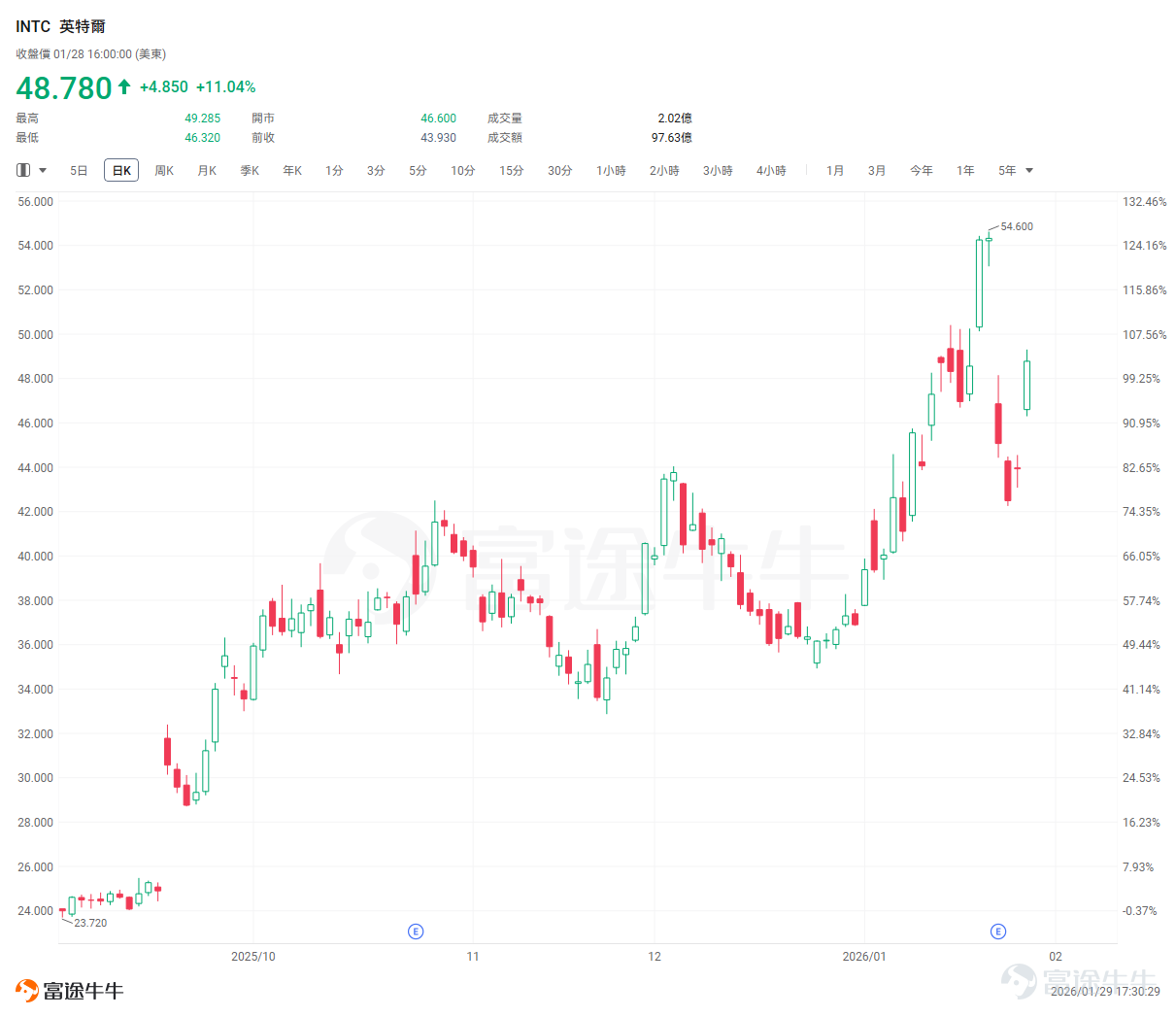
Looking back at the past week, $Intel (INTC.US)$ The stock price of experienced "experienced sharp fluctuations characterized by 'a rapid rise, a sharp fall, and a rebound'.On January 23, Intel had just released its Q4 earnings report, which slightly exceeded expectations, but the guidance for Q1 was weak. Due to disappointing progress in foundry operations and supply constraints, the stock plummeted 17% after the results were announced;
However, the market did not dwell too much on the lackluster performance. On January 29, following news from the supply chain that 'NVIDIA’s next-generation GPU would also be manufactured by Intel,' the stock surged over 11%.With Apple and NVIDIA both entering the scene, does this signal an upcoming turning point for Intel's foundry business?

Apple and NVIDIA’s dual involvement ignites market enthusiasm
As early as December 2025, renowned analyst Ming-Chi Kuo revealed that the likelihood of Intel becoming $Apple (AAPL.US)$ a leading-edge process supplier significantly increased,with Apple evaluating Intel’s 18A process technology for manufacturing its lower-end M-series chips starting from 2027., the stock price also surged over 10% at one point on the same day.
In December last year, TrendForce also reported that $Alphabet-A (GOOGL.US)$$Alphabet-C (GOOG.US)$has confirmed the adoption of Intel's EMIB advanced packaging technology for its TPU chips to be launched in 2027, $Meta Platforms (META.US)$ and is actively assessing outsourcing its own MTIA chips to Intel for similar packaging;
following Apple, $NVIDIA (NVDA.US)$the news that some chip manufacturing businesses will shift to Intel's foundry services has once again boosted market sentiment.Following the September 2025 announcement of a $5 billion investment in Intel, the latest plan is to collaborate with Intel on the next-generation successor to the Rubin series, the Feynman architecture chip.
According to supply chain sources, the GPU core chips will still be manufactured by Taiwan Semiconductor, while some of the I/O chips will use Intel's 18A process or the 14A process scheduled for mass production in 2028, with final advanced packaging done by Intel EMIB. In terms of the proportion of advanced packaging, Intel accounts for up to 25%, while Taiwan Semiconductor accounts for about 75%.
Although the above collaborations have not been finalized, the 'significantly increased possibility' has been enough to ignite market enthusiasm.
Supply chain 'Plan B' remains a necessity, but major manufacturers are still cautious.
Against the backdrop of the Trump administration's push for 'Made in America,' Intel, as the only IDM manufacturer in the US with advanced process potential, enjoys certaingeopolitical premium。
Moreover, having a 'Plan B' for the supply chain is essential.Although$Taiwan Semiconductor (TSM.US)$ Currently the sole manufacturer of Apple’s custom chips (including the upcoming 2nm A20 chip), Taiwan Semiconductor faces ongoing efforts from Apple to diversify its supply chain to mitigate geopolitical risks and control rising costs. Additionally, much of Taiwan Semiconductor’s CoWoS capacity is monopolized by leading customers such as NVIDIA, with high pricing. For ASIC customers like Meta and Google, Intel provides a 'second source' option that does not rely on Taiwan Semiconductor’s capacity, which is crucial for supply chain resilience.
However, judging from the nature of these collaborations, major companies remain cautious in their approach to working with Intel.
– High-end Apple chips will continue to be exclusively manufactured by Taiwan Semiconductor, with Intel only entering the low-end product lines (with annual shipments of approximately 15 to 20 million units), providing limited revenue contribution.
– In its collaboration with NVIDIA, it has adopted“a strategy of small volumes, lower-end, and non-core components.”The core GPU chips remain locked with Taiwan Semiconductor, but some I/O chips will be manufactured using Intel's 18A or 14A process. For NVIDIA, directly handing over the core GPU to Intel, whose yield is still climbing (currently around 55-65% for 18A), posestoo great a risk.I/O (Input/Output) handles memory control, protocol conversion, power management, acting as the 'logistics center' and 'highway entrance/exit' in factories, and is less sensitive to the 'scaling effect' of advanced processes.
Compared to the high risks associated with adopting Intel’s 14A and 18A processes, most companies have chosen tostart cooperation with Intel through advanced packaging solutions like EMIB.The 'trial-and-error costs' of wafer fabrication and packaging differ significantly. Wafer fabrication (18A/14A) carries extremely high risks, while packaging risks are relatively manageable; even if issues arise during the packaging phase, they do not involve the reconstruction of underlying circuit designs. Intel's EMIB packaging technology has evolved through several generations (first used in Intel's own FPGAs and server CPUs). For manufacturers seeking customization and cost control, EMIB offers a more cost-effective alternative. For Intel, successful adoption of EMIB means expanding from chip manufacturing into the lucrative field of advanced packaging, potentially reaching more ASIC customers.
Through cooperation on EMIB packaging and I/O chips, major companies like NVIDIA and Google can work out Intel’s process flows at a lower trial-and-error cost.This represents a form of 'incremental trust'—If the cooperation goes smoothly, in the future, gradually transferring the 18A or 14A wafer orders to Intel is like 'making friends first, then discussing big business.'
The driving force and looming challenges for Intel's valuation recovery
$Intel (INTC.US)$ It is a typical investment target for a turnaround from difficulties.The characteristics of this type of investment target are often 'running ahead of expectations,' which cannot be proven true or false. It means paying in advance for a story that will materialize in 2027-2028, with the narrative lingering between a 'value trap' and 'valuation recovery,' heavily influenced by news and sentiment.
(1) Upward momentum: Re-rating of the foundry business
In the past four quarters, Intel's foundry business has cumulatively recorded an operating loss of approximately $10.1 billion. The market previously valued Intel's foundry business at nearly zero, even treating it as a negative asset (due to substantial losses). Now, Lip-Bu Tan points out that the yield for 18A is 'steadily improving.'Improving by about 7-8% per month.Although market analysis and rumors indicate that, as of early 2026, the 18A yield is expected to be around 55-65%, still below the industry profitability standard (typically needing 70-80% to truly become profitable).
If the foundry business secures key customer commitments, it will serve as a positive catalyst. While this does not mean that Intel has completely reversed the competitive landscape, it may suggest thatIntel has moved beyond the phase of 'promising roadmaps.'
(2) Downside risk: Divergence between fundamentals and execution能力
Supply constraints and competitive pressure:We cannot ignore—Intel in the server CPU market.Facing来自$Advanced Micro Devices (AMD.US)$the continuous competitive pressureDespite the current supply shortage in the entire CPU market, the supply constraints faced by Intel may hinder potential customers' willingness to cooperate. According to data from Mercury Research cited by Tom's Hardware, AMD's server CPU unit market share rose to 27.8% in the third quarter of 2025 (up from 27.3% in the second quarter of 2025). At the same time, Mercury also pointed out that thanks to a higher proportion of EPYC product offerings, AMD's server revenue has reached a new record high, although specific revenue shares were not disclosed.
The prospects for the OEM business are long and full of challenges:CEO Chen Liwu admitted that the true mass production of 14A will not occur until 2028, which means we will not see significant revenue from the 14A process until at least 2029. Additionally, TSMC's factory construction in Arizona, USA, has somewhat diminished the geopolitical urgency for customers to choose Intel for foundry services.
The fulfillment period for the above collaborations is relatively long, requiring a wait of more than two years.Short-term performance is unlikely to make a substantial contribution, and there is a risk of overextending the benefits. There is uncertainty in technical validation, and Apple is currently only assessing feasibility.It will not be until Q1 2026 to advance to the critical design validation phase.Apple has always been extremely strict about yield rates. If the yield, performance, or delivery schedule falls short of expectations, the collaboration could be shelved once again.
Options strategy
As of January 28, 2026,The implied volatility (IV) of Intel's current options stands at 63.78%, which is relatively high historically (with an IV percentile of 72%).The Put/Call Ratio is 0.5, and a lower ratio typically indicates that market trading sentiment leans towards optimism. Despite technical uncertainties,there have been significant unusual purchases of medium- to long-term call options in the options market.This indicates that some capital has strong confidence in its medium- to long-term prospects and is willing to bear the time decay and volatility risks to place bets.
The market is currently in a phase of 'high volatility expectations + bullish sentiment.'High implied volatility means expensive option prices, making simple long call strategies less cost-effective at this moment. This is because even if the stock price rises, cooling sentiment (IV Crush) may cause option prices to fall instead of rise. Selling options (Short)orand spread strategies (Spread) are better alternatives.
1. Strong bulls (those who believe in the long-term story)
Buy a Bull Call Spread.Suitable for investors who are optimistic about 18A's turnaround in the long term, believe Intel can secure major client orders from NVIDIA and Apple, and are willing to bear significant drawdown risks.
Given that implied volatility (IV) is very high, buying calls is too expensive. By selling higher strike calls, you can offset some costs (and volatility risk). If the stock price rises as expected, you gain limited but highly leveraged returns; if the stock price moves sideways, the loss is smaller than directly buying calls.

2. Conservative/neutral traders (who see not falling as a win)
Sell a Bull Put Spread.Suitable for investors who are skeptical yet hopeful about Intel’s long-term prospects, do not want to chase highs, but believe that with support from news of cooperation among tech giants, downside support is strong and the stock is unlikely to fall sharply in the short term.
This strategy is essentially a 'low-risk Short Put strategy,' which carries characteristics of an options seller, suitable for when expecting the market to not fall. Use this strategy to collect premium income while reducing the risk associated with being an option seller. Therefore,it is suitable for implementation when implied volatility is high, as profits can be made even if the stock price remains stable, moves sideways, or fluctuates.When the stock price rises above the higher strike price, both options are out-of-the-money, resulting in maximum profit, equal to the total premium received at the time of opening the position.

3. Investors holding for appreciation (defensive and income-enhancing strategies for existing shareholders)
Covered Call strategy. Suitable for those already holding the underlying stock or stuck with losses, happy about yesterday’s big rally, but worried about a pullback after short-term positive catalysts run out, or thinking the current stock price is above their target price.
Covered CallWhile holding the position, sell a Call option with a strike price at the resistance level, capitalizing on the current high implied volatility (IV). The option premium is very attractive. If the stock price continues to rise beyond the strike price, you will secure profits at a higher price, and although the stock will be called away (sold), you lock in the profit at the strike price plus the substantial premium. If the market moves sideways or declines, the high premium will significantly reduce your holding cost, providing a buffer against downside risk.

Finally, here's a small perk for fellow investors—welcome to claim it!Beginner's Options Package
This event is exclusively for invited HK users, click to learn moreDetailed event rules >>
Major upgrade to the US options mechanism! New Monday and Wednesday options added for nine major symbols including Tesla and NVIDIA. A step-by-step guide to profiting from end-of-term options using the NiuNiu tool >>

Disclaimer
This content does not constitute any offer, solicitation, recommendation, opinion, or guarantee of any securities, financial products, or tools. The risk of loss in buying and selling options can be substantial. In some cases, your losses may exceed the initial margin amount deposited. Even if you set contingent orders, such as 'stop-loss' or 'limit' orders, these may not necessarily prevent losses. Market conditions may make these orders unexecutable. You might be required to deposit additional margin within a short period. If you fail to provide the required amount within the specified time, your open positions may be liquidated. However, you will still be responsible for any account deficit arising from this. Therefore, before trading, you should study and understand options and carefully consider whether such trading suits you based on your financial situation and investment objectives. If you trade options, you should be familiar with the procedures upon exercising options and at expiration, as well as your rights and obligations when exercising options and at expiration.
Risk Disclaimer: The above content only represents the author's view. It does not represent any position or investment advice of Futu. Futu makes no representation or warranty.Read more

Comment (1)
to post a comment
6
26