
Grand View | Rise in Japan's Long-Term Government Bond Yields and Its Investment Implications
Japanese Prime Minister Sanae Takaichi proposed a plan to significantly increase government spending while cutting taxes, raising concerns among bond investors. The yield on the 10-year Japanese government bond rose from 2.18% on January 16 to 2.35% on January 20 [1]. This represents a very significant fluctuation for Japanese government bonds, which have long been regarded as one of the most stable and safest asset classes globally. The Prime Minister’s policy aimed at reigniting economic reflation by 2026 is positive for Japanese stocks and the yen but relatively unfavorable for Japanese government bonds.
The Japanese Prime Minister announced a new campaign pledge.
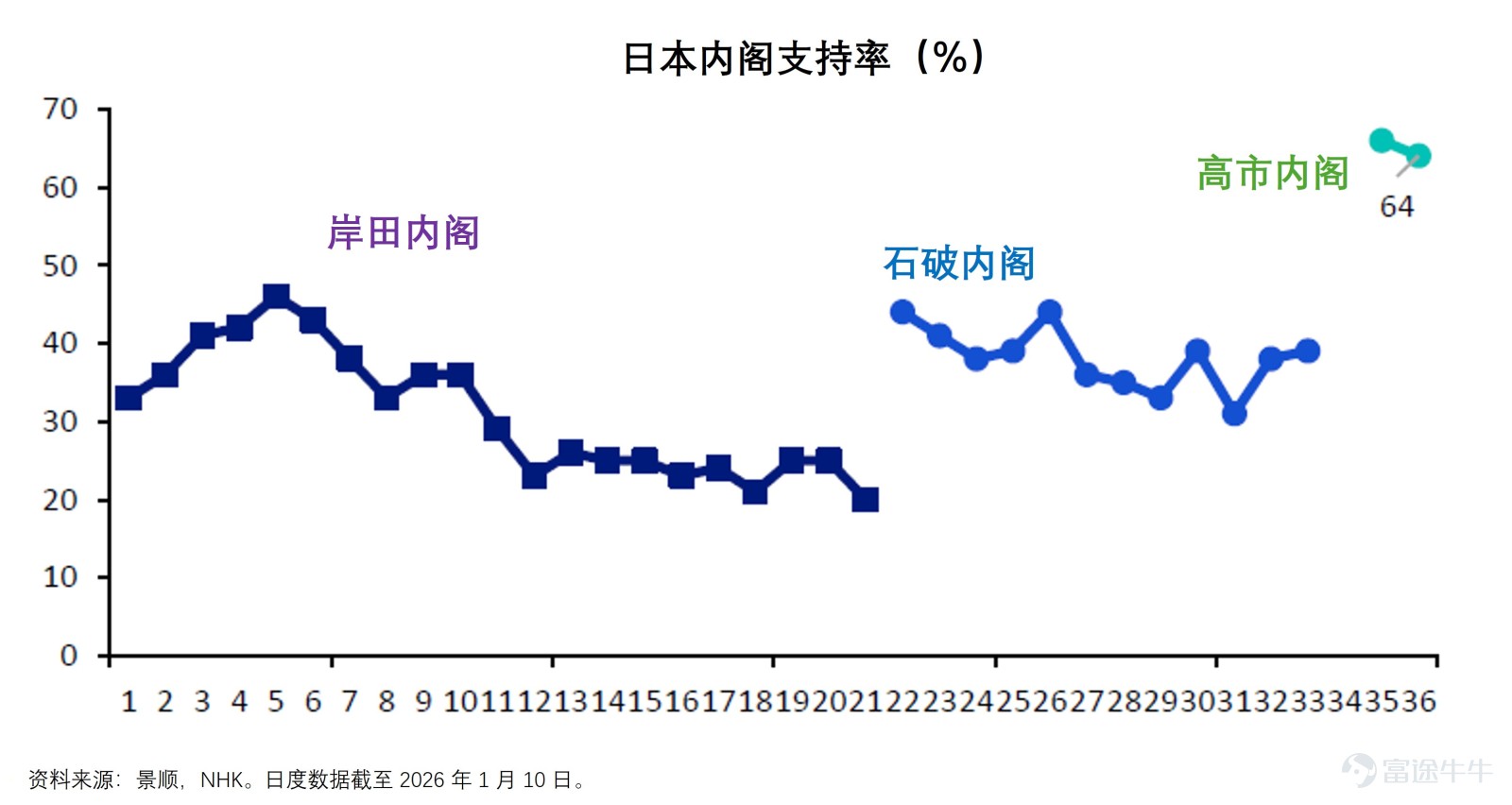
Amid strong public support, Japanese Prime Minister Sanae Takaichi held a press conference on the evening of January 19, formally announcing the dissolution of the House of Representatives on January 23. She hopes to gain more political backing in the upcoming election.
![Japanese Prime Minister Sanae Takaichi proposed a plan to significantly increase government spending while cutting taxes, raising concerns among bond investors. The yield on the 10-year Japanese government bond rose from 2.18% on January 16 to 2.35% on January 20 [1]. This represents a very significant fluctuation for Japanese government bonds, which have long been regarded as one of the most stable and safest asset classes globally. The Prime Minister’s policy aimed at reigniting economic reflation by 2026 is positive for Japanese stocks and the yen but relatively unfavorable for Japanese government bonds. The Japanese Prime Minister announced a new campaign pledge. Amid strong public support, Japanese Prime Minister Sanae Takaichi held a press conference on the evening of January 19, formally announcing the dissolution of the House of Representatives on January 23. She hopes to gain more political backing in the upcoming election. Within the next two years, the consumption tax on food will be reduced from the current 8% to zero. The fiscal cost of eliminating this tax is estimated at about 5 trillion yen annually, equivalent to approximately 0.8% of Japan’s 2024 GDP [2]. Given that the Japanese government has not yet specified how the tax relief will be funded, markets broadly expect the government to fill the fiscal gap by issuing more government bonds. More importantly, it is widely believed that the temporary food tax cut will face significant political resistance after two years, making it difficult to reinstate. If these tax cuts eventually become permanent policies, Japan’s fiscal situation will further deteriorate...](https://nnqimage.futunn.com/sns_client_feed/17944716/20260129/web-1769666102773-Ya4vuxRBw9.jpeg/big?area=2&is_public=true&imageMogr2/ignore-error/1/format/webp)
The consumption tax on food will be reduced from the current 8% to zero over the next two years. The fiscal cost of eliminating this tax is estimated at approximately 5 trillion yen annually, equivalent to about 0.8% of Japan's gross domestic product (GDP) in 2024 [2]. Given that the Japanese government has not yet clarified how the revenue loss from the tax cuts will be covered, the market widely expects the government to fill the fiscal gap by issuing more government bonds. More importantly, it is generally believed in the market that the temporary food tax reduction measures will face significant political resistance after two years and are unlikely to be reinstated.
If these tax cuts eventually become permanent policies, Japan's fiscal situation will face further pressure. By the end of 2025, Japan’s total government debt as a percentage of GDP had reached as high as 229.6% [3]. Thus, concerns about Japan's future fiscal outlook are driving up yields on long-term government bonds, while higher debt servicing costs would in turn exacerbate fiscal pressures.
Outlook
At present, it seems unlikely that Japan’s Prime Minister will withdraw the proposal to cut the food consumption tax. Therefore, market attention in the short term is expected to shift toward potential stabilizing measures that may be introduced by Japan's Ministry of Finance and the Bank of Japan. Possible measures include the Ministry of Finance repurchasing long-term government bonds or the Bank of Japan adjusting the pace of its quantitative tightening policy.
At the monetary policy meeting held on January 22–23, the Bank of Japan may slow down the pace of reducing its balance sheet, a move that could stabilize the government bond market but might also increase the risk of further depreciation of the yen.
Looking at the long term, the results of Japan’s House of Representatives election scheduled for February 8 will be a key factor influencing market trends. Once the election outcome is announced, the governing structure and policy direction will become clearer, and Japan’s government bond market is expected to gradually stabilize.
Investment implications
We maintain a constructive and optimistic stance on Japan’s stock market. It is projected that by 2026, with easing inflationary pressures and real wage growth turning positive, Japan’s economy will recover driven by domestic demand, creating a favorable macro environment for equity performance. In contrast to Japanese bond investors, Japanese stock market investors have reacted positively to the Prime Minister's dissolution of the House of Representatives and his push for economic reflation policies.
In comparison, given the continued upward risk in long-term interest rates, we remain cautious about investing in Japanese government bonds. As for the yen, we maintain our previous view that with the ongoing narrowing of the interest rate differential between Japan and the US, the yen still holds appreciation potential, reflecting expectations of Federal Reserve rate cuts and further policy normalization by the Bank of Japan.
Source of information:
1. Bloomberg, as of January 20, 2026
2. Source: Reuters, as of January 20, 2026
3. International Monetary Fund, as of November 30, 2025
Risk Warning:
The value of investments and any income generated may fluctuate (partly due to exchange rate fluctuations), and investors may not be able to recover their full principal.
Important Information:
This article is for reference only and does not constitute an authorization for anyone to distribute, buy, sell, or solicit the buying or selling of any securities or financial products in any jurisdiction. It is also not directed at anyone in jurisdictions where such publication or provision is prohibited (due to nationality, place of residence, or otherwise) on Invesco Shanghai's Futubull page. The information contained herein may change in response to market dynamics, and Invesco assumes no obligation to update any forward-looking statements. Actual events may also differ from assumptions. The content of this account is copyrighted by Invesco unless otherwise stated. All rights reserved. Investment involves risks. Neither Invesco nor its affiliates, nor any director or employee of Invesco or its affiliates, shall be liable for any damage or loss (whether in tort, contract, or otherwise) incurred by anyone relying on such information, nor for any errors or omissions (including but not limited to those from third-party sources).
Risk Disclaimer: The above content only represents the author's view. It does not represent any position or investment advice of Futu. Futu makes no representation or warranty.Read more
Comments
to post a comment