
Barings: Global High Yield Bond Market - Key Signals in a Rapidly Changing Market
The global high-yield bond market started 2026 on a solid footing. However, due to elevated valuations, ongoing shifts in technical factors, and increasing divergence in the macroeconomic environment, precise asset allocation has become crucial.
The global fixed income market faces a situation in the new year where economic momentum is generally stable but macro signals remain divergent.
– Stronger fiscal policy, deregulation, and a continued accommodative monetary environment in the United States have collectively driven its economic performance to consistently exceed expectations.
– Divergence in global interest rate trends: Yields in several developed markets (especially Europe) have risen to cyclical highs, while yields in the US were lower than many other major international markets by year-end.
– Geopolitical uncertainties continue to increase volatility in global markets, causing periodic fluctuations that present both challenges and potential investment opportunities.
In the current environment, the overall performance of global high-yield bonds is relativelySteady, butlimited room for further price increases. Regional differences remain key: inflation in Europe is at a more manageable level, policy paths are diverging, and relative value continues to shift. Looking ahead, investors should focus on yield while closely monitoring macro and geopolitical developments.
Fundamental Factors: Credit Quality and Sector Divergence
The overall credit quality of the global high-yield bond market remains stable. Issuers generally maintain prudent financial strategies, with leverage at manageable levels. Profit momentum is no longer confined to large technology companies but tends to spread across various industries. However,the differences across sectors remain significant.。
– United States:The building materials and chemicals sectors continue to face headwinds, with the chemicals sector particularly affected by oversupply and margin compression globally.
– Europe:The building materials sector benefits from initial positive trends driven by real estate activity and fiscal stimulus measures, while chemical companies remain constrained by higher input costs and competitive pressures from low-cost exporters.
- Two regions'Energy Sectoris stronger compared to previous cycles, with healthier balance sheets and improved credit ratings. Nevertheless, investors should remain cautious given oil price volatility and abundant supply.
In this environment, default rates remain at relatively controlled levels but are concentrated among lower-rated issuers. Therefore, as pressure on CCC-rated and B-rated assets increases,Security Selectionwill be crucial
Technical factors: supply and demand conditions continue to evolve
Due to global market expectationsM&A activity will increase, indicating that new issuance size will expand following a period of tight supply. Market technical factors are continuously evolving, which could potentially rebalance the current issuer-friendly market environment.
The relatively narrow spreads across the overall market limit price upside potential. Investors are increasingly focusing on selecting individual bonds, with attention onthe sustainability of income, the resilience of credit, and clear drivers. As the market anticipates increased issuance, technical factors may normalize during the year or could face mild challenges.
Analyzing Investment Opportunities
Investors need toselect individual bonds carefullyTo seize investment opportunities, focus should be on the idiosyncratic drivers of individual companies rather than broad market trends.
Global high yield bonds:
– Short-duration credits trading at a discount and higher-quality BB-rated bonds may demonstrate more resilience, with discounts often reflecting potential price recovery due to early refinancing leading to a 'pull to par' effect.
– Select B-rated and CCC-rated bonds with specific company-driven catalysts (e.g., refinancing, balance sheet adjustments, or acquisition potential) could unlock value.
– Appropriate duration can help reduce interest rate sensitivity while capturing spread opportunities.
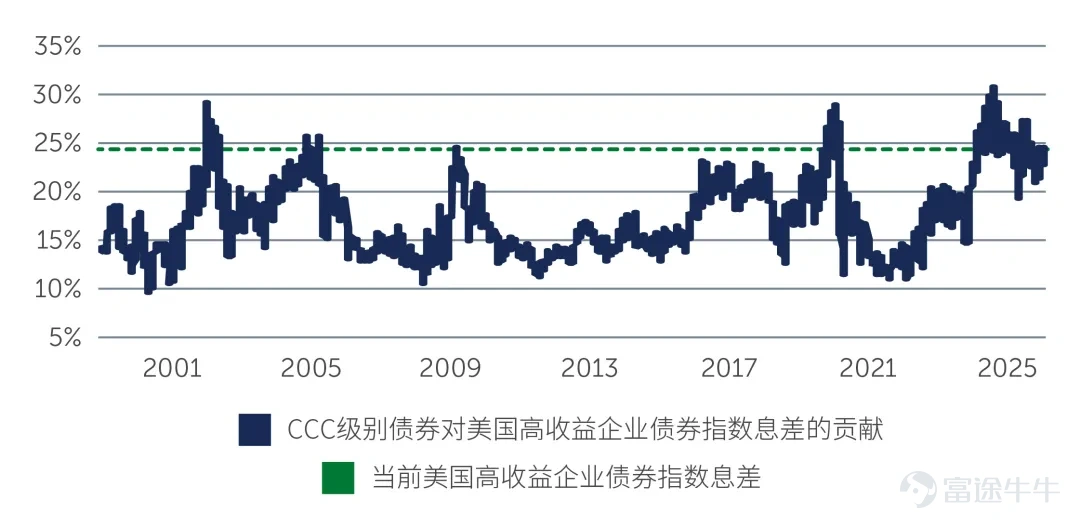
As shown in Figure 1, CCC-rated bonds account for only about 12% of the weight in the U.S. high yield corporate bond index but contribute nearly a quarter of the index spread. This meansCCC-rated bonds contribute disproportionately more to the index spread than their market share suggests,and even exceed their long-term average contribution levels. Given that the U.S. economy has demonstrated stronger resilience compared to broader market expectations, select CCC-rated bonds have performed well. With sustained economic growth, market expectations for interest rate cuts may continue to decline, which not only supports credit fundamentals but also provides more room for lower-rated issuers.
Figure 1: The contribution of CCC-rated bonds to the U.S. high yield corporate bond index spread is approaching one-quarter.

Source: Barclays U.S. Corporate High Yield Index. As of December 2025.
Regional Opportunities:
– Europe: Select credits are expected to benefit from fiscal stimulus measures, such as those linked to improvements in construction activity and where initial momentum is already evident, offering potential investment opportunities.
– United States: Against a backdrop of still relatively robust economic conditions, combined with attractive quality spreads, selectively allocating to sectors that benefit from broadening profit trends remains appealing.
Across markets, the core focus has become quite clear:Concentrate on whether issuers have credible deleveraging plans, sustainably stable cash flows, and identifiable drivers.。
Key Insights
The global high-yield bond market started the new year on a relatively solid footing, butfuture performance may diverge.Despite overall corporate earnings growth, increased M&A activity, some market dislocations, and the US economy continuing to outperform expectations providing investment opportunities, valuations remain elevated and the macro environment is still evolving.
In this environment, investment performance willrely more on 'bottom-up' credit selection rather than market beta.Identifying issuers with continuously improving fundamentals and clear value drivers will be key to capturing the upside potential of the global high-yield bond market.
For the purposes of this document, high-yield bonds refer to bonds rated below investment grade. Sub-investment grade refers to a rating of “BB+” or lower assigned by rating agencies such as Standard & Poor's or Fitch Ratings, “Ba1” or lower assigned by Moody's Investors Service, or an equivalent rating from other internationally recognized rating agencies.
Important Information
This document is for informational purposes only and does not constitute an offer or solicitation to buy or sell any financial instrument or provide financial services. The information contained herein has been prepared without considering the investment objectives, financial situation, or specific needs of potential recipients. This document is not, nor should it be construed as, investment advice, recommendation, research, or a commitment. Prospective investors must independently assess the merits and risks associated with the investment in question and seek appropriate independent professional advice on investments, legal matters, taxation, accounting, or otherwise before making any investment decisions.
Unless otherwise specified, the views expressed in this document are those of Barings. These views are based on information available as of the date of preparation of this document and may be subject to change due to various factors after the publication date without further notice. To the extent possible, portions of this document are based on data believed to be from reliable sources. Barings has made every effort to ensure the accuracy of the data contained herein but makes no express or implied representation or warranty regarding its accuracy, completeness, or adequacy. Any forecasts contained in this document are based on Barings' opinions of the market at the time of compilation and are subject to many factors that may result in changes without prior notice.
Investment involves risks. Past performance is not indicative of future results. Investors should not make investment decisions based solely on this material. This document is issued by Barings Asset Management (Asia) Limited and has not been reviewed by the Securities and Futures Commission of Hong Kong.
Risk Disclaimer: The above content only represents the author's view. It does not represent any position or investment advice of Futu. Futu makes no representation or warranty.Read more


Comments
to post a comment
2