

Politician Portfolio Tracker | Decoding the Top Strategies of 'Capitol Hill Stock Guru' Pelosi: Swapping Stocks for Long-Dated Options, Doubling Down on Four Tech Giants—Is This a Strategy Worth Following?
Former House Speaker Pelosi disclosed her latest portfolio holdings, appearing to significantly reduce her stakes in tech giants’ common stocks while actually leveraging deep-in-the-money options to maintain long exposure until 2027. This article provides an in-depth analysis of the capital efficiency logic behind her 'stock replacement strategy' and her latest moves in AI energy and application layers.
In the US stock market, Capitol Hill has long been regarded as the legendary 'hotspot for excess returns.'Data shows that lawmakers consistently outperform the broader market with their investments, forming what appears to be an 'all-star lineup of stock gurus' within this elite club.
Among these top players, former House Speaker Nancy Pelosi is undoubtedly the 'lead trader.' Despite being embroiled in controversies over allegedly using political intelligence to boost family assets, this 'Capitol Hill stock guru’s' trading strategies remain highly watched—Today, Pelosi disclosed her latest portfolio moves as required by regulations.
At first glance, it seems Pelosi is selling Google, Amazon, Apple, and NVIDIA, raising concerns in the market about whether the 'guru is exiting.' However, a detailed breakdown of the trades reveals this is not an exit signal but rather an aggressive 'Stock Replacement Strategy.'

I. Core Operation Breakdown: Moving Away from Common Stocks, Embracing Long-Dated Options
According to the latest disclosure, Pelosi conducted bulk trades on several major tech stocks between mid-December last year and mid-January this year, including Google, Amazon, Apple, and NVIDIA. Specifically:
The Pelosi family executed a unified tactical move across the four tech giants: reducing/donating existing common stocks to free up substantial cash; buying long-term call options with extremely low strike prices, expiring on January 15, 2027.Details of operations on the four tech giants are as follows:
Donated 7,704 personally held shares to a 'Donor-Advised Fund';
Exercised 50 call options with a strike price of $150, representing 5,000 shares of Google stock;
Bought 20 call options with a strike price of $150 and an expiration date of January 15, 2027;
Sold 20,000 shares of Amazon stock;
Bought 20 call options with a strike price of $120 and an expiration date of January 15, 2027;
Exercised 50 call options with a strike price of $150, representing 5,000 shares;
Sold 45,000 shares of Apple stock;
Donated 28,200 personally held shares to a 'Donor-Advised Fund';
Bought 20 call options with a strike price of $100 and an expiration date of January 15, 2027;
Sold 20,000 shares of NVIDIA stock;
Bought 20 call options with a strike price of $100 and an expiration date of January 15, 2027;
Exercised 50 call options with a strike price of $80, representing 5,000 shares of NVIDIA stock.
Other individual stock operations are as follows:
$AllianceBernstein Holding (AB.US)$ : Bought 25,000 shares;
$PayPal (PYPL.US)$ : Sold 5,000 shares;
$Disney (DIS.US)$ : Sold 10,000 shares;
$Tempus AI (TEM.US)$ : Exercised 50 call options with a strike price of $20, representing 5,000 shares of stock;
$Vistra Energy (VST.US)$ : Exercised 50 call options with a strike price of $50, representing 5,000 shares of stock;
$Versant Media (VSNT.US)$ : Received 776 shares and cash due to the spin-off from Comcast.
II. How to interpret these transactions?
First, the Pelosi family executed a unified tactical move on the four major tech giants – dumping 'common stocks' and embracing 'long-term options'.This is known as the 'stock substitution strategy' in professional trading. Simply put, she sold off expensive stocks, freeing up a large amount of cash, and then used much less money to buy deep-in-the-money options. The benefits include the following three points:
1. Maximizing capital efficiency: The Delta value of deep-in-the-money options is close to 1, meaning that for every $1 increase in the stock price, the option price also rises by almost $1. Pelosi locked in the same upside gains using far less capital than holding common stock.
2. Built-in leverage and defense: The freed-up cash can be allocated to other low-risk investments (such as buying Treasury bonds or high-dividend stocks), while the maximum loss on the options is limited to the premium paid.
3. Strong bullish signal: Buying options expiring in 2027 shows her extremely high confidence in the trajectory of tech stocks over the next two years (especially in 2026).
Secondly, apart from the tech giants, Pelosi has also pointed out two very clear niche tracks for us:
1. The endgame for AI is energy:She exercised her options for $Vistra Energy (VST.US)$ 's stock. This is an independent power producer. The logic is solid: AI data centers are "electricity guzzlers," and power infrastructure is the "water and pickaxes" of the AI era. Pelosi is bullish not only on computing power but also on the energy that supports it!
2. AI application implementation:She exercised her options for $Tempus AI (TEM.US)$ , a company focused on applying AI to healthcare data analysis. This indicates her strategy has expanded from the 'hardware layer' to the 'application layer.'
3. Clearing out old assets:At the same time, she sold $PayPal (PYPL.US)$ and $Disney (DIS.US)$ . It seems that in the eyes of the 'Oracle of Omaha,' the stories of traditional payment and traditional media can no longer compete with hardcore technology.
Finally, Pelosi also built a barbell strategy that balances offense and defense.Among a group of aggressive tech stocks, she unusually opened a position of 25,000 shares in $AllianceBernstein Holding (AB.US)$ This is an old-school asset management company known for high dividends. It uses the substantial dividends from AllianceBernstein Holdings to provide continuous cash flow or cover time decay for tech stock options. This is a perfect 'barbell strategy' that combines aggressive offense with robust defense.
Third, how is Pelosi's track record?
There's a saying on Wall Street: to outperform Buffett, you still need Pelosi.
Pelosi’s 2025 portfolio gained 20.1% in floating profits, outperforming the S&P 500 index.In recent years, her stock holdings have consistently outperformed the broader market. Pelosi opposed the congressional ban on stock trading, stating that lawmakers should be able to participate in a 'free-market economy.'
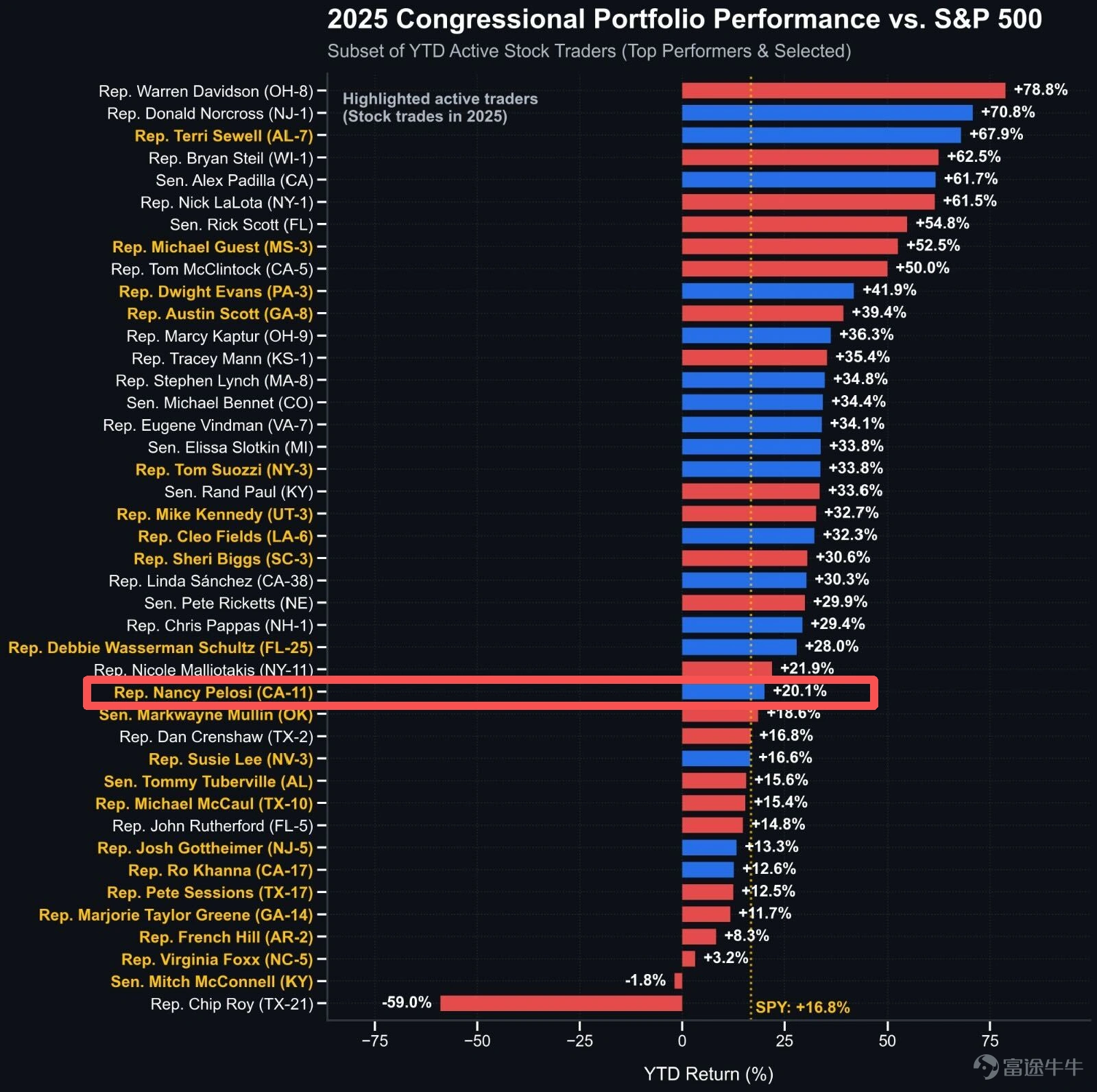
Notably, over the past decade, the investment returns of the Pelosi couple have been astonishingly high, with an estimated cumulative return of up to 838%, nearly triple that of the S&P 500 index (256%) during the same period.
However, Nancy Pelosi, the 85-year-old former Speaker of the US House of Representatives, announced at the end of 2025,that she will not seek re-election after completing her current term as a representative in 2027, concluding her forty-year career as a member of Congress.
Meanwhile, some in the market are attempting to directly replicate Pelosi's trading strategy. Dan Weiskopf, portfolio manager of the exchange-traded fund tracking Pelosi's holdings, $UNUSUAL WHALES SUBVERSIVE DEMOCRATIC TRADING ETF (NANC.US)$ stated,After Pelosi retires, he believes what he will miss most is Pelosi's trading strategy.The NANC, established in February 2023, currently has a total investment return rate of 88.87%, while the S&P 500's increase during the same period was 69.3%.

Weiskopf emphasized that the confidence and aggressiveness of Pelosi and others in trading are very high. The only reason is that their trades are not based on technical analysis but rather because they possess information about relevant companies, and they have a trading process that gives them full confidence.
He added thatPelosi’s trading style heavily uses options to leverage, while also committing large amounts of capital.And throughout this process, he did not see Pelosi exhibit any panic, nor did he observe her being inconsistent in her trading activities.
IV. Conclusion
Pelosi has announced that she will end her term as a Congresswoman in 2027, and the expiration date of her options also happens to be January 2027.This may be her last 'bull market feast' before the curtain falls on her political career. For investors, Pelosi’s homework conveys three signals:
1. The bull market is not over: The mid-to-long-term prospects for tech giants remain promising.
2. Focus on the main theme: Keep a close eye on AI computing power, energy infrastructure, and vertical applications.
3. Tool iteration: For high-priced tech stocks, utilizing options tools to improve capital efficiency might be a better choice.
Risk Disclaimer: The above content only represents the author's view. It does not represent any position or investment advice of Futu. Futu makes no representation or warranty.Read more


Comments (190)
to post a comment
227
320