
NVIDIA splashes $2 billion! Has the CRWV rebound cycle begun?

Options Trading Insights | NVIDIA Bets Big on CoreWeave with $2 Billion Investment! Stock Surges 17% Intraday; Capture AI Computing Volatility Opportunities with Options
This article comes from the 'Options Market Insights' column, which aims to position itself at the forefront of investment trends, providing readers with insights into market opportunities and teaching them how to seize these opportunities using options. If you are interested, feel free to subscribe.Click hereUpon joining the learning platform, you will receive notifications when subsequent columns are updated.
*The following content is for educational purposes only and does not constitute any investment advice. The information is time-sensitive, so please exercise caution in your judgment.
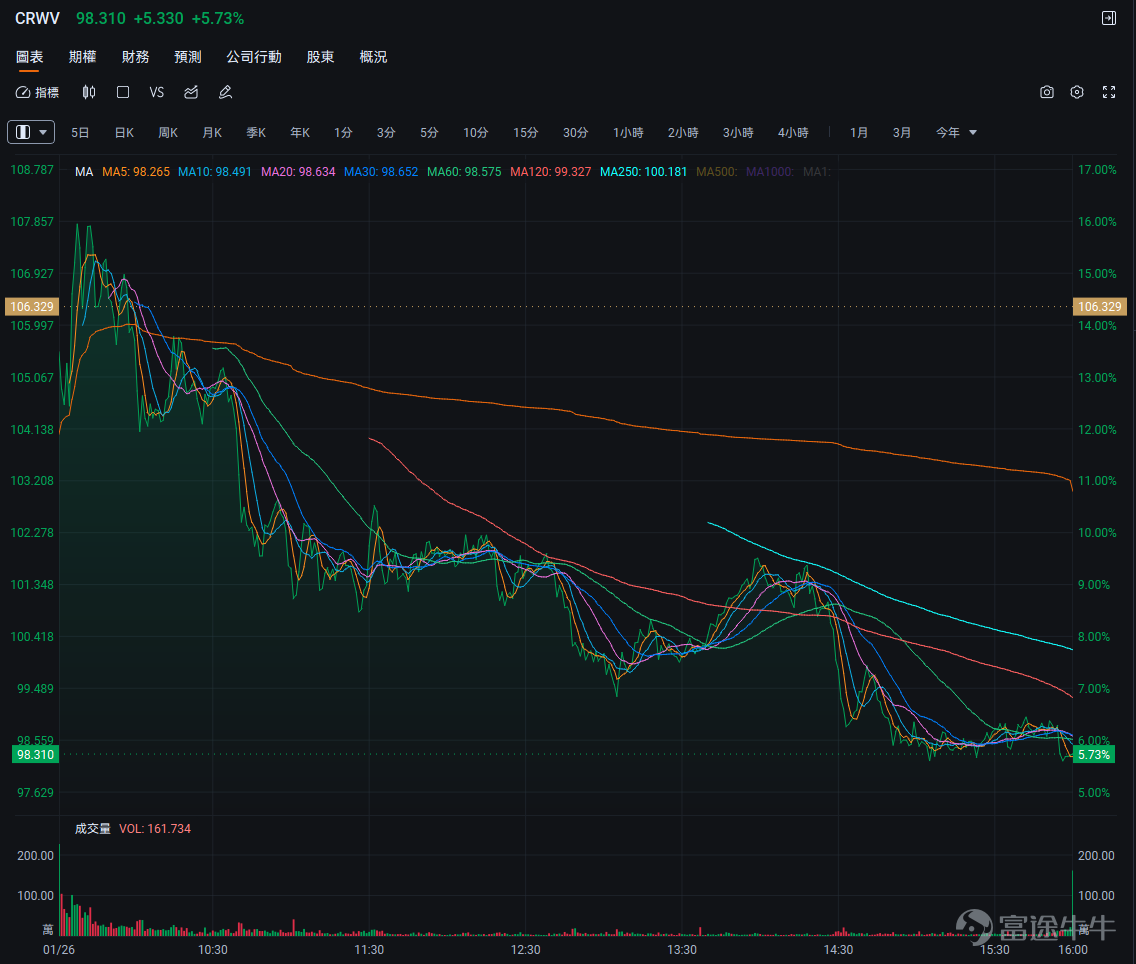
At the close of trading on January 26 Eastern Time, $CoreWeave (CRWV.US)$ the stock price rose by 5.73% to $98.31, with intraday gains reaching nearly 17%, hitting $108.65. The direct catalyst for this rally was $NVIDIA (NVDA.US)$ adding a $2 billion investment into this AI infrastructure company.
On the surface, this is a vote of confidence from a giant to an emerging AI infrastructure company, but behind it lies a more complex strategic game within the AI computing power industry. Below, we will break down the opportunities and risks involved.
![This article comes from the 'Options Market Insights' column, which aims to position itself at the forefront of investment trends, providing readers with insights into market opportunities and teaching them how to seize these opportunities using options. If you are interested, feel free to subscribe.[Share Link: Click here]Upon joining the learning platform, you will receive notifications when subsequent columns are updated. *The following content is for educational purposes only and does not constitute any investment advice. The information is time-sensitive, so please exercise caution in your judgment. Eastern Time, January 26th, $CoreWeave (CRWV.US)$ the stock closed up 5.73% at $98.31, with intraday gains reaching nearly 17%, hitting $108.65. The direct catalyst for this rally was $NVIDIA (NVDA.US)$ 's additional $2 billion investment in this AI infrastructure company. On the surface, this is a vote of confidence from a giant to an emerging AI infrastructure company, but behind it lies a more complex strategic game within the AI computing power industry. Below, we will break down the opportunities and risks involved. 1. Giant's Bet and Era Cycle: What did NVIDIA invest $2 billion in? NVIDIA purchased CoreWeave Class A common stock at a discounted price of $87.20 per share, adding a $2 billion investment.This funding will help CoreWeave build 5 gigawatts (GW) of AI computing power infrastructure by 2030 (i.e., "...](https://nnqimage.futunn.com/sns_client_feed/999908/20260127/web-1769505952563-IuWNss5BfA.png/big?area=2&is_public=true&imageMogr2/ignore-error/1/format/webp)
1. Giant's bet and era cycle: What did NVIDIA invest $2 billion in?
NVIDIA purchased CoreWeave Class A common stock at a discounted price of $87.20 per share, adding a $2 billion investment.This capital will help CoreWeave build 5 gigawatts (GW) of AI computing infrastructure ('AI factories') by 2030 — equivalent to the total capacity of several large data centers globally today. As part of the collaboration, CoreWeave will be among the first to deploy NVIDIA’s upcoming new products, including the Rubin platform, Vera CPU, and Bluefield storage system.
According to the subsequently published SEC filing (Form 13G/A), after the completion of the investment, NVIDIA will hold approximately 47.21 million shares of CoreWeave, accounting for 11.5%, becoming a major shareholder with over 10% ownership. This strengthens the existing capital ties between the two parties; previously, NVIDIA held about 4.87% through GPU Ventures and had committed to purchasing more than $6 billion worth of services from the company by 2032.
![This article comes from the 'Options Market Insights' column, which aims to position itself at the forefront of investment trends, providing readers with insights into market opportunities and teaching them how to seize these opportunities using options. If you are interested, feel free to subscribe.[Share Link: Click here]Upon joining the learning platform, you will receive notifications when subsequent columns are updated. *The following content is for educational purposes only and does not constitute any investment advice. The information is time-sensitive, so please exercise caution in your judgment. Eastern Time, January 26th, $CoreWeave (CRWV.US)$ the stock closed up 5.73% at $98.31, with intraday gains reaching nearly 17%, hitting $108.65. The direct catalyst for this rally was $NVIDIA (NVDA.US)$ 's additional $2 billion investment in this AI infrastructure company. On the surface, this is a vote of confidence from a giant to an emerging AI infrastructure company, but behind it lies a more complex strategic game within the AI computing power industry. Below, we will break down the opportunities and risks involved. 1. Giant's Bet and Era Cycle: What did NVIDIA invest $2 billion in? NVIDIA purchased CoreWeave Class A common stock at a discounted price of $87.20 per share, adding a $2 billion investment.This funding will help CoreWeave build 5 gigawatts (GW) of AI computing power infrastructure by 2030 (i.e., "...](https://nnqimage.futunn.com/sns_client_feed/999908/20260127/web-1769505951838-tAp4m3uBuc.png/big?area=2&is_public=true&imageMogr2/ignore-error/1/format/webp)
NVIDIA CEO Jensen Huang stated in an interview that this investment reflects confidence in CoreWeave’s growth prospects, management team, and business model. He also emphasized that the collaboration focuses more on integrating the technical R&D capabilities of both companies to accelerate the deployment of computing infrastructure.
However, it is estimated that the total investment in this AI factory could be as high as $75 billion, meaning the $2 billion is only a small portion of the massive capital expenditure CoreWeave needs to achieve its 5-gigawatt goal. CoreWeave's financing journey has just begun.
In his latest remarks, Huang Renxun refuted claims about 'AI cycle financing.' He emphasized that these investments represent only a small fraction of the overall infrastructure spending by relevant companies, pointing out that giants like Microsoft and Alphabet continue to pour substantial funds into new equipment because it helps consolidate and expand their existing businesses. Meanwhile, a group of AI-native startups active in areas such as automated programming, healthcare, and video editing are emerging in this wave, marking companies of great significance for this era.
From a broader historical perspective, we are at the starting point of a new Kondratiev Wave driven by artificial intelligence.Each technological revolution cycle lasting 50-60 years (such as the steam engine, railways, electricity, information technology) has been characterized early on by frenzied infrastructure construction. The current surge in AI computing power infrastructure mirrors the internet cable-laying boom of the late 1990s and the mobile communication base station construction wave in the early 2000s.
NVIDIA's collaboration with CoreWeave represents a key move in this grand process, aiming to build the power plants and transmission networks for the intelligent era of the future.
According to IMF forecasts: from 2025 to 2035, AI will contribute an additional 1.8% annual growth to global GDP, creating trillion-dollar new markets. The Kondratiev Wave driven by AI implies that infrastructure (computing power), core hardware (GPU/CPU), and application layers may see a 5-10 year investment window, but require strategic thinking based on industrial cycles rather than focusing on daily fluctuations.
2. Deep Game: From Ecosystem Binding to the 'Normandy Landing' of Vera CPU
Behind this investment lies a deeper bundling of resources and ecosystems.
NVIDIA's massive investment and long-term cooperation commitment serve as the strongest endorsement of the business model focused on 'an AI-native cloud powered by NVIDIA GPUs.' It can also be imagined that NVIDIA’s contributions will go far beyond capital; it will leverage its financial strength to help CoreWeave accelerate the acquisition of land, power, and data center shells, addressing the most critical and time-consuming bottlenecks in the expansion of computing power infrastructure.$CoreWeave (CRWV.US)$ This strong endorsement of 'a cloud native to NVIDIA GPU-powered AI' demonstrates the commercial viability of CoreWeave's strategy. In addition, NVIDIA’s contribution goes beyond funding, as it will deploy its financial resources to assist CoreWeave in accelerating access to land, electricity, and data center facilities—directly targeting the most crucial and time-intensive bottlenecks in scaling up computational infrastructure.
The agreement grants CoreWeave the right to prioritize the deployment of NVIDIA’s top-tier hardware for several future generations, meaning that CoreWeave will lead all competitors in access to cutting-edge computing resources. This advantage could translate into better service and pricing power for its clients.
For CoreWeave, which is still in a phase of rapid expansion and currently has negative free cash flow, the $2 billion direct investment significantly strengthens its balance sheet, providing the necessary capital for its large-scale capital expenditure plans.
For NVIDIA, making a substantial investment and forming a deep partnership with a top-tier downstream cloud computing provider aims to reinforce its control and influence over the entire AI computing ecosystem. This is akin to securing a major, prioritized showcase and application scenario for its top-tier chips. It is also the latest example of NVIDIA leveraging its vast resources to drive the broader artificial intelligence industry, as well as an essential component of NVIDIA's AI ecosystem.
The first standalone sale of the Vera CPU in this partnership represents a strategic move comparable in significance to the 'D-Day invasion.'
For a long time, data centers have been the stronghold of Intel and AMD’s CPUs, while GPUs have been NVIDIA’s foothold. The introduction of the Vera CPU signifies that NVIDIA has launched an all-out offensive, aiming to provide end-to-end integrated solutions for AI factories—from training (GPU) to inference (CPU). This directly challenges Intel and AMD’s position in the data center processor market and may also undermine the strategic value of Amazon and Google’s self-developed CPUs.
To understand the disruptive nature of this step, it is crucial to clarify the new division of labor between CPUs and GPUs in the AI era.
Traditionally, CPUs have been considered the brain of computing devices, responsible for logic control and general-purpose computing, while GPUs were initially designed for graphics rendering but gradually came to be used in scientific computing and AI training due to their strong parallel computing capabilities.
In different stages of AI applications, the two play distinct roles.
AI Training Phase: Dominated primarily by GPUs, especially NVIDIA products, which have almost monopolized this market. Training requires massive matrix computations, and the parallel architecture of GPUs perfectly meets this demand.
AI Inference Phase: CPUs begin to play a larger role. Inference workloads are more varied and require stronger single-thread performance and lower latency, areas where CPUs have traditionally excelled.
As AI models become larger and more complex, relying solely on GPUs for all AI workloads is becoming neither economical nor efficient. The industry is beginning to explore more specialized computing architectures.
NVIDIA’s introduction of the Vera CPU is essentially an attempt to create a complete AI computing stack from training to inference. Through optimized CPU design, NVIDIA aims to provide an end-to-end solution for AI workloads, further solidifying its dominance in the AI computing field.
For investors, this means that competition in the AI computing hardware market is expanding from a singular focus on GPU performance to a broader competition encompassing comprehensive computing architectures. Companies capable of providing full solutions will occupy a more advantageous position in the future market.
3. High potential coexists with high risk, and the market shows clear divergence between bulls and bears.
Returning to the substantive impact of this collaboration on investment, the core focus lies in$CoreWeave (CRWV.US)$ itself. NVIDIA's significant bet provides a blueprint for CoreWeave, but for investors, whether this blueprint can be translated into tangible stock price returns depends on how the company navigates its complex fundamentals characterized by both 'high potential' and 'high risk.'
The deep integration with NVIDIA undoubtedly forms CoreWeave’s strongest value support. This relationship not only translates into explosive growth across consecutive quarters in actual business operations (e.g., $1.365 billion in revenue for Q3 2025, a year-over-year increase of 133.7%) but also lends credibility to its massive backlog of contracts worth $55.6 billion.
In the battle for AI computing power, being part of 'NVIDIA’s inner circle' has become a powerful moat, giving it an irreplicable supply chain advantage and first-mover rights over traditional cloud providers or independent computing power lessors.
However, CoreWeave’s current Price-to-Sales ratio (PS TTM) stands at a high 11.38x, reflecting extremely high growth expectations already priced in. Any sign of future growth falling short of these expectations could trigger a stock price correction. Moreover, the company remains unprofitable (with a net loss of $110 million in Q3 2025), has a low current ratio (0.49), and a high debt-to-assets ratio (88.22%). Expansion under high debt poses a significant challenge for cash flow management.
Investing in CoreWeave today centers not on whether it has a bright future, but rather on whether it can convert astronomical orders and capacity plans into sustainable cash flow and profit at an acceptable cost and risk.The key catalysts for the future are mainly:
● Delivery milestones: Whether data centers can go online as planned, converting contract backlogs into realized revenue.
● Profitability inflection point: Whether gross margins can stabilize or improve as scale expands, proving the health of its business model.
● Financial structure optimization: Whether it can improve its debt structure without excessively diluting equity while expanding.
In summary, this is a typical growth stock investment with high risk and high potential returns. Investors' success or failure depends on whether they can remain confident in its long-term narrative while staying clear-headed about the fragility of its short-term execution, and prepare for possible sharp fluctuations.
Current market data perfectly reflects the significant divergence in fundamentals.
The stock price strongly rebounded on news stimulus, now challenging the key resistance level at $104 of the 200-day moving average.
However, multiple technical indicators (such as RSI_6) have signaled overbought conditions. Moreover, despite the stock price rising by 5.73% on January 26, there was net capital outflow that day, with both large and very large orders showing net outflows, creating a certain divergence from the price increase—a signal generally considered noteworthy.
![This article comes from the 'Options Market Insights' column, which aims to position itself at the forefront of investment trends, providing readers with insights into market opportunities and teaching them how to seize these opportunities using options. If you are interested, feel free to subscribe.[Share Link: Click here]Upon joining the learning platform, you will receive notifications when subsequent columns are updated. *The following content is for educational purposes only and does not constitute any investment advice. The information is time-sensitive, so please exercise caution in your judgment. Eastern Time, January 26th, $CoreWeave (CRWV.US)$ the stock closed up 5.73% at $98.31, with intraday gains reaching nearly 17%, hitting $108.65. The direct catalyst for this rally was $NVIDIA (NVDA.US)$ 's additional $2 billion investment in this AI infrastructure company. On the surface, this is a vote of confidence from a giant to an emerging AI infrastructure company, but behind it lies a more complex strategic game within the AI computing power industry. Below, we will break down the opportunities and risks involved. 1. Giant's Bet and Era Cycle: What did NVIDIA invest $2 billion in? NVIDIA purchased CoreWeave Class A common stock at a discounted price of $87.20 per share, adding a $2 billion investment.This funding will help CoreWeave build 5 gigawatts (GW) of AI computing power infrastructure by 2030 (i.e., "...](https://nnqimage.futunn.com/sns_client_feed/999908/20260127/web-1769505952566-6Mf8xXifLB.jpeg/big?area=2&is_public=true&imageMogr2/ignore-error/1/format/webp)
![This article comes from the 'Options Market Insights' column, which aims to position itself at the forefront of investment trends, providing readers with insights into market opportunities and teaching them how to seize these opportunities using options. If you are interested, feel free to subscribe.[Share Link: Click here]Upon joining the learning platform, you will receive notifications when subsequent columns are updated. *The following content is for educational purposes only and does not constitute any investment advice. The information is time-sensitive, so please exercise caution in your judgment. Eastern Time, January 26th, $CoreWeave (CRWV.US)$ the stock closed up 5.73% at $98.31, with intraday gains reaching nearly 17%, hitting $108.65. The direct catalyst for this rally was $NVIDIA (NVDA.US)$ 's additional $2 billion investment in this AI infrastructure company. On the surface, this is a vote of confidence from a giant to an emerging AI infrastructure company, but behind it lies a more complex strategic game within the AI computing power industry. Below, we will break down the opportunities and risks involved. 1. Giant's Bet and Era Cycle: What did NVIDIA invest $2 billion in? NVIDIA purchased CoreWeave Class A common stock at a discounted price of $87.20 per share, adding a $2 billion investment.This funding will help CoreWeave build 5 gigawatts (GW) of AI computing power infrastructure by 2030 (i.e., "...](https://nnqimage.futunn.com/sns_client_feed/999908/20260127/web-1769505952014-l1JFHwJncp.jpeg/big?area=2&is_public=true&imageMogr2/ignore-error/1/format/webp)
Additional data shows that CoreWeave's short-selling ratio is approximately 14%, higher than the market average, indicating a significant presence of bearish positions in the market.
![This article comes from the 'Options Market Insights' column, which aims to position itself at the forefront of investment trends, providing readers with insights into market opportunities and teaching them how to seize these opportunities using options. If you are interested, feel free to subscribe.[Share Link: Click here]Upon joining the learning platform, you will receive notifications when subsequent columns are updated. *The following content is for educational purposes only and does not constitute any investment advice. The information is time-sensitive, so please exercise caution in your judgment. Eastern Time, January 26th, $CoreWeave (CRWV.US)$ the stock closed up 5.73% at $98.31, with intraday gains reaching nearly 17%, hitting $108.65. The direct catalyst for this rally was $NVIDIA (NVDA.US)$ 's additional $2 billion investment in this AI infrastructure company. On the surface, this is a vote of confidence from a giant to an emerging AI infrastructure company, but behind it lies a more complex strategic game within the AI computing power industry. Below, we will break down the opportunities and risks involved. 1. Giant's Bet and Era Cycle: What did NVIDIA invest $2 billion in? NVIDIA purchased CoreWeave Class A common stock at a discounted price of $87.20 per share, adding a $2 billion investment.This funding will help CoreWeave build 5 gigawatts (GW) of AI computing power infrastructure by 2030 (i.e., "...](https://nnqimage.futunn.com/sns_client_feed/999908/20260127/web-1769505952257-OC0sOnhcrG.jpeg/big?area=2&is_public=true&imageMogr2/ignore-error/1/format/webp)
But aggressive bets have appeared in the options market. Some investors paid hefty premiums to buy call options expiring in two months with a strike price of $130, betting that the stock price will surge more than 30%.
![This article comes from the 'Options Market Insights' column, which aims to position itself at the forefront of investment trends, providing readers with insights into market opportunities and teaching them how to seize these opportunities using options. If you are interested, feel free to subscribe.[Share Link: Click here]Upon joining the learning platform, you will receive notifications when subsequent columns are updated. *The following content is for educational purposes only and does not constitute any investment advice. The information is time-sensitive, so please exercise caution in your judgment. Eastern Time, January 26th, $CoreWeave (CRWV.US)$ the stock closed up 5.73% at $98.31, with intraday gains reaching nearly 17%, hitting $108.65. The direct catalyst for this rally was $NVIDIA (NVDA.US)$ 's additional $2 billion investment in this AI infrastructure company. On the surface, this is a vote of confidence from a giant to an emerging AI infrastructure company, but behind it lies a more complex strategic game within the AI computing power industry. Below, we will break down the opportunities and risks involved. 1. Giant's Bet and Era Cycle: What did NVIDIA invest $2 billion in? NVIDIA purchased CoreWeave Class A common stock at a discounted price of $87.20 per share, adding a $2 billion investment.This funding will help CoreWeave build 5 gigawatts (GW) of AI computing power infrastructure by 2030 (i.e., "...](https://nnqimage.futunn.com/sns_client_feed/999908/20260127/web-1769505952565-KU8yhgJyEK.jpeg/big?area=2&is_public=true&imageMogr2/ignore-error/1/format/webp)
Meanwhile, the implied volatility of the stock surged to extremely high levels (over 100%), reflecting market expectations that its price will continue to experience sharp fluctuations, which also makes option prices abnormally expensive.
![This article comes from the 'Options Market Insights' column, which aims to position itself at the forefront of investment trends, providing readers with insights into market opportunities and teaching them how to seize these opportunities using options. If you are interested, feel free to subscribe.[Share Link: Click here]Upon joining the learning platform, you will receive notifications when subsequent columns are updated. *The following content is for educational purposes only and does not constitute any investment advice. The information is time-sensitive, so please exercise caution in your judgment. Eastern Time, January 26th, $CoreWeave (CRWV.US)$ the stock closed up 5.73% at $98.31, with intraday gains reaching nearly 17%, hitting $108.65. The direct catalyst for this rally was $NVIDIA (NVDA.US)$ 's additional $2 billion investment in this AI infrastructure company. On the surface, this is a vote of confidence from a giant to an emerging AI infrastructure company, but behind it lies a more complex strategic game within the AI computing power industry. Below, we will break down the opportunities and risks involved. 1. Giant's Bet and Era Cycle: What did NVIDIA invest $2 billion in? NVIDIA purchased CoreWeave Class A common stock at a discounted price of $87.20 per share, adding a $2 billion investment.This funding will help CoreWeave build 5 gigawatts (GW) of AI computing power infrastructure by 2030 (i.e., "...](https://nnqimage.futunn.com/sns_client_feed/999908/20260127/web-1769505952328-xNsFWiDbJq.png/big?area=2&is_public=true&imageMogr2/ignore-error/1/format/webp)
The analysts' consensus rating also shows significant divergence, with an average target price of $123.14, but a range spanning from a low of $36 to a high of $180, starkly revealing the gap in judgment among institutions. Optimists focus on its irreplaceable strategic positioning and explosive order flow, while cautious observers remain wary of its heavy debt burden and cash burn rate.
![This article comes from the 'Options Market Insights' column, which aims to position itself at the forefront of investment trends, providing readers with insights into market opportunities and teaching them how to seize these opportunities using options. If you are interested, feel free to subscribe.[Share Link: Click here]Upon joining the learning platform, you will receive notifications when subsequent columns are updated. *The following content is for educational purposes only and does not constitute any investment advice. The information is time-sensitive, so please exercise caution in your judgment. Eastern Time, January 26th, $CoreWeave (CRWV.US)$ the stock closed up 5.73% at $98.31, with intraday gains reaching nearly 17%, hitting $108.65. The direct catalyst for this rally was $NVIDIA (NVDA.US)$ 's additional $2 billion investment in this AI infrastructure company. On the surface, this is a vote of confidence from a giant to an emerging AI infrastructure company, but behind it lies a more complex strategic game within the AI computing power industry. Below, we will break down the opportunities and risks involved. 1. Giant's Bet and Era Cycle: What did NVIDIA invest $2 billion in? NVIDIA purchased CoreWeave Class A common stock at a discounted price of $87.20 per share, adding a $2 billion investment.This funding will help CoreWeave build 5 gigawatts (GW) of AI computing power infrastructure by 2030 (i.e., "...](https://nnqimage.futunn.com/sns_client_feed/999908/20260127/web-1769505952327-6jC6EIqitm.jpeg/big?area=2&is_public=true&imageMogr2/ignore-error/1/format/webp)
4. Option Strategies in High Volatility: Two Key Approaches to Reduce Costs and Control Risks
Facing$CoreWeave (CRWV.US)$For a stock with grand prospects, high volatility, and significant long-short divergence, simply buying the underlying stock or naked options is often not the optimal solution. Moreover, as mentioned earlier, a higher IV implies expensive option pricing, making it challenging for pure option buyers to reach breakeven points.
Therefore,In such cases, using combination strategies to 'reduce costs and control risks' may be more prudent.Below are two straightforward, highly practical strategies tailored to meet the needs of ordinary investors.
1) One approach is the Bull Call Spread — a bullish multi-strike call option strategy designed to address 'costly upside plays.'
If you believe in NVIDIA's endorsement effect and want to follow major players by betting on a rising stock price without paying expensive premiums, you can adopt a 'buy low, sell high' spread strategy. Purchase a call option with a lower strike price while selling another call option with a higher strike price, both with the same expiration date. Preferably choose contracts within three months with good liquidity.
The premium collected from selling the option can offset part of the cost of buying the option, significantly lowering the entry threshold and breakeven point. Although this strategy caps the maximum potential profit (any rise beyond the sold call’s strike price does not benefit the investor), in a high-volatility, expensive-option environment, this is a cost-effective choice to protect capital and manage risk.
Risk Warning: ① Time value erosion risk: If the stock price does not reach the expected increase before expiration, the option's value will gradually shrink as the expiration date approaches, potentially leading to losses; ② Downside loss risk: If the stock price falls below the strike price of the purchased Call, the maximum loss is the net premium cost; ③ Sudden negative news risk: If unexpected adverse events occur, such as delays in data center delivery or financing falling short of expectations, a sharp drop in stock price could very quickly lead to strategy losses exceeding expectations.
For specific profit and loss scenarios at expiration, refer to the illustration below (for educational purposes only, not representing any investment advice):
![This article comes from the 'Options Market Insights' column, which aims to position itself at the forefront of investment trends, providing readers with insights into market opportunities and teaching them how to seize these opportunities using options. If you are interested, feel free to subscribe.[Share Link: Click here]Upon joining the learning platform, you will receive notifications when subsequent columns are updated. *The following content is for educational purposes only and does not constitute any investment advice. The information is time-sensitive, so please exercise caution in your judgment. Eastern Time, January 26th, $CoreWeave (CRWV.US)$ the stock closed up 5.73% at $98.31, with intraday gains reaching nearly 17%, hitting $108.65. The direct catalyst for this rally was $NVIDIA (NVDA.US)$ 's additional $2 billion investment in this AI infrastructure company. On the surface, this is a vote of confidence from a giant to an emerging AI infrastructure company, but behind it lies a more complex strategic game within the AI computing power industry. Below, we will break down the opportunities and risks involved. 1. Giant's Bet and Era Cycle: What did NVIDIA invest $2 billion in? NVIDIA purchased CoreWeave Class A common stock at a discounted price of $87.20 per share, adding a $2 billion investment.This funding will help CoreWeave build 5 gigawatts (GW) of AI computing power infrastructure by 2030 (i.e., "...](https://nnqimage.futunn.com/sns_client_feed/999908/20260127/web-1769505952565-RpdbVi3pCe.jpeg/big?area=2&is_public=true&imageMogr2/ignore-error/1/format/webp)
2) Another strategy is the Cash-secured Put — addressing 'wanting to buy but finding it too expensive.'
If you are fundamentally bullish on CoreWeave in the long term, are willing to hold its stock, but feel that the current price of $98 is technically overbought and prefer to wait for a pullback before entering, you can consider selling Put options at your target price. It’s recommended to choose an expiration date within two months to avoid long-term time value erosion.
This strategy can capitalize on the currently high IV values to collect relatively substantial premiums. If the stock price pulls back and falls below the strike price, investors must purchase the stock at the agreed price, with the actual purchase cost being the strike price minus the per-share premium, which is more cost-effective than buying directly through a limit order. If the stock price doesn’t fall but instead rises, not breaching the strike price, the investor earns the full premium, bolstering cash flow.
Risk Warning: ① Forced purchase risk: If the stock price plunges significantly below the strike price, the investor must buy the stock at the agreed price, possibly facing losses from a sharp short-term decline in the underlying stock; ② Missed opportunity risk: If the stock price doesn’t pull back but instead surges sharply, the chance to buy the stock at a lower price will be missed, leaving the investor with only limited premium earnings; ③ Cash-secured risk: Ensure the account has sufficient cash for fulfillment; otherwise, margin default risks may arise.
For specific profit and loss scenarios at expiration, refer to the illustration below (for educational purposes only, not representing any investment advice):
![This article comes from the 'Options Market Insights' column, which aims to position itself at the forefront of investment trends, providing readers with insights into market opportunities and teaching them how to seize these opportunities using options. If you are interested, feel free to subscribe.[Share Link: Click here]Upon joining the learning platform, you will receive notifications when subsequent columns are updated. *The following content is for educational purposes only and does not constitute any investment advice. The information is time-sensitive, so please exercise caution in your judgment. Eastern Time, January 26th, $CoreWeave (CRWV.US)$ the stock closed up 5.73% at $98.31, with intraday gains reaching nearly 17%, hitting $108.65. The direct catalyst for this rally was $NVIDIA (NVDA.US)$ 's additional $2 billion investment in this AI infrastructure company. On the surface, this is a vote of confidence from a giant to an emerging AI infrastructure company, but behind it lies a more complex strategic game within the AI computing power industry. Below, we will break down the opportunities and risks involved. 1. Giant's Bet and Era Cycle: What did NVIDIA invest $2 billion in? NVIDIA purchased CoreWeave Class A common stock at a discounted price of $87.20 per share, adding a $2 billion investment.This funding will help CoreWeave build 5 gigawatts (GW) of AI computing power infrastructure by 2030 (i.e., "...](https://nnqimage.futunn.com/sns_client_feed/999908/20260127/web-1769505952259-iqxQ04YTev.jpeg/big?area=2&is_public=true&imageMogr2/ignore-error/1/format/webp)
If you want more inspiration regarding options strategies, you can easily get it on the mobile app or the new desktop version by following these steps!
![This article comes from the 'Options Market Insights' column, which aims to position itself at the forefront of investment trends, providing readers with insights into market opportunities and teaching them how to seize these opportunities using options. If you are interested, feel free to subscribe.[Share Link: Click here]Upon joining the learning platform, you will receive notifications when subsequent columns are updated. *The following content is for educational purposes only and does not constitute any investment advice. The information is time-sensitive, so please exercise caution in your judgment. Eastern Time, January 26th, $CoreWeave (CRWV.US)$ the stock closed up 5.73% at $98.31, with intraday gains reaching nearly 17%, hitting $108.65. The direct catalyst for this rally was $NVIDIA (NVDA.US)$ 's additional $2 billion investment in this AI infrastructure company. On the surface, this is a vote of confidence from a giant to an emerging AI infrastructure company, but behind it lies a more complex strategic game within the AI computing power industry. Below, we will break down the opportunities and risks involved. 1. Giant's Bet and Era Cycle: What did NVIDIA invest $2 billion in? NVIDIA purchased CoreWeave Class A common stock at a discounted price of $87.20 per share, adding a $2 billion investment.This funding will help CoreWeave build 5 gigawatts (GW) of AI computing power infrastructure by 2030 (i.e., "...](https://nnqimage.futunn.com/sns_client_feed/999908/20260127/web-1769505953903-M4PifGyuTb.png/big?area=2&is_public=true&imageMogr2/ignore-error/1/format/webp)
5, Conclusion: In the frenzy of AI infrastructure development, maintain respect and rationality.
NVIDIA$CoreWeave (CRWV.US)$ An additional $2 billion investment, while seemingly a straightforward capital bet, represents a critical layout in the integration of the AI computing power industry ecosystem—allowing NVIDIA to strengthen its control over the AI computing ecosystem and launch a comprehensive offensive in the data center CPU market with its Vera CPU. CoreWeave, leveraging this partnership, gains significant support and secures a position in the core track of AI computing infrastructure.
From an investment perspective, CoreWeave represents a typical target with both high potential and high risk in the new AI Kondratiev cycle: $55.6 billion in orders and deep integration with NVIDIA form its core strengths, but issues such as high debt and delivery pressures also mean its stock price will experience significant volatility, making it difficult to reconcile bullish and bearish positions in the short term.
For investors, blindly chasing gains or fleeing losses is not wise: in the short term, beware of risks from technical overbuying and expensive options, which can be mitigated through appropriate option combination strategies to reduce costs and control risks; in the long term, focus on core catalysts, tracking improvements in data center deliveries, profitability, and financial structure.
CoreWeave's success hinges on its ability to transform its grand blueprint into solid performance; for investors, success depends on maintaining a clear sense of risk while believing in the long-term narrative, using rational strategies to hedge volatility and seize opportunities amid fluctuations.
Alright, that's it for today. Welcome.Click hereJoin the learning group, and you will receive notifications when new updates to the column are published. We also strongly welcome any specific content suggestions!
Finally, here’s a small perk for fellow investors. Welcome to claim it!Options Beginner's Package(*This event is exclusively for HK invited users. Click to learn more.Detailed event rules>>)
Risk Disclaimer: The above content only represents the author's view. It does not represent any position or investment advice of Futu. Futu makes no representation or warranty.Read more


Comments (2)
to post a comment
17
46