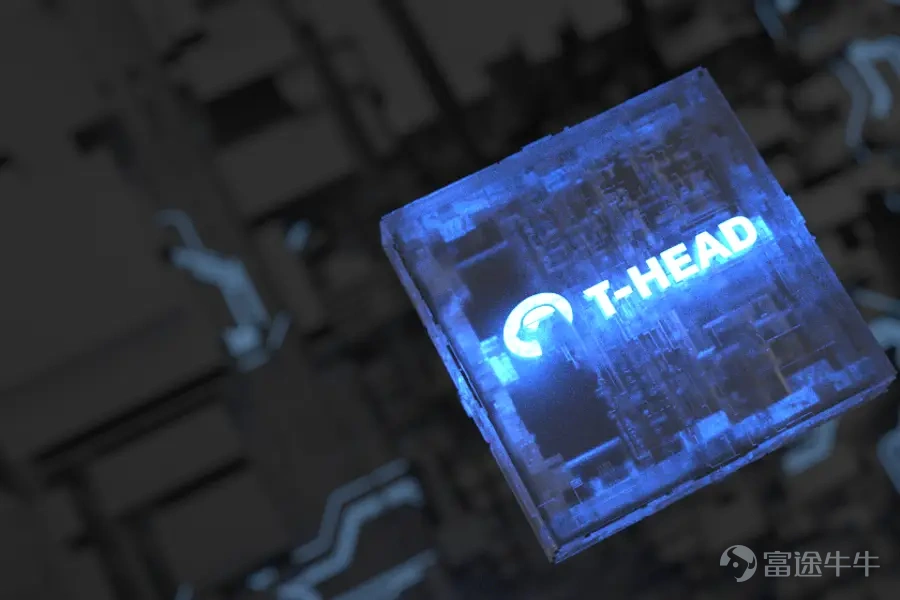

Reports suggest Alibaba’s semiconductor unit, 'Pingtouge,' may be spun off for an IPO

T-Head's Valuation Attracts Attention as Alibaba Plans to Spin Off a New Future
Reports indicate that Chinese e-commerce giant Alibaba is considering spinning off its chip business, T-Head, for an independent listing, following a similar strategy adopted by another major player, Baidu.

Key points:
* Reports suggest that Alibaba is evaluating the feasibility of spinning off its subsidiary Pingtouge for an independent listing, aiming to join the ranks of highly valued Chinese AI chip companies
* Competitor Biren Technology's stock price has nearly doubled since its January 2 listing in Hong Kong, while Moore Threads' shares have surged almost fourfold since its December listing in Shanghai
This article was authored by Yang Ge
If one key doesn't open a lock, try another. This seems to be the latest portrayal of e-commerce giant $Alibaba (BABA.US)$Reports indicate that the company is considering spinning off its chip division, Pingtouge Semiconductor Co., Ltd., and seeking an independent listing
If this plan comes to fruition, this divestiture action, often referred to as 'unlocking shareholder value,' will occur nearly three years after Alibaba announced its split into six business units with some or all pursuing independent listings during a major restructuring. Those familiar with the matter know that the original plan was never realized, and Alibaba has largely maintained its current structure ever since
Ironically, Pingtouge, now on the potential divestiture list, is closely tied to Alibaba’s cloud intelligence business. Despite Pingtouge's official website describing itself merely as 'the wholly-owned semiconductor chip business entity under Alibaba Group.' Among the original group's divestiture plans, cloud intelligence was among the first businesses to abandon the spin-off due to reasons including U.S. export controls restricting Chinese companies from purchasing advanced AI chips from $NVIDIA (NVDA.US)$American suppliers like NVIDIA
Pingtouge and a growing number of Chinese chip startups are attempting to fill this gap by independently developing AI chips, formally known as graphics processing units (GPUs). Some of these companies belong to large technology conglomerates, such as HiSilicon under Huawei, and $Baidu (BIDU.US)$Kunlun Chip under Baidu
Others are independently operated startups, such as $Moore Threads Technology (688795.SH)$、 $Cambricon (688256.SH)$and $BIREN TECH (06082.HK)$, the share prices of these companies have all surged significantly recently. Since its listing on January 2, Biren Technology's stock price has nearly doubled; Moore Threads, since its IPO in December last year, has accumulated gains exceeding fourfold. The price-to-sales ratios (P/S) of the three companies have now reached triple digits, with Moore Threads and Biren Technology’s P/S ratios both surpassing 200 times.
In comparison, NVIDIA currently has a price-to-sales ratio of only 24 times, while what is considered a second-tier GPU manufacturer, $Marvell Technology (MRVL.US)$, has a P/S ratio as low as 9.2 times. The sky-high valuations of Chinese chip companies are evidently one of the key reasons why Alibaba is considering a spin-off at this moment. The market generally expects that China will provide substantial policy and financial support for these enterprises as part of efforts to reduce reliance on Western technology.
However, doubts remain as to whether these valuations are already excessively high, and once the current uptrend in Hong Kong stocks and A-shares comes to an end, a correction may follow.
Against this backdrop, it is not surprising that Alibaba is accelerating the spin-off plan for Pingtouge. The company clearly hopes to seize the opportunity while valuations are high to raise significant capital to sustain the business’s ongoing operations. In fact, almost all GPU companies are currently in a phase of heavy cash burn, and the capital markets are one of the main drivers keeping them operational.
First to disclose the news was a Bloomberg report, which stated that under a potential spin-off plan, Alibaba would first restructure Pingtouge, introduce an employee stock ownership scheme, and then assess the possibility of going public. Although the report pointed out that the IPO timeline has not yet been finalized, given the current high market enthusiasm, the process is not expected to be delayed for long and could start within the next three to four months.
Following in Baidu's footsteps
Alibaba is not the only tech giant speeding up the spin-off and listing of its chip business. Just last month, Baidu, the search engine leader actively expanding into autonomous driving, alsoannouncedPlans to spin off its subsidiary Kunlun Chip have been announced. According to media reports, the fundraising scale of this deal could reach up to $20 billion. Kunlun Chip initially mainly supplied chips for Baidu's internal use, but in recent years, it has also started selling products externally, such as supplying large telecom operators like China Mobile.
Pingtouge's development path is similar to that of Kunlun Chip, and it has also begun selling chips externally to China Unicom, the country's second-largest telecom operator. China Mobile and China Unicom are the two major operators most actively building new-generation data centers domestically. These facilities will become important hubs for AI computing power in the future, creating a huge demand for chips. Alibaba's cloud business itself operates a large number of data centers in China and overseas, which was one of the key reasons the company decided to establish an internal chip division.
The potential spin-off plans have brought significant benefits to the share prices of Alibaba and Baidu. Following the Bloomberg report, Alibaba's stock listed in New York rose by 5% on Thursday. Over the past 52 weeks, Alibaba's share price has more than doubled, outperforming the 56% increase of Tencent, China's largest internet company, during the same period. The recent rise in share price has also pushed Alibaba's market value to $423 billion, narrowing the gap with Tencent's market value of $693 billion.
In terms of price-to-earnings (P/E) ratio, Alibaba's recent rise has allowed it to catch up with Tencent, with both companies currently at around 24 times, higher than the leading food delivery platform.$MEITUAN-W (03690.HK)$which is at 19 times, and significantly higher than Temu's parent company. $PDD Holdings (PDD.US)$which is only about 11 times.
It remains to be seen where Pingtouge and Kunlun Chip will eventually choose to list. Our speculation is that both may prefer Hong Kong, which has a higher degree of internationalization, reflecting their global ambitions while also considering Hong Kong's relatively rational market valuation. At the same time, it raises the question of whether Huawei might also consider a similar spin-off for its HiSilicon chip division, given that its Kunpeng series chips are widely regarded as some of the most advanced products in China.
If Pingtouge successfully spins off, it will continue a series of relatively positive developments for Alibaba. After the original group spin-off plan fell through, Alibaba's stock price remained low for a period. The company’s latest earnings show that revenue for the quarter ending September increased by 5% year-over-year to 248 billion yuan; excluding two large offline retail assets currently being sold, actual growth could reach 15%.
The cloud business remains one of Alibaba's brightest sectors, with quarterly revenue growing 34% year-on-year to approximately 40 billion yuan, accounting for about 16% of the group's total revenue. Another growth driver comes from the instant retail business, where Alibaba has integrated Ele.me’s food delivery service into Taobao’s instant retail offering. This business falls under the 'instant e-commerce' segment, which saw revenue surge 60% year-on-year to 23 billion yuan in the September quarter, accounting for 17% of core e-commerce revenue.
Overall, Alibaba's spin-off plan reflects a clear alignment with current trends, driven by investors’ high valuations of Chinese AI chip companies. If the plan proceeds, coupled with strong growth in cloud services and instant retail businesses, it could provide further momentum for Alibaba's stock price as it regains its former glory.
Risk Disclaimer: The above content only represents the author's view. It does not represent any position or investment advice of Futu. Futu makes no representation or warranty.Read more

Comments
to post a comment
3