
HKEJ Podcast analyzes price drop with increasing volume, focusing on Tencent's key support at HKD 582
Recently, the share price trend of Tencent has become a focal point in the market. After breaking below the key psychological level of HKD 600, the divergence between bulls and bears has significantly intensified. On one hand, some market analysts suggest a potential 'triple bottom' technical pattern in its share price; on the other hand, concerns from major banks about slowing short-term earnings growth have also pressured the stock. This article will integrate the latest market dynamics, institutional views, and technical charts to deeply analyze the core bullish and bearish logic behind Tencent's share price and explore how to use derivatives to find opportunities amid volatility.
Market Bull-Bear Tug-of-War: The Battle Between Technical Patterns and Fundamental Expectations
The current market discussion surrounding Tencent reflects a delicate balance between optimistic technical signals and cautious fundamental expectations. On the positive side, technical charts provide potential support clues. Some market analysts point out that Tencent’s recent share price movements show signs of forming a 'triple bottom' technical pattern. This is a bullish signal worth watching, indicating that the share price has repeatedly found support at a certain level. If an upward breakout can be confirmed eventually, it may imply the formation of a short-term bottom and a reversal in trend.
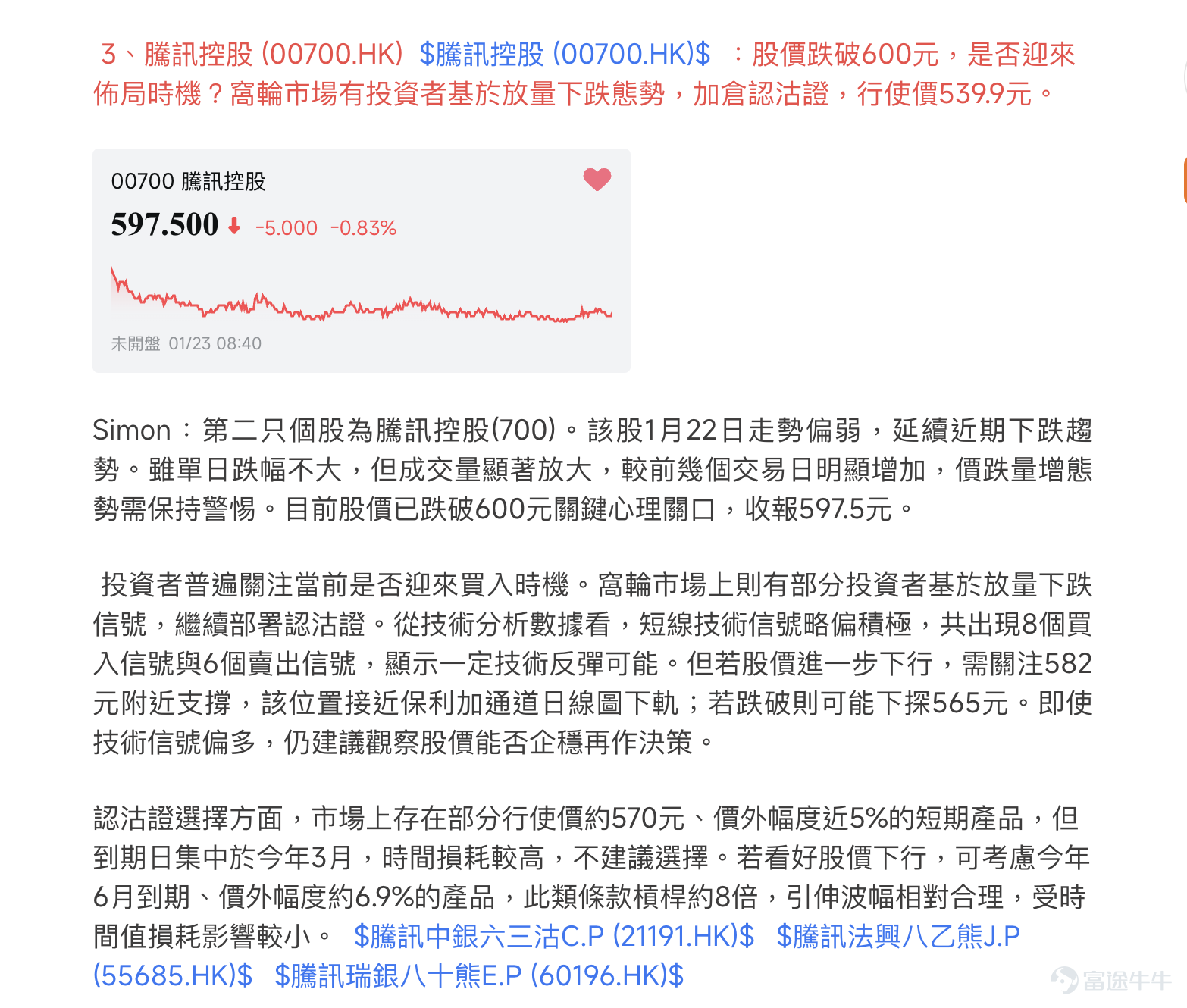
[HKEJ Podcast] In the January 22 commentary, a concerning signal was specifically highlighted: Tencent experienced a significant increase in trading volume alongside a falling share price, creating a 'price down, volume up' situation. This typically indicates heavy selling pressure and is not an optimistic sign. This contradiction between technical and fundamental signals explains why the share price has been fiercely contested around HKD 600. Some capital sees pullbacks as an opportunity to accumulate positions, while other funds choose to exit or deploy short positions due to growth concerns.
Technical Analysis: Precise Calculation of Key Support and Resistance
From a purely technical perspective, Tencent's share price is oscillating around several clear key levels, which will serve as important benchmarks for determining the short-term direction. Based on the latest technical data, Tencent’s primary support level is near HKD 582. This level is crucial because if it is decisively broken, the share price may further decline to a deeper support at HKD 565. This aligns with Simon, the host of [HK Stocks Podcast], who emphasized that HKD 582 is a key support level to watch.
![Recently, the share price trend of Tencent has become a focal point in the market. After breaking below the key psychological level of HKD 600, the divergence between bulls and bears has significantly intensified. On one hand, some market analysts suggest a potential 'triple bottom' technical pattern in its share price; on the other hand, concerns from major banks about slowing short-term earnings growth have also pressured the stock. This article will integrate the latest market dynamics, institutional views, and technical charts to deeply analyze the core bullish and bearish logic behind Tencent's share price and explore how to use derivatives to find opportunities amid volatility. Market Bull-Bear Tug-of-War: The Battle Between Technical Patterns and Fundamental Expectations The current market discussion surrounding Tencent reflects a delicate balance between optimistic technical signals and cautious fundamental expectations. On the positive side, technical charts provide potential support clues. Some market analysts point out that Tencent’s recent share price movements show signs of forming a 'triple bottom' technical pattern. This is a bullish signal worth watching, indicating that the share price has repeatedly found support at a certain level. If an upward breakout can be confirmed eventually, it may imply the formation of a short-term bottom and a reversal in trend. [Share Link: January 22nd [Hong Kong Stock Podcast] - Hang Seng Index, Tencent, Li Auto, Alibaba, Pop Mart, China Unicom] [HKEJ Podcast] In the January 22 commentary, a concerning signal was specifically highlighted: Tencent experienced a significant increase in trading volume alongside a falling share price, creating a 'price down, volume up' situation. This typically indicates heavy selling pressure and is not an optimistic sign...](https://nnqimage.futunn.com/sns_client_feed/1162342/20260123/web-1769139133107-dDmTkcft7i.png/big?area=1&is_public=true&imageMogr2/ignore-error/1/format/webp)
On the resistance side, any price rebound will face significant challenges. The first major resistance level is near HKD 616. If this level is breached, the next target would be HKD 631. Notably, these two resistance levels may overlap with the potential neckline of an observed 'triple bottom' pattern or previous rebound highs, adding complexity to breaking through them.
Technical indicators show divergence. Although the overall technical signal suggests a 'buy', with more short-term buy signals (8) than sell signals (6), multiple oscillation indicators such as the Williams %R and Stochastic Oscillator still indicate sell or neutral signals. This inconsistency suggests that market momentum remains divided, making it critical whether the stock can stabilize above HKD 582 and gather enough strength to challenge the HKD 616 resistance, determining the short-term balance between bulls and bears.
![Recently, the share price trend of Tencent has become a focal point in the market. After breaking below the key psychological level of HKD 600, the divergence between bulls and bears has significantly intensified. On one hand, some market analysts suggest a potential 'triple bottom' technical pattern in its share price; on the other hand, concerns from major banks about slowing short-term earnings growth have also pressured the stock. This article will integrate the latest market dynamics, institutional views, and technical charts to deeply analyze the core bullish and bearish logic behind Tencent's share price and explore how to use derivatives to find opportunities amid volatility. Market Bull-Bear Tug-of-War: The Battle Between Technical Patterns and Fundamental Expectations The current market discussion surrounding Tencent reflects a delicate balance between optimistic technical signals and cautious fundamental expectations. On the positive side, technical charts provide potential support clues. Some market analysts point out that Tencent’s recent share price movements show signs of forming a 'triple bottom' technical pattern. This is a bullish signal worth watching, indicating that the share price has repeatedly found support at a certain level. If an upward breakout can be confirmed eventually, it may imply the formation of a short-term bottom and a reversal in trend. [Share Link: January 22nd [Hong Kong Stock Podcast] - Hang Seng Index, Tencent, Li Auto, Alibaba, Pop Mart, China Unicom] [HKEJ Podcast] In the January 22 commentary, a concerning signal was specifically highlighted: Tencent experienced a significant increase in trading volume alongside a falling share price, creating a 'price down, volume up' situation. This typically indicates heavy selling pressure and is not an optimistic sign...](https://nnqimage.futunn.com/sns_client_feed/1162342/20260123/web-1769139098141-bsI6HXTv85.png/big?area=1&is_public=true&imageMogr2/ignore-error/1/format/webp)
Review of Warrants and Bull/Bear Contracts: Market Sentiment 'Amplifiers' and Efficient Tools
Warrants (call options) and bull/bear contracts, as derivatives linked to underlying stocks, offer the core advantage of providing higher capital efficiency compared to direct stock investment. They allow investors to track share price fluctuations with relatively less capital while offering flexible long/short directional choices. Reviewing the performance of certain products mentioned on January 19 over the following two days (as of January 21), one can clearly observe this feature: when Tencent shares fell by about 1.23%, related bearish products saw significant amplified gains. Among them, UBS Group’s bear contract (60196) rose by 22%, Xinyi Put Warrant (21495) increased by 21%, and UBS Group’s bear contract (55636) and Bank of China Put Warrant (21191) also recorded respective rises of 15%. This vividly demonstrates the ability of leveraged products to capture price movements when direction predictions are correct.
![Recently, the share price trend of Tencent has become a focal point in the market. After breaking below the key psychological level of HKD 600, the divergence between bulls and bears has significantly intensified. On one hand, some market analysts suggest a potential 'triple bottom' technical pattern in its share price; on the other hand, concerns from major banks about slowing short-term earnings growth have also pressured the stock. This article will integrate the latest market dynamics, institutional views, and technical charts to deeply analyze the core bullish and bearish logic behind Tencent's share price and explore how to use derivatives to find opportunities amid volatility. Market Bull-Bear Tug-of-War: The Battle Between Technical Patterns and Fundamental Expectations The current market discussion surrounding Tencent reflects a delicate balance between optimistic technical signals and cautious fundamental expectations. On the positive side, technical charts provide potential support clues. Some market analysts point out that Tencent’s recent share price movements show signs of forming a 'triple bottom' technical pattern. This is a bullish signal worth watching, indicating that the share price has repeatedly found support at a certain level. If an upward breakout can be confirmed eventually, it may imply the formation of a short-term bottom and a reversal in trend. [Share Link: January 22nd [Hong Kong Stock Podcast] - Hang Seng Index, Tencent, Li Auto, Alibaba, Pop Mart, China Unicom] [HKEJ Podcast] In the January 22 commentary, a concerning signal was specifically highlighted: Tencent experienced a significant increase in trading volume alongside a falling share price, creating a 'price down, volume up' situation. This typically indicates heavy selling pressure and is not an optimistic sign...](https://nnqimage.futunn.com/sns_client_feed/1162342/20260123/web-1769139147446-XmBf1z846f.png/big?area=1&is_public=true&imageMogr2/ignore-error/1/format/webp)
Product Deployment Strategies Under Current Market Conditions
Given that the share price is at a critical juncture, regardless of whether one anticipates a technical rebound or guards against further declines, investors can make targeted deployments using derivatives with varying terms. The key is to match product terms with personal judgments of support/resistance levels and risk tolerance.
If the belief is that the share price will rebound from key support levels, attention can be focused on call warrants or bull contracts.
* Call Warrants: Suitable for investors who want to purely speculate on share price increases and prefer not to have their positions prematurely closed due to short-term volatility. For example, HSBC Call Warrant (15275) and UBS Group Call Warrant (15002). $UBTENCT@EC2607A.C (15002.HK)$$UBTENCT@EC2607A.C (15002.HK)$ The strike price for both is 622.72 yuan. This strike price is slightly higher than the first resistance level at 616 yuan. If investors believe the stock price can break through this resistance and continue to rise, this clause allows for upside potential. Both provide approximately 7x effective leverage. When choosing, it is important to carefully evaluate the remaining maturity to manage the impact of time decay.
* Bull certificates: Suitable for investors who have strong confidence in key support levels such as 582 yuan and 565 yuan and seek higher capital efficiency. For example, J.P. Morgan bull certificate (67638) with a call price of 574 yuan and BNP Paribas bull certificate (63246) with a call price of 576 yuan. $BP#TENCTRC2606E.C (63246.HK)$ These two call prices are set between the current share price and the first support level of 582 yuan, making them more aggressive choices that offer 19-22x high leverage. This means higher sensitivity to rebounds in the underlying stock, but also requires caution, as the risk of hitting the call price increases if the stock price quickly tests support.
![Recently, the share price trend of Tencent has become a focal point in the market. After breaking below the key psychological level of HKD 600, the divergence between bulls and bears has significantly intensified. On one hand, some market analysts suggest a potential 'triple bottom' technical pattern in its share price; on the other hand, concerns from major banks about slowing short-term earnings growth have also pressured the stock. This article will integrate the latest market dynamics, institutional views, and technical charts to deeply analyze the core bullish and bearish logic behind Tencent's share price and explore how to use derivatives to find opportunities amid volatility. Market Bull-Bear Tug-of-War: The Battle Between Technical Patterns and Fundamental Expectations The current market discussion surrounding Tencent reflects a delicate balance between optimistic technical signals and cautious fundamental expectations. On the positive side, technical charts provide potential support clues. Some market analysts point out that Tencent’s recent share price movements show signs of forming a 'triple bottom' technical pattern. This is a bullish signal worth watching, indicating that the share price has repeatedly found support at a certain level. If an upward breakout can be confirmed eventually, it may imply the formation of a short-term bottom and a reversal in trend. [Share Link: January 22nd [Hong Kong Stock Podcast] - Hang Seng Index, Tencent, Li Auto, Alibaba, Pop Mart, China Unicom] [HKEJ Podcast] In the January 22 commentary, a concerning signal was specifically highlighted: Tencent experienced a significant increase in trading volume alongside a falling share price, creating a 'price down, volume up' situation. This typically indicates heavy selling pressure and is not an optimistic sign...](https://nnqimage.futunn.com/sns_client_feed/1162342/20260123/web-1769139172360-1qZOExJL0V.jpeg/big?area=1&is_public=true&imageMogr2/ignore-error/1/format/webp)
If the stock price is expected to continue testing support, put warrants or bear certificates can be considered.
* Put warrants: For example, J.P. Morgan put warrant (21612) with a strike price of 544.38 yuan. $JPTENCT@EP2603E.P (21612.HK)$ This price is close to the lower side of the deeper support level at 565 yuan, serving as a tool to bet on the possibility of the stock price breaking below the key support area, offering nearly 15x leverage. Similarly, when selecting such products, terms with longer remaining maturities should be prioritized to counteract the natural decay of time value.
* Bear certificates: Such as UBS Group bear certificate (58433) with a call price of 620 yuan. $UB#TENCTRP2812E.P (58433.HK)$ And UBS Group bear certificate (57455) with a call price of 630 yuan. $UB#TENCTRP2812D.P (57455.HK)$ These two call prices are set near and above the resistance level of 616 yuan, respectively, used as a strategy choice to bet on the stock price failing to rebound and subsequently falling again. Among them, the product with a call price of 620 yuan offers leverage as high as 26.6x, requiring greater accuracy in directional judgment.
![Recently, the share price trend of Tencent has become a focal point in the market. After breaking below the key psychological level of HKD 600, the divergence between bulls and bears has significantly intensified. On one hand, some market analysts suggest a potential 'triple bottom' technical pattern in its share price; on the other hand, concerns from major banks about slowing short-term earnings growth have also pressured the stock. This article will integrate the latest market dynamics, institutional views, and technical charts to deeply analyze the core bullish and bearish logic behind Tencent's share price and explore how to use derivatives to find opportunities amid volatility. Market Bull-Bear Tug-of-War: The Battle Between Technical Patterns and Fundamental Expectations The current market discussion surrounding Tencent reflects a delicate balance between optimistic technical signals and cautious fundamental expectations. On the positive side, technical charts provide potential support clues. Some market analysts point out that Tencent’s recent share price movements show signs of forming a 'triple bottom' technical pattern. This is a bullish signal worth watching, indicating that the share price has repeatedly found support at a certain level. If an upward breakout can be confirmed eventually, it may imply the formation of a short-term bottom and a reversal in trend. [Share Link: January 22nd [Hong Kong Stock Podcast] - Hang Seng Index, Tencent, Li Auto, Alibaba, Pop Mart, China Unicom] [HKEJ Podcast] In the January 22 commentary, a concerning signal was specifically highlighted: Tencent experienced a significant increase in trading volume alongside a falling share price, creating a 'price down, volume up' situation. This typically indicates heavy selling pressure and is not an optimistic sign...](https://nnqimage.futunn.com/sns_client_feed/1162342/20260123/web-1769139164943-PDWGj31fE1.jpeg/big?area=1&is_public=true&imageMogr2/ignore-error/1/format/webp)
Risk Warning: Warrants and bull/bear certificates are complex leveraged derivative products with extremely high risks. Their prices are affected not only by the underlying stock price but also by factors such as time decay, implied volatility, market liquidity, and mandatory call mechanisms (for bull/bear certificates). If the underlying stock price of a bull/bear certificate hits the call price, the product will terminate immediately, and investors may lose their entire principal. Investors must carefully read the relevant listing documents before trading to ensure full understanding of the product characteristics and risks.
Interaction and Questions
From the technical chart perspective, Tencent's stock price is testing a key support level. Which scenario do you think is more likely to occur next?
A. Stabilizing above 582 yuan and rebounding towards the resistance level at 616 yuan.
B. Breaking below the 582 yuan support level, further dropping to test 565 yuan.
C. Remaining in a narrow range between 582-616 yuan with limited volatility.
#Tencent Holdings #Technical Analysis #Support and Resistance Levels #Warrants #Bull and Bear Certificates #Triple Bottom #Time Value Decay #Hong Kong Stocks Short-term #Derivatives #Capital Flow
Friendly reminder: This article does not constitute any investment advice.
This article is for reference only and does not constitute any investment advice. The market data, opinions, and analyses contained herein may change at any time without prior notice. We assume no responsibility for any loss or damage resulting from reliance on the information provided in this article. Technical analysis only indicates whether certain technical conditions are met. A comprehensive evaluation of asset performance should be conducted by integrating additional data. Trading decisions should not be made solely based on this article. Please note that past performance is not indicative of future results. $Hang Seng Index (800000.HK)$$Hang Seng TECH Index (800700.HK)$$Hang Seng China Enterprises Index (800100.HK)$$BABA-W (09988.HK)$$NTES-S (09999.HK)$$HKEX (00388.HK)$
Risk Disclaimer: The above content only represents the author's view. It does not represent any position or investment advice of Futu. Futu makes no representation or warranty.Read more

Comment (1)
to post a comment
3
9