
Micron's earnings doubled—explosive growth! Will memory stocks keep soaring?

Must-read for AI investment in 2026! Understand the industry chain and wealth map from power, chips to applications in one article
Recently, if you've been following the market, you'll notice that the storage and semiconductor sectors are extremely hot.
Take the storage giant $SanDisk (SNDK.US)$ as an example; it surged 10.63% in a single day on January 21, with its stock price climbing from around $240 at the end of December 2025 to $501.29 at the close on January 21. The semiconductor design leader $Broadcom (AVGO.US)$ , and the AI chip challenger $Advanced Micro Devices (AMD.US)$ , have also been market highlights, with the latter soaring 7.71% on January 21.

The common engine behind this surge is AI. In fact, according to mainstream market views, AI remains the dominant investment trend for 2026 and the coming years.
However, many investors are confused by technical terms like GPUs, computing power, chips, liquid cooling, etc., and don't understand what specific businesses different AI companies rely on to make money within the industrial chain. Therefore,this article will systematically outline the overall logic and investment map of AI, providing easy-to-understand and insightful strategies for positioning yourself.
The following content is for investment education purposes only and does not represent any investment advice.
1. The core logic of the AI industry chain: Infrastructure layer → Model layer → Application layer, each layer interlocking without complexity.
To understand AI investment, you can imagine it as a three-layer pyramid:The bottom layer is infrastructure (infrastructure layer), the middle is the intelligent core (model layer), and the top layer is specific services (application layer).The lower you go, the more hardcore it becomes, with higher certainty in earnings; the higher you go, the greater the room for imagination, but the fiercer the competition.

1. Infrastructure Layer: The Steel and Cement of the AI World
1) Electricity: The lifeblood of AI operations, with growing rigid demand gaps
AI operations consume massive amounts of electricity and generate significant heat. The electricity consumption of an AI data center may rival that of an entire county; NVIDIA’s latest GPU has a thermal design power of up to 2300W, making traditional cooling solutions insufficient. Thus, electricity supply and liquid cooling have become absolute necessities.
● Investment Highlights:The surge in AI data center power consumption has pushed traditional air cooling to its limits. Liquid cooling (especially cold plate-based solutions) has transitioned from an optional choice to a necessity, and its adoption rate is expected to reach an explosive inflection point. Additionally, there is an urgent need for grid upgrades and backup power systems.
● Coverage Scope:Green energy (solar, nuclear power for AI data centers), liquid cooling equipment (for GPU and data center heat dissipation), and data center power infrastructure (high-voltage DC equipment, etc.).
● Key Stocks: $GE Vernova (GEV.US)$ Engages in gas-fired power generation, nuclear power, grid solutions, and energy storage, making it a comprehensive energy giant that provides the electricity and grid upgrades required by AI data centers. $Oklo Inc (OKLO.US)$ Focuses on developing small modular nuclear reactors to provide 24/7 stable and clean baseload power for data center campuses. This technology is regarded as one of the disruptive pathways to solving the power consumption bottlenecks of AI. $Vertiv Holdings (VRT.US)$ A global leader in critical data center infrastructure (especially thermal management and power supply solutions), its liquid cooling technology directly addresses the high heat dissipation demands of power-intensive AI chips, with a clear trend of increasing adoption rates.
For more power-related investment opportunities, see the chart below:

2) Computing Power: The GPU-driven computing power race prioritizes scarce resources.
Computing power refers to AI's computational capability. For example, training a large AI model requires processing tens of millions or even hundreds of millions of data points. Ordinary computers can't handle this; specialized AI chips (GPUs) and AI servers are necessary.
● Investment Highlights:High-end training GPUs (especially NVIDIA products) remain scarce resources. Meanwhile, the market is focusing on two major trends: whether competitors like AMD can capture market share, and the growth in AI inference demands bringing diversified chip opportunities. Key areas to watch include the detailed release of NVIDIA’s next-generation Rubin architecture GPU; large-scale customer delivery data for AMD's MI350 series; and expansion plans for major cloud providers' in-house chips (e.g., Google TPU, Amazon Trainium).
● Coverage Scope:GPUs (core computing chips), CPUs (auxiliary computing), AI-specific chips (e.g., Google TPU and Amazon Trainium), and AI servers (devices equipped with these chips).
● Key Stocks: $NVIDIA (NVDA.US)$ is the global leader in AI chips, almost monopolizing the high-end market. $Advanced Micro Devices (AMD.US)$ is NVIDIA’s challenger, launching the MI300 series as competition. These chips are cheaper, with performance striving to catch up. $Intel (INTC.US)$ is a transitioning competitor, traditionally a CPU giant now striving to enter the GPU market. $Taiwan Semiconductor (TSM.US)$ is the behind-the-scenes contributor, not involved in chip design but responsible for manufacturing nearly all high-end chips.
3) Transport Capacity: Optical module iteration at a turning point, the superhighway for AI data transmission
AI data needs to be transmitted quickly, just like cars need highways. Transport capacity is AI’s highway, primarily enabled by optical modules and networking equipment — the faster the data transmission, the higher the efficiency of AI operations. This aspect is often overlooked by beginners but remains an essential requirement.
● Investment Highlights:The larger the GPU cluster, the higher the demand for data transmission speed and bandwidth. Optical modules are transitioning from 800G to 1.6T; manufacturers with advanced technology will benefit from increased volume and price. Pay attention to the increase in network equipment investment as part of major cloud providers’ capital expenditure announcements for 2026, along with the landing of large-scale procurement orders for 1.6T optical modules.
● Coverage Scope:Optical modules (core transmission equipment), data center network equipment (switches, routers), fiber optic cables, etc.
For optical communication-related stocks, refer to the image below:

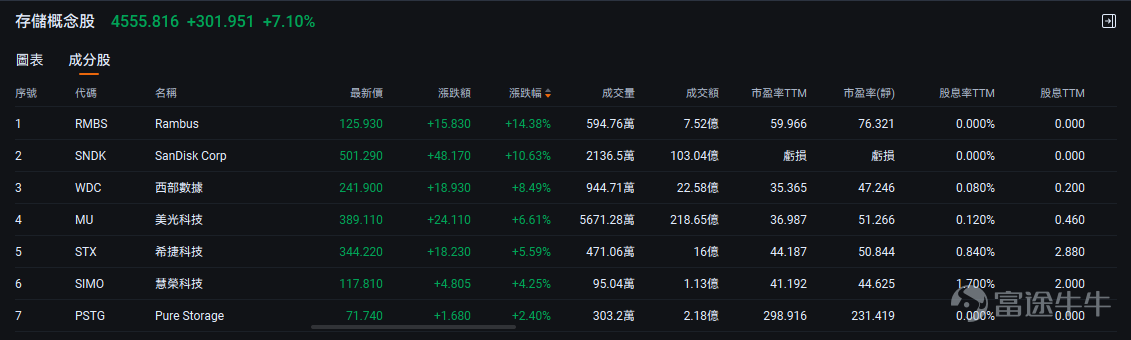
4) Storage Capacity: Led by HBM, supply-demand mismatch benefits in memory chips
Storage capacity is AI’s hard drive. The vast amounts of data generated from AI thinking and operations need to be stored, such as data from large model training, AI PC files, and humanoid robot operational data, all of which rely on memory chips and HBM high-bandwidth memory. With the explosion in AI demand, storage devices are in short supply, and prices continue to rise.
● Investment Highlights:High Bandwidth Memory (HBM) is a key companion to GPUs, with its complex technology, concentrated production capacity, and the most prominent supply-demand gap, making its price the most elastic. Traditional DRAM and flash memory are also benefiting from the demand for AI servers. Investors should pay attention to HBM4 specification certification and order allocation in the second half of 2026; monitor guidance on HBM capacity allocation and pricing in major storage companies' quarterly earnings; and track whether AI server shipments exceed expectations.
● Coverage Scope:Memory chips (DRAM, NAND), HBM high bandwidth memory (AI-specific storage), cloud storage (such as Amazon S3), and memory modules.
● Key Stocks: $Micron Technology (MU.US)$ is a global memory giant and one of the three major HBM suppliers, with its HBM3E product already supplied to NVIDIA. Its performance is highly sensitive to HBM prices. Samsung Electronics and SK Hynix are the other two major players dominating the HBM market. Among them, SK Hynix is currently leading in HBM technology, while Samsung is catching up quickly.
Note: NAND (flash memory): A type of non-volatile memory (ROM), meaning it retains data even after power loss, commonly used in external storage devices. Similar to what we typically refer to as hard drives, SSDs, USB drives, etc., are all forms of flash memory. DRAM (Dynamic Random Access Memory), commonly known as 'memory sticks,' uses capacitors to store data based on charge levels and requires periodic refresh circuits to address capacitor leakage issues. HBM stands for High Bandwidth Memory, which meets the high computational and large storage needs of the large model era.
More memory stocks can be seen in the figure below:

5) Others: Infrastructure service providers and cybersecurity moats
In addition to the four core pillars mentioned above, there are some easily overlooked but equally crucial components in AI infrastructure. Although these areas may not be as prominent as chips or power, they are still vital forces ensuring the smooth operation of the entire AI ecosystem.
AI Infrastructure Service Providers: These companies do not directly manufacture hardware but provide AI infrastructure solutions to help businesses quickly set up AI computing environments. Positioned as midstream integrators in the industry chain, they are tied upstream to chip manufacturers like NVIDIA and downstream to end customers.
For example,$NEBIUS (NBIS.US)$ It provides diversified AI infrastructure solutions, including data labeling, AI training platforms, and supercomputer R&D. Its distinguishing feature lies in full-stack services, covering everything from data preparation, model training, to deployment and inference. CRWV does not manufacture chips but procures NVIDIA GPUs on a large scale and builds cloud platforms, allowing small and medium-sized enterprises and startups to access top-tier computing power.
Their growth logic is as follows: On the demand side, the wave of enterprise AI adoption continues, but building data centers is costly and time-consuming, making rental models more flexible. On the supply side, core resources like GPUs remain scarce, and whoever secures more quotas or offers optimized solutions gains an advantage. The profit model is usage-based charging, with margins improving as scale expands. However, they also face direct competition from $Amazon (AMZN.US)$ AWS, $Microsoft (MSFT.US)$ Azure, $Alphabet-C (GOOG.US)$ Cloud giants.
Additionally, there are dimensions like cybersecurity. For instance, $CrowdStrike (CRWD.US)$ is a leading cloud-native endpoint security company. Its value proposition lies in providing critical security protection for servers and cloud workloads that carry AI computing power. Its collaboration with AI cloud vendors like CoreWeave delivers tailored security guarantees for AI computing environments.
2. Model Layer: The Brain of AI
If the foundational layer is the power plant that enables AI to operate, then the model layer is the brain of AI. It is responsible for enabling machines to understand, reason, and generate content, forming the core of AI capabilities. This part may not be as tangible as hardware, but it is the engine driving all applications.
You can think of it as different brands of car engines: some are powerful and versatile (general-purpose large models), while others are optimized for specific tracks with extreme performance (industry-specific models).
General-purpose models aim to solve a wide range of problems, such as GPT, Claude, and Gemini. They are characterized by comprehensive capabilities but come with extremely high training and maintenance costs. This space is dominated by tech giants, with significant barriers in capital, data, and computing power, resulting in oligopolistic competition.
Industry-specific models are those deeply optimized for particular fields such as finance, healthcare, law, and scientific research. Their core advantage lies in industry knowledge (know-how) and proprietary data. This presents a key opportunity for startups and investment firms, with a clear commercial path. The crucial factor is whether they can truly reduce costs and improve efficiency for clients. The competitive moat comes from accumulated data within vertical domains and the integration of workflows.
Simply put, when looking at investment model layers, assessing general-purpose large models equates to observing the arms race between tech giants; when examining industry-specific models, the goal is to find those who best understand a specific sector and can use AI to address its core pain points—akin to specialized doctors. Currently, the competitive landscape and investment logic within the model layer are very clear, focusing on technological implementation and profitability. Selecting leading companies is a more prudent approach.
● Investment Highlights:Focus on tracking the progress of multimodal technologies (able to process text, images, and videos simultaneously) and their commercial application, while avoiding investments that only burn cash without profits or lack actual orders.
● Key Stocks:In the US stock market, $Microsoft (MSFT.US)$ is a core investor in OpenAI, and the commercialization of the GPT series of large models relies mainly on its implementation (such as Office AI), with clear profit expectations; $Alphabet-C (GOOG.US)$ Gemini's large model leads technologically in the multimodal domain, integrating with its search and YouTube ecosystems, offering rich application scenarios. In the Hong Kong stock market, $BIDU-SW (09888.HK)$ Baidu is one of the few companies domestically with full-stack AI capabilities. Its Wenxin Yiyang large model not only drives its own search, cloud services, and autonomous driving but also provides services to government and enterprise clients through Baidu Intelligent Cloud, securing widespread orders.
3. Application Layer: AI’s monetizable scenarios within reach
The application layer is the frontline where AI technology generates value and directly interacts with users. It also represents the area with the greatest potential for innovation and diversity. Relying on the hardware of the foundational layer and the technologies of the model layer, it integrates AI into daily life and various industries to generate real profits. This is the segment with the most potential in 2026, favoring familiar, highly feasible scenarios for ordinary people.
It addresses the question of how AI can specifically make money, with the core being the transformation of model layer technologies into products that ordinary people can use and businesses are willing to pay for. There's no need to delve deeply into technical details; the focus is on essential use-case demands + sales/orders, making the logic straightforward.
● Investment Highlights:Track the AI PC upgrade trend, the progress of humanoid robot implementation, and the penetration rate of industry applications, selecting stocks with core products and verifiable performance.
● Key Stocks:In the US stock market, $Apple (AAPL.US)$ leads the AI PC wave, with a surge in demand for new-generation products; $Tesla (TSLA.US)$ Humanoid robots continue to iterate, with the potential for large-scale mass production. $UBTECH ROBOTICS (09880.HK)$ In the Hong Kong stock market, Ubtech Robotics is the leader in humanoid robots, with rapid progress in implementation; $TENCENT (00700.HK)$ has a vast user ecosystem (e.g., WeChat with 1.414 billion monthly active users), providing extensive scenarios for AI applications; $BABA-W (09988.HK)$ The AI capabilities are mainly provided as services through the Cloud Intelligence Group, while also driving the intelligence of core businesses such as e-commerce and logistics.
For more AI application targets, see the figure below:


II. Under the Top-Tier Perspective for 2026: Focus on These Opportunities
After reviewing the industry chain, many investors may still be confused: with the AI boom already underway in 2026, should one choose the infrastructure layer, model layer, or application layer? For beginners who don't have time to closely monitor the market, how can they position themselves securely?
Whether it’s Goldman Sachs' '2026 AI Industry Investment Outlook' or Morgan Stanley's latest market analysis, both clearly indicate:AI remains the most certain investment mainline for the year, with three key consensuses reached, highly consistent with the previous breakdown of the industry chain:
● Opportunity 1:As a rigid demand, the infrastructure layer remains the stable first choice, with the most attention-worthy gaps. The demand for AI computing power, storage, electricity, and transportation in 2026 will continue to grow significantly, especially for HBM memory, 1.6T optical modules, and liquid cooling equipment, where supply-demand gaps will be difficult to resolve in the short term. The performance certainty of leading companies in these fields is the strongest—this is why stocks like SNDK, Micron, and NVIDIA continue to perform strongly.
● Opportunity 2:The implementation of the application layer is set to see explosive growth, with two major scenarios being highly anticipated. Goldman Sachs explicitly predicts that in 2026, the AI application layer will experience both volume and price increases, with a particular focus on the AI PC replacement wave and the rollout of humanoid robots. Morgan Stanley adds that the commercialization progress of essential applications like office and design tools (e.g., WPS AI) will accelerate, with notable profit potential for related stocks.
● Opportunity 3:The model layer will be dominated by an oligopoly, requiring caution against money-burning traps. General-purpose large models remain a game for tech giants; companies like Microsoft, Google, and Baidu, which have advantages in computing power, data, and ecosystems, are better choices in the model layer. While industry-specific large models present opportunities, it is difficult for beginners to assess technical authenticity, so it is recommended to avoid startups that only tell stories without orders. Instead, prioritize companies deeply tied to government and enterprise clients with clear profit expectations.
Additionally, the latest outlook from asset management giants shows that China's market is leading in AI monetization compared to other markets. AI and semiconductor hard-tech stocks in the Hong Kong stock market, such as those of Baidu, Ubtech Robotics, and Tencent, are expected to continue their upward trend, providing extra room for imagination for these Hong Kong-listed stocks.
Three, 2026 AI Investment Strategy: Approaches and Key Points
After understanding the industry landscape, the key is to translate insights into actionable plans. Below is a concise strategy framework and practical tools.
1. Core Strategy Framework
Follow the principle of focusing on the main trends and allocating investments across layers to build a portfolio.
For example, consider using the foundational layer as the anchor of the portfolio, prioritizing allocations in areas with clear supply-demand gaps, such as HBM, 1.6T optical modules, and liquid cooling sectors. Simultaneously, allocate to the application layer as an offensive component to capitalize on rebounds, selecting companies with clear business models and verified orders.
You may also consider gaining exposure through index ETFs (such as those tracking the Nasdaq 100).$Invesco QQQ Trust (QQQ.US)$ , semiconductor index $iShares Semiconductor ETF (SOXX.US)$ ) to capture the overall growth benefits of the AI industry. Additionally, carefully select leading stocks at various levels or细分赛道ETFs for超额收益, with flexible adjustments.
At the same time, it is crucial to closely monitor major industry events that could drive stock prices, such as NVIDIA's GTC conference, earnings reports and capital expenditure guidance from major cloud vendors, and important product launches. Around key event windows, market attention and expectations for related companies will significantly increase.
2. Application of Options Strategies
For advanced investors looking to manage risk-reward more precisely or leverage market volatility, options are a powerful tool. Below are several common options strategies applicable to the AI sector:
1) Strategy One: Protective Put —— Insuring Your Holdings
● Applicable Scenario: You are long-term bullish on and hold a leading AI stock but are concerned about significant losses due to short-term market pullbacks or earnings fluctuations.
● Key Operations: While holding the underlying stock, buy a put option with a strike price slightly below the current market price. This is equivalent to purchasing insurance for your holdings. If the stock price plummets, the profit from the put option can offset the loss in the stock; if the stock price rises, you only lose the premium (insurance cost).
2) Strategy Two: Covered Call —— Enhancing Cash Flow and Reducing Holding Costs
● Applicable Scenario: You own AI stocks but believe they will trade sideways or experience mild upside in the short term. You want to generate extra income without selling the shares.
● Key strategy: While holding the underlying stock, sell a call option with a strike price higher than the current market price. You will immediately receive a premium income. If the stock price is below the strike price at expiration, the option expires worthless and the premium becomes net profit; if the stock price is above the strike price, you will sell the stock at the strike price, earning the difference + premium. This is an income-enhancing strategy but limits potential profits if the stock price rises significantly.

3) Strategy Three: Bull Call Spread - A Lower-Cost Trend Trading Approach Using Call Options
Applicable scenario: You are confident that a particular AI stock will rise within the next 1-3 months but want to participate at a lower cost than directly buying the stock or purchasing a naked call option.
Key points of the strategy: Simultaneously buy a call option with a lower strike price and sell a call option with the same expiration date but a higher strike price. This is a combination strategy. Your maximum loss is limited to the net premium paid for both options, while your maximum profit is capped at the difference between the two strike prices minus the net cost. It sacrifices unlimited upside potential in exchange for reduced downside risk and cost.

A final reminder: While embracing opportunities, it's essential to remain aware of risks, including overvaluation, technological iteration and competition, cyclical fluctuations, geopolitical factors, and policy changes.
Final Thoughts
From the soaring stock prices of SNDK and AMD, to the surge in electricity and cooling demands, as well as advancements in optical module technology, and now AI applications reaching households everywhere, we are in the midst of a profound industrial revolution driven by AI, spanning both hardware and software.
AI investment in 2026 is no longer about vague thematic speculation but represents a value discovery journey unfolding along a clear chain of [infrastructure development → core capability breakthroughs → commercial value realization].
For investors, rather than chasing daily hot trends, it’s better to return to the industry map: seek certainty in technological iterations and supply-demand mismatches at the foundational level, embrace ecosystems led by tech giants or focus on specialized vertical experts at the model level, and identify products and services that truly transform work and life—and can generate real profits—at the application level.
I hope everyone can choose the right tools that match their risk tolerance at appropriate stages of the industry chain and enter the market at the right time, based on understanding the value transmission pathways across the value chain, to seize future profit potential.
Risk Disclaimer: The above content only represents the author's view. It does not represent any position or investment advice of Futu. Futu makes no representation or warranty.Read more


Comments (205)
to post a comment
390
681