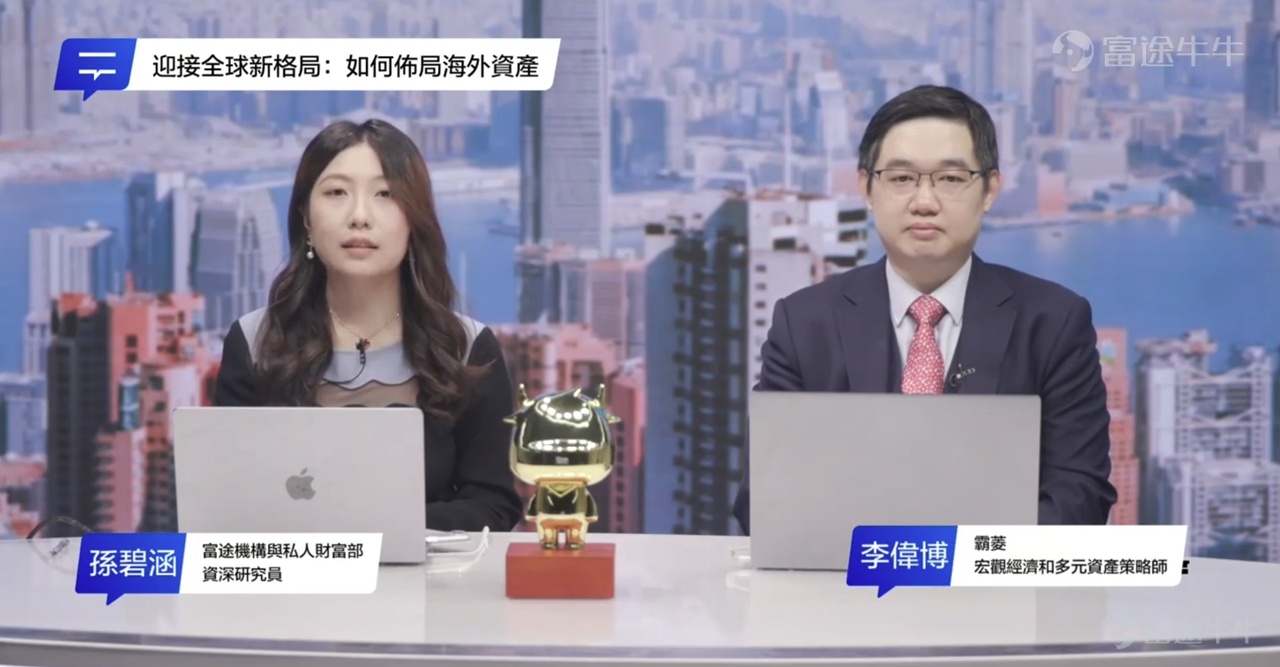

Event Recap | Envision 2026 Investment Outlook Strategy Session — Embracing the New Global Paradigm, Seizing Overseas Opportunities
On January 8, the first private live broadcast event of Futu Global Private Sharing 'Forecast 2026 Investment Outlook Strategy Meeting' successfully concluded. This event focused on ‘Embracing the New Global Paradigm: How to Allocate Overseas Assets’ as the core theme and specially invited@霸菱BaringsMacro Economy and Multi-Asset Strategist Wei Bo Lito host the live stream,Senior Researcher at Futu Institutional and Private Wealth Division, Bi Han Sun,who engaged in dialogue with the guest on key topics.
Mr. Li Wei Bo, leveraging a global perspective, provided an in-depth review of the key trends in the 2025 capital market. He offered detailed analysis on core issues such as the macroeconomic trend for 2026, the reshaping of trade patterns, and the policy directions of major economies. Ms. Sun Bi Han simultaneously shared Futu's investment research insights, engaging in professional discussions with Mr. Li Wei Bo on focal points. The live broadcast was packed with valuable content, featuring lively interactive engagement. Many clients actively asked questions on specific macro strategies and asset allocation directions, engaging in deep exchanges with the guest.
This sharing not only provided investors with a professional platform to grasp the 2026 investment trends, but also offered asset allocation insights that combine a global perspective with practical value, serving as an important reference for investment decision-making amid macroeconomic fluctuations.
![On January 8, the first private live broadcast event of Futu Global Private Sharing 'Forecast 2026 Investment Outlook Strategy Meeting' successfully concluded. This event focused on ‘Embracing the New Global Paradigm: How to Allocate Overseas Assets’ as the core theme and specially invited@霸菱BaringsMacro Economy and Multi-Asset Strategist Wei Bo Lito host the live stream,Senior Researcher at Futu Institutional and Private Wealth Division, Bi Han Sun,who engaged in dialogue with the guest on key topics. Mr. Li Wei Bo, leveraging a global perspective, provided an in-depth review of the key trends in the 2025 capital market. He offered detailed analysis on core issues such as the macroeconomic trend for 2026, the reshaping of trade patterns, and the policy directions of major economies. Ms. Sun Bi Han simultaneously shared Futu's investment research insights, engaging in professional discussions with Mr. Li Wei Bo on focal points. The live broadcast was packed with valuable content, featuring lively interactive engagement. Many clients actively asked questions on specific macro strategies and asset allocation directions, engaging in deep exchanges with the guest. This sharing not only provided investors with a professional platform to grasp the 2026 investment trends, but also offered asset allocation insights that combine a global perspective with practical value, serving as an important reference for investment decision-making amid macroeconomic fluctuations. [Share Link: Embrace the New Global Landscape: How to Allocate Overseas Assets] Global Economy: Resilience Remains, But Faces a Slowdown After the 'Front-Loading Effect' Although the International Monetary Fund (IMF) acknowledges the resilience of the global economy in 2025, this back...](https://nnqimage.futunn.com/sns_client_feed/988889/20260122/101897f52237d3d75ed400c6bb2bac9b.jpg/big?area=1&is_public=true&imageMogr2/ignore-error/1/format/webp)
Global Economy: Resilience Remains, But Faces a Slowdown After the 'Front-Loading Effect'
Although the International Monetary Fund (IMF) acknowledges the resilience of the global economy in 2025, there are underlying concerns. In 2025, the 'rush to export' and 'rush to import' behaviors triggered by trade war worries essentially pre-empted some future demand, leading to front-loaded economic activities. Therefore,Demand and industrial activity in 2026 may face a lagging decline,with forecasted growth rates for both the global and emerging economies in 2025 higher than those for 2026.
– Clear regional divergence:
◦ Western Economies: Capital expenditures related to the U.S. technology sector and artificial intelligence are expected to drive economic growth in 2025, with part of the growth in the first half coming from AI investments. Although fixed asset investment in the tech sector slowed in the third quarter, consumption has remained resilient, and annual economic growth is expected to exceed forecasts. The Eurozone’s economic growth remains relatively robust, supported by increased contributions from intra-regional trade, consumer spending, and government sectors.
◦ China's Economy: As a major manufacturing country, China has room to increase its export share, which is expected to become an important driver of economic growth in 2026. However, an excessively high export share may bring international pressure, and trade surplus reserves can be used to manage the pace of RMB appreciation.
In-depth structural analysis: The tilt of the policy balance and the debt cycle
1. Policy shift: Fiscal expansion to support employment
The world's major economies have exhibited a 'multi-faceted unity' characteristic—The marginal weakening of the job market has shifted policy focus towards employment and fiscal support.
From the employment perspective, signs of cooling are emerging in the three major economies—the US, Europe, and China:
– United States: Non-farm payrolls (excluding education and health services) have shown negative growth, with the job market gradually cooling;
– Eurozone: The unemployment rate across 20 countries has risen from its low point, and the annualized year-on-year growth of the European Central Bank’s wage tracking indicator has also slowed down;
– China: Unemployment insurance payouts have risen to seasonally high levels, reflecting temporary pressure on employment.
Against this backdrop,Fiscal expansion has become the core direction for supporting employment and cushioning downturns.The US has expanded fiscal support through the 'Great Beautiful Act,' the Eurozone (such as Germany) has increased investments in infrastructure and other areas, and China's combination of debt resolution measures since '924' and the introduction of fiscal tools all represent specific implementations of policies tilting towards the job market.
![On January 8, the first private live broadcast event of Futu Global Private Sharing 'Forecast 2026 Investment Outlook Strategy Meeting' successfully concluded. This event focused on ‘Embracing the New Global Paradigm: How to Allocate Overseas Assets’ as the core theme and specially invited@霸菱BaringsMacro Economy and Multi-Asset Strategist Wei Bo Lito host the live stream,Senior Researcher at Futu Institutional and Private Wealth Division, Bi Han Sun,who engaged in dialogue with the guest on key topics. Mr. Li Wei Bo, leveraging a global perspective, provided an in-depth review of the key trends in the 2025 capital market. He offered detailed analysis on core issues such as the macroeconomic trend for 2026, the reshaping of trade patterns, and the policy directions of major economies. Ms. Sun Bi Han simultaneously shared Futu's investment research insights, engaging in professional discussions with Mr. Li Wei Bo on focal points. The live broadcast was packed with valuable content, featuring lively interactive engagement. Many clients actively asked questions on specific macro strategies and asset allocation directions, engaging in deep exchanges with the guest. This sharing not only provided investors with a professional platform to grasp the 2026 investment trends, but also offered asset allocation insights that combine a global perspective with practical value, serving as an important reference for investment decision-making amid macroeconomic fluctuations. [Share Link: Embrace the New Global Landscape: How to Allocate Overseas Assets] Global Economy: Resilience Remains, But Faces a Slowdown After the 'Front-Loading Effect' Although the International Monetary Fund (IMF) acknowledges the resilience of the global economy in 2025, this back...](https://nnqimage.futunn.com/sns_client_feed/988889/20260122/web-1769073445549-WhHW6xpNa3.jpeg/big?area=1&is_public=true&imageMogr2/ignore-error/1/format/webp)
2. Debt Cycle: Fiscal Space and Sectoral Debt Divergence in the US, Europe, China, and Japan
– Government Sector Debt: China’s government debt-to-GDP ratio (about 90%) is significantly better than that of the US (108%), France (107%), and Japan (200%), reflecting a healthier fiscal condition of the Chinese government, which also provides room for central fiscal support to local debt resolution.
– Non-financial Corporate Sector Debt: China’s non-financial corporate sector debt-to-GDP ratio is about 142%, driving the direction of debt reduction. The US non-financial corporate sector debt-to-GDP ratio is 74%, significantly better than other major economies, due to its conservative balance sheet management from 2020-2025, which also strengthens the resilience of its corporate fundamentals.
![On January 8, the first private live broadcast event of Futu Global Private Sharing 'Forecast 2026 Investment Outlook Strategy Meeting' successfully concluded. This event focused on ‘Embracing the New Global Paradigm: How to Allocate Overseas Assets’ as the core theme and specially invited@霸菱BaringsMacro Economy and Multi-Asset Strategist Wei Bo Lito host the live stream,Senior Researcher at Futu Institutional and Private Wealth Division, Bi Han Sun,who engaged in dialogue with the guest on key topics. Mr. Li Wei Bo, leveraging a global perspective, provided an in-depth review of the key trends in the 2025 capital market. He offered detailed analysis on core issues such as the macroeconomic trend for 2026, the reshaping of trade patterns, and the policy directions of major economies. Ms. Sun Bi Han simultaneously shared Futu's investment research insights, engaging in professional discussions with Mr. Li Wei Bo on focal points. The live broadcast was packed with valuable content, featuring lively interactive engagement. Many clients actively asked questions on specific macro strategies and asset allocation directions, engaging in deep exchanges with the guest. This sharing not only provided investors with a professional platform to grasp the 2026 investment trends, but also offered asset allocation insights that combine a global perspective with practical value, serving as an important reference for investment decision-making amid macroeconomic fluctuations. [Share Link: Embrace the New Global Landscape: How to Allocate Overseas Assets] Global Economy: Resilience Remains, But Faces a Slowdown After the 'Front-Loading Effect' Although the International Monetary Fund (IMF) acknowledges the resilience of the global economy in 2025, this back...](https://nnqimage.futunn.com/sns_client_feed/988889/20260122/web-1769073472866-oVakmzht6V.jpeg/big?area=1&is_public=true&imageMogr2/ignore-error/1/format/webp)
Market Dynamics: Rebalancing Inflation and Capital Flows
1. US-China Trade Negotiation Window and Dual Impact on Inflation
The optimistic window for US-China trade agreement negotiations centers around the first half of 2026, especially before the key moment of Trump’s potential visit to China in April, with more negotiation outcomes expected. Tariffs, as a core influencing variable, have differentiated effects on inflation in the US and China:
– For the US: Tariffs will push up goods inflation; if the impact does not extend to the service sector, this inflation pressure is a one-time shock, likely to be absorbed in the first half of the year; if inflation continues to fall subsequently, it will provide support for stable capital market development.
– For China: Tariffs bring deflationary pressures, but domestic anti-internal competition policies have been specifically implemented to support upstream commodity prices, and it is expected that China’s PPI (Producer Price Index) negative growth will narrow in 2026, while CPI (Consumer Price Index) remains in a mild range below 1%, with overall inflation staying moderate.
2. Eurozone Maintains Monetary Policy Amidst Balancing Inflation and Employment
Inflation in the Eurozone has remained stable since it fell below the 2% target in September 2024. The cooling of wage levels has been slow, and the labor market remains tight without large-scale layoffs. Against this backdrop, the European Central Bank's monetary policy stance is clear: it will likely maintain the current interest rate level with no clear signs of rapid rate cuts or hikes, showing strong policy resilience.
3. The Second Half of Global Easing: Policy Expectation Risks and Capital Rotation Trends
The current global monetary policy easing cycle has started and entered its second half, but frequent errors persist in market forecasts regarding the Federal Reserve’s and the European Central Bank’s rate cut paths, indicating that interest rate volatility risks remain.
Capital flows are showing significant cross-market rotation characteristics:
– U.S. Market: From December 2019 to the first half of 2025, household deposits and currency holdings increased by $6.3 trillion. After the Fed's rate cuts, capital may rotate into U.S. Treasuries and U.S. stocks.
– Chinese Market: Household deposits have grown by 55% over the past five years; 'deposit migration' continues but at a slower pace, with funds shifting towards higher-yield assets.
![On January 8, the first private live broadcast event of Futu Global Private Sharing 'Forecast 2026 Investment Outlook Strategy Meeting' successfully concluded. This event focused on ‘Embracing the New Global Paradigm: How to Allocate Overseas Assets’ as the core theme and specially invited@霸菱BaringsMacro Economy and Multi-Asset Strategist Wei Bo Lito host the live stream,Senior Researcher at Futu Institutional and Private Wealth Division, Bi Han Sun,who engaged in dialogue with the guest on key topics. Mr. Li Wei Bo, leveraging a global perspective, provided an in-depth review of the key trends in the 2025 capital market. He offered detailed analysis on core issues such as the macroeconomic trend for 2026, the reshaping of trade patterns, and the policy directions of major economies. Ms. Sun Bi Han simultaneously shared Futu's investment research insights, engaging in professional discussions with Mr. Li Wei Bo on focal points. The live broadcast was packed with valuable content, featuring lively interactive engagement. Many clients actively asked questions on specific macro strategies and asset allocation directions, engaging in deep exchanges with the guest. This sharing not only provided investors with a professional platform to grasp the 2026 investment trends, but also offered asset allocation insights that combine a global perspective with practical value, serving as an important reference for investment decision-making amid macroeconomic fluctuations. [Share Link: Embrace the New Global Landscape: How to Allocate Overseas Assets] Global Economy: Resilience Remains, But Faces a Slowdown After the 'Front-Loading Effect' Although the International Monetary Fund (IMF) acknowledges the resilience of the global economy in 2025, this back...](https://nnqimage.futunn.com/sns_client_feed/988889/20260122/web-1769073488330-885V0mE9jT.jpeg/big?area=1&is_public=true&imageMogr2/ignore-error/1/format/webp)
Supply Chain Restructuring: Evolution of Trade Patterns and Pursuit of Self-Sufficiency
1. Supply Chain Rebalancing: Trends in Trade Ratio Adjustments and Production Capacity Relocations
Global trade ratios peaked before the financial crisis and have since entered a structural adjustment phase. In this process, China’s manufacturing share has continued to rise. Looking ahead, emerging economies like ASEAN, leveraging cost advantages, are expected to take on some low-value-added production capacity, becoming an important complementary link in the global supply chain.
In terms of trade trends, regional trade linkage characteristics formed after the 2018 trade friction continue to manifest: China’s exports to the U.S. remain relatively stable, while ASEAN’s exports to the U.S. and China’s exports to ASEAN have both increased. The trend of re-exporting or value-added re-exporting will continue long-term, with increasing trade interconnectivity within the region.
2. Self-sufficiency Pursuit in China and the US: Differentiated Layouts and Local Impacts
Meanwhile, the competition between China and the US over industrial chain security is epitomized by their pursuit of 'self-sufficiency.' On the Chinese side, efforts are accelerating to achieve autonomy and control in high-end chips and strategic resources such as rare earths—a trend that has been strengthening since 2018. Meanwhile, although the US ‘re-industrialization’ strategy aims to bring manufacturing back, Mr. Li Weibo pointed out that this will not be a comprehensive return process and will inevitably cause a slight rise in domestic inflation, an economic cost of reversing globalization.
![On January 8, the first private live broadcast event of Futu Global Private Sharing 'Forecast 2026 Investment Outlook Strategy Meeting' successfully concluded. This event focused on ‘Embracing the New Global Paradigm: How to Allocate Overseas Assets’ as the core theme and specially invited@霸菱BaringsMacro Economy and Multi-Asset Strategist Wei Bo Lito host the live stream,Senior Researcher at Futu Institutional and Private Wealth Division, Bi Han Sun,who engaged in dialogue with the guest on key topics. Mr. Li Wei Bo, leveraging a global perspective, provided an in-depth review of the key trends in the 2025 capital market. He offered detailed analysis on core issues such as the macroeconomic trend for 2026, the reshaping of trade patterns, and the policy directions of major economies. Ms. Sun Bi Han simultaneously shared Futu's investment research insights, engaging in professional discussions with Mr. Li Wei Bo on focal points. The live broadcast was packed with valuable content, featuring lively interactive engagement. Many clients actively asked questions on specific macro strategies and asset allocation directions, engaging in deep exchanges with the guest. This sharing not only provided investors with a professional platform to grasp the 2026 investment trends, but also offered asset allocation insights that combine a global perspective with practical value, serving as an important reference for investment decision-making amid macroeconomic fluctuations. [Share Link: Embrace the New Global Landscape: How to Allocate Overseas Assets] Global Economy: Resilience Remains, But Faces a Slowdown After the 'Front-Loading Effect' Although the International Monetary Fund (IMF) acknowledges the resilience of the global economy in 2025, this back...](https://nnqimage.futunn.com/sns_client_feed/988889/20260122/web-1769073504851-91nmO8v5di.jpeg/big?area=1&is_public=true&imageMogr2/ignore-error/1/format/webp)
Asset Allocation Advice: Focusing on Diversification and Cost-effectiveness
1. Maintain the advantages of a multi-asset portfolio, reinforcing allocation foundations
Portfolio diversification is crucial; combining different types of assets such as stocks and bonds can effectively reduce overall portfolio volatility and improve risk-adjusted expected returns. In terms of asset class selection, high-yield bonds may offer cyclical resilience through corporate credit risk premiums, with medium-term cost-effectiveness superior to interest rate bonds.
2. Equity Market: Balancing Valuation and Profitability, Seizing Cost-effective Opportunities
In Q4 2025, global stock markets exhibited 'valuation adjustments and profit differentiation': US stock valuations declined, profitability slightly increased but growth slowed marginally; meanwhile, Chinese A-shares, MSCI China, and South Korean markets saw profit growth continue despite valuation corrections. Based on market conditions at the end of 2025, Chinese A-shares offer better cost-effectiveness in profit growth and relative valuation compared to US stocks, presenting attractive allocation potential. However, upside potential is constrained by corporate operations, external risks, and fiscal targets in March, requiring careful timing.
*The content represents the guest's personal views and does not reflect the position of Futu. It is advisable to consider one’s risk tolerance and consult independent advice before making any investment decisions.
Risk Disclaimer: The above content only represents the author's view. It does not represent any position or investment advice of Futu. Futu makes no representation or warranty.Read more

Comments
to post a comment
1
1