

Multi-Asset Outlook — January 2026

Global risk assets extended their strong momentum at the start of the year, despite relatively high valuation levels and crowded market positions, reflecting that while liquidity remains abundant, sensitivity to geopolitical and policy risks is rising. Tensions in Latin America and the Middle East remain key uncertainties, and the market’s optimistic sentiment combined with its dismissive attitude towards risks also warrants investor caution.
In Greater China, Hong Kong equities remain within a reasonable historical valuation range. However, mixed macro data, a consumer recovery still awaiting further momentum, and ongoing pressure on the real estate sector suggest that the mainland economy and stock market will continue to exhibit a 'K-shaped recovery' led by growth sectors. Chinese A-shares benefit from a stronger renminbi and policy support for technological self-reliance, but against a backdrop of less-than-cheap valuations and challenging macro fundamentals, investors are focusing on sectors with higher earnings visibility, such as artificial intelligence, raw materials, and healthcare.
Valuations in Asian markets outside Japan have shown further divergence. South Korea has performed strongly, driven by an upcycle in the memory industry and breakthroughs in robotics technology; by contrast, Taiwan's market appears overvalued, with some high-valuation stocks already starting to see profit-taking. Southeast Asian markets are showing initial signs of stabilization, but a full recovery in investment sentiment will take time.
On the fixed income side, credit spreads for Asian investment-grade and high-yield bonds remain tight, limiting upside potential for bond prices and increasing sensitivity to interest rate and duration risks, although an improved refinancing environment helps keep default risks at a low level.
Gold is supported by geopolitical uncertainties and the ongoing shift of funds from US dollar assets to other assets, but volatility in gold prices has also increased. In this environment, a well-diversified multi-asset allocation and stable sources of income are becoming increasingly important for investors.
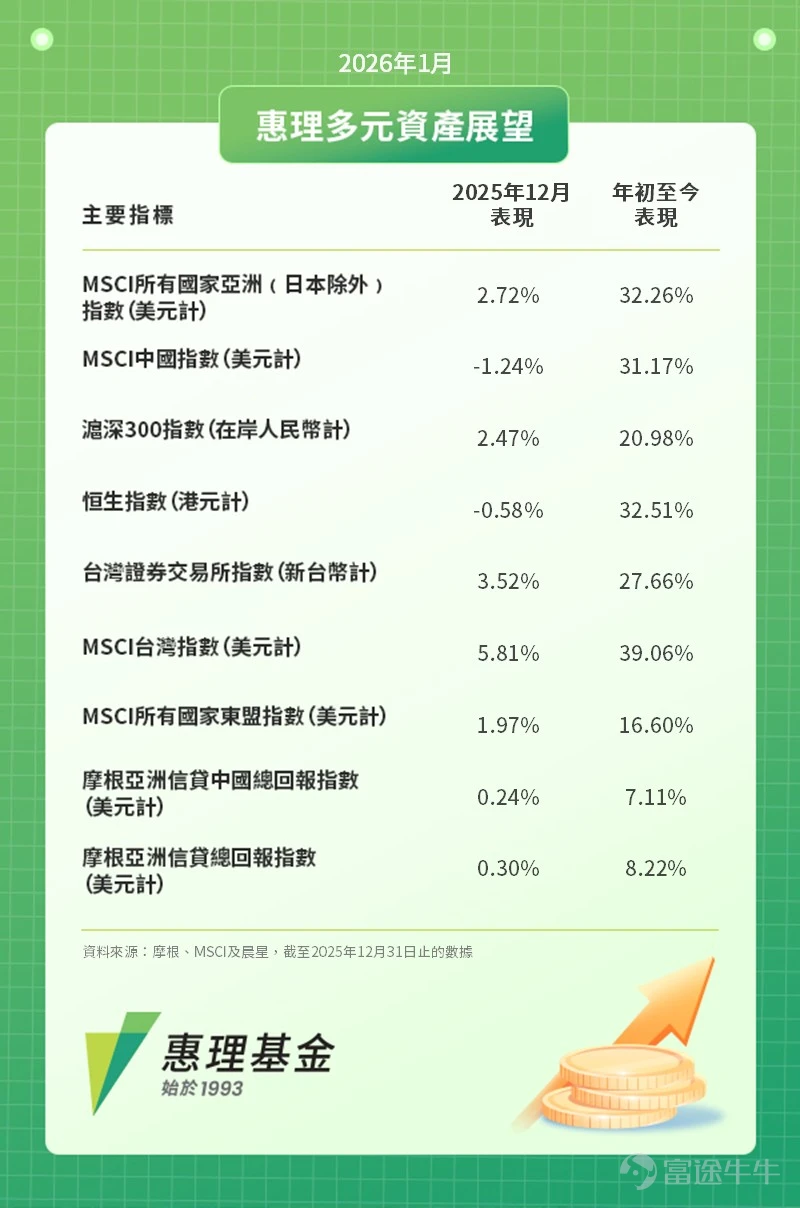
China / Hong Kong Equities
Despite generally high valuations across global equity markets, sentiment and positioning appear quite crowded. However, with liquidity still supportive, market momentum in global equities has remained strong since the start of the year.
Geopolitical risks remain elevated as market focus shifts towards developments in Venezuela and Iran. However, the market’s vigilance towards potential risks seems to have declined, so investors need to remain cautious.
Valuations for Hong Kong and China stocks are slightly above historical averages, but overall still within a reasonable range. Nonetheless, China's macroeconomic data remains mixed, with services PMI coming in below expectations, and a soft real estate market dampening overall sentiment.
The recovery in domestic consumption in mainland China remains weak, and overall corporate profitability has yet to show clear signs of bottoming out. The economy and stock market are expected to continue on a 'K-shaped recovery' trajectory, with sectors showing growth momentum likely to continue outperforming the broader market.
China A-shares
Supported by a stronger renminbi, momentum in China’s A-share market has improved. The People's Bank of China allowing the renminbi to gradually appreciate helps support domestic demand and boosts market confidence.
This move is also a positive signal for China’s A-share market, as policies supporting technological self-reliance and localization have further increased overseas investors’ interest in China’s technology sector.
However, given that overall stock market valuations are not cheap and the macroeconomic environment still needs improvement, investors continue to focus on sectors with higher earnings visibility and sustainable growth potential, such as artificial intelligence/technology, raw materials, and healthcare. In contrast, investment appetite for consumer sectors remains subdued. As domestic demand recovery takes time, the divergence in performance among these sectors is expected to persist for some time.
Asia ex-Japan equities
North Asia markets have seen a significant rise in valuations despite upward revisions in earnings forecasts; in comparison, Southeast Asian markets remain at relatively low valuations due to political uncertainties and concerns over economic growth.
South Korea has benefited from a stronger-than-expected upturn in the memory industry and recent breakthroughs in robotics technology, leading its performance among Asian markets since the start of the year. However, outside the memory and robotics sectors, profit-taking has started to emerge in other parts of the South Korean stock market, and more frequent market volatility and sector rotation are expected going forward.
– Taiwan's stock market has become the third most highly valued market globally, only behind the US and India. Many individual stocks have already priced in a 'perfect growth' scenario. Recently, profit-taking has begun to appear in high-valuation stocks unrelated to Taiwan Semiconductor.
– There are initial signs of a turnaround in Southeast Asian markets, with capital starting to flow back into the region amid positive progress on US tariffs and stabilizing regional political situations. However, market sentiment will still need more time to fully recover.
Emerging Market (Excluding Asia) Equities
– Emerging markets outside of Asia are now trading at relatively high valuations, with geopolitical risks remaining the biggest concern, especially given the high uncertainty surrounding developments in Latin America and the Middle East.
Japanese Equities
– The proposal by Japanese Prime Minister Sanae Takaichi to dissolve the House of Representatives and hold early elections boosted the local stock market. It also pushed USD/JPY closer to the 160 level, potentially increasing the likelihood of intervention by the Bank of Japan in the currency market.
– A weaker yen benefits Japan’s export-driven companies, while rising bond yields support the performance of Japanese bank stocks. However, as valuations in the Japanese stock market continue to rise, market volatility is expected to increase.
Asian Investment Grade Bonds
– Credit spreads for Asian investment-grade bonds are currently at extremely low levels. Following the US Department of Justice's summons to Federal Reserve Chair Jerome Powell, concerns over the Fed’s independence have risen, which could lead to a steeper US Treasury yield curve.
– These events have added uncertainty to the rate-cutting path of the next Federal Reserve chair, leading to higher duration risk in the bond market. Markets currently expect no further rate cuts by the Fed before Powell's term ends in May, gradually increasing the risk of higher US Treasury yields.
Asian high-yield bonds
– Spreads for Asian high-yield bonds remain below historical averages but are still higher than those for US high-yield bonds.
– With limited new bond supply, investors in the yield-chasing environment are focusing on a small number of high-yield bond issuers. Despite elevated valuations, default risks for these bonds remain low due to improving refinancing conditions for regional companies.
Emerging market bonds
– Although credit spreads have continued to narrow, investors are still chasing emerging market bonds given the limited options for yield. Rising commodity prices are also supporting this asset class.
Gold
– As geopolitical risks in Latin America and Iran escalate, coupled with growing concerns over the Federal Reserve's independence, gold prices have once again broken upward.
– From a medium to long-term perspective, we remain optimistic about gold as a key asset in 'currency devaluation trades,' helping investors diversify risks associated with U.S. Treasury bonds and dollar assets.
– Central banks continue to increase gold reserves to diversify their foreign exchange reserve allocations; however, due to a rapid rise in speculative long positions, gold price volatility is expected to increase further.
Multi-asset
– Compared to single-asset or traditional balanced portfolios, multi-asset strategies can provide lower volatility. However, the correlation between risky assets such as equities, corporate bonds, and commodities has risen significantly recently. Given the high level of uncertainty in the current market environment, a stable source of income will be a key driver of investment returns.
Source: Bloomberg, as of December 31, 2025.
Learn more about Value Partners' latest multi-asset outlook: Value Partners | Multi-Asset Outlook — January 2026
$VALUE PARTNERS (00806.HK)$$Value Partners Asian Income Fund MDis (HK0000352291.MF)$
Learn more about Value Partners' latest multi-asset outlook: Value Partners | Multi-Asset Outlook — January 2026
$VALUE PARTNERS (00806.HK)$$Value Partners Asian Income Fund MDis (HK0000352291.MF)$
-
Investment involves risks, and past performance is not indicative of future returns. The above information is for reference only and does not constitute an offer to sell, an invitation to buy any securities, or a recommendation regarding any securities. This content has not been reviewed by the Hong Kong Securities and Futures Commission. Publisher: Value Partners Asset Management Hong Kong Limited.
Risk Disclaimer: The above content only represents the author's view. It does not represent any position or investment advice of Futu. Futu makes no representation or warranty.Read more
Comments
to post a comment