
BOC Niki analyzes Xiaomi's two breakdowns, funds shift to warrants seeking rebound opportunities
Xiaomi's stock price fell to 35.48 yuan, retreating over 40% from its near 60-yuan high. Amid spreading market panic, technical indicators are showing dense oversold signals, setting the stage for a critical battle between bulls and bears at key support levels. On January 20, Xiaomi’s stock closed at 35.48 yuan, down 2.74% for the day, hitting a low not seen since November of last year. That day, two incidents involving Xiaomi’s automotive division drew market attention to vehicle safety concerns, further pressuring the stock. However, technical indicators suggest multiple oscillators have entered extremely oversold territory, hinting at a possible short-term technical rebound.
[BOC Guest] Analysis: Market Divergence and Capital Flows
In the BOC Guest program,Niki, a director at BOC International,a comprehensive analysis of Xiaomi’s current situation was provided. She noted that Xiaomi started from the mid-20s last year and surged to nearly 60 yuan at its peak, but began retreating from that high around October last year.
NikiNiki specifically mentioned that the stock had hit a low of 36.62 yuan around November 20 last year, and on January 20 it broke below that level, dropping to near 35 yuan. She believes the afternoon news related to Xiaomi's automobiles brought investor focus back to vehicle safety, which naturally impacted stock performance.
NikiNiki also recalled that the last time the stock dropped to 36.62 yuan, company management, including Lei Jun and Xiaomi itself, spent 200 million yuan in cash for share repurchases. But this time, with the stock breaking through support levels twice, the decline has made investors more concerned and worried. This round shows continued capital flows; some investors who bought in the 30-yuan range when it rose to over 60 yuan, now seeing it drop back into the 30s, are starting to consider whether this might be an opportunity for long-term entry.
[BOC Guest] Recommendation: Tactical Value of Warrants
Niki focused on analyzing investment strategies under the current conditions in the program.She pointed out that since the stock price has broken below the support level, investors lack confidence in a rebound of the underlying stock. When considering deploying capital to bet on a rebound, they may hesitate due to risk factors. At this point, she suggests investors consider Xiaomi's call warrants, which can be purchased for a few hundred to a thousand yuan to bet on a rebound in the underlying stock. Niki explained that if the underlying stock stabilizes and rebounds from this level, investors can continue to add positions, as the rebound could potentially persist. However, if the stock price unfortunately continues to decline, the loss would only be a few hundred to a few thousand yuan in entry fees, making the cost much lower compared to investing directly in the stock. She also observed that since January 19, there has been continuous inflow of funds into Xiaomi's bullish products. Some terms in the market, such as call warrants with a strike price above 55 yuan expiring in August or September this year, have already been acquired by investors.
In the January 20 broadcast, Niki specifically recommended a Xiaomi call warrant:“Today, I’m introducing a Xiaomi call warrant—22709 $BIXIAMI@EC2606C.C (22709.HK)$ , with a strike price of 48 yuan, not as far out-of-the-money as 55 yuan, and a shorter term, expiring at the end of June this year. The leverage is very attractive, reaching nearly 7 times.” Meanwhile, Niki also considered different investor perspectives: “Of course, some investors may feel that Xiaomi has just started to decline and might continue to fall, so they may want to choose Xiaomi's put warrants as a hedging tool. For Xiaomi's put warrants, you can refer to 22168 $BIXIAMI@EP2606C.P (22168.HK)$ , with a strike price of 32.18 yuan, expiring at the end of June this year, offering leverage of about 5 times.”
These specific recommendations reflect BOC’s guest column’s comprehensive consideration for investors with different risk preferences.
Technical Analysis: Multiple Indicators Enter Oversold Territory
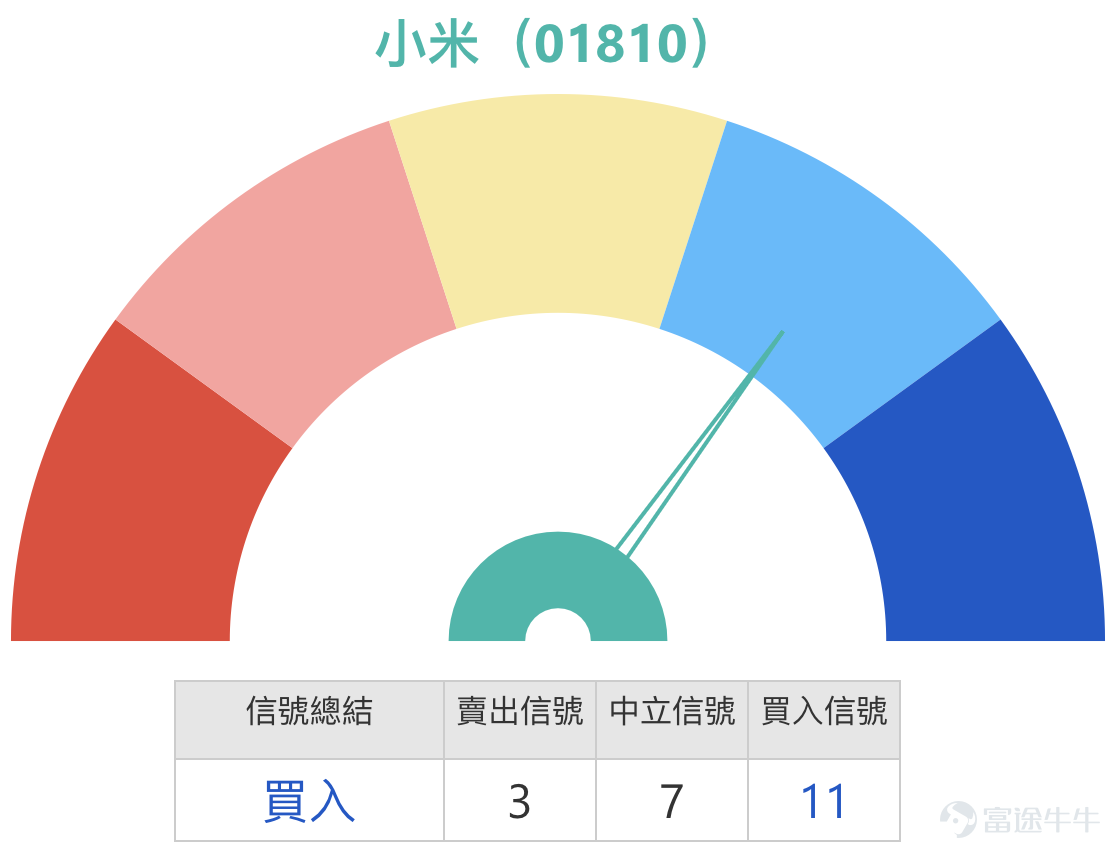
According to the latest technical data, multiple technical indicators for Xiaomi have signaled oversold conditions. The 14-day RSI value has dropped to 28, significantly below the oversold line of 30, indicating that the stock price has entered an oversold state. The Williams %R indicator also shows oversold conditions, while the stochastic oscillator is in the oversold range, issuing a buy signal. Combining RSI oversold conditions with the momentum oscillator gives a 'consider buying' recommendation. From the moving average system perspective, the stock price has fallen below all key moving averages: MA10 at 37.54 yuan, MA30 at 39.58 yuan, and MA60 at 40.87 yuan. The current stock price of 35.48 yuan shows a significant deviation from these moving averages. Historically, this level of divergence often indicates the possibility of a technical rebound.
![$XIAOMI-W (01810.HK)$ Xiaomi's stock price dropped to HKD 35.48, retreating over 40% from its near-HKD 60 high. Amid spreading market panic, technical indicators are showing dense oversold signals, setting the stage for a multi-air standoff at key support levels. On January 20, Xiaomi closed at HKD 35.48, falling 2.74% in a single day and hitting its lowest point since November of last year. On the same day, two incidents related to Xiaomi Auto drew market attention to its vehicle safety, further pressuring the stock. However, technical indicators show multiple oscillators entering extremely oversold zones, hinting at a possible short-term technical rebound. [BOC Guest Analysis] Market divergence and fund flows explained [Share Link: January 20th [BOC Guest] Hang Seng Index, Xiaomi, SMIC, Pop Mart, Zijin Mining, Li Ning, Midea] In the BOC guest column,Niki, a director at BOC International,A comprehensive analysis of Xiaomi’s current situation was provided. She noted that Xiaomi started from around HKD 20 last year, rising to nearly HKD 60 at its peak, but began declining from that height around October of last year. NikiSpecifically mentioned that the stock price hit a low of HKD 36.62 around November 20 last year, but on January 20 it broke below that level, reaching as low as near HKD 35. She believed that afternoon news about Xiaomi Auto reignited investor focus on vehicle safety, naturally affecting stock performance. NikiRecalled that the last time the stock price fell...](https://nnqimage.futunn.com/sns_client_feed/1162342/20260121/web-1768962012397-cxIDsn0gF3.png/big?area=1&is_public=true&imageMogr2/ignore-error/1/format/webp)
Key Price Levels and Market Sentiment
Based on technical analysis, Xiaomi's key price levels have been clearly established. The first support level is at 34.5 yuan, and the second support level is at 32.3 yuan; the first resistance level is at 37.9 yuan, and the second resistance level is at 41 yuan. These price levels echo the historical low of 36.62 yuan mentioned by Niki from BOC’s guest column and the current stock price position. After breaking below 36.62 yuan, the next critical support zone lies within the 34.5-32.3 yuan range. Regarding market sentiment, as Niki observed, investors lack confidence after the stock price broke below the support level twice, which could lead to continued selling pressure in the short term but also presents potential entry opportunities for long-term investors.
Review and Market Performance of Warrants Products
The performance of the warrants products mentioned on January 15th verified the value of derivatives in a volatile market over the following two days. When Xiaomi's underlying stock fell by 3.65%, related bearish products saw significant gains: HSBC Put Warrant 22196 rose by 27%, HSBC Bear Certificate 69927 surged by 48%; UBS Put Warrant 22136 increased by 24%, and UBS Bear Certificate 69732 jumped by 55%.
![$XIAOMI-W (01810.HK)$ Xiaomi's stock price dropped to HKD 35.48, retreating over 40% from its near-HKD 60 high. Amid spreading market panic, technical indicators are showing dense oversold signals, setting the stage for a multi-air standoff at key support levels. On January 20, Xiaomi closed at HKD 35.48, falling 2.74% in a single day and hitting its lowest point since November of last year. On the same day, two incidents related to Xiaomi Auto drew market attention to its vehicle safety, further pressuring the stock. However, technical indicators show multiple oscillators entering extremely oversold zones, hinting at a possible short-term technical rebound. [BOC Guest Analysis] Market divergence and fund flows explained [Share Link: January 20th [BOC Guest] Hang Seng Index, Xiaomi, SMIC, Pop Mart, Zijin Mining, Li Ning, Midea] In the BOC guest column,Niki, a director at BOC International,A comprehensive analysis of Xiaomi’s current situation was provided. She noted that Xiaomi started from around HKD 20 last year, rising to nearly HKD 60 at its peak, but began declining from that height around October of last year. NikiSpecifically mentioned that the stock price hit a low of HKD 36.62 around November 20 last year, but on January 20 it broke below that level, reaching as low as near HKD 35. She believed that afternoon news about Xiaomi Auto reignited investor focus on vehicle safety, naturally affecting stock performance. NikiRecalled that the last time the stock price fell...](https://nnqimage.futunn.com/sns_client_feed/1162342/20260121/web-1768962040233-7xjYi7ktJa.png/big?area=1&is_public=true&imageMogr2/ignore-error/1/format/webp)
Analysis and Strategy for Selected Warrants Products
Investors who agree with Niki's view and are optimistic about Xiaomi’s technical rebound may consider BOC Call Warrant (22824) $BIXIAMI@EC2605C.C (22824.HK)$ , with a strike price of 40 yuan, offering leverage of 7.3 times, and the lowest implied volatility. This product’s strike price is close to the first resistance level at 37.9 yuan, which could yield good returns if the stock price rebounds to this area. Morgan Stanley Call Warrant (24249) has a strike price of 40.02 yuan, providing leverage of 7.5 times, with the lowest premium and implied volatility, making it a cost-efficient bullish choice. $BPXIAMI@EP2606B.P (22664.HK)$ For investors concerned about further declines in the stock price, BNP Paribas Put Warrant (22664)
![$XIAOMI-W (01810.HK)$ Xiaomi's stock price dropped to HKD 35.48, retreating over 40% from its near-HKD 60 high. Amid spreading market panic, technical indicators are showing dense oversold signals, setting the stage for a multi-air standoff at key support levels. On January 20, Xiaomi closed at HKD 35.48, falling 2.74% in a single day and hitting its lowest point since November of last year. On the same day, two incidents related to Xiaomi Auto drew market attention to its vehicle safety, further pressuring the stock. However, technical indicators show multiple oscillators entering extremely oversold zones, hinting at a possible short-term technical rebound. [BOC Guest Analysis] Market divergence and fund flows explained [Share Link: January 20th [BOC Guest] Hang Seng Index, Xiaomi, SMIC, Pop Mart, Zijin Mining, Li Ning, Midea] In the BOC guest column,Niki, a director at BOC International,A comprehensive analysis of Xiaomi’s current situation was provided. She noted that Xiaomi started from around HKD 20 last year, rising to nearly HKD 60 at its peak, but began declining from that height around October of last year. NikiSpecifically mentioned that the stock price hit a low of HKD 36.62 around November 20 last year, but on January 20 it broke below that level, reaching as low as near HKD 35. She believed that afternoon news about Xiaomi Auto reignited investor focus on vehicle safety, naturally affecting stock performance. NikiRecalled that the last time the stock price fell...](https://nnqimage.futunn.com/sns_client_feed/1162342/20260121/web-1768962065307-DfutddCdKx.jpeg/big?area=1&is_public=true&imageMogr2/ignore-error/1/format/webp)
Characteristics and Risk Management of Bull and Bear Certificates
Regarding bull and bear certificates, J.P. Morgan Bull Certificate (56927) $JP#XIAMIRC2608E.C (56927.HK)$ has a call price of 33 yuan, actual leverage of 10.4 times, and a relatively low premium. This call price is slightly higher than the second support level at 32.3 yuan, requiring close attention to stock price fluctuations to avoid mandatory recall risks. UBS Bull Certificate (55530) also has a call price of 33 yuan, actual leverage of 10.8 times, low premium, and more pronounced leverage effect. From a technical analysis perspective, the 33-yuan call price is near the second support level, necessitating cautious evaluation of risk-reward characteristics. For bearish choices, J.P. Morgan Bear Certificate (55682) $JP#XIAMIRP2810D.P (55682.HK)$ has a call price of 40 yuan, leverage of 8.4 times; UBS Bear Certificate (69732) has a call price of 40 yuan, leverage of 8.9 times, with the lowest premium. The call prices of these two bear certificates are close to the second resistance level at 41 yuan, suitable for investors who believe there is limited upside potential for the stock price.
![$XIAOMI-W (01810.HK)$ Xiaomi's stock price dropped to HKD 35.48, retreating over 40% from its near-HKD 60 high. Amid spreading market panic, technical indicators are showing dense oversold signals, setting the stage for a multi-air standoff at key support levels. On January 20, Xiaomi closed at HKD 35.48, falling 2.74% in a single day and hitting its lowest point since November of last year. On the same day, two incidents related to Xiaomi Auto drew market attention to its vehicle safety, further pressuring the stock. However, technical indicators show multiple oscillators entering extremely oversold zones, hinting at a possible short-term technical rebound. [BOC Guest Analysis] Market divergence and fund flows explained [Share Link: January 20th [BOC Guest] Hang Seng Index, Xiaomi, SMIC, Pop Mart, Zijin Mining, Li Ning, Midea] In the BOC guest column,Niki, a director at BOC International,A comprehensive analysis of Xiaomi’s current situation was provided. She noted that Xiaomi started from around HKD 20 last year, rising to nearly HKD 60 at its peak, but began declining from that height around October of last year. NikiSpecifically mentioned that the stock price hit a low of HKD 36.62 around November 20 last year, but on January 20 it broke below that level, reaching as low as near HKD 35. She believed that afternoon news about Xiaomi Auto reignited investor focus on vehicle safety, naturally affecting stock performance. NikiRecalled that the last time the stock price fell...](https://nnqimage.futunn.com/sns_client_feed/1162342/20260121/web-1768962073162-59SmFbVN47.jpeg/big?area=1&is_public=true&imageMogr2/ignore-error/1/format/webp)
Supplementary Views on Hong Kong Stock Podcast and Market Consensus
In the January 14th episode of [Hong Kong Stock Podcast], Simon pointed out that Xiaomi's stock price has “seriously lagged behind,” and from the daily chart, it is approaching the lower Bollinger Band. He believes there is support for the stock around 37 yuan, and if it breaks below that level, it may test 35.8 yuan. Simon observed that in the warrant market, some investors have started to slowly buy Xiaomi’s call warrants. Summarizing from technical signals, Xiaomi shows relatively more buy signals, as the stock price has dropped significantly. He specifically reminded that when considering buying call warrants, avoid purchasing products that are too far out-of-the-money. Currently, there are some relatively near-the-money options in the market, such as products expiring in May this year with leverage exceeding six times and a strike price around 40 yuan.
Integrating Niki's views from Bank of China’s guest appearance, the analysis from the Hong Kong Stock Podcast, and technical indicator signals, Xiaomi is currently at a critical technical juncture. The stock price has fallen below the previous low and entered the oversold region, but fundamental factors like safety concerns surrounding the car business might continue to affect investor sentiment. When choosing products, one should comprehensively consider factors such as the relationship between the strike/recovery price and key technical levels, product expiration time, leverage levels, and implied volatility. Avoid selecting products that are too far out-of-the-money, especially when the underlying stock price is far from the strike price, as these products show lower sensitivity to changes in the underlying stock.
Do you think Xiaomi’s stock price is more likely to find support and rebound near 34.5 yuan first, or will it further drop to test the second support level at 32.3 yuan? In the current market environment, what kind of CBBC (Callable Bull/Bear Contracts) or warrant strategy would you prefer? Feel free to share your thoughts, and you can also follow Jenny's Hong Kong Stock Warrants for more market analysis and product insights.
#Xiaomi Technical Analysis #Bank of China Guest Perspective #Hong Kong Stock Derivatives #Warrants Deployment #Support and Resistance Levels #Oversold Rebound #Bull and Bear Certificates Selection #Call Warrant Strategy #Market Volatility #Risk Management
Disclaimer: This article does not constitute any investment advice.
This article is for reference only and does not constitute any investment advice. The market data, opinions, and analysis contained herein may change at any time without prior notice. We shall not be liable for any loss or damage arising from reliance on the information in this article. Technical analysis merely indicates whether certain technical conditions are met; a comprehensive evaluation of asset performance should incorporate additional data. Trading decisions should not be based solely on the content of this article. Please note that past performance is not indicative of future results.
![$XIAOMI-W (01810.HK)$ Xiaomi's stock price dropped to HKD 35.48, retreating over 40% from its near-HKD 60 high. Amid spreading market panic, technical indicators are showing dense oversold signals, setting the stage for a multi-air standoff at key support levels. On January 20, Xiaomi closed at HKD 35.48, falling 2.74% in a single day and hitting its lowest point since November of last year. On the same day, two incidents related to Xiaomi Auto drew market attention to its vehicle safety, further pressuring the stock. However, technical indicators show multiple oscillators entering extremely oversold zones, hinting at a possible short-term technical rebound. [BOC Guest Analysis] Market divergence and fund flows explained [Share Link: January 20th [BOC Guest] Hang Seng Index, Xiaomi, SMIC, Pop Mart, Zijin Mining, Li Ning, Midea] In the BOC guest column,Niki, a director at BOC International,A comprehensive analysis of Xiaomi’s current situation was provided. She noted that Xiaomi started from around HKD 20 last year, rising to nearly HKD 60 at its peak, but began declining from that height around October of last year. NikiSpecifically mentioned that the stock price hit a low of HKD 36.62 around November 20 last year, but on January 20 it broke below that level, reaching as low as near HKD 35. She believed that afternoon news about Xiaomi Auto reignited investor focus on vehicle safety, naturally affecting stock performance. NikiRecalled that the last time the stock price fell...](https://nnqimage.futunn.com/sns_client_feed/1162342/20260121/web-1768961890541-jSp0TB4Cjf.jpeg/big?area=1&is_public=true&imageMogr2/ignore-error/1/format/webp)
Risk Disclaimer: The above content only represents the author's view. It does not represent any position or investment advice of Futu. Futu makes no representation or warranty.Read more
Comments
to post a comment