
Short-selling firms are targeting Applovin! Should you sell?

AppLovin embroiled in short-selling storm: Analysis of money laundering allegations and market dynamics, how to approach options strategy?
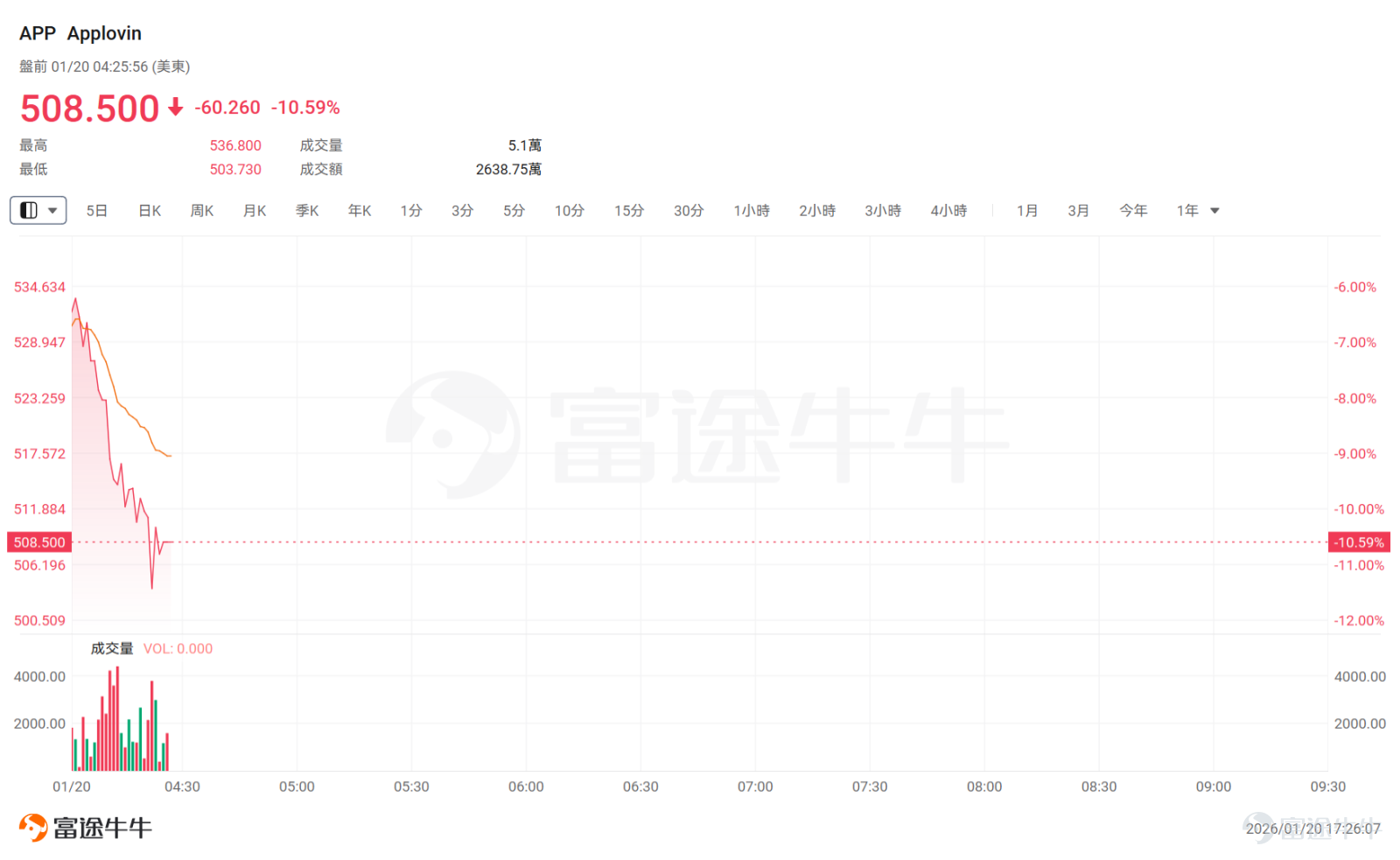
In early 2026, a Nasdaq-listed company $Applovin (APP.US)$ became the focus of the capital market. A bombshell report released by short-selling firm Capitalwatch pushed this advertising technology company to the brink of accusations of 'assisting in cross-border money laundering,' causing its stock price to plummet significantly within a month. As of press time, it fell more than 10% in pre-market trading.
This capital storm, involving unresolved issues of China's P2P sector and a transnational crime network in Southeast Asia, has not only drawn regulatory attention but also plunged investors into a decision-making dilemma.

Core allegation: A multi-country 'advertising money laundering' puzzle
The Capitalwatch report directly points to systemic compliance risks in AppLovin's core shareholder structure and business model. The report reveals that the company’s major shareholder, Hao Tang, is alleged to be the actual controller of illicit funds from the Chinese P2P platform Tuandai.com. Before Tuandai's collapse in 2019, approximately RMB 6.67 billion in illegal funds were transferred through a complex network of shell companies, while Tuandai accumulated illegal fundraising totaling RMB 253.5 billion, leaving an unpaid debt black hole of RMB 34.8 billion. Additionally, Hao Tang is accused of acquiring around RMB 15 billion in gambling proceeds via Macau casino transactions, which constitute the primary source of capital for his stake in AppLovin.

Even more shocking, the Capitalwatch report accuses Hao Tang of collaborating with Chen Zhi, the实际控制人 (actual controller) of Cambodia's Prince Group and a leader of a transnational criminal organization as defined by the U.S. Department of Justice, to build a deep-rooted money laundering network. Prince Group lured foreigners into telecom fraud schemes like “pig butchering” through closed compounds disguised as tech parks in Cambodia. The crypto-assets obtained through these scams — of which $15 billion was confiscated by the U.S. Department of Justice — were converted into massive advertising expenses via their super app WOWNOW, flowing into the AppLovin platform. These excessive ad expenditures are grossly disproportionate to WOWNOW’s market size, essentially serving as a 'transaction fee' for money laundering.
Two key technologies of AppLovin, Array and AXON, played crucial roles in these illegal transactions. The report cites technical forensics showing that Array gained system-level access through partnerships with smartphone manufacturers and telecom operators, enabling the automatic installation of illegal gambling and fraud apps without user knowledge. Meanwhile, the AXON algorithm precisely targeted potential victims to push fraudulent ads. Ultimately, after AppLovin confirmed these illicit funds as legitimate revenue, they were returned to accounts controlled by the criminal syndicate in the form of 'developer revenue shares,' completing the closed loop of 'ads as money laundering.'
The report also highlights that Ling Tang, who holds a 7.7% stake in AppLovin, not only exhibits highly synchronized shareholding patterns with Hao Tang but also shares the same street address in Hong Kong. Combined with records from French court documents indicating that a “sister assisted in transferring illicit funds,” she is identified as Hao Tang’s relative. Her shareholding is considered a critical link in the money laundering network. Furthermore, the company is accused of forcibly confiscating employee equity through 'option hijacking' and erasing traces of its China operations, raising serious governance concerns.
Market dynamics: Risks and controversies under the shadow of short selling
This short-selling attack did not come out of thin air. Prior to the report’s release, social media platforms were already buzzing with rumors that Capitalwatch would target a listed company valued at hundreds of billions. Notably, Capitalwatch's prior accusation of financial fraud against New Horizon Health ultimately led to the latter’s delisting in 2025, making its short-selling impact a cause for heightened market vigilance.

However, doubts about this report have persisted. Some investors noted that neither Hao Tang nor his controlled holding platforms appeared explicitly in AppLovin’s prospectus or subsequent filings, lacking direct evidence to establish shareholder relationships. The inference of a sibling relationship between Ling Tang and Hao Tang also contains gaps; French court documents did not specify that the recipient of the funds was Hao Tang’s sister, leaving room for possible misinterpretation.
The more critical debate centers on whether suspicions of wrongdoing at the shareholder level should be separated from the intrinsic business value of the listed company. Some market observers argue that the short-selling report failed to provide specific revenue percentages tied to illegal funds from related parties, making it difficult to prove fundamental flaws in AppLovin’s core operations. In fact, despite enduring three waves of short selling and SEC investigations last year, AppLovin still successfully joined the SPY index, and partners such as Apple and Meta took no substantial action, leading many investors to remain skeptical about the report’s persuasiveness.
In terms of regulatory risks, AppLovin is indeed under multiple pressures. According to Nasdaq listing rules and the U.S. Bank Secrecy Act, if the major shareholder’s funds are proven to be proceeds of crime, the company may face delisting risks, with related shares potentially being judicially frozen. At the same time, the U.S. Department of Justice (DOJ) might initiate civil asset forfeiture actions, and OFAC sanctions along with national security reviews could follow, creating uncertainties that loom over the stock price like a 'Sword of Damocles'.
Given the current changes, what options strategies can we use? Let’s consider scenario assumptions.
Scenario One: Event escalation + regulatory intervention, seizing opportunities in the downward trend.
If U.S. regulators subsequently launch an investigation—whether it's the SEC inquiring about disclosure fraud, the DOJ initiating a case around anti-money laundering (AML), or CFIUS conducting a national security review—it will further validate the short-seller report, potentially exacerbating market panic. The stock price will likely break through the previous support level and continue its decline. This situation calls fora bearish hedging strategy,which locks in downside gains while avoiding extreme volatility risks.
Strategy: Buy out-of-the-money put options.
For investors unwilling to bear the high cost of short selling stocks, a simpler strategy of 'buying out-of-the-money put options (OTM PUT)' is recommended. The strike price should be set below the key support level, with expiration locked for late March. The advantage of this strategy lies in gaining leveraged returns from a significant drop in the stock price at a low premium cost. If regulatory investigations confirm delisting risks, the intrinsic value of the option will increase significantly. Even if the stock price fluctuates slightly, the maximum loss would only be the initial premium paid, offering strong risk control.

Scenario Two: Short-selling allegations disproven, capturing rebound recovery opportunities.
If subsequent developments bring key positive signals—such as AppLovin issuing a detailed clarification announcement providing audited evidence of legitimate revenue sources, or regulators not launching substantive investigations, and Capitalwatch’s allegations being proven to have evidentiary flaws (e.g., incorrect shareholder relationship inferences, zero illegal funding in revenue)—market sentiment will quickly recover. The previously oversold stock price is expected to see a strong rebound. In this case, it is suitable to adoptAn offensive strategy biased towards bullishness, leveraging to amplify rebound gains.
Strategy: Buy in-the-money call options
This strategy is suitable for entering after signals of stock price stabilization appear, with the core being 'using minimal cost to achieve high leverage returns'.
The advantage of in-the-money call options lies in their higher Delta value (usually above 0.6), meaning that for every $1 increase in the stock price, the option price rises more closely in line with the corresponding stock increase, and the time value decays relatively slowly. If the stock price rebounds to near the previous high of $650, the option's return will far exceed that of directly buying the stock; even if the rebound falls short of expectations, losses can be controlled by closing the position early, offering more flexibility compared to holding the stock directly.

Key reminders for strategy execution
Closely track key signals: Official updates such as SEC filings and Department of Justice announcements must be monitored at the regulatory level; the authenticity of events should be assessed through company clarification announcements, third-party audit reports, and responses from short-selling institutions—these signals will directly determine adjustments to the strategy direction.
Position control and stop-loss: Clear stop-loss lines must be set for both scenarios to prevent risk escalation.
Flexible adjustment of expiration dates: If regulatory investigations progress faster than expected or the company releases critical announcements earlier, the option expiration date should be adjusted promptly to avoid missing trading opportunities due to time value decay.
Conclusion
The essence of AppLovin's short-selling storm is a game between compliance risks and market valuation. In the short term, regulatory investigation progress and earnings report data will be the core drivers of the stock price, and investors should beware of delisting risks and liquidity shocks; in the long term, if the company cannot prove the legality of its revenue sources, the commercial value of its advertising network will face fundamental restructuring. For ordinary investors, it is recommended to prioritize hedging risks using option tools, avoiding blindly bottom-fishing or chasing highs, and adjusting position strategies only after regulatory conclusions and business authenticity become clear. The final answer to this capital puzzle spanning China, the US, and Cambodia may gradually emerge through ongoing investigations by regulators and market dynamics.
 Sell automatically when the target price is reached; stop loss if it breaks below the support level! Once one is triggered, the other is automatically canceled, making trading more worry-free>>
Editor/Lee
Risk Disclaimer: The above content only represents the author's view. It does not represent any position or investment advice of Futu. Futu makes no representation or warranty.Read more

Comment (1)
to post a comment
3
8