
Taiwan Semiconductor's latest earnings report gives us a clearer picture of AI in 2026
By Jinduan
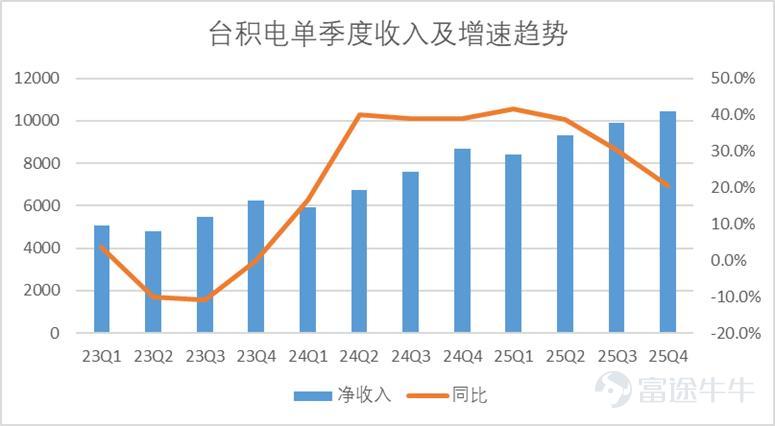
On the 15th Eastern Time, Taiwan Semiconductor released its Q4 2025 financial report, recording total revenue of 1.05 trillion New Taiwan Dollars (NTD), significantly higher than the analysts' expected 1.02 trillion NTD. The gross margin reached 62.3%, much higher than the estimated 60.6%. Net profit attributable to shareholders was recorded at 505.7 billion NTD, also significantly higher than the analysts’ prediction of 475.2 billion NTD.

For the infographic of the financial report, see the image below (all units are in billion New Taiwan Dollars, $ denotes billion USD, data sourced from financial reports, click to enlarge):

Taiwan Semiconductor's business structure is relatively simple, with the vast majority of its revenue coming from wafer processing. It also discloses performance on a monthly basis. Therefore, our analysis of quarterly reports focuses on two main points:
The first is the proportion of advanced process nodes.Taiwan Semiconductor currently holds an irreplaceable and significant advantage in N2 and N3 process nodes. The shipment volume of advanced nodes directly impacts its gross margin. Aside from production costs, the largest cost component in wafer processing is depreciation. The level of advanced node shipments directly affects the extent of fixed cost dilution, which in turn influences overall profitability.
The second is the proportion of end-user devices.Particularly, the trend in HPC (High-Performance Computing) proportion can reflect the overall capital expenditure trends in the AI industry. For a long time, Taiwan Semiconductor's performance was constrained by downstream leading customers (such as Apple), resulting in noticeable quarterly cyclicality (especially with high smartphone dependence). Since the rise of AI, its growth rate has stabilized. Observing Taiwan Semiconductor’s quarterly changes in end-user device share also helps us better understand today’s popular AI market.
This quarter serves as a short-term milestone in analyzing Taiwan Semiconductor’s financial reports because it is highly likely that Taiwan Semiconductor’s 2nm process products will officially enter the books in Q1 or Q2 this year. By Q4 2025, the most mature financial report for the 3nm process era will set the tone for Taiwan Semiconductor’s overall gross margin levels in the coming year.
Let’s first summarize Taiwan Semiconductor’s Q4 financial performance:
1. The gold mine of 3nm continues to yield. Although the advanced processes of 2nm and 1.6nm hold enormous potential, the current mainstream demand for 3nm remains strong. With costs not expanding significantly in the short term, it drove revenue, gross profit, and net profit to new highs. The guidance for Q1 is very robust, with expected revenue in the range of $34.6 billion to $35.8 billion and a gross margin guidance range of 63-65%.
2. The equivalent price per 12-inch wafer hit a new high, with no signs of a price decline in the short term.
3. Smartphone growth reached 11% in Q4, while HPC maintained a low single-digit growth rate. The growth of high-performance HPC has slowed for two consecutive quarters, likely due to the expected capacity shortage of CoWoS advanced packaging, which impacted the shipment volume of HPC end products.
4. Taiwan Semiconductor holds a relatively optimistic outlook on AI development, raising its guidance for capital expenditure in 2026, with advanced packaging becoming one of the key areas of focus for capital spending.
5. Cost advantages are gradually expanding, and Taiwan Semiconductor may enter its prime period by 2026.
Since the AI boom, semiconductors have shed their cyclical label, a phenomenon especially evident in Taiwan Semiconductor.
In Q3 2023, Taiwan Semiconductor officially began shipping its 3nm products. Prior to this, Taiwan Semiconductor's gross margin fluctuated around the maturity of the process node. For example, from the start of 5nm shipments in Q3 2020 to the 3nm shipments in Q3 2023, over three years and 12 quarters, the gross margin increased from 53% to 62%. Once the process matured, the gross margin retreated to 53%, only to rise again after the ramp-up of 3nm production.
The cycle rhythm of the 3nm process has been significantly disrupted, with gross margins continuing to rise. Even on the eve of 2nm shipments, there’s no sign of a decline in 3nm demand, and gross margins have again reached a high of 62.3%.

This is mainly due to the surge in computing power demand brought on by the AI boom. Even with 3nm, Taiwan Semiconductor still enjoys a clear generational advantage. In the past, Samsung and Intel could take over advanced process supply within four quarters, but now it appears the cycle will lengthen further.
Earlier this year, Taiwan Semiconductor announced a price hike for its 3nm process and temporarily halted new 3nm orders. This implies that nearly all capacity for the next two years has already been booked. Coupled with 2nm shipments expected as early as Q1 or as late as H2 next year, Taiwan Semiconductor offers both certainty and strong expectations, and a 65% gross margin within the year may become the norm.
Price hikes are at the core of Taiwan Semiconductor's gross margin improvement.
In the fourth quarter of this year, Taiwan Semiconductor’s 12-inch equivalent wafer shipments reached 3,961 (kpcs), a year-on-year increase of 15.9%, but a quarter-on-quarter decrease of 3%. This indicates that the revenue growth was not driven by capacity expansion.
If we calculate based on revenue/shipment volume, the processing unit price for 12-inch equivalent wafers in the fourth quarter was NT$264,100, breaking historical records. Despite a high base, it still maintained a quarter-on-quarter growth rate of 9%.
This is mainly due to the strong growth of 3nm process products. In the fourth quarter last year, 3nm process products accounted for 28% of Taiwan Semiconductor’s revenue, an increase of 5 percentage points quarter-on-quarter.

During the earnings call, an analyst pointed out that Taiwan Semiconductor's average selling price had risen approximately 20% for two consecutive years until 2025. Will 20% become the norm for the future? C.C. Wei avoided a direct answer, stating that pricing is influenced by various factors and remains unstable.
However, looking at the trend in Taiwan Semiconductor's financial reports, when transitioning from 7nm to 5nm products, these processes accounted for about 36% of total revenue. With increasing demand for computing power, the growth potential for 3nm appears more certain, which may further drive up unit prices. It is estimated that prices will repeatedly reach new highs in 2026, and a 20% increase in unit prices might indeed become the norm in the future.
In terms of consumer end-products, the growth in HPC is notably lower than that of smartphones, primarily due to Apple’s new product cycle. In the fourth quarter, smartphones grew by 11%, HPC increased by 4%, IoT grew by 3%, while automotive and consumer electronics were relatively weak, declining by 1% and 22%, respectively.
In terms of revenue composition, smartphones accounted for 32% of revenue in the fourth quarter, while HPC contributed 55%. Together, they accounted for 87% of Taiwan Semiconductor’s revenue, consistent with the first three quarters.

However, the outlook for smartphone business is uncertain. Several analysts have noted that excessive price increases in memory chips could directly impact smartphone shipments. Therefore, we believe that Taiwan Semiconductor's key focus this year will still revolve around HPC, though HPC doesn’t bring entirely good news either.
HPC revenue growth was 4% in Q4, while HPC revenue saw no year-over-year growth in Q3. This marks two consecutive quarters of low single-digit growth, contradicting the strong sentiment in the AI computing power market.
In our view, the low growth rate of HPC is not closely related to demand, but may be constrained by two factors:
The first factor is customer prioritization. The third and fourth quarters are Apple's new product cycle, with some capacity being allocated to smartphones, naturally slowing down HPC growth.
The second factor is that CoWoS advanced packaging might be limiting the scaling up of HPC. The current mainstream perception in the market has already elevated HBM to a relatively high position, and today’s computing products indeed rely heavily on advanced packaging to integrate cutting-edge chips with HBM memory.
Previously, according to TrendForce reports, Taiwan Semiconductor considered allocating some of its 45-90nm production lines to CoWoS packaging, which indirectly confirms that CoWoS advanced packaging is indeed restricting the scaling up of HPC products.
Google, due to insufficient CoWoS capacity, cut its TPU production target for 2026 from 4 million units to 3 million units.
During the Q&A session of the Q4 earnings call, Taiwan Semiconductor’s management first addressed the discussion about an AI bubble. C.C. Wei actually gave a relatively conservative statement, noting that Taiwan Semiconductor has been internally evaluating whether AI demand is real or illusory, as it directly affects the company’s future capital investment decisions.
However, according to C.C. Wei’s remarks, over the past three to four months, Taiwan Semiconductor spent considerable time revisiting clients and concluded that AI is indeed driving tremendous momentum in today’s development. Thus, Taiwan Semiconductor remains firmly committed to AI investment, providing a relatively high capital expenditure forecast for the new year, expected to reach $52 billion to $56 billion.
If calculated based on the 2025 timeline (full-year 40.9 billion), it equates to maintaining a capital expenditure growth rate of 27%-37% on a high base, which clearly demonstrates Taiwan Semiconductor's confidence.

In the earnings call, management also provided a rough breakdown of the new year’s capital expenditure allocation: 70%-80% will be invested in advanced process capacity construction to support the structural demand of AI, about 10% will be used for specialty process technologies, and approximately 10%-20% will go toward advanced packaging and testing.
This implies that the capital expenditure for advanced packaging could be around 10 billion USD, reaffirming the importance of advanced packaging.
Finally, let us examine Taiwan Semiconductor’s cost-side performance in Q4.
In fact, over the past three years, Taiwan Semiconductor's overall expense ratio trend has been very stable, with R&D expenses maintained at 7-8%. However, it is evident that due to the increase in unit prices, revenue growth far exceeds period cost growth without any significant change in costs.


In Q4, Taiwan Semiconductor’s total period costs were only 8.4%, a five-year low. The key cost item, depreciation and amortization rate, also dropped significantly to around 15%. From an industry chain perspective, Taiwan Semiconductor’s position has noticeably strengthened, as days sales outstanding have fallen by 26 days since 2023, and inventory turnover days decreased by 8 days, now standing at just 26 days overall.

During the earnings call, management also discussed the cost outlook for the new year. Taiwan Semiconductor expects depreciation expenses in 2026 to grow by about 10% year-over-year, an expectation notably lower than revenue growth guidance. Thus, next year, Taiwan Semiconductor’s depreciation as a percentage of revenue is likely to decrease further, spreading fixed costs once again.
In summary, Taiwan Semiconductor shows strong performance across revenue growth, product mix, capital expenditure expectations, and cost structure. 2026 may well mark Taiwan Semiconductor’s peak period.
[This article is based on publicly available information and is intended solely for informational exchange. It does not constitute any investment advice.]
Risk Disclaimer: The above content only represents the author's view. It does not represent any position or investment advice of Futu. Futu makes no representation or warranty.Read more

Comments
to post a comment
1