
[Warrant Insights] Divergence in Hang Seng Index Technical Signals! Key Points for High-Leverage Warrant Deployment
January 14th, $Hang Seng Index (800000.HK)$
The Hang Seng Index closed at 26,999.81 points, rising slightly by 0.56% in a single day with a trading volume of 340.393 billion yuan. Technically, the current support levels for the Hang Seng Index are 26,342 points and 25,817 points, while resistance levels are at 27,353 points and 27,982 points. The probability of an upward move is 52%, with a 5-day volatility of 4.4%. In terms of moving averages, MA10 is at 26,432.35 points, MA30 at 25,962.92 points, and MA60 at 26,035.54 points, with prices currently above all major moving averages.
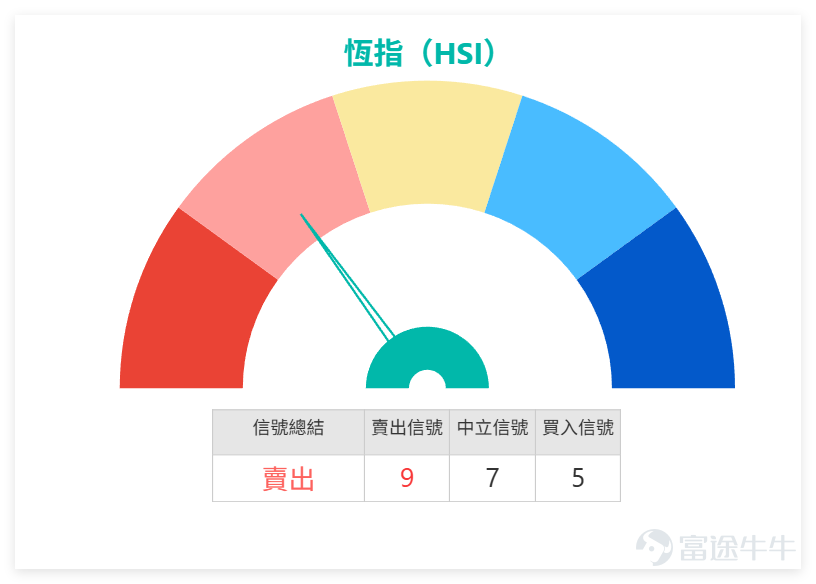
In terms of indicators, the RSI is at 66, nearing the overbought region. The overall technical indicator signal suggests selling, with a signal strength of 9. Multiple oscillating indicators show divergence: the Williams %R is in the overbought zone but gives a neutral signal, the Stochastic Oscillator is overbought and signals selling, the CCI indicates selling, while the ADX indicates buying. Both MACD and Bollinger Bands issue buy signals.

On January 14th, technology stocks generally remained stable. Tencent (00700) closed at 633.00 yuan, rising slightly by 0.88%, with its share price standing firmly above multiple key moving averages; MACD signals were neutral, and overall technical indicators were strong. Alibaba (09988) closed at 169.00 yuan, surging significantly by 5.69%; however, RSI was nearing the overbought zone, and short-term pullback risks should be monitored. Kuaishou (01024) closed at 81.95 yuan, rising by 4.46%, breaking through short-term resistance, with momentum indicators strengthening. However, Meituan (03690) performed weakly, closing at 101.50 yuan, dropping by 3.24%, showing a range-bound technical pattern with notable trading volume reaching 8.142 billion yuan. Xiaomi Group (01810) closed at 37.78 yuan, falling slightly by 0.53%, with the moving average system indicating a bearish alignment but stochastic oscillators signaling oversold conditions. Financial stocks showed mixed performances: HSBC Holdings (00005) closed at 127.00 yuan, rising slightly by 0.47%, though most technical indicators suggested selling signals, reflecting significant upward pressure. AIA (01299) closed at 84.70 yuan, edging up by 0.36%, with prices contending near the middle band of the Bollinger Bands, and the short-term direction remains unclear. Ping An (02318) closed at 68.70 yuan, falling by 1.86%, with RSI entering the neutral zone, necessitating observation to see if support can hold. HKEX (00388) closed at 434.80 yuan, rising by 0.69%, with MACD showing a bullish divergence, potentially offering a technical rebound opportunity. China Construction Bank (00939) closed at 7.77 yuan, dropping slightly by 0.51%, with thin trading and overall neutral-to-weak technical signals. Among other blue chips, Sunny Optical (02382) closed at 64.75 yuan, declining slightly by 0.46%, with the share price constrained by the MA30 moving average, lacking short-term catalysts for growth. Wuxi Bio (02269) closed at 40.00 yuan, rising slightly by 0.55%, but several technical indicators signaled overbought conditions, increasing downward pressure.
Overall, blue chip performance on January 14th was mixed; investors should pay attention to short-term technical indicator changes to formulate strategies.
Reviewing the performance of popular Hang Seng Index-related warrants and bull certificates, UBS Group’s call warrant (23091) rose by 20% two days later on January 12, 2026, while Bank of China's call warrant (23128) surged by 23% during the same period. Regarding bull certificates, Bank of China’s bull certificate (64016) and bull certificate (63488) increased by 36% and 35%, respectively, compared to the Hang Seng Index's cumulative rise of only 1.47% during the same period. It is evident that under the backdrop of a minor rebound in the Hang Seng Index, related call warrants and bull certificates leveraged their high gearing characteristics to amplify elasticity, providing investors with higher phased returns.
Based on the current market environment and product data, the following high-value Hang Seng Index-related derivatives have been selected.
In terms of call warrants, UBS Group's call warrant (23091) and Bank of China’s call warrant (23128) both have the advantage of the lowest implied volatility, with leverage ratios of 11.9 and an exercise price of 28,341 points. For investors optimistic about the Hang Seng Index breaking through upper resistance levels, these products offer both cost efficiency and flexibility advantages.
For put warrants, Bank of China’s put warrant (21317) stood out with the lowest premium and implied volatility among similar products, featuring a leverage ratio of 15.4 and an exercise price of 25,671 points, making it suitable for strategies aiming to hedge against potential Hang Seng Index pullbacks while maintaining cost stability. UBS Group’s put warrant (21347), with relatively higher leverage at 14.9 and an exercise price of 25,671 points, suits investors preferring high elasticity and willing to bear corresponding risks.
For bull certificates, Bank of China’s bull certificate (69532) has a relatively higher leverage ratio of 24.1 with a recovery price of 26,005 points, while Bank of China’s bull certificate (64765) has a leverage ratio of 22.7 and a recovery price of 25,895 points. Both possess strong elastic potential and suit investors optimistic about the Hang Seng Index holding support levels and continuing its rebound.
For bear certificates, Bank of China’s bear certificate (60102) has a leverage ratio of 24.8 with a recovery price of 27,988 points, while Bank of China’s bear certificate (60164) has a leverage ratio of 23.9 and a recovery price of 28,000 points. These bear certificates have relatively high leverage and suit investors expecting the Hang Seng Index to test upper resistance unsuccessfully and face pullback pressures.
Risk warning: Two key points require attention: Firstly, the Hang Seng Index's RSI has reached 66, approaching the overbought region, and technical indicators show divergence, which may increase short-term volatility. Investors choosing highly leveraged instruments (such as bull/bear certificates with leverage exceeding 20) must closely monitor market trend changes to avoid blindly chasing highs. Secondly, some Hang Seng Index-related derivatives have recovery prices close to the current index level (e.g., bull certificate 64765 with a recovery price of 25,895 points, just below the current Hang Seng Index at 26,999.81 points). If the market reverses, it might trigger mandatory redemption risks. Investors are advised to set strict stop-loss strategies and reasonably control positions.
The Hang Seng Index shows diverging technical signals. Would you choose low-premium call warrants to follow the rebound driven by tech stocks, or position high-leverage put warrants to hedge against market pullbacks? Share your thoughts in the comments!
Disclaimer: This article does not constitute any investment advice.
This article is for reference only and does not constitute any investment advice. The market data, opinions, and analysis contained herein may change at any time without prior notice. We shall not be liable for any loss or damage arising from reliance on the information in this article. Technical analysis merely indicates whether certain technical conditions are met; a comprehensive evaluation of asset performance should incorporate additional data. Trading decisions should not be based solely on the content of this article. Please note that past performance is not indicative of future results.
#Hang Seng Index #Hong Kong Stocks #Real-time Analysis #Warrants Selection #Warrants Strategy #Derivatives Hedging #Technology Stocks #Financial Stocks #Technical Analysis
Risk Disclaimer: The above content only represents the author's view. It does not represent any position or investment advice of Futu. Futu makes no representation or warranty.Read more

Comments
to post a comment
2