
2026 IPO bonanza! Over 90% of new stocks rose on their debut

Suny Sandy Charges into the Hong Kong Stock Market: High Growth Overshadowed by IP Dependency, Can the 'Affordable Pop Mart' Last?
Produced by Corporate Research Office IPO Team
By Wang Zheping
On January 8, Sunny Sandy (Hunan) Group Co., Ltd. ('Sunny Sandy') officially submitted its prospectus to the Hong Kong Stock Exchange, planning to list on the main board.
This IP toy company, labeled as offering 'quality for price,' achieved explosive growth driven by domestic animation hits such as 'Ne Zha 2' and 'The Little Monsters of Langlang Mountain.'
However, amid this rapid growth, the market has raised questions about the sustainability of its growth and the risks associated with its reliance on IPs— is it the 'affordable Pop Mart,' or yet another bubble inflated by short-term IP dividends?
Leveraging 'Ne Zha 2' for a dual transformation
Sunny Sandy was founded in 2015 as an IP toy company. The brand name comes from the founder Yang Jie's English name 'Sunny' and his daughter’s English name 'Sandy'.
Sunny Sandy, established in Xiangtan, Hunan, initially positioned itself as an export-oriented ODM enterprise focusing on promotional toys. It primarily provided development and production services for IP-licensed toys to large overseas supermarkets and chain retailers.
Clients were responsible for securing IP licenses, while Sunny Sandy handled design and manufacturing. Its products, in miniature sizes (typically 4-5 cm), were packaged in blind bags and integrated into promotional campaigns. In the prospectus, this segment is described as the 'IP Toy+' business.
According to previous public reports, its production series like 'Jurassic Park,' 'PAW Patrol,' and 'Harry Potter' often received orders starting at tens of millions of units, mainly sold in European, South American, and Southeast Asian markets.
Prospectus data shows that in 2023, the company's 'IP Toy+' business accounted for 72% of revenue, while overseas income made up 67.6%.
However, long-term reliance on overseas major clients resulted in thin profit margins and a lack of proprietary branding.
By the end of 2021, Sunny Sandi opened a flagship store on Douyin to test domestic sales, but the real turning point in its strategy came with the release of 'Ne Zha: The Demon Child's Wrath 2'.
According to public reports, in October 2024, upon learning the release schedule for 'Ne Zha: The Demon Child's Wrath', Sunny Sandi’s management immediately contacted the production team to secure the exclusive national license for 3D plastic food toys for 'Ne Zha 2'.
This collaboration became a key stepping stone for the company's transformation.
Leveraging the popularity of the 'Ne Zha 2' IP, Sunny Sandi launched the 'Surprise Box' series, which quickly exploded in the market due to its ultra-high cost performance priced at RMB 69 per box or RMB 8.8 per single item. Within a week of launch, over 510,000 sets were sold, generating revenue exceeding RMB 35 million. It topped the trendy blind box bestseller list and even went out of stock at offline snack stores like Hao Xiang Lai. Factories resumed full operations by the sixth day of the Lunar New Year.
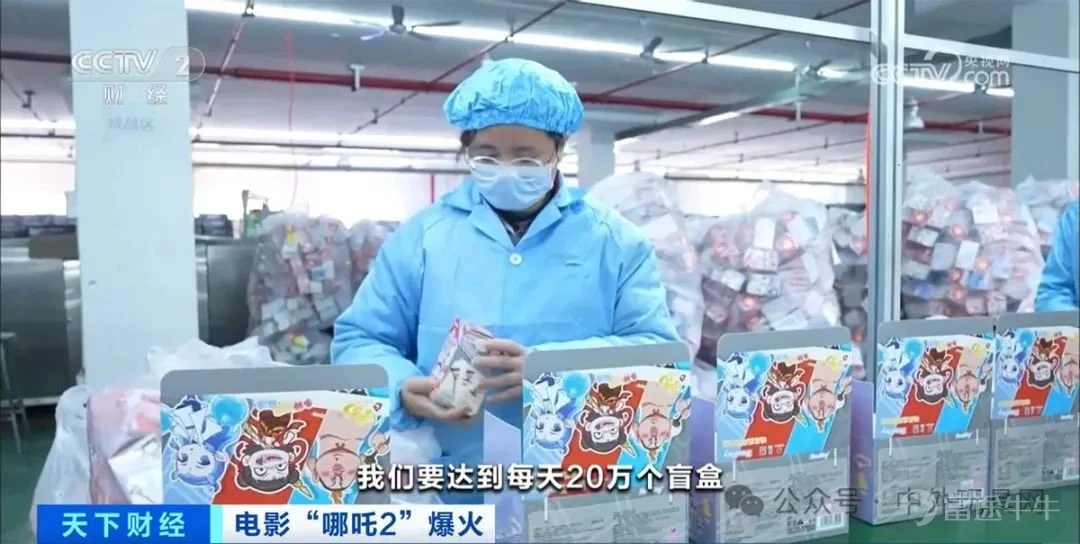
Riding the wave of 'Ne Zha 2', Sunny Sandi completed its critical transformation.
In the first three quarters of 2025, revenue from IP toy products surged from 28% in 2023 to 78.3%, while the business segment of IP toys+ (custom promotional toys for corporate clients), once the mainstay of revenue, shrank from 72% to 21.7%.
Meanwhile, the company’s market focus shifted from being export-driven to prioritizing domestic sales. From 2023 to the first three quarters of 2025, revenue from mainland China jumped from 32.4% to 79.7%.
From an OEM factory focused on exports to a market innovator breaking through with domestic animation IPs and creating affordable trendy toy brands, Sunny Sandi achieved a dual leap from 'manufacturing' to 'branding' and from 'B2B' to 'B2C'.
The absence of proprietary IPs poses hidden risks.
Benefiting from the company’s ongoing transformation and the strong support of the 'Ne Zha 2' IP, Sunny Sandi’s performance skyrocketed over the past three years.
In the first three quarters of 2023, 2024, and 2025, the company achieved operating revenues of 107 million yuan, 245 million yuan, and 386 million yuan respectively, with year-over-year growth rates reaching as high as 129.38% and 134.62%.
Profitability quality improved significantly, with a successful turnaround to profitability in 2024. In the first three quarters of 2025, net profit reached 51.959 million yuan, and the adjusted net profit margin increased to 13.7%.
As of September 2025, the company's IP toy products have covered over 32,000 retail terminals, with e-commerce channel revenue surging 264.3% year-over-year.
However, behind the impressive performance, concerns linger about the sustainability of Sunnyside's growth, with multiple risks yet to be addressed.
The core risk lies in the vulnerability of the IP licensing model.
The company currently collaborates on more than 20 IPs, all under non-exclusive licenses. The typical duration of relevant licensing agreements is only 1-2 years, with no automatic renewal mechanism. The company explicitly cautioned in its prospectus: 'If we fail to continuously secure or maintain IP licenses, our business will suffer significant adverse effects.'
More critically, blockbuster IPs in the film industry are rare finds, and super IPs like 'Ne Zha 2,' which set domestic box office records, are even scarcer. If the company cannot continue to tie up with high-profile IPs in the future, its revenue growth will lose core support.
Secondly, the company's competitive shortcomings in the market are also prominent.
According to Frost & Sullivan data, based on 2024 sales volume, Sunnyside holds only a 4.5% share in the domestic affordable 3D IP toy market, below the industry leader’s 13.0% share.
Additionally, the 'high marketing for growth' model may not be sustainable.
In the first three quarters of 2025, the company's sales and distribution expenses surged 126% year-on-year to 36.82 million yuan, mainly used for purchasing traffic on e-commerce platforms and expanding the sales team. This growth model that relies heavily on high marketing investment is highly susceptible to losing momentum once the IP popularity fades.
In this IPO, Sunny Sandy plans to allocate part of the proceeds to 'enhance its in-house IP development capabilities' and aims to expand into overseas markets by leveraging the 2026 FIFA World Cup partnership as an opportunity.
How far can the 'affordable Pop Mart' go?
Sunny Sandy's founder Yang Jie's entrepreneurial vision stems from his rural upbringing – the scarcity and high cost of quality licensed IP toys inspired him with the aspiration to 'enable all consumers, regardless of location or income, to easily own quality IP toys.'
This vision gave rise to the company’s core label of 'value-for-money,' also establishing its differentiated track: retail prices are concentrated between 3.9 yuan and 19.9 yuan, with most below 9.9 yuan, forming a stark contrast to Pop Mart's mainstream blind box pricing of 69.9 yuan, hence being tagged by the market as the 'affordable version of Pop Mart.'
Although both operate in the IP toy sector, the core differences between Sunny Sandy and Pop Mart determine the fundamentally different logic behind their development.
Pop Mart centers around its proprietary IPs, using hidden design editions, serialized operations, and secondary market speculation to give products collectible attributes and social value, precisely targeting the self-expression needs of young consumers in first- and second-tier cities; Sunny Sandy focuses on spot sales, relying on licensed IPs rather than independent operations, with core competitiveness centered on the cost-performance ratio for lower-tier markets, lacking the premium pricing ability emphasized in the trendy toy industry.
Moreover, the value-for-money strategy directly limits profit margins.
In 2023, 2024, and the first three quarters of 2025, Sunny Sandy’s gross profit margins were 16.9%, 23.3%, and 35.3%, respectively. Although the gross margin has been continuously increasing, it remains lower than the industry leaders.
Based on 2024 performance comparisons, Pop Mart's gross margin that year was 66.8%, while Bruckly’s gross margin was 52.6%.
52TOYS' gross margin is 39.9%, while the gross margin of TOP TOY, a trendy toy brand under Miniso, is 32.7%.
Behind the low gross margin lies dual cost pressures: on one hand, high IP licensing fees, and on the other, bearing the full cost chain from design to production.
In the first three quarters of 2025, Sunny Sandy's licensing fees reached RMB 50.768 million, accounting for 13.1% of revenue. In 2024, 52TOYS' IP licensing costs accounted for 7.3% of its revenue; in the first half of 2024, Brucke's licensing fees accounted for 8.7% of its revenue.
Unlike companies like 52TOYS and Brucke that mainly rely on outsourced production, Sunny Sandy primarily depends on in-house manufacturing. Given that the company’s IPs are entirely licensed externally, this means Sunny Sandy must bear the entire chain of risks alone.
From the company’s development over the past year or so, Sunny Sandy has carved out a differentiated path by keenly capturing domestic trend IPs and penetrating lower-tier markets. Founder Yang Jie, with the original aspiration of 'letting every child afford authentic trendy toys,' carries an infectious passion.
However, the core focus of the capital market remains sustainable business models. If Sunny Sandy cannot achieve breakthroughs in its proprietary IPs, quality control systems, and cost structure, the halo of being the 'affordable Pop Mart' may quickly fade.
Risk Disclaimer: The above content only represents the author's view. It does not represent any position or investment advice of Futu. Futu makes no representation or warranty.Read more
Comments
to post a comment