
Hong Kong-listed AI 'twin leaders' see active trading! How to position in the AI sector for the Year

Short-term Analysis of Alibaba: Technical Breakthrough Poised to Launch, Focus on AI and Instant Retail as New Drivers
$BABA-W (09988.HK)$ Short-term Analysis of Alibaba: Technical Breakthrough Poised to Launch, Focus on AI and Instant Retail as New Drivers
As of January 13, 2026, Alibaba (09988) stock price has shown strong momentum driven by multiple positive catalysts, last traded at HKD 159.7, up 3.50%, with a turnover of HKD 15.867 billion. Recent market focus has been on the overall technical rebound in the Chinese tech sector, and Alibaba, with its clear business growth path, has become one of the leading indicators attracting investor attention.
From a technical perspective, Alibaba's stock price has successfully moved above all key short-term moving averages. Currently, the 10-day moving average (MA10) is at HKD 148.89, the 30-day moving average (MA30) is at HKD 149.62, and the 60-day moving average (MA60) is at HKD 154.95. The stock price is currently higher than these averages, indicating relatively strong upward momentum in the short term. Multiple trend indicators such as Ichimoku Cloud and MACD signals are pointing to 'Buy,' supporting a favorable mid-term trend.
However, after a rapid rise, some oscillation indicators suggest the market may need short-term consolidation. The current Relative Strength Index (RSI) is at 64, which, although not entering extremely overbought territory, is already at a relatively high level. Both the Williams %R and Stochastic Oscillator are issuing 'Overbought' or 'Sell' signals, indicating increased divergence between buyers and sellers in the short term. This aligns with the 'Sell' signal from the overall technical summary, reminding investors that the stock price may face certain technical pullback pressures when challenging key resistance levels.
Support and Resistance Analysis: 158.3 yuan becomes the short-term critical watershed
According to the latest technical analysis data, the short-term trading range for Alibaba's stock price has become relatively clear, which is highly consistent with analyst Simon's comments in the recent [Hong Kong Stock Podcast].
On the upside resistance, the primary threshold is at 168.7 yuan. Simon specifically pointed out in the program that the key to whether the current stock price can continue its upward trend lies in whether it can effectively break through the resistance near 158.3 yuan. If it successfully breaks through and stabilizes above this level, the next target will be 173.9 yuan. This range between 158 yuan and 160 yuan is a crucial path for the stock price to reach previous highs.
On the downside support, the first important defense line is at 152.4 yuan, which is close to the 10-day moving average and is expected to provide strong support. The more critical support level is at 145.5 yuan, which aligns closely with Simon's mentioned support zone of 147 yuan to 145 yuan and is considered an important observation point for short-term trend strength. Investors deploying bull certificates should refer to this support zone when choosing the stop-loss price to help manage risks.
Market View Summary: Sector Reversal and Company New Strategy Resonance
Alibaba's recent strength is the result of macro technical factors, industry policies, and the company's own new growth engines working together.
First, on the macro level, China's tech stock sector has shown positive technical reversal signals. A CLSA report indicated that major indices and leading stocks have achieved a series of key breakthroughs, and China's internet sector is demonstrating new strength. Barron's also analyzed that related stock indices have completed bullish technical patterns, indicating waning downward momentum, providing an opportunity for risk asset allocation. As a heavyweight stock in the sector, Alibaba naturally attracts capital attention.
Second, two new growth drivers at the company level have become market focal points. On one hand, the progress of AI (artificial intelligence) business has exceeded expectations. The Tongyi Qianwen series model under Alibaba Cloud has gained significant global influence, with cumulative downloads exceeding 700 million times, becoming one of the most downloaded AI series in mainstream open-source communities. This reinforces market confidence in its long-term growth logic driven by 'consumption and AI dual-**Morgan expects Alibaba Cloud's revenue growth to continue accelerating in the coming quarters.
On the other hand, the company has made a strong push into the instant retail market. Alibaba has clearly set 'Taobao Flash Purchase' as its core development goal for 2026, aiming to capture the 'absolute first' market share. In the fourth quarter of 2025, this business showed strong growth, quickly breaking through non-meal orders, narrowing losses faster than competitors, with daily order peaks reaching 120 million orders. This strategy is expected to open up a trillion-yuan new growth space for the company.
Derivatives Review: Leverage effects significantly amplified in one-sided market conditions
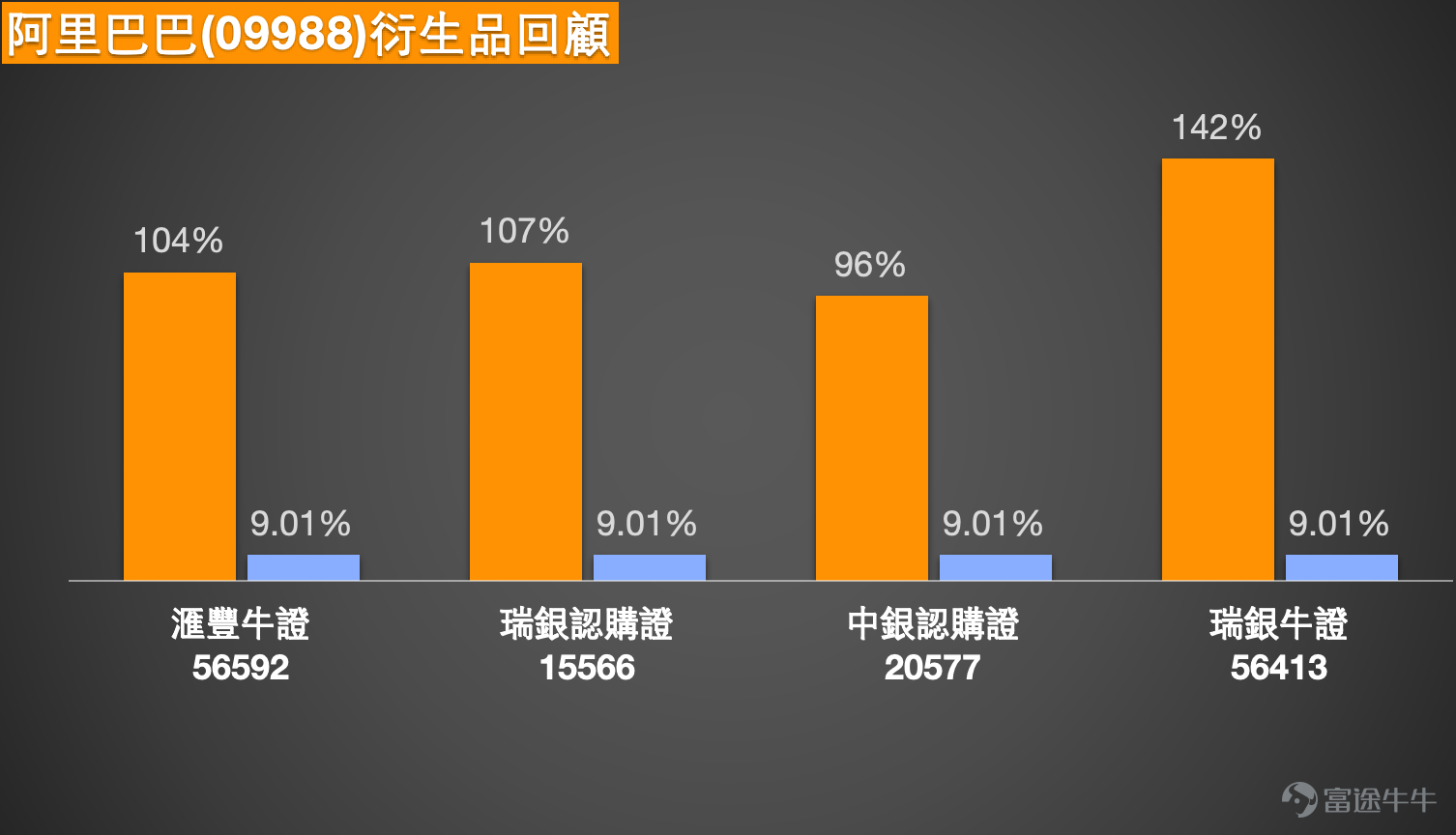
When the underlying stock shows a clear trend movement, derivatives can effectively improve capital utilization efficiency. Reviewing the products mentioned on January 9, 2026, during the subsequent two trading days (up to January 11), Alibaba's underlying stock cumulatively rose by 9.01%, and the performance of related derivative products fully demonstrated their leverage characteristics.
Specifically, bull certificates showed astonishing gains: UBS bull certificate (56413) $UB#ALIBARC2607I.C (56413.HK)$ and HSBC bull certificate (56592) $HS#ALIBARC2607E.C (56592.HK)$ saw their prices rise sharply by 142% and 104% respectively over two days. Call warrants also performed well: UBS call warrant (15566) and Bank of China call warrant (20577) $BIALIBA@EC2604B.C (20577.HK)$ recorded increases of 107% and 96% respectively. This set of data clearly shows that when the underlying stock experiences a one-sided rise, whether it is bull certificates with mandatory recall mechanisms or call warrants affected by time value, the magnitude of their price changes may be several times that of the underlying stock, providing investors with a more efficient way to deploy in trends.

Derivatives Deployment Strategies Under Current Market Conditions
Based on the judgment that Alibaba's stock price is at a critical resistance level, investors can choose products according to different expectations for the future market. Please note that the prices of all derivative products can rise or fall sharply, and investors may lose all their principal. Before investing, they should fully understand the product risks and refer to relevant listing documents.
If optimistic about the underlying stock breaking through resistance, out-of-the-money call warrants or high-leverage bull certificates can be considered.
For investors who believe that the sector reversal and new drivers such as AI and instant retail will push the stock price to break through resistances at 158.3 yuan and even 168.7 yuan, the following products are worth noting.
* UBS call warrant (15566) $UBALIBA@EC2603A.C (15566.HK)$ and HSBC call warrant (14334) $HSALIBA@EC2604A.C (14334.HK)$ These two products have strike prices near 170 yuan, classified as slightly out-of-the-money warrants, offering approximately 7.6x and 7.4x actual leverage. As previously mentioned, this type of out-of-the-money warrant can provide higher potential returns when the underlying stock experiences significant gains.
* Societe Generale Bull (56908) and UBS Group Bull (69157): These two bull contracts have stop-loss levels set at 140 yuan and 144 yuan respectively, providing approximately 7.1x and 8.6x actual leverage. The price movement of bull contracts typically closely follows the underlying stock and is not affected by time decay, making them suitable for swing trading. Among these, Societe Generale Bull (56908) $SG#ALIBARC2610K.C (56908.HK)$ is characterized by high actual leverage and low premium.

If you expect the underlying stock to consolidate after a pullback, consider looking at put warrants or bear contracts.
For investors concerned about high RSI levels and divergences in technical indicators, bearish instruments can be used to hedge risks or capture pullback opportunities.
* Bank of China Put Warrant (20664) $BIALIBA@EP2604B.P (20664.HK)$ and UBS Group Put Warrant (20869) $UBALIBA@EP2604B.P (20869.HK)$ : These two products have a strike price of 134.9 yuan, offering approximately 6.9x actual leverage. Their premiums and implied volatilities are relatively low compared to similar products, meaning their prices are less affected by market sentiment fluctuations.
* BNP Paribas Bear (64687) $BP#ALIBARP2805L.P (64687.HK)$ : This bear contract has a stop-loss level set at 169 yuan, offering approximately 15.8x actual leverage, the highest among the recommended products, with the lowest premium. It is suitable for investors with a higher risk tolerance who have a clear bearish view on the short-term trend.

Amid expectations of AI technology breakthroughs, the push in instant retail strategy, and a technical reversal in the US-listed Chinese stock sector, do you think Alibaba's stock price will first gather momentum to break through the key resistance at 168.7 yuan, or will it first pull back to consolidate near the support level at 152.4 yuan? In terms of deployment strategy, after understanding the rationale behind choosing the strike price, would you lean more towards high-leverage out-of-the-money warrants or more conservative in-the-money warrants to implement your market view?
#Learn Warrants and Bull/Bear Certificates with Jenny# Key Insights: The Importance of Strike Price Selection
When choosing warrants, the 'strike price' is one of the core terms, directly determining the product’s leverage level, risk characteristics, and correlation with the underlying stock. Simply put, the strike price is the price at which investors have the right to buy (call warrant) or sell (put warrant) the related underlying stock on the expiration date.
Generally speaking, depending on the relationship between the strike price and the current price of the underlying stock, they can be divided into three categories:
1. In-the-money warrants: For call warrants, the strike price is lower than the current price of the underlying stock; for put warrants, the strike price is higher than the current price of the underlying stock. These products have relatively high intrinsic value, low time value proportion, are less affected by implied volatility and time decay, move closely with the underlying stock, but typically offer lower actual leverage.
2. At-the-money warrants: The strike price is very close to the current price of the underlying stock. Their characteristics lie between in-the-money and out-of-the-money.
3. Out-of-the-money warrants: For call warrants, the strike price is higher than the current price of the underlying stock; for put warrants, the strike price is lower than the current price of the underlying stock. These products only have time value and zero intrinsic value, so they provide higher actual leverage. However, their price sensitivity to changes in the underlying stock (Delta value) is usually lower than that of in-the-money warrants initially, and they are more affected by implied volatility and time decay.
How to choose? It depends on your expectations for the movement of the underlying stock and your risk tolerance:
* If you expect significant upside in the underlying stock and are willing to take on higher risks for potentially higher returns, consider slightly out-of-the-money call warrants. For instance, this time we recommend UBS Group Call Warrant (15566) and HSBC Call Warrant (14334), with strike prices of 170.1 yuan and 170 yuan respectively, compared to the current stock price (about 159.7 yuan). These products provide about 7.6x and 7.4x higher actual leverage, which could yield considerable multiple returns if the underlying stock rises as expected.
* If you believe the underlying stock will rise moderately or prefer a more stable deployment, then in-the-money or at-the-money call warrants may be more suitable choices, as they track the underlying stock performance with smaller deviation.
For put warrants, the logic is reversed. If you are bearish on the market outlook, out-of-the-money put warrants offer higher leverage; if used for hedging risk, in-the-money or at-the-money warrants provide stronger protection.
For analysis on Hong Kong stock warrants and bull/bear certificates, this is Jenny. See you again next time.
This article does not constitute any investment advice
This article is for reference only and does not constitute any investment advice. The market data, opinions, and analysis contained herein may change at any time without prior notice. We shall not be liable for any loss or damage arising from reliance on the information in this article. Technical analysis merely indicates whether certain technical conditions are met; a comprehensive evaluation of asset performance should incorporate additional data. Trading decisions should not be based solely on the content of this article. Please note that past performance is not indicative of future results.
#Alibaba #TechnicalAnalysis #SupportResistanceLevels #Warrants #BullBearCertificates #ExercisePrice #TongyiQianwen #TaobaoFlashSale #HongKongStockDeployment #RiskManagement
Risk Disclaimer: The above content only represents the author's view. It does not represent any position or investment advice of Futu. Futu makes no representation or warranty.Read more
Comments
to post a comment
7