
2026 IPO bonanza! Over 90% of new stocks rose on their debut

[IPO Watch] Xiaomi-backed robotics firm makes another run at HKEX, what are its chances?

In the crowded robotics track, the desire to 'make it' has never been stronger.
At the start of 2026, when Standard Robots’ updated IPO application documents reappeared on $HKEX (00388.HK)$ the official website, its intention to become the 'first industrial embodied intelligence stock' was very clear. This is not its first attempt—back in June 2025, the company had filed its initial application, but that document expired in December of the same year after reaching the six-month mark.
For this robotics company,$XIAOMI-W (01810.HK)$ which is invested by [entity] and holds a leading market share in the 3C and automotive industries, resubmitting its application does not mean facing any less competition—in fact, competition has intensified as more industrial robotics and other embodied intelligence peers, such as Xian Gong Intelligence, have submitted their IPO applications during the same period.
Stanford Robotics' main business
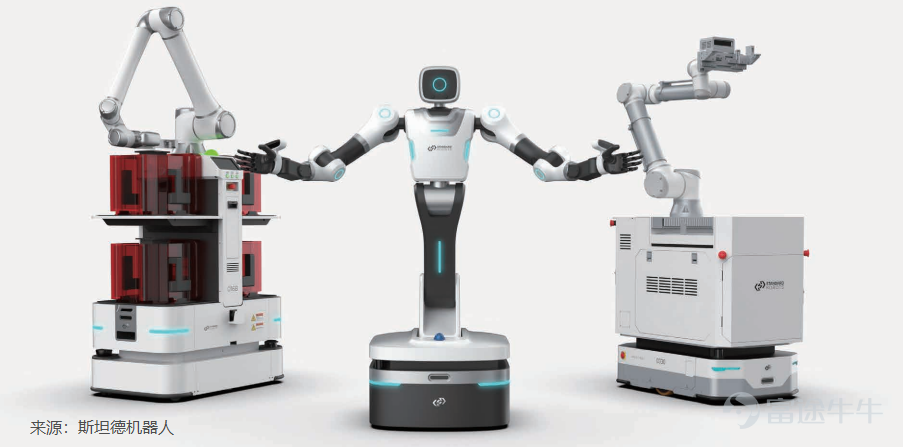
Stanford Robotics primarily provides intelligent industrial robotics solutions to empower smart manufacturing. Its customized one-stop robotics solutions include a core robotics technology platform, one-stop intelligent industrial robot products, and the RoboVerse system (a one-stop intelligent collaboration system).
Its core technology, robotic products, and RoboVerse system are all self-developed. The core robotics technology platform includes a core controller, a self-developed operating system SROS, and algorithms. The robot products include standard robots, functional robots, and embodied robots, all built on the core robotics technology platform. The RoboVerse system is a one-stop intelligent collaboration system based on a self-developed industry scenario-oriented world model and large-scale multi-robot coordination technology. The industry scenario-oriented world model integrates AI-driven modeling and predictive capabilities to enhance robots' environmental perception and decision-making.

Stanford Robotics’ robotics solutions are mainly divided into three types:
Standard robots are mobile, with three degrees of freedom, and their main feature is providing mobility for various complex scenarios driven by proprietary algorithms. Their prices range from 60,000 RMB to 350,000 RMB.
Functional robots are equipped with additional capabilities such as lifting, transporting, stacking, and towing, primarily characterized by their ability to execute advanced functions based on customized requirements. They have four to eight degrees of freedom and can be tailored in a one-stop solution, priced between RMB 100,000 to RMB 600,000.
Embodied robots can perform complex tasks with nine or more degrees of freedom, enhancing flexibility through additional degrees of freedom. These robots can execute intricate tasks across various industrial scenarios, offering bespoke robotic solutions for high-end manufacturing sectors like semiconductors, with prices ranging from RMB 450,000 to RMB 1,250,000.
As the above chart shows, functional robots constitute the company's primary revenue source, accounting for 68.42% of its total income in the first three quarters of 2025. It focuses particularly on industries such as 3C, automotive, and semiconductors, with 3C clients contributing over half of its revenue, as shown below.

Industry Position and Development Prospects
Industrial robots possess extensive market growth potential, which should be an industry consensus. The question lies only in how much benefit industrial robot enterprises can derive from this growth. According to data provided by Standard Robots' hired consultancy, CIC, based on global sales volume of related industrial smart mobile robot solutions in 2024, Standard Robots ranks fifth, with 1,900 units sold, capturing approximately 3.2% of the market share. By comparison, we speculate that the top-ranking company is Hikvision (002415.SZ)under HikRobot, holding a market share of 27.9%, with estimated sales of 17,000 units, while the fourth-ranked company is likely to be Xian Gong Intelligence, with an estimated sales volume of 2,600 units and a market share of around 4.2%.
From these figures, it appears that the market concentration among leading industrial robotics firms is quite high, and competition remains fierce. Whether Standard Robots can break through this competitive landscape remains highly uncertain.
The prospect of turning losses into profits still contains significant uncertainties.
We noticed that in the full year of 2024 and the first three quarters of 2025, Standard Robots' total revenues were RMB 251 million (all figures in RMB unless otherwise stated) and RMB 188 million respectively, showing promising sales growth. Gross margins improved significantly, reaching 38.78% and 44.74%. However, it is important to note that as a technology-intensive sector, the robotics industry requires substantial R&D investment to maintain technical competitiveness: In 2024 and the first three quarters of 2025, the company's expensed R&D spending accounted for 14.61% and 29.81% of total revenue respectively. Additionally, marketing expenses needed to compete for customers in this fiercely contested market reached 25.78% and 41.30%—even higher than R&D spending—indicating there is still a long way to go before achieving profitability.
According to the company's data, in the first three quarters of 2024 and 2025, its average customer value was 1.204 million yuan and 926,000 yuan respectively, while the customer acquisition costs were 778,000 yuan and 892,000 yuan, which are not low. The contract value at the end of September 2025 was approximately 177 million yuan, which should secure its revenue for the next six months, but it still struggles to cover the high cost expenditures.
Stanford Robotics' financial status shows that its inventory turnover days in the first three quarters of 2024 and 2025 were 261 days and 216 days respectively, while accounts receivable turnover days reached 163 days and 236 days. However, accounts payable turnover days were only 117 days and 149 days, meaning the payment cycle to suppliers is much shorter than inventory and accounts receivable turnover. This explains why its net operating cash flow has long been negative. For the company to continue operations, financing activities seem necessary, making the urgency of an IPO evident.
The company plans to use the proceeds raised through the IPO for:
1) R&D: Strengthening core robotics technology platforms, robotic products, and the RoboVerse system, as well as developing proprietary robotics technologies;
2) Sales and service network expansion and brand promotion.
3) Development of production capabilities and new production lines.
4) General corporate purposes and working capital.
Conclusion
In the industrial robotics sector in 2026, on one hand, policy support and the intelligent transformation of manufacturing industries are creating a trillion-dollar blue ocean market. The industry is expected to maintain a high growth rate, with embodied intelligence and collaborative industrial robots opening up structural explosive potential. On the other hand, the harsh reality of 'involution' intensifies, with leading companies dominating the market share and price wars escalating. The industry has moved from a 'ranking race' into an 'elimination race.' Stanford Robotics’ second attempt to file for an IPO on the Hong Kong Stock Exchange reflects the intersection of opportunities and risks in this industry wave, where enterprises seek breakthroughs.
As a player focusing on core areas such as 3C and automotive, although Stanford Robotics holds major client orders like those from Xiaomi Auto and has built certain technological barriers through self-developed technology, its market share may still lag behind global leaders in industrial robotics. Persistent high R&D and marketing expenses, strained cash flow, and pressure from inventory and accounts receivable turnover mean the path to profitability remains long and arduous.
In the capital markets, storytelling is no easy task either. HKEX’s Chapter 18C has attracted a cluster of peers such as Immortal Intelligence to flock to IPOs, making the track just as crowded as the industry side. Investors prioritize commercialization capabilities and profit prospects. To convince investors, Stanford Robotics needs to demonstrate stronger customer value, clearer paths to profitability, and more efficient operational capabilities to stand out in the fiercely competitive IPO environment and win valuable trust and funding.
By: Mao Ting
Risk Disclaimer: The above content only represents the author's view. It does not represent any position or investment advice of Futu. Futu makes no representation or warranty.Read more
Comments
to post a comment