
[2026 Outlook] Plan Ahead! Share the Investment Opportunities You Are Optimistic About

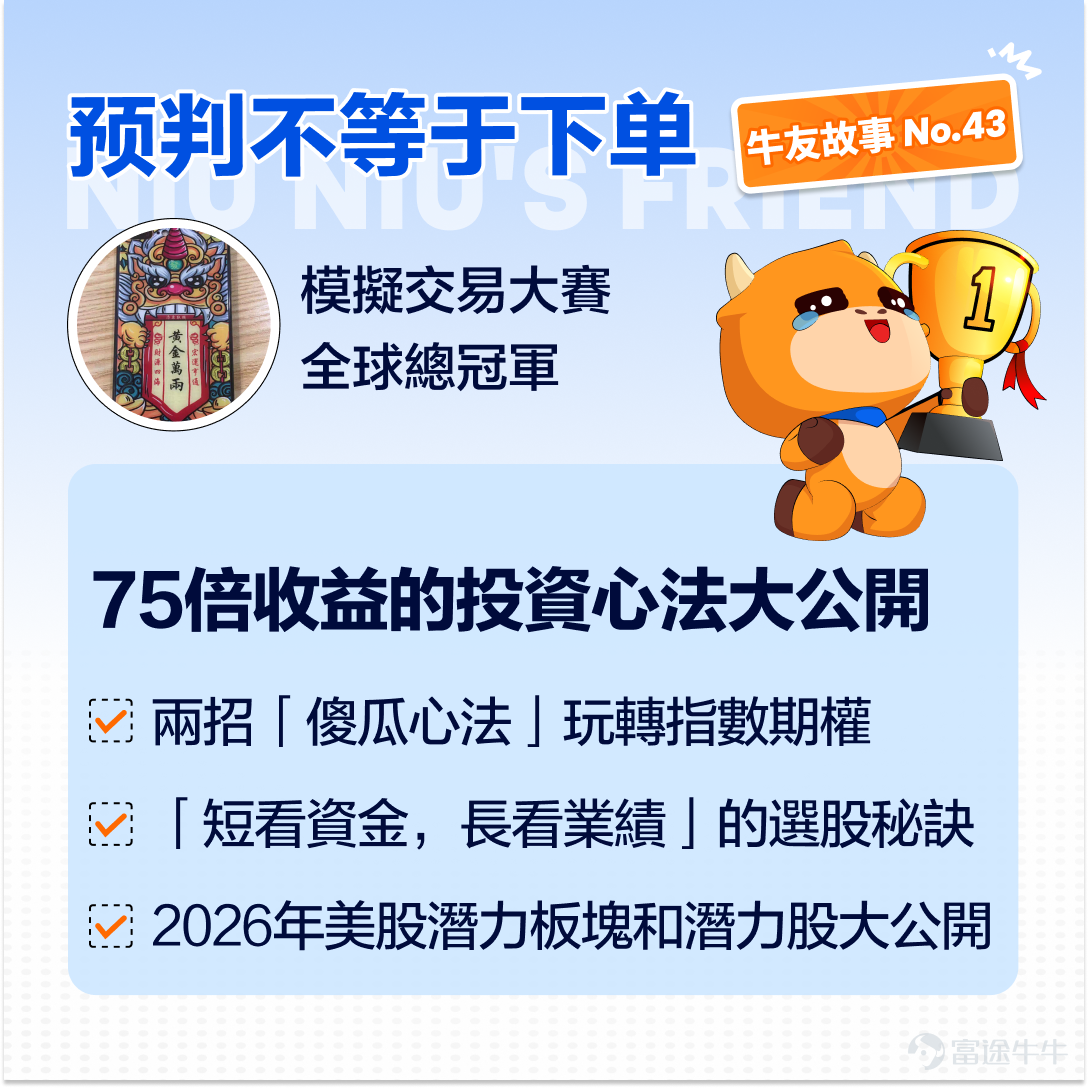
[Investor Story] 7528% return dominating globally! Unveiling a simple-to-understand high win-rate strategy for index options!
Want to improve your win rate in index options with just two simple strategies? The overlooked logic behind a 75x return miracle in one month?
In the recently concluded global mock trading competition, a fellow investor specializing in $S&P 500 Index (.SPX.US)$ options and US equities achieved success by relying onTwo foolproof rules for index options, achieving 7528.12% an astonishing return rate, capturing the global championship title, and his photo was evendisplayed on the Nasdaq big screen!In this Investor Story, we have invited this fellow investor with over 25 years of rich investment experience@预判不等于下单, to share how he has navigated multiple market cycles and distilled a set ofhigh-probability 'certainty trading' investment principles。
 Friendly reminder: This article is lengthy, so we recommend liking and bookmarking it for careful reading later. There's a surprise awaiting at the end for interaction!
![To increase the win rate for index options, only two foolproof strategies are needed? Behind the miraculous 75x return in one month, could the trading logic actually be so simple that it’s often overlooked? In the recently concluded global simulated trading competition, a fellow investor $S&P 500 Index (.SPX.US)$ focused on options and U.S. stocks, achievedtwo essential winning rules for index optionsand achieved 7528.12% an astonishing return rate, capturing the global championship title. The investor's photo evenappeared on the Nasdaq big screen.!In this Investor Story, we invited this fellow investor with over 25 years of rich investment experience.@预判不等于下单, sharing how he navigated multiple market cycles and distilled a set ofhigh-probability 'certainty trading' investment principles。 [Microphone]Friendly reminder: This article is lengthy, so we recommend liking and bookmarking it for careful reading later. There's a surprise awaiting at the end for interaction! 1. The Road to 75x Returns: The Ultimate Bet on 'Certainty' Q: Congratulations on winning the global simulation competition and being featured on the Nasdaq screen. Could you briefly introduce your investment journey? A: My parents started investing in stocks back in the 90s, and I grew up accompanying them to the exchange. Influenced by this environment, I began stock trading in 2000, dabbling in A-shares and Hong Kong stocks. By around 2012, I had entered the US stock market and also experimented with highly leveraged futures. This experience deeply ingrained in me the importance of risk management. Currently, my main focus is on the US market, primarily trading index options and US equities, supplemented by some long-term positions in Hong Kong stocks...](https://nnqimage.futunn.com/sns_client_feed/999992/20260109/web-1767972223401-wxKUSyc7vX.png/big?area=1&is_public=true&imageMogr2/ignore-error/1/format/webp)
I. The Road to Success with 75x Returns: The Ultimate Bet on 'Certainty'
![To increase the win rate for index options, only two foolproof strategies are needed? Behind the miraculous 75x return in one month, could the trading logic actually be so simple that it’s often overlooked? In the recently concluded global simulated trading competition, a fellow investor $S&P 500 Index (.SPX.US)$ focused on options and U.S. stocks, achievedtwo essential winning rules for index optionsand achieved 7528.12% an astonishing return rate, capturing the global championship title. The investor's photo evenappeared on the Nasdaq big screen.!In this Investor Story, we invited this fellow investor with over 25 years of rich investment experience.@预判不等于下单, sharing how he navigated multiple market cycles and distilled a set ofhigh-probability 'certainty trading' investment principles。 [Microphone]Friendly reminder: This article is lengthy, so we recommend liking and bookmarking it for careful reading later. There's a surprise awaiting at the end for interaction! 1. The Road to 75x Returns: The Ultimate Bet on 'Certainty' Q: Congratulations on winning the global simulation competition and being featured on the Nasdaq screen. Could you briefly introduce your investment journey? A: My parents started investing in stocks back in the 90s, and I grew up accompanying them to the exchange. Influenced by this environment, I began stock trading in 2000, dabbling in A-shares and Hong Kong stocks. By around 2012, I had entered the US stock market and also experimented with highly leveraged futures. This experience deeply ingrained in me the importance of risk management. Currently, my main focus is on the US market, primarily trading index options and US equities, supplemented by some long-term positions in Hong Kong stocks...](https://nnqimage.futunn.com/sns_client_feed/999992/20260109/web-1767972236010-0FGzNv65nt.png/big?area=1&is_public=true&imageMogr2/ignore-error/1/format/webp)
Q: Congratulations on winning the global simulation competition and having your photo displayed on the Nasdaq big screen. Can you briefly introduce your investment background?
A: My parents started investing in stocks back in the 90s, and I grew up accompanying them to the exchange. Influenced by that environment, I began stock trading in 2000, dabbling in A-shares and Hong Kong stocks. By around 2012, I ventured into the US stock market and even experimented with highly leveraged futures. This journey taught me the importance of risk management. Currently, my primary focus is on the US stock market, mainly trading index options and US stocks, complemented by some long-term holdings in Hong Kong stocks.
Q: Could you share the key strategy behind your success in the simulation competition with a return rate of 7528.12%?
A: In the simulation competition, I mainly traded $S&P 500 Index (.SPX.US)$ options because compared to $Invesco QQQ Trust (QQQ.US)$ other underlying assets, the S&P 500 Index is the most active with strong liquidity and high volatility.The biggest contributor was the 'final decisive move' on the S&P 500 Index options at the end of the competition. At that time, the index had surged continuously to 6770 points, and market sentiment seemed to point towards 6800 points. However, I judged that without new catalysts, it would be difficult to break through the previous resistance level; when something reaches its extreme, it reverses—making a pullback highly probable. This was an opportunity with very high 'certainty.'I used almost all my simulated funds to buy put options. Subsequently, the index indeed fell over 200 points from its peak, and the put options I held surged nearly a hundredfold at their peak. My core trading logic is simple: ignore daily fluctuations and only bet when there's a highly certain opportunity. If no opportunity arises, patiently wait.。
![To increase the win rate for index options, only two foolproof strategies are needed? Behind the miraculous 75x return in one month, could the trading logic actually be so simple that it’s often overlooked? In the recently concluded global simulated trading competition, a fellow investor $S&P 500 Index (.SPX.US)$ focused on options and U.S. stocks, achievedtwo essential winning rules for index optionsand achieved 7528.12% an astonishing return rate, capturing the global championship title. The investor's photo evenappeared on the Nasdaq big screen.!In this Investor Story, we invited this fellow investor with over 25 years of rich investment experience.@预判不等于下单, sharing how he navigated multiple market cycles and distilled a set ofhigh-probability 'certainty trading' investment principles。 [Microphone]Friendly reminder: This article is lengthy, so we recommend liking and bookmarking it for careful reading later. There's a surprise awaiting at the end for interaction! 1. The Road to 75x Returns: The Ultimate Bet on 'Certainty' Q: Congratulations on winning the global simulation competition and being featured on the Nasdaq screen. Could you briefly introduce your investment journey? A: My parents started investing in stocks back in the 90s, and I grew up accompanying them to the exchange. Influenced by this environment, I began stock trading in 2000, dabbling in A-shares and Hong Kong stocks. By around 2012, I had entered the US stock market and also experimented with highly leveraged futures. This experience deeply ingrained in me the importance of risk management. Currently, my main focus is on the US market, primarily trading index options and US equities, supplemented by some long-term positions in Hong Kong stocks...](https://nnqimage.futunn.com/sns_client_feed/999992/20260109/web-1767972224445-teonHKnEIo.png/big?area=1&is_public=true&imageMogr2/ignore-error/1/format/webp)
Q: Many people say there's a big difference between simulation competitions and real-money trading. What’s your take?
A: Achieving this return in the simulation competition does involve some luck, but more importantly, it's about the strategy itself, which is a well-thought-out conclusion based on scientific calculations. The core strategies for simulation competitions and real-money trading are the same, except risk control in real-money trading will be much stricter.I would never risk 100% of my capital on a single options trade in live trading.。 I typically divide my capital into three parts:About 70% is cash and core stocks held for the long term,used to maintain control and a solid base; approximately30% of the funds are used for short-term trading.And within this 30% allocated for short-term trades, the bet ona single "high-probability" opportunity usually does not exceed 10%.Even if the judgment is wrong, the loss remains fully controllable; but if correct, the high leverage characteristic of options can still yield substantial returns. Accumulating small gains over time is far more robust than chasing overnight riches.
Two: After 25 years of market refinement, two "foolproof" high-win-rate strategies have been distilled.
Q: What are the secrets to identifying inflection points in index trends and improving win rates for index options?
A: When it comes to the overall market index, I mainly rely on two 'foolproof' but highly effective methods for determining trends:
① Resistance/Support Level Analysis:The market has a memory. When an important price level (such as a previous high) is tested multiple times without a successful breakthrough, this becomes a significant psychological and technical resistance.Without new, decisive positive catalysts, the probability of prices pulling back after reaching this area is extremely high.This logic underpins operations during the final stages of a trading period.
② Reversion After Extremes Method:Observe historical volatility patterns. For instance,The S&P 500 rarely experiences more than 5-6 consecutive trading days of one-sided upward or downward movement.When such extreme continuous movements occur, by the 5th or 6th day, market sentiment reaches a short-term peak, significantly increasing the probability of a reversal. This is the data-based manifestation of 'reversion after extremes.'
After mastering the basic judgment methods,The key to a high win rate lies in only trading when there's an opportunity.If you trade every day, with the index going up one day and down the next without any pattern, you might end up feeling overwhelmed. If you're unsure, it's better to stay on the sidelines. Not losing money means you won’t be too passive; if your funds get tied up, you'll be very constrained. Therefore, you must always maintain control.
![To increase the win rate for index options, only two foolproof strategies are needed? Behind the miraculous 75x return in one month, could the trading logic actually be so simple that it’s often overlooked? In the recently concluded global simulated trading competition, a fellow investor $S&P 500 Index (.SPX.US)$ focused on options and U.S. stocks, achievedtwo essential winning rules for index optionsand achieved 7528.12% an astonishing return rate, capturing the global championship title. The investor's photo evenappeared on the Nasdaq big screen.!In this Investor Story, we invited this fellow investor with over 25 years of rich investment experience.@预判不等于下单, sharing how he navigated multiple market cycles and distilled a set ofhigh-probability 'certainty trading' investment principles。 [Microphone]Friendly reminder: This article is lengthy, so we recommend liking and bookmarking it for careful reading later. There's a surprise awaiting at the end for interaction! 1. The Road to 75x Returns: The Ultimate Bet on 'Certainty' Q: Congratulations on winning the global simulation competition and being featured on the Nasdaq screen. Could you briefly introduce your investment journey? A: My parents started investing in stocks back in the 90s, and I grew up accompanying them to the exchange. Influenced by this environment, I began stock trading in 2000, dabbling in A-shares and Hong Kong stocks. By around 2012, I had entered the US stock market and also experimented with highly leveraged futures. This experience deeply ingrained in me the importance of risk management. Currently, my main focus is on the US market, primarily trading index options and US equities, supplemented by some long-term positions in Hong Kong stocks...](https://nnqimage.futunn.com/sns_client_feed/999992/20260109/web-1767972226070-PG5LffxGnJ.png/big?area=1&is_public=true&imageMogr2/ignore-error/1/format/webp)
Three, from 'price' to 'value,' the secret to picking stocks that work across bull and bear markets.
Q: Besides index options, what are your insights on trading stocks?
A: The core of stock selection is to choose companies that create 'social value.'A company must create real social value to have long-term investment significance, such as $MEITUAN-W (03690.HK)$ 、 $TENCENT (00700.HK)$ 、 $Tesla (TSLA.US)$ . In mainland China, almost everyone uses Meituan’s services daily—it creates value every single day.To assess whether it's worth buying, compare the current price with its intrinsic value.If the price is lower than the value, it's worth buying; if the price is higher, wait and see. Simply following the news or events will likely lead to losses since by the time the news comes out, the stock price has already changed.
Determining whether a stock is worth purchasing depends on whether your investment goal is short-term or mid-to-long term: 'Short-term focus on liquidity, long-term focus on performance.'
① Short-term trading:Look at 'price trends' and 'money flows'。 As long as these two aspects are fine and the price is relatively low, you can consider buying. This is actually about observing the current momentum and sentiment of the market compared to its past performance, and seeing if there's capital driving it.
② Long-term holding:Check the financial reports for 'cash flow' and 'gross margin,' which reflect profitability。 These are the key indicators of a company’s intrinsic value and ability to consistently generate profits. Short-term money flows might deceive, but long-term financial health data is hard to fake.
Of course, the influence of the broader environment must also be considered, just like the impact of previous gaming regulatory policies on Tencent's stock price, which presented a great swing trading opportunity.Misjudgments caused by the broader environment often present the best swing trading opportunities.
Q: What stocks do you usually trade?
A: For Hong Kong stocks, I only trade familiar stocks in swings, and I trade more frequently with $TENCENT (00700.HK)$ . My method is straightforward: I first determine the 'value range' of the stock in my mind and then trade back and forth within this preset price range. For instance, I think it’s quite normal for Tencent to rise to HKD 720, and when it pulls back to around HKD 450 or even HKD 420, it’s a good range to buy boldly.
In the US stock market, I'm currently holding long-term positions $Tesla (TSLA.US)$ 、 $Boeing (BA.US)$ , as well as AI sector stocks like $NVIDIA (NVDA.US)$ 、 $Intel (INTC.US)$ . There will definitely be short-term fluctuations in these stocks, but they are certainly optimistic in the long run. For example, NVIDIA, I believe its barrier to entry is extremely high. Unless something akin to DeepSeek happens again, where someone develops software or hardware that can bypass NVIDIA's technology, it essentially holds a monopoly. Tesla does what others cannot; and even what Tesla can do, others may not necessarily achieve. Additionally, I frequently monitor Cathie Wood’s holdings and select companies that fit my investment logic from her portfolio.
![To increase the win rate for index options, only two foolproof strategies are needed? Behind the miraculous 75x return in one month, could the trading logic actually be so simple that it’s often overlooked? In the recently concluded global simulated trading competition, a fellow investor $S&P 500 Index (.SPX.US)$ focused on options and U.S. stocks, achievedtwo essential winning rules for index optionsand achieved 7528.12% an astonishing return rate, capturing the global championship title. The investor's photo evenappeared on the Nasdaq big screen.!In this Investor Story, we invited this fellow investor with over 25 years of rich investment experience.@预判不等于下单, sharing how he navigated multiple market cycles and distilled a set ofhigh-probability 'certainty trading' investment principles。 [Microphone]Friendly reminder: This article is lengthy, so we recommend liking and bookmarking it for careful reading later. There's a surprise awaiting at the end for interaction! 1. The Road to 75x Returns: The Ultimate Bet on 'Certainty' Q: Congratulations on winning the global simulation competition and being featured on the Nasdaq screen. Could you briefly introduce your investment journey? A: My parents started investing in stocks back in the 90s, and I grew up accompanying them to the exchange. Influenced by this environment, I began stock trading in 2000, dabbling in A-shares and Hong Kong stocks. By around 2012, I had entered the US stock market and also experimented with highly leveraged futures. This experience deeply ingrained in me the importance of risk management. Currently, my main focus is on the US market, primarily trading index options and US equities, supplemented by some long-term positions in Hong Kong stocks...](https://nnqimage.futunn.com/sns_client_feed/999992/20260109/web-1767972710311-UWkm31qBF6.jpeg/big?area=1&is_public=true&imageMogr2/ignore-error/1/format/webp)
Q: What's your outlook on the future of the US stock market in 2026?
A: I believe the main trend in 2026 will still revolve aroundtechnology stocks, but volatility will increase, meaning there will be more opportunities.Every major pullback could be an opportunity for medium to long-term deployment.From 2026 and into the future, the investment themes in the US stock market will be‘Computing Power-Energy-Resources (including rare earths, silver)-Research’。
Computing Power Sector: Companies providing core hardware for supercomputingFor example:$NVIDIA (NVDA.US)$ 、 $Advanced Micro Devices (AMD.US)$ 、 $Micron Technology (MU.US)$ 、 $Intel (INTC.US)$, especially favoring the "builders" and "custodians" of supercomputing$CoreWeave (CRWV.US)$Planning to hold for the ultra-long term!
Electric power sector: Electricity will absolutely be at the core of US demand in the future, particularly nuclear and wind energy. Whether it’s AI computing power, artificial intelligence, cryptocurrency development, or the rise of new energy vehicles, all require electricity support, and nuclear power is currently the most efficient energy source. If the US ramps up construction of nuclear plants, independently operated nuclear companies could see greater revenue potential. Keep an eye on $Energy Fuels (UUUU.US)$ 、 $Dominion Resources (D.US)$ 、 $GE Vernova (GEV.US)$ 、 $Constellation Energy (CEG.US)$ 、 $Vistra Energy (VST.US)$ 。
Resources sector:Resources remain an evergreen topic for speculation, with a focus on rare earths and silver. The US relies heavily on rare earth materials for both its military-industrial complex and cutting-edge technology, while silver will become a national strategic resource starting from 2025. It serves as one of the foundational materials for products such as semiconductors, photovoltaics, aerospace, satellites, artificial intelligence, and brain-computer chips. With an anticipated annual supply gap of over 3,000 tons, its role in advanced technology applications is irreplaceable, not to mention its financial characteristics.2026 will definitely be a great time to invest in silverWorthy of attention $Hecla Mining (HL.US)$ 、 $Coeur Mining (CDE.US)$ 、 $Americas Gold And Silver (USAS.US)$ 、 $Pan American Silver (PAAS.US)$ In 2026, precious metals are expected to experience significant volatility, including industrial metals such as copper, aluminum, nickel, etc.Dollar-cost averaging into silver-related or precious metal-related ETFsis a wise choice.
The 'scientific research' sector: The current technology landscape resembles a 'Cold War race,' with both the US and Chinese governments aiming to continuously break through technological barriers. Therefore, they will keep providing incentives to tech companies and increase R&D investment. It’s hard to simply judge whether new technological breakthroughs are worth investing in, but they are certainly worth speculating on. I’m particularly interested in'brain-computer interfaces,' 'AI healthcare,' 'humanoid robots,' 'supercomputing power,' and 'Musk's space program'。
but it must be emphasized thatinvestments ultimately need to return to whether the company creates real, long-term value for society. The above are my personal views and do not constitute any investment advice.
Fourth, from 'total loss' to 'steady profits,' risk control is the only rule for survival.
Q: What advice do you have for beginners who want to try options trading?
A: I once turned 200,000 in principal into 2.8 million through $Invesco QQQ Trust (QQQ.US)$ 's options, but I also experienced a total loss due to being overly subjective and stubborn—instead of cutting losses after making the wrong move, I kept adding positions until it led to a blown account. For beginners wanting to trade options, I suggest following these three steps.
First, full awareness. Don't rush into trading; first thoroughly understand the characteristics, risks, and payoff structure of this tool.Second, proceed step by step. You can start by trading common stocks, get familiar with the volatility patterns of the underlying asset, then try trading options with small positions.Third, respect risk. The risks of options are much higher than stocks, requiring strong mental fortitude, discipline, and risk management skills.Stock trading uses disposable income, while options trading uses money you can afford to lose.
5. Maintain a beginner's mindset and keep evolving in a changing market.
Q: As a Futu user for nearly 10 years, which features are your 'secret weapons' when trading?
A: I've been using Futu for over 10 years. The interface is clear, clean, and free of clutter, with comprehensive functionality, which is the primary reason I’ve continued using it long-term. I find Futu’s AI feature very convenient—any questions I have, I can ask the AI. I often use it to quickly obtain and analyze macro news and policy impacts, and it provides efficient and professional preliminary research and reference points.
![To increase the win rate for index options, only two foolproof strategies are needed? Behind the miraculous 75x return in one month, could the trading logic actually be so simple that it’s often overlooked? In the recently concluded global simulated trading competition, a fellow investor $S&P 500 Index (.SPX.US)$ focused on options and U.S. stocks, achievedtwo essential winning rules for index optionsand achieved 7528.12% an astonishing return rate, capturing the global championship title. The investor's photo evenappeared on the Nasdaq big screen.!In this Investor Story, we invited this fellow investor with over 25 years of rich investment experience.@预判不等于下单, sharing how he navigated multiple market cycles and distilled a set ofhigh-probability 'certainty trading' investment principles。 [Microphone]Friendly reminder: This article is lengthy, so we recommend liking and bookmarking it for careful reading later. There's a surprise awaiting at the end for interaction! 1. The Road to 75x Returns: The Ultimate Bet on 'Certainty' Q: Congratulations on winning the global simulation competition and being featured on the Nasdaq screen. Could you briefly introduce your investment journey? A: My parents started investing in stocks back in the 90s, and I grew up accompanying them to the exchange. Influenced by this environment, I began stock trading in 2000, dabbling in A-shares and Hong Kong stocks. By around 2012, I had entered the US stock market and also experimented with highly leveraged futures. This experience deeply ingrained in me the importance of risk management. Currently, my main focus is on the US market, primarily trading index options and US equities, supplemented by some long-term positions in Hong Kong stocks...](https://nnqimage.futunn.com/sns_client_feed/999992/20260109/web-1767972244836-ZA7dYkH9kj.png/big?area=1&is_public=true&imageMogr2/ignore-error/1/format/webp)
Additionally, I frequently attend investment seminars at Futu's physical store in Tsim Sha Tsui. Even though I have 25 years of investment experience, I still need to maintain a 'beginner’s mindset.' The market and society change daily; a decade ago, we traded infrastructure stocks, now we trade AI and new energy. If you cling to old ways of thinking, your sensitivity to the market will decline. For example, at the physical store seminars, I learned about some option strategy combinations that I hadn’t used much before and applied them during this simulated competition.Investing is essentially about pricing future value; only by continuously learning new things can you discover good companies of the future.

Lecture Registration: Investor Story - More - Physical Store - Physical Store Lecture
Whether it’s the 'Two-Step Foolproof Mindset' to assess trends or 'Short-Term Focus on Capital Flows, Long-Term Focus on Performance' to select individual stocks, their powerful effectiveness ultimately stems from adhering to simple logic and exercising extreme discipline in 'only betting when confident.' This may prove that in complex markets, the secret to sustained success often lies in the pure execution of basic principles.
[Interactive Giveaway]Share your thoughts on this article in the comment section. The first 150 fellow investors who submit a reflection of over 30 words with meaningful content will receive 66 points~
If you find this article insightful for your investment, feel free to @ your friends to read it together.
Event deadline: From now until January 18, 2026
If you have more suggestions for our column, feel free to leave a comment! Follow us. @牛友有料到,Stay tuned for the next [Investor Story] so you won't miss it!
Disclaimer: The content of this article was provided by@预判不等于下单 and was compiled based on an interview. The images in the article were provided and authorized for use by @预判不等于下单. The cases in the article are for reference only and do not constitute any investment advice. The information related to the article does not recommend any industry or indicator; the information and introduction of the individual stocks involved represent the personal opinions of the user and do not constitute any stock recommendation. Past performance of individual stocks is not indicative of future results. The stock market involves risks, and investments should be made with caution.
Risk Disclaimer: The above content only represents the author's view. It does not represent any position or investment advice of Futu. Futu makes no representation or warranty.Read more


Comments (218)
to post a comment
359
164