
[Prize] The Secret to Stop-Profit and Stop-Loss! Let Your Orders Make Money for You

Say goodbye to selling too early, being deeply trapped, and doomsday nightmares! Help you go from "being right but doing wrong" to "being right and doing right"
Recently, I’ve noticed that many fellow investors have an extremely sharp eye for picking stocks—spotting the right trends and choosing the right companies—but in the end, their accounts show no profits, and they may even incur losses.
Why? Because investing isn’t just about turning knowledge into profit; it’s also a test of one's weaknesses. I've seen too many people struggle between emotions and discipline, ultimately missing opportunities, losing to the market, and even losing to themselves.
Today, I won’t talk about grand theories; I’ll justshare a few painfully realistic scenarios to see how Futu’s order functions can help you elegantly resolve these pain points.
1. Say goodbye to selling too early and being deeply trapped: Overcome greed and fear with “automated orders”
Failing to act when necessary turns profits into losses! Failing to act when necessary turns shallow traps into deep ones! You must have experienced situations like this:Thinking about cutting losses in time, but either hesitating at critical moments or missing the right opportunity because you were busy.

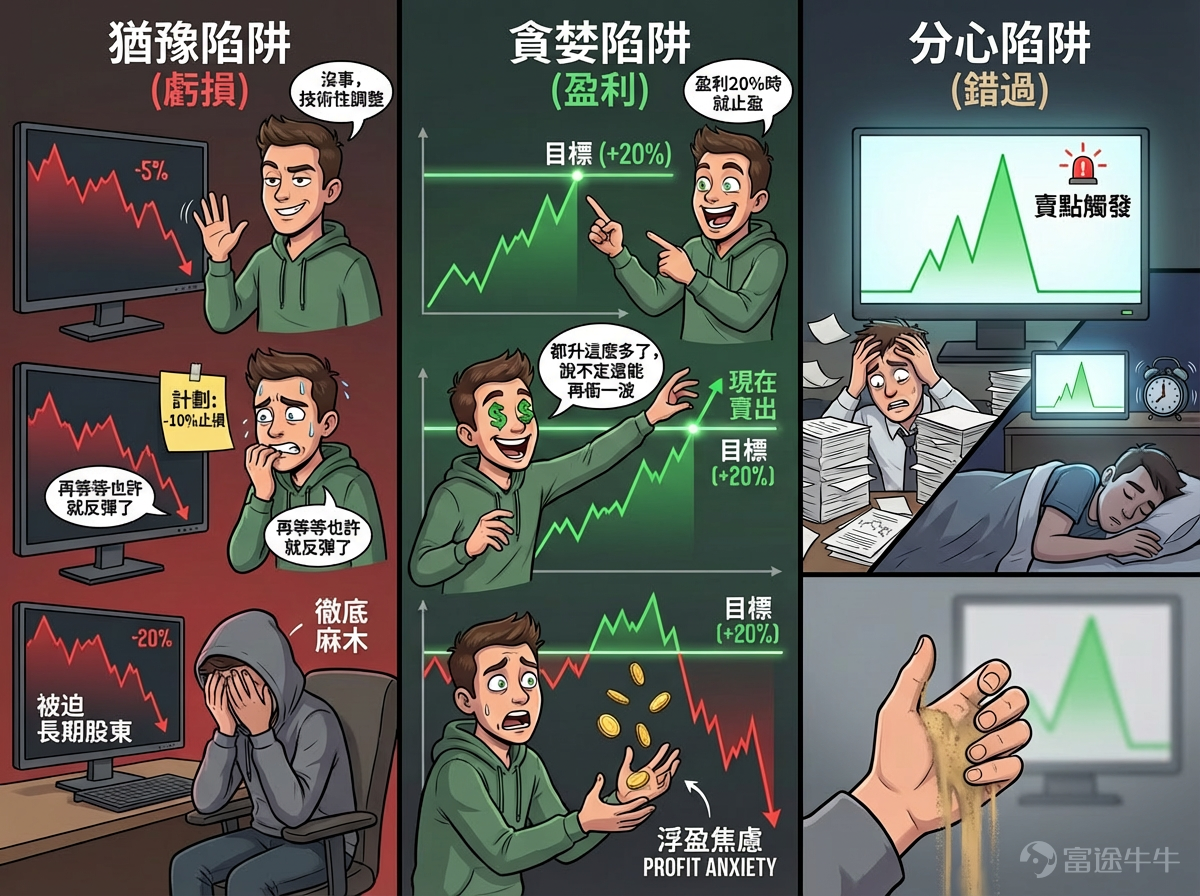
For instance, you’re optimistic about a stock and plan to hold it for some time. After purchasing, it starts to decline slowly. You think, 'I'll stop loss if it drops by 10%.' When it first drops by 5%, you think, 'No problem, it’s just a technical adjustment.' When it falls by 10%, you start to panic but don’t want to admit defeat, thinking, 'Maybe it will rebound if I wait a little longer.' By the time it drops 20%, you’ve become completely numb, even afraid to look at your account, and are forced to become a 'long-term shareholder.' This kind of deep trap caused by indecision and侥幸 (wishful thinking) is a nightmare for many beginners.
Another example is that you hold a stock and have already accumulated some unrealized gains, thinking to yourself, 'I'll take profit when it rises 20%.' But when the stock price actually reaches your target line and the paper profit just meets the criteria, you start to waver: 'It has risen so much, maybe it can surge a bit more. If I wait a little longer, I can earn more.' In this way, you toss aside your original profit-taking target, continuously extending your expectations. The final result could fall from 'the joy of unrealized gains' back to 'the anxiety of losses.'
What makes it even more painful is when you originally intended to monitor the market for profit-taking or stop-loss, but were busy with work or other trivial matters—or fell asleep in the middle of the night—only to later find that you've missed the best selling point, watching your profits slip away like sand through fingers.
Whether it’s the ‘unwillingness to admit defeat’ during a stop-loss or the ‘greed-driven dissatisfaction’ during profit-taking, or missing the right opportunity due to time constraints, fundamentally, these all boil down to failing to truly practice ‘letting go,’ losing out on hesitation and missed opportunities when action was needed.
This is where you really need tools like profit-taking orders or stop-loss orders.For example, you can place a 'pre-market + in-market + after-hours' stop-loss or profit-taking order with 'good till canceled.'

Alternatively, you could use an either-or order combination, setting both a stop-loss order and a profit-taking order simultaneously., once one order is triggered and executed, the other will be automatically canceled. This type of order may prove especially helpful when you're uncertain about upcoming fluctuations or major events, while also being torn between fear and greed.
If you want to address more challenging issues like 'fear of missing out on a big bull run' or 'profits taking a rollercoaster ride,' a trailing stop-loss order would be a more suitable choice.For instance, after purchasing a growth stock and seeing its price rise, you might want to hold onto the trend to let profits run, but are also worried about a pullback eroding gains. In this case, setting a trailing stop-loss order with a pullback percentage (e.g., 5%) allows the system to automatically adjust the trigger price based on a 5% drop from the current highest price. As the stock price continues to climb, the trigger price moves up accordingly; once the trend reverses and hits the trigger price, profits are locked in automatically, giving room for profits to grow while ensuring timely exit when risks arise.

(For tutorials on using various types of orders, click 'Why Do You Always Earn Less Than Others? It May Come Down to How These Orders Are Used!'。)
Once you've set the order, this trade doesn't require your presence anymore. You canleave the execution of the order to fellow investors instead of relying on your own memory. This effectively prevents undisciplined behavior and avoids losses caused by unexpected events.
*Risk Warning: Stop-loss/take-profit levels should not be set too extremely: A stop-loss that's too tight may be easily triggered by normal fluctuations, while a take-profit that's too high might never be reached. It is recommended to refer to the recent volatility range or key support/resistance levels of the target when setting these parameters. The parameter settings for trailing stop orders shouldn't be too loose or too tight either; they can be adjusted based on the stock’s average volatility in recent times. However, this process itself may involve trial-and-error costs. Always double-check parameters before the order goes live to avoid unnecessary losses due to errors like reversed buy/sell directions or incorrect trigger prices.
II. Say Goodbye to Ineffective Orders: 'Conditional Limit Orders' Help You Strike Precisely
It is worth noting that many people tend to place regular limit orders habitually when planning entry points, overlooking some hidden issues within them.
For instance, if before the market opens, you decide to “buy Tencent once it pulls back to HKD 600,” and you place a regular limit order at HKD 600 but the stock price never reaches your target level, then the order will tie up your funds all day, causing you to miss sudden opportunities in another stock, such as Meituan.
This is where conditional limit orders come into play perfectly. Their core logic is“Wait for a clear signal, then enter at the specified price.” They only strike momentarily upon condition fulfillment and begin attempting to execute the order.
Besides the above scenario, they are also suitable for several frequent yet reasonable situations:
First,You can accurately follow trends while waiting for prices to break through or fall below key levels.
For example, a certain stock is currently priced at $98 and has been oscillating around this price for a long time. The strong resistance level is at $100. You don’t want to buy now (because you're afraid it might drop again), and you predict that once it breaks through the $100 resistance level, a new upward trend will begin. You want to wait until after the resistance level is broken before entering the market.
If you place a regular limit order at $100 now, the system will execute it immediately due to the lower current price, defeating the purpose of 'waiting for a breakout.' At this point, you can set a trigger condition as 'price ≥ $100.1' (to confirm an effective breakout) and a 'limit price of $100.5' buy limit order. This way, you can avoid entering the market prematurely while being able to purchase at a favorable price once the trend is confirmed.

Similarly, if you want to stop losses promptly when the support level is breached, you can use a similar type of order. For instance, if your cost basis for a stock is $60 and you determine that $48 is a key support level, a breach could trigger a sharp decline, but you're worried about short-term fluctuations mistakenly triggering a stop-loss.
At this point, you can set up a conditional limit order: the trigger condition would be 'stock price ≤ $48,' and upon triggering, submit a $47.8 limit sell order. Only when the stock price truly falls below the support level (signal confirmation) will the system execute the stop-loss, avoiding premature stop-loss and missing a rebound, while also mitigating slippage losses through the limit order during sudden drops.
Second,This allows for optimal timing in trading, addressing pain points such as 'not having time to monitor the market' and 'emotional chasing of orders.'
For example, if Meituan announces unexpected positive news over the weekend, you anticipate a gap-up opening on Monday. You neither want to blindly chase the high nor miss out on valid market movements, so you decide to 'wait 15 minutes after the market opens for a cooling-off period, and if the stock price retraces to HKD 101, then enter the market to buy.' However, you have other commitments at that time and cannot monitor the market.
This not only avoids irrational volatility at the start of trading but also enables precise execution of strategies once market sentiment stabilizes. Meanwhile, before the conditions are met, your funds remain free for other investment opportunities.
Thus, this 'conditional limit order' acts like your intelligent trading assistant.It monitors the market and waits for signals, acting only at the most critical moments, freeing you from worrying about 'whether to buy/sell now,' and ensuring you won't miss planned trades due to busyness or lack of time.Set your trading logic ('if...then...') in advance, and let the system handle execution. This prevents emotional interference while optimizing the use of capital and time for more important matters.
*Risk Warning: Conditional limit orders should have a reasonable buffer for the trigger price. When trading low liquidity securities, there could be situations where "the order is triggered but cannot be executed at the limit price," and it is recommended to prioritize actively traded securities. Ensure the order's validity period matches your trading strategy; avoid missing overnight market moves by setting "day-only validity," or tying up funds long-term with "good-till-cancelled."
III. Farewell to Doomsday Nightmares: Recover Your Money Before Options Expire Worthless
"Greed and fear" in investing are infinitely magnified in the trading of end-stage options.This is a race against time: High leverage offers the temptation of instant doubling, but the rapid decay of time value and liquidity drying up near expiration also mean profits can vanish in the blink of an eye, potentially wiping out the entire principal.
Have you ever experienced such a 'doomsday nightmare'?
Investor Xiao Chen focuses on end-stage options. One day, he bought a call option with a premium of $0.6. After the market opened, the underlying stock price surged, and the premium quickly rose to $1.2, giving him a 100% paper profit. Greedily, he thought: "Wait a little longer, I'll sell when it hits $1.5." However, just half an hour later, the stock price slightly retraced, causing the premium to plummet to $0.8. He began to hesitate: "Should I take profit now? Will it bounce back?"
In those few minutes of hesitation, market liquidity dropped sharply, and the premium plunged like a cliff to $0.3. With only one hour left until expiration, the time value had almost completely evaporated, forcing him to exit at a loss. He watched his profits turn into losses, all because of momentary greed and delays in manual execution.
The core pain point of such scenarios is that time waits for no one, volatility is extreme, and liquidity can disappear in an instant. In this environment, relying on manual monitoring and emotional decision-making is akin to gambling. To handle the 'fast, urgent, and risky' nature of end-stage options effectively, tools like the One-Cancels-the-Other (OCO) combination order become essential.
Using this tool, you can set up two automated defenses simultaneously: one as the ideal 'take-profit line' (e.g., when the premium rises to $1.2), and another as the firm 'stop-loss line' (e.g., if the premium falls to $0.5). You can configure it to 'execute at market price once triggered' to facilitate quick execution and avoid greater losses due to rapid price declines without execution.

This strategy locks in profit and loss boundaries at the opening of the position, replacing emotions with system automation to eliminate greed and侥幸心理. Secondly, it prioritizes ultra-fast execution speed, ensuring a swift exit via market orders in volatile and rapidly changing liquidity environments. Lastly, it automates execution for you, reducing the pressure of constant monitoring.
This method not only saves 'doomsday gamblers,' but also applies to any major event nodes that make you anxious, such as before earnings reports or Fed resolution releases.
*Risk Warning: End-of-term options are inherently high-risk products. Even when using either-or combo orders, the risks brought by sharp fluctuations in the underlying asset cannot be completely offset. It is recommended to control position size and avoid blindly adding leverage. Although executing at market price after triggering ensures speed, it may result in certain slippage losses, especially during times of near expiration and extremely poor liquidity. Avoid setting orders too late to prevent complete loss of end-of-day liquidity, which could lead to order non-execution and ultimately the risk of premium loss.
Summary: From 'being right but doing wrong' to 'being right and doing right'
From overcoming emotional swings with 'profit-taking and stop-loss orders,' to achieving precise execution with 'conditional limit orders,' and then mastering extreme volatility with 'either-or combo orders,' these order tools provided by Futu act as enforcers of your trading discipline and a firewall for human weaknesses. While they can't replace your cognitive judgment on 'what to buy,' they can perfectly ensure strict execution of your 'how to trade' plan.
In fact, the success of investing lies not only in being right about something, but more importantly, in being able to do the right thing at the right time without hesitation. Utilizing these order tools might just be the critical step in moving from 'being right but doing wrong' to 'being right and doing right'!
From now until January 30, 2026, 23:59, feel free to share your experience or suggestions on any of Futu’s order functions in the comment section. Comments over 30 words + including function screenshots will receive66 points~Come and share to claim your reward!
Risk Disclaimer: The above content only represents the author's view. It does not represent any position or investment advice of Futu. Futu makes no representation or warranty.Read more


Comments (243)
to post a comment
528
271