
Up over 30% since the start of the year! Intel becomes the frontrunner in the tech stock rally

Intel surged over 6%. Is it due to the 18A catalyst or a shift in AI logic towards CPUs?
Yesterday (January 7, 2026), $Intel (INTC.US)$ The stock price surged strongly by 6.47%, closing at a new high for the year, continuing its leading position in the semiconductor sector recently. What is the reason behind this? Does it reflect the market's positive pricing of its technological breakthrough?
1. Key AI PC chip release: Can Intel's 18A save Intel?
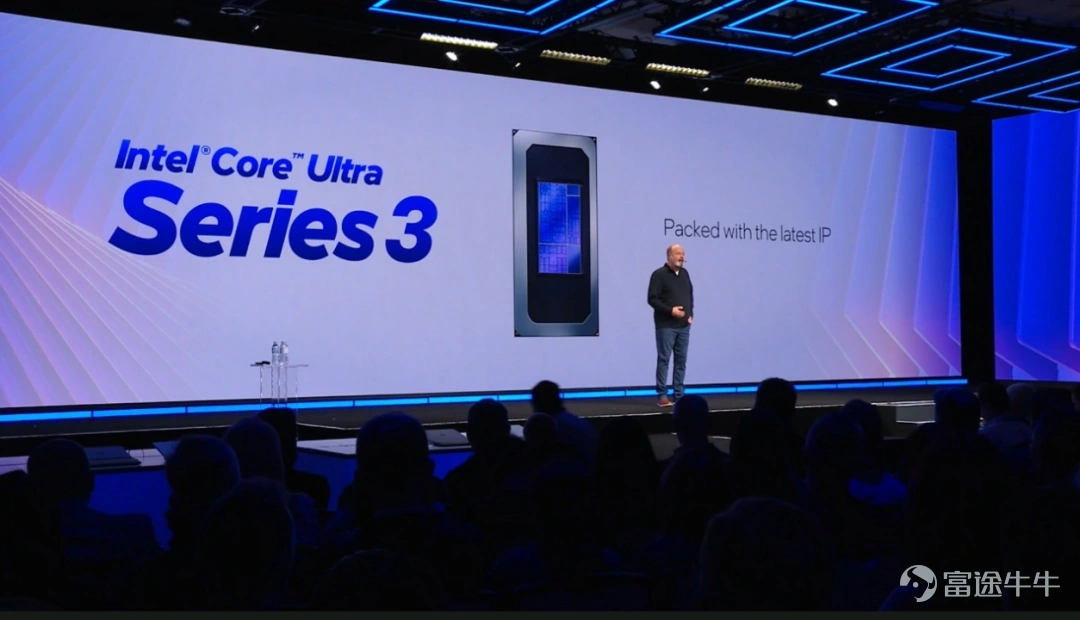
The most direct catalyst was at CES 2026, $Intel (INTC.US)$At CES 2026, Intel officially unveiled its latest generation of client processors based on the Intel 18A process node — the Intel Core Ultra 3 series (codenamed Panther Lake), formally bringing the 18A process (equivalent to 2nm) into the spotlight.
Regarding the process technology, Lip-Bu Tan announced that Intel has achieved the mass production target for the 18A process node as planned, or even exceeded expectations, and has begun delivering products to customers.Intel also provided a clear timeline for implementation: Panther Lake has entered the mass production ramp-up phase, and OEMs can start accepting full system orders the day after the presentation, with actual shipments to be gradually announced by partners.
![Yesterday (January 7, 2026), $Intel (INTC.US)$ the stock price surged strongly by 6.47%, closing at a one-year high, continuing its recent leading performance within the semiconductor sector. What is the reason behind this? Does it reflect the market's positive pricing of its technological breakthroughs? 1. Key AI PC chip release: Can 18A save Intel? The most direct catalyst was at CES 2026, [Share Link: $Intel (INTC.US)$]At CES 2026, Intel officially unveiled its latest generation of client processors based on the Intel 18A process node — the Intel Core Ultra 3 series (codenamed Panther Lake), formally bringing the 18A process (equivalent to 2nm) into the spotlight. Regarding the process technology, Lip-Bu Tan announced that Intel has achieved the mass production target for the 18A process node as planned, or even exceeded expectations, and has begun delivering products to customers.Intel also provided a clear timeline for implementation: Panther Lake has entered the mass production ramp-up phase, and OEMs can start accepting full system orders the day after the presentation, with actual shipments to be gradually announced by partners. compared to the previous generation Lunar Lake (Core Ultra 2 series), the overall performance of the Core Ultra 3 series improved by 60%. Meanwhile, Intel claims to have secured over 200 OEM design wins, covering Lenovo, Dell, and emerging brands,far exceeding $Advanced Micro Devices (AMD.US)$ the approximately 120 designs from...](https://nnqimage.futunn.com/sns_client_feed/999908/20260108/web-1767866020565-FpM1S8TFhS.webp/big?area=2&is_public=true&imageMogr2/ignore-error/1/format/webp)
Compared to the previous generation Lunar Lake (Core Ultra 2 series), the overall performance of the Core Ultra 3 series has improved by 60%. Meanwhile, Intel claims to have secured support from over 200 OEM designs, covering Lenovo, Dell, and emerging brands.Far exceeding $Advanced Micro Devices (AMD.US)$ the approximately 120 design counts during the same period.
Intel positions Panther Lake as the “debut” of the 18A process, and its implications extend far beyond consumer competition. Investors are more focused on the technical value behind it — does Panther Lake truly validate the mass production capability of the 18A process?Current foundry customers remain cautious about Intel's node roadmap. On December 24, according to a Reuters report, NVIDIA tested Intel’s 18A process but has since slowed down its progress.
Over the past four quarters, Intel's foundry business has recorded an operating loss of approximately $10.1 billion.If Intel’s 18A demonstrates stable performance in the mass production of Panther Lake (e.g., improving yield to 65%-70%), Intel can send a “technology under control” signal to external customers, supporting its foundry pricing power.If 18A is successfully implemented and gains the trust of external customers, driving this business closer to breakeven, it will bring significant valuation elasticity; if yields fluctuate or deliveries are delayed, it will exacerbate market concerns about Intel's “failure in technological catch-up,” potentially postponing customer adoption plans for its foundry business to 2027.
This does not mean that Intel has completely reversed the competitive landscape. However, this presentation might suggest that Intel has moved beyond the 'roadmap hype' phase,and returned to a position where it can be taken seriously.
2. CPU supply shortages or expectations of major clients in the foundry business
Another driving force in the market stems from the resurgence of the trading logic tied to supply tightness. Following reports of supply constraints in the storage and memory sectors, investors are positioning themselves ahead of time for a 'CPU shortage' theme.
Intel has previously mentioned multiple times that some of its product lines are experiencing supply tightness, providing a credible basis for the shortage narrative. Recently, the market has further developed a new logic: In the Agentic AI era, the importance of CPUs is rising — due to the need for extensive task scheduling, preprocessing, and orchestration, which often revolve around GPU clusters but heavily rely on CPU support.
FundaAI, an AI company publishing investment research on Substack, released a report on the CPU market on Wednesday. FundaAI stated, 'Current market attention is focused on the shortage of general-purpose GPUs and AI ASICs.'However, an equally severe crisis is brewing in the CPU sector.Server CPUs face structural shortages caused by foundry limitations, claiming$Taiwan Semiconductor (TSM.US)$Can only meet approximately80%to only meet around50%。
![Yesterday (January 7, 2026), $Intel (INTC.US)$ the stock price surged strongly by 6.47%, closing at a one-year high, continuing its recent leading performance within the semiconductor sector. What is the reason behind this? Does it reflect the market's positive pricing of its technological breakthroughs? 1. Key AI PC chip release: Can 18A save Intel? The most direct catalyst was at CES 2026, [Share Link: $Intel (INTC.US)$]At CES 2026, Intel officially unveiled its latest generation of client processors based on the Intel 18A process node — the Intel Core Ultra 3 series (codenamed Panther Lake), formally bringing the 18A process (equivalent to 2nm) into the spotlight. Regarding the process technology, Lip-Bu Tan announced that Intel has achieved the mass production target for the 18A process node as planned, or even exceeded expectations, and has begun delivering products to customers.Intel also provided a clear timeline for implementation: Panther Lake has entered the mass production ramp-up phase, and OEMs can start accepting full system orders the day after the presentation, with actual shipments to be gradually announced by partners. compared to the previous generation Lunar Lake (Core Ultra 2 series), the overall performance of the Core Ultra 3 series improved by 60%. Meanwhile, Intel claims to have secured over 200 OEM design wins, covering Lenovo, Dell, and emerging brands,far exceeding $Advanced Micro Devices (AMD.US)$ the approximately 120 designs from...](https://nnqimage.futunn.com/sns_client_feed/999908/20260108/web-1767866020563-bBLcMHbrst.png/big?area=2&is_public=true&imageMogr2/ignore-error/1/format/webp)
However, this logical chain is not without flaws. Currently, TSMC's most prominent bottleneck is actually in advanced packaging capacity (such as CoWoS).$NVIDIA (NVDA.US)$Taiwan Semiconductor has repeatedly emphasized that even with significant production expansion, CoWoS remains a production bottleneck. However, mainstream server CPUs typically do not rely on CoWoS-level HBM stacking technology. In other words, congestion in CoWoS capacity does not necessarily lead to a shortage in general-purpose CPU supply.
Some analysts have also raised doubts. Mizuho analyst Jordan Klein, after communicating with Intel's investor relations team, pointed out that discussions about supply tightness are focused on next-generation PC chips rather than server products, and the company has never mentioned a significant price increase for server CPUs. He believes market rumors are merely 'noise.'
Another market perspective suggests thatthe catalyst for the stock price increase may come from expectations around foundry business growth. Recently, rumors have surfaced that Qualcomm is considering cooperation with Samsung Foundry, which has led the market to speculate that Qualcomm may also outsource chip production to Intel in the future. Gabelli Funds analyst Ryuta Makino pointed out that if Intel can secure a major customer for its 18A or 14A process nodes in the second half of 2026 or the first half of 2027, this would be the biggest driver for the stock price this year.
Options strategy
Intel’s stock price has quickly rebounded from a one-month low of $36.05 to $42.63,with high bullish sentiment and elevated implied volatility (IV).The current IV stands at 60.16% (as of January 7), higher than the historical volatility (42.38%), indicating that the options market expects increased price fluctuations.The Put/Call volume ratio is 0.3,reflecting dominant bullish sentiment, with near-term open interest concentrated at the $60 strike price, forming short-term resistance.
Technically, the moving average system shows a bullish alignment, but the short-term RSI may enter overbought territory, facing profit-taking pressure; support lies in the $40-$37 range. With high bullish sentiment and elevated IV, if the stock price stabilizes above $40, it may attract more bullish option bets.
(1) If investors are optimistic about the turnaround of 18A in the long term but consider chasing the current price as risky, they may look to accumulate shares at lower prices.
they can chooseCash-secured Put optionsIt may be more appropriate to look for opportunities to buy at the bottom. Take advantage of the current high volatility to earn premiums. If the stock price pulls back, you can accumulate positions at an ideal low price (strike price - premium); if the stock price continues to rise or moves sideways, you simply pocket the premium, enhancing your margin of safety. The strike price can be chosen below the support level or at a price where investors are willing to build positions.
![Yesterday (January 7, 2026), $Intel (INTC.US)$ the stock price surged strongly by 6.47%, closing at a one-year high, continuing its recent leading performance within the semiconductor sector. What is the reason behind this? Does it reflect the market's positive pricing of its technological breakthroughs? 1. Key AI PC chip release: Can 18A save Intel? The most direct catalyst was at CES 2026, [Share Link: $Intel (INTC.US)$]At CES 2026, Intel officially unveiled its latest generation of client processors based on the Intel 18A process node — the Intel Core Ultra 3 series (codenamed Panther Lake), formally bringing the 18A process (equivalent to 2nm) into the spotlight. Regarding the process technology, Lip-Bu Tan announced that Intel has achieved the mass production target for the 18A process node as planned, or even exceeded expectations, and has begun delivering products to customers.Intel also provided a clear timeline for implementation: Panther Lake has entered the mass production ramp-up phase, and OEMs can start accepting full system orders the day after the presentation, with actual shipments to be gradually announced by partners. compared to the previous generation Lunar Lake (Core Ultra 2 series), the overall performance of the Core Ultra 3 series improved by 60%. Meanwhile, Intel claims to have secured over 200 OEM design wins, covering Lenovo, Dell, and emerging brands,far exceeding $Advanced Micro Devices (AMD.US)$ the approximately 120 designs from...](https://nnqimage.futunn.com/sns_client_feed/999908/20260108/web-1767866020283-eOcNDUUS3g.webp/big?area=2&is_public=true&imageMogr2/ignore-error/1/format/webp)
(2) If investors already hold positions and are concerned about a rapid rise in the short term leading to a pullback but do not want to sell their shares
In this case, you can usea Long Collar strategy,, which can hedge downside risks like aProtective Put, while also generating additional income like aCovered Call. While holding the underlying stock, use 'buying a Put' to hedge against the impact of a drop in the underlying stock. Use the income from 'selling a Call' to offset part of the cost of buying the Put, thereby achieving the goal of hedging risks at a lower cost.
Buy a protective Put below to lock in the downside, while selling a Call above the resistance level to cover the cost of the Put. This locks in the profit range and is suitable for protecting gains after a sharp rise, while waiting for further news on 18A.
![Yesterday (January 7, 2026), $Intel (INTC.US)$ the stock price surged strongly by 6.47%, closing at a one-year high, continuing its recent leading performance within the semiconductor sector. What is the reason behind this? Does it reflect the market's positive pricing of its technological breakthroughs? 1. Key AI PC chip release: Can 18A save Intel? The most direct catalyst was at CES 2026, [Share Link: $Intel (INTC.US)$]At CES 2026, Intel officially unveiled its latest generation of client processors based on the Intel 18A process node — the Intel Core Ultra 3 series (codenamed Panther Lake), formally bringing the 18A process (equivalent to 2nm) into the spotlight. Regarding the process technology, Lip-Bu Tan announced that Intel has achieved the mass production target for the 18A process node as planned, or even exceeded expectations, and has begun delivering products to customers.Intel also provided a clear timeline for implementation: Panther Lake has entered the mass production ramp-up phase, and OEMs can start accepting full system orders the day after the presentation, with actual shipments to be gradually announced by partners. compared to the previous generation Lunar Lake (Core Ultra 2 series), the overall performance of the Core Ultra 3 series improved by 60%. Meanwhile, Intel claims to have secured over 200 OEM design wins, covering Lenovo, Dell, and emerging brands,far exceeding $Advanced Micro Devices (AMD.US)$ the approximately 120 designs from...](https://nnqimage.futunn.com/sns_client_feed/999908/20260108/web-1767866024244-c8Hxqm5UPF.png/big?area=2&is_public=true&imageMogr2/ignore-error/1/format/webp)
(3) If investors agree with the narrative of a 'CPU shortage' and seek high leverage
they can chooseBull Call SpreadA Bull Call Spread involves buying a Call option while simultaneously selling another Call with a higher strike price, reducing the cost of entry but also capping the potential profit. The biggest risk of this strategy is losing the entire premium paid when initially establishing the position.
Compared to directly buying a Call, constructing a spread can reduce the risks associated with time decay and a drop in volatility. Selling an out-of-the-money Call limits the maximum profit but also lowers the breakeven point, making it suitable for short-term upward price movements.
![Yesterday (January 7, 2026), $Intel (INTC.US)$ the stock price surged strongly by 6.47%, closing at a one-year high, continuing its recent leading performance within the semiconductor sector. What is the reason behind this? Does it reflect the market's positive pricing of its technological breakthroughs? 1. Key AI PC chip release: Can 18A save Intel? The most direct catalyst was at CES 2026, [Share Link: $Intel (INTC.US)$]At CES 2026, Intel officially unveiled its latest generation of client processors based on the Intel 18A process node — the Intel Core Ultra 3 series (codenamed Panther Lake), formally bringing the 18A process (equivalent to 2nm) into the spotlight. Regarding the process technology, Lip-Bu Tan announced that Intel has achieved the mass production target for the 18A process node as planned, or even exceeded expectations, and has begun delivering products to customers.Intel also provided a clear timeline for implementation: Panther Lake has entered the mass production ramp-up phase, and OEMs can start accepting full system orders the day after the presentation, with actual shipments to be gradually announced by partners. compared to the previous generation Lunar Lake (Core Ultra 2 series), the overall performance of the Core Ultra 3 series improved by 60%. Meanwhile, Intel claims to have secured over 200 OEM design wins, covering Lenovo, Dell, and emerging brands,far exceeding $Advanced Micro Devices (AMD.US)$ the approximately 120 designs from...](https://nnqimage.futunn.com/sns_client_feed/999908/20260108/web-1767866024238-XjglNQC3EG.png/big?area=2&is_public=true&imageMogr2/ignore-error/1/format/webp)
Finally, Options Sir brings a small perk for fellow investors. Welcome to claim it!Beginner's Options Package
This event is exclusive to invited HK users. Click to learn more.Detailed rules of the event >>
Market conditions are complex and volatile,Options strategyOverwhelmed by choices? Futubull helps you build a portfolio in three steps.Options strategy, making investment simple and efficient!
![Yesterday (January 7, 2026), $Intel (INTC.US)$ the stock price surged strongly by 6.47%, closing at a one-year high, continuing its recent leading performance within the semiconductor sector. What is the reason behind this? Does it reflect the market's positive pricing of its technological breakthroughs? 1. Key AI PC chip release: Can 18A save Intel? The most direct catalyst was at CES 2026, [Share Link: $Intel (INTC.US)$]At CES 2026, Intel officially unveiled its latest generation of client processors based on the Intel 18A process node — the Intel Core Ultra 3 series (codenamed Panther Lake), formally bringing the 18A process (equivalent to 2nm) into the spotlight. Regarding the process technology, Lip-Bu Tan announced that Intel has achieved the mass production target for the 18A process node as planned, or even exceeded expectations, and has begun delivering products to customers.Intel also provided a clear timeline for implementation: Panther Lake has entered the mass production ramp-up phase, and OEMs can start accepting full system orders the day after the presentation, with actual shipments to be gradually announced by partners. compared to the previous generation Lunar Lake (Core Ultra 2 series), the overall performance of the Core Ultra 3 series improved by 60%. Meanwhile, Intel claims to have secured over 200 OEM design wins, covering Lenovo, Dell, and emerging brands,far exceeding $Advanced Micro Devices (AMD.US)$ the approximately 120 designs from...](https://nnqimage.futunn.com/sns_client_feed/999908/20260108/web-1767866067551-6CxwGBUZ6f.webp/big?area=2&is_public=true&imageMogr2/ignore-error/1/format/webp)
Risk Warning
An option is a contract that grants the holder the right, but not the obligation, to buy or sell an asset at a fixed price on a specific date or at any time before that date. The price of an option is influenced by various factors, including the current price of the underlying asset, the strike price, the time to expiration, andimplied volatility。
implied volatilityreflects the market's expectation of volatility in the option over a future period. It is data derived inversely from the Black-Scholes option pricing model and is generally considered an indicator of market sentiment. When investors anticipate higher volatility, they may be more willing to pay a higher price for options to help hedge risks, thereby leading to a higherimplied volatility。
Traders and investors useimplied volatilityto evaluateoption pricesthe attractiveness, identify potential mispricing, and manage risk exposure.
Disclaimer
This content does not constitute any offer, solicitation, recommendation, opinion, or guarantee regarding securities, financial products, or tools. The risk of loss in trading options can be substantial. In certain circumstances, the losses you incur may exceed the initial margin amount deposited. Even if you set contingent orders, such as “stop-loss” or “limit” orders, they may not prevent losses. Market conditions may render such orders unexecutable. You may be required to deposit additional margin within a short period. If you fail to provide the required amount within the specified time, your open positions may be liquidated. However, you will remain responsible for any shortfall in your account resulting from such liquidation. Therefore, before engaging in trading, you should study and understand options and carefully consider whether such trading is suitable for you based on your financial situation and investment objectives. If you trade options, you should familiarize yourself with the procedures upon option exercise and expiration, as well as your rights and obligations upon option exercise and expiration.
Risk Disclaimer: The above content only represents the author's view. It does not represent any position or investment advice of Futu. Futu makes no representation or warranty.Read more


Comments (2)
to post a comment
183
26