
Kicking off the year with a bang! Multiple sectors in Hong Kong's stock market are quietly gaining m

Short-term Analysis of Alibaba: Defense of Key Support Levels and Use of Derivative Instruments
As of January 7, 2026, the stock price of Alibaba-W (09988.HK) closed at HKD 145.9, down 3.25% on the day with a trading volume as high as HKD 21.759 billion. This movement is centered around a key technical range. According to the latest technical data analysis, the current first support level is at HKD 142, while the second support level is at HKD 137.8. As of today (January 8), the latest stock price is HKD 143.6, with a decline of 1.51%.
Market News and Column Views: The Battle Between Bulls and Bears Amid Capital Disagreements
The market's view on Alibaba’s fundamentals has recently shown divergence. On one hand, Zhejiang Securities issued a report on January 6 maintaining a 'Buy' rating for the company, stating that its AI application 'Qwen' has seen rapid user growth, and its integration with the ecosystem could reshape the business. They also noted strong certainty in long-term profitability improvements for the cloud business, setting a target price of HKD 189.09. On the other hand, lacking short-term catalysts, the stock price movements are more driven by technical factors and market sentiment. According to the January 7 [HK Stocks Podcast] column, some investors were concerned about whether the stock price would fall back to HKD 140 and considered holding bullish warrants with a recovery price at HKD 140. In response, Simon explicitly pointed out that given the stock price had broken below HKD 150 and trading volume had increased, if the first support at HKD 142 fails, there is indeed potential to test HKD 140 or even HKD 137.8. He specifically reminded that choosing bullish warrants with a recovery price at HKD 140 was “slightly too close to the price,” carrying higher risk. A safer approach would be to select products with recovery prices around HKD 138 or HKD 135 to avoid known support levels and reduce the risk of forced liquidation. This view echoed UBS Group's observations on January 6,
which noted that despite the decline in stock price, more than HKD 40 million flowed into Alibaba-related call warrants and bullish contracts, reflecting some investors taking advantage of the dip to position for a rebound.
Review of Warrant Products: Leverage Effects in Market Volatility
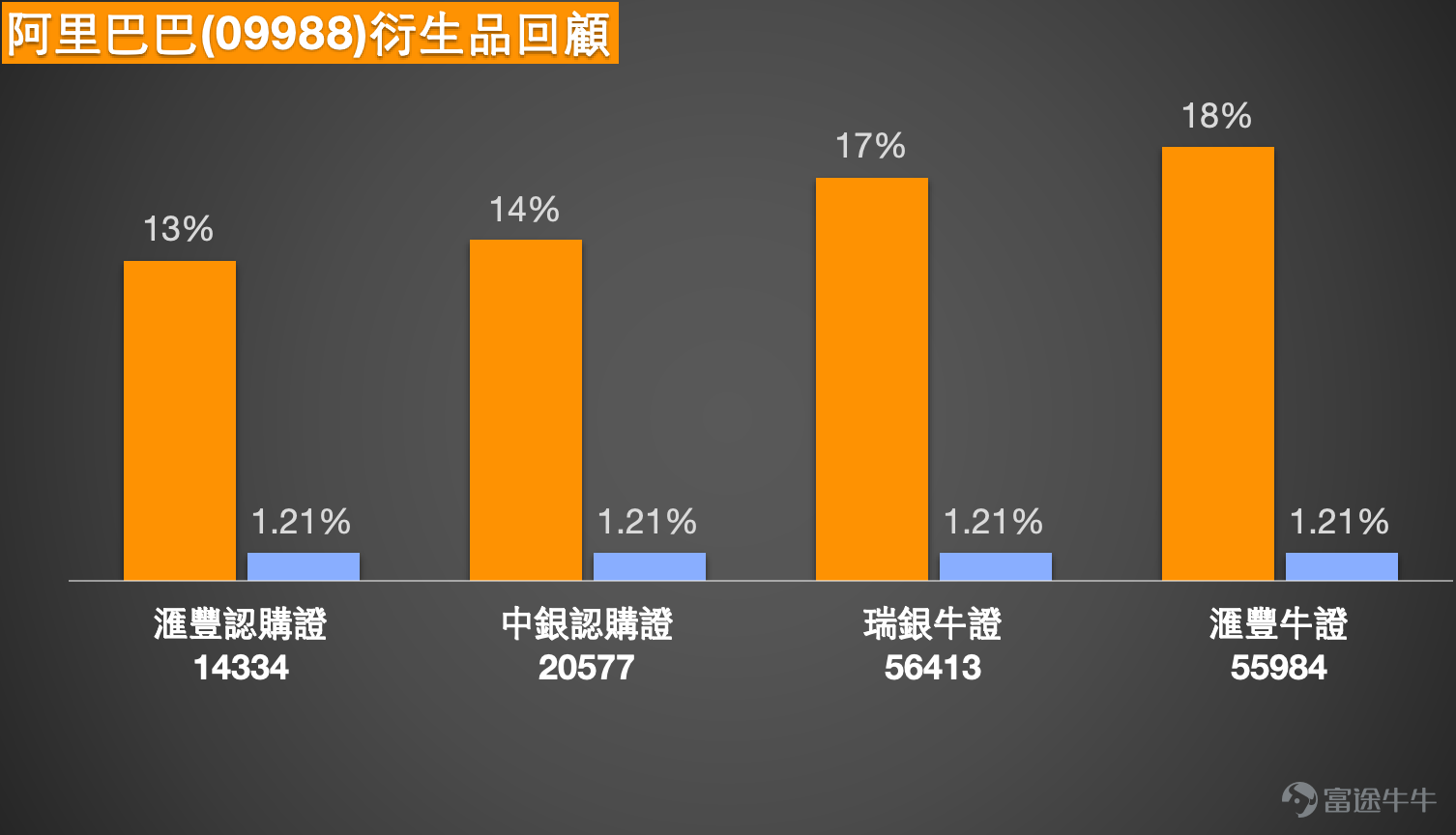
Reviewing recent historical data, it is clear to see the price elasticity of derivatives when the underlying stock fluctuates. In the two days following January 2, 2026, when Alibaba's stock rose by 1.21%, the linked derivatives saw significant increases: HSBC Bull Certificate (55984) surged 18%, while UBS Group Bull Certificate (56413) $UB#ALIBARC2607I.C (56413.HK)$ rose 17%. Meanwhile, two call warrants—HSBC Call Warrant (14334) $HSALIBA@EC2604A.C (14334.HK)$ and Bank of China Call Warrant (20577) $BIALIBA@EC2604B.C (20577.HK)$ recorded gains of 13% and 14%, respectively. This performance vividly demonstrates one of the core advantages of bull/bear certificates and callable bull/bear contracts (CBBCs): capital efficiency. Investors do not need to pay the full amount for the underlying stock but can track its price movement through these products, allowing them to allocate funds more effectively across different market views or strategies.
![$BABA-W (09988.HK)$ [Share Link: January 7 [HK Stocks Podcast] Hang Seng Index, Hong Kong Exchange, Yanzhou Energy, AIA, China Mobile, Alibaba] As of January 7, 2026, the stock price of Alibaba-W (09988.HK) closed at HKD 145.9, down 3.25% on the day with a trading volume as high as HKD 21.759 billion. This movement is centered around a key technical range. According to the latest technical data analysis, the current first support level is at HKD 142, while the second support level is at HKD 137.8. As of today (January 8), the latest stock price is HKD 143.6, with a decline of 1.51%. Market News and Column Views: The Battle Between Bulls and Bears Amid Capital Disagreements The market's view on Alibaba’s fundamentals has recently shown divergence. On one hand, Zhejiang Securities issued a report on January 6 maintaining a 'Buy' rating for the company, stating that its AI application 'Qwen' has seen rapid user growth, and its integration with the ecosystem could reshape the business. They also noted strong certainty in long-term profitability improvements for the cloud business, setting a target price of HKD 189.09. On the other hand, lacking short-term catalysts, the stock price movements are more driven by technical factors and market sentiment. According to the January 7 [HK Stocks Podcast] column, some investors were concerned about whether the stock price would fall back to HKD 140 and considered holding bullish warrants with a recovery price at HKD 140. In response, Simon explicitly pointed out that given the stock price had broken below HKD 150 and trading volume had increased, if the first support at HKD 142 fails...](https://nnqimage.futunn.com/sns_client_feed/1162342/20260108/web-1767844286677-dw6qonCdye.png/big?area=1&is_public=true&imageMogr2/ignore-error/1/format/webp)
Current selection and detailed terms analysis of CBBCs and bull/bear certificates
Given that Alibaba’s share price is near a key support level, with heightened market volatility and intensified bullish-bearish battles, the derivatives market offers a wide range of products covering different directions and risk preferences. For call warrants, Bank of China Call Warrant (20577) $BIALIBA@EC2604B.C (20577.HK)$ has a strike price set at HK$173.43, offering approximately 8x leverage. Its main feature is having the lowest implied volatility among similar products. A lower implied volatility typically indicates that the market expects relatively moderate fluctuations in the underlying stock in the future, making the time value portion of this warrant priced more 'cheaply,' with its value growth purely dependent on upward movements in the underlying stock. Another UBS Group Call Warrant (15566) $UBALIBA@EC2603A.C (15566.HK)$ with a strike price of HK$170.10 and about 8.8x leverage, stands out due to its lowest premium. A low premium means the product has a breakeven point closer to the current underlying stock price, resulting in relatively lower investment costs and less required upside movement in the underlying stock. It is important to note that both call warrants have strike prices (HK$170.10 and HK$173.43) significantly higher than the current stock price and nearby resistance level (HK$156.60), classifying them as deep out-of-the-money warrants. This makes them better suited for betting on substantial mid-term trend rallies rather than short-term technical rebounds; their performance may lag compared to more closely priced terms if the stock only experiences limited gains.
For bullish bull certificates, UBS Group Bull Certificate (55783) $UB#ALIBARC2608I.C (55783.HK)$ and J.P. Morgan Bull Certificate (55300) are lower-risk choices. Their forced-call levels are set at HK$130.50 and HK$131.00, respectively, both significantly below the second support level of HK$137.80, providing around 8x actual leverage and relatively low premiums. The advantage of bull certificates is that, before being forcibly called, their price movements closely follow the underlying stock without the issue of time decay. The critical aspect of their terms analysis is that the forced-call levels offer a high margin of safety. According to the [HKEX Podcast] column, bull certificates with forced-call levels too close to known support levels (e.g., HK$140.00) carry greater risks. By setting forced-call levels at HK$130.50 and HK$131.00, far below the market's key support zone, these products substantially reduce the risk of forced termination due to short-term price fluctuations hitting the forced-call levels, making them more suitable for capturing rebound opportunities rather than extreme scenario bets.
![$BABA-W (09988.HK)$ [Share Link: January 7 [HK Stocks Podcast] Hang Seng Index, Hong Kong Exchange, Yanzhou Energy, AIA, China Mobile, Alibaba] As of January 7, 2026, the stock price of Alibaba-W (09988.HK) closed at HKD 145.9, down 3.25% on the day with a trading volume as high as HKD 21.759 billion. This movement is centered around a key technical range. According to the latest technical data analysis, the current first support level is at HKD 142, while the second support level is at HKD 137.8. As of today (January 8), the latest stock price is HKD 143.6, with a decline of 1.51%. Market News and Column Views: The Battle Between Bulls and Bears Amid Capital Disagreements The market's view on Alibaba’s fundamentals has recently shown divergence. On one hand, Zhejiang Securities issued a report on January 6 maintaining a 'Buy' rating for the company, stating that its AI application 'Qwen' has seen rapid user growth, and its integration with the ecosystem could reshape the business. They also noted strong certainty in long-term profitability improvements for the cloud business, setting a target price of HKD 189.09. On the other hand, lacking short-term catalysts, the stock price movements are more driven by technical factors and market sentiment. According to the January 7 [HK Stocks Podcast] column, some investors were concerned about whether the stock price would fall back to HKD 140 and considered holding bullish warrants with a recovery price at HKD 140. In response, Simon explicitly pointed out that given the stock price had broken below HKD 150 and trading volume had increased, if the first support at HKD 142 fails...](https://nnqimage.futunn.com/sns_client_feed/1162342/20260108/web-1767844387858-kkUFE3AcZD.jpeg/big?area=1&is_public=true&imageMogr2/ignore-error/1/format/webp)
For investors who are cautious and believe that the stock price may continue to fall or even break below the support level, the market offers bearish products. Among put warrants, UBS Group's put warrant (21355)$UBALIBA@EP2603J.P (21355.HK)$and Societe Generale’s put warrant (21288)$SGALIBA@EP2603B.P (21288.HK)$both have an exercise price of 149.78 yuan, slightly higher than the current market price. The former provides about 5.5x leverage, while the latter offers approximately 5.9x leverage. An additional feature of 21288 is that both its premium and implied volatility are the lowest in its category. Low premium combined with low implied volatility makes this product a cost-effective bearish tool, with its value being less affected by market sentiment fluctuations and more dependent on the actual decline of the underlying stock.
In terms of bearish bear certificates, UBS Group’s bear certificate (69993)$UB#ALIBARP2810E.P (69993.HK)$and J.P. Morgan’s bear certificate (54828)$JP#ALIBARP2810B.P (54828.HK)$offer higher leverage and more direct risk exposure. The recovery price for 69993 is 160 yuan, with the lowest premium and relatively high actual leverage, reaching 10.8x. The recovery price for 54828 is 164 yuan, offering the highest actual leverage (8.1x) and lower premium. The key to analyzing the terms of bear certificates lies in the distance between the recovery price and the resistance level. The recovery prices of these two products (160 yuan and 164 yuan) are significantly higher than the current first resistance level at 151.1 yuan. This means that if Alibaba's share price experiences a strong technical rebound and breaks through 151.1 yuan, these bear certificates will face the risk of being forcibly recovered.
![$BABA-W (09988.HK)$ [Share Link: January 7 [HK Stocks Podcast] Hang Seng Index, Hong Kong Exchange, Yanzhou Energy, AIA, China Mobile, Alibaba] As of January 7, 2026, the stock price of Alibaba-W (09988.HK) closed at HKD 145.9, down 3.25% on the day with a trading volume as high as HKD 21.759 billion. This movement is centered around a key technical range. According to the latest technical data analysis, the current first support level is at HKD 142, while the second support level is at HKD 137.8. As of today (January 8), the latest stock price is HKD 143.6, with a decline of 1.51%. Market News and Column Views: The Battle Between Bulls and Bears Amid Capital Disagreements The market's view on Alibaba’s fundamentals has recently shown divergence. On one hand, Zhejiang Securities issued a report on January 6 maintaining a 'Buy' rating for the company, stating that its AI application 'Qwen' has seen rapid user growth, and its integration with the ecosystem could reshape the business. They also noted strong certainty in long-term profitability improvements for the cloud business, setting a target price of HKD 189.09. On the other hand, lacking short-term catalysts, the stock price movements are more driven by technical factors and market sentiment. According to the January 7 [HK Stocks Podcast] column, some investors were concerned about whether the stock price would fall back to HKD 140 and considered holding bullish warrants with a recovery price at HKD 140. In response, Simon explicitly pointed out that given the stock price had broken below HKD 150 and trading volume had increased, if the first support at HKD 142 fails...](https://nnqimage.futunn.com/sns_client_feed/1162342/20260108/web-1767844413691-35LTyslU6W.jpeg/big?area=1&is_public=true&imageMogr2/ignore-error/1/format/webp)
Based on technical analysis and column insights, Alibaba’s stock price is testing the key support zone of 142-137.8 yuan. Do you think it’s time to bet on a technical rebound at the current price, or should we wait for clearer signs of stabilization? If choosing to use derivatives, between low-premium put warrants and highly leveraged bear certificates, which would you prefer to hedge against potential downside risks?
For more real-time technical analysis, in-depth interpretation of product terms, and market strategy discussions related to individual Hong Kong stocks and derivatives, please follow 'Jenny's Warrants & CBBC Insights' professional sharing.
#Alibaba #TechnicalAnalysis #SupportLevel #Warrants #BullBearCertificates #Premium #ImpliedVolatility #ForcedLiquidation #CapitalEfficiency #AI
Disclaimer: This article does not constitute any investment advice.
This article is for reference only and does not constitute any investment advice. The market data, opinions, and analyses contained herein may change at any time without prior notice. We assume no responsibility for any loss or damage resulting from reliance on the information provided in this article. Technical analysis only indicates whether certain technical conditions are met. A comprehensive evaluation of asset performance should be conducted by integrating additional data. Trading decisions should not be made solely based on this article. Please note that past performance is not indicative of future results. $Hang Seng Index (800000.HK)$$Hang Seng TECH Index (800700.HK)$$Hang Seng China Enterprises Index (800100.HK)$
Risk Disclaimer: The above content only represents the author's view. It does not represent any position or investment advice of Futu. Futu makes no representation or warranty.Read more
Comments
to post a comment