

[2026 Outlook] Plan Ahead! Share the Investment Opportunities You Are Optimistic About

2026 Cryptocurrency Market Outlook: A New Era of Institutional Integration Driven by Utility, Six Key Regulatory Anchors You Must Know
In 2026, the cryptocurrency market is reaching an inflection point moving from a speculative era to practical integration. Market drivers are shifting from the "halving narrative" to structural factors such as the global liquidity environment, regulatory frameworks, and institutional capital deployment. As the global regulatory framework gradually becomes clearer and institutional funds deeply intervene, the market is no longer just a 'price game' but an accelerator permeating the real economy.
This article focuses on major cryptocurrencies $Bitcoin (BTC.CC)$ 、 $Ethereum (ETH.CC)$ and $Solana (SOL.CC)$ the evolving roles of cryptocurrencies and the differentiation opportunities within specific sectors, while highlighting six critical events in 2026 that could impact the cryptocurrency market. As investors, this will be a golden window for capturing long-term value.
Evolution of Major Cryptocurrencies: A Stunning Transformation from Speculation to Infrastructure
In 2026, major cryptocurrencies will weaken the old narrative framework of the 'four-year cycle' and shift towards growth driven by fundamentals. Below, we analyze the evolutionary paths of BTC, ETH, and SOL one by one.
BTC: Consolidating its 'Digital Gold' Status, Further Advancing as a Mainstream Asset
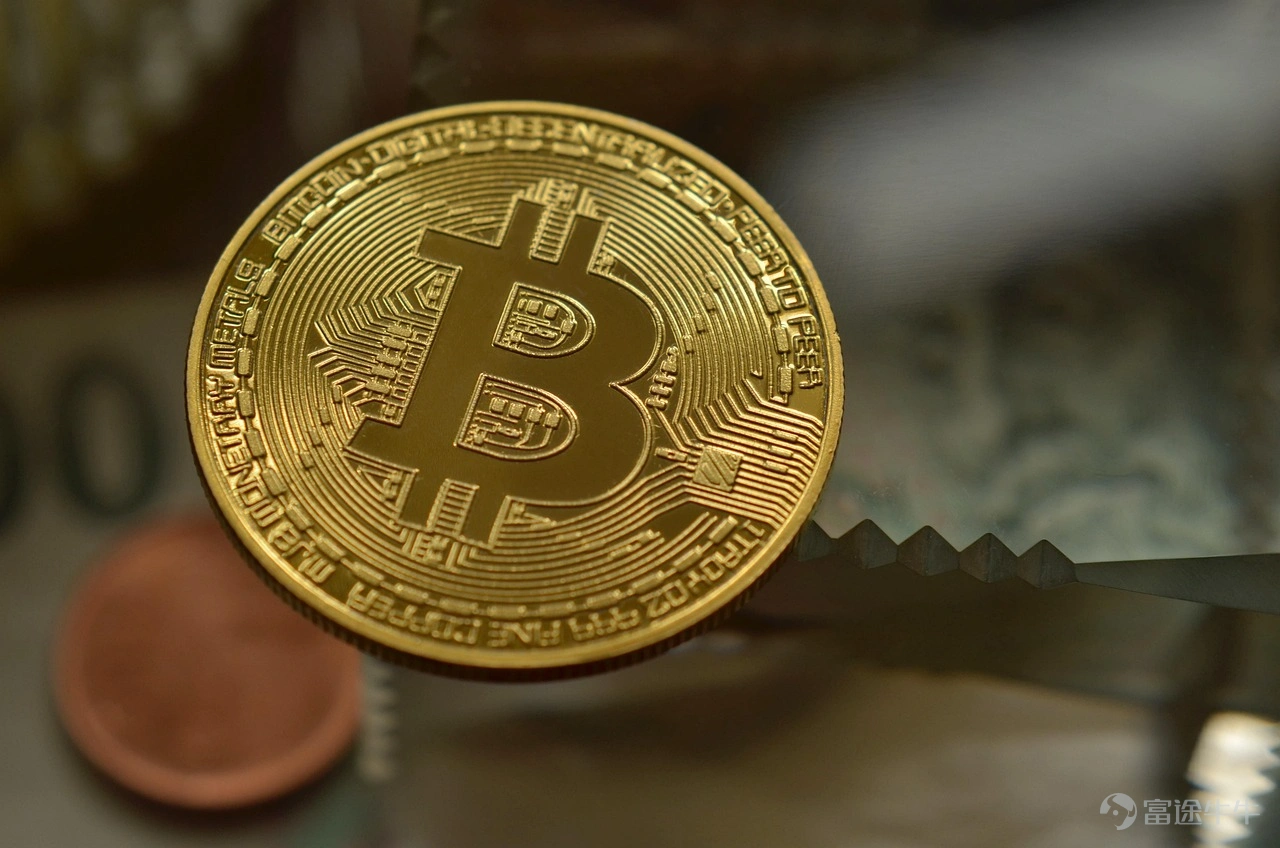
As the anchor asset of the cryptocurrency market, $Bitcoin (BTC.CC)$ the institutional wave of 2024 and 2025 has laid the foundation, with net inflows into spot ETFs reaching $35.2 billion and $21.4 billion respectively, and more than 120 listed companies holding Bitcoin.
Entering 2026, Grayscale is optimistic that BTC may reach new all-time highs in the first half of the year amid a liquidity-easing environment, potentially even breaking $150,000 in a bull market scenario.Galaxy Digital forecasts that BTC could reach $250,000 by the end of 2027.
This is thanks to multiple catalysts: First, improvements in the U.S. regulatory environment, such as relaxed pension fund allocations, will attract more 401(k) plans and listed companies to enter the market. Second, in a macro context where the risk of U.S. dollar depreciation is rising, BTC's scarcity will further stand out, with its total supply cap reinforcing its inflation-resistant attributes.
More importantly, BTC's role is transitioning from a speculative asset to a mainstream allocation.Coinbase's outlook indicates that progress in the private sector will accelerate by 2026, with major brokers opening up ETF allocations, custodian banks providing direct services, and even some sovereign wealth funds (such as Norway's pension fund) potentially piloting small-scale BTC reserves. This will drive Bitcoin’s market cap share to stabilize above 60%.
Ethereum: Transitioning from a smart contract platform to institutional-grade infrastructure
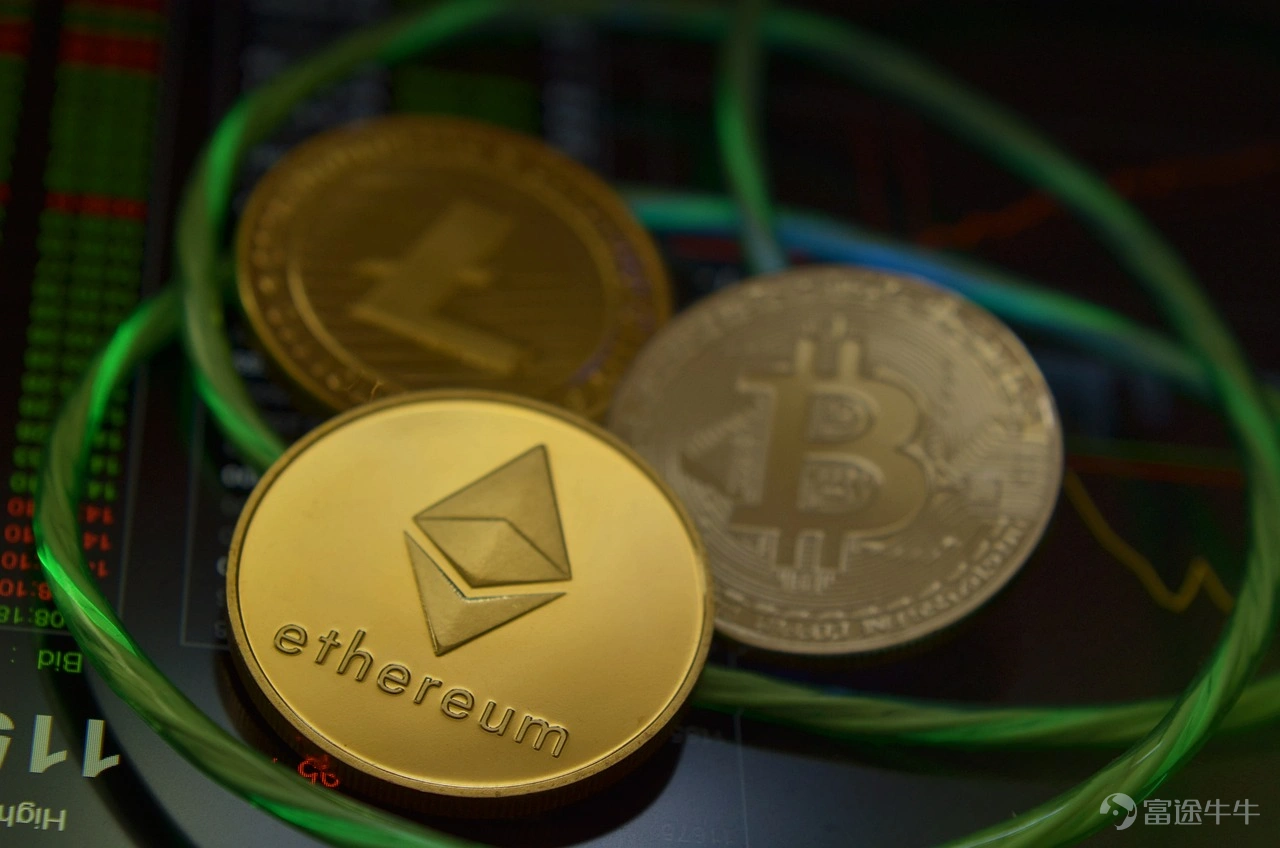
2025, the United States$Ethereum (ETH.CC)$In 2025, spot ETF inflows in the U.S. will quadruple compared to 2024, attracting $9.6 billion in investment throughout the year. Meanwhile, Ethereum successfully implements two milestone upgrades, Pectra and Fusaka, in 2025, completely restructuring the network’s scalability capabilities, leading to explosive growth in the Layer 2 ecosystem.
The key driver for ETH in 2026 will be the explosion of RWA tokenization practices.Most of Blackrock’s BUIDL Fund is on Ethereum, signaling clearly that traditional financial institutions still prefer Ethereum when handling asset settlements worth hundreds of millions of dollars.
On-chain RWA scale exceeded $30 billion in 2025 and is expected to expand to trillions of dollars by 2026, with Ethereum as the preferred platform capturing this value.$SharpLink (SBET.US)$Co-CEO Joseph Chalom stated that the surge in stablecoins, tokenized RWAs, and growing interest from sovereign wealth funds could drive Ethereum’s TVL to increase significantly by the end of 2026.Bitwise predicts that ETH may reach new highs in 2026.
Beyond the RWA explosion, investors can focus on the breakthrough of staking ETFs and two critical upgrades in 2026.The current Ethereum spot ETF does not support staking. Once an ETF with staking functionality is approved, the Ethereum ETF will become a USD-denominated asset with an annualized return of 3-4%, significantly increasing its attractiveness to institutions.
In 2026, Ethereum will undergo two major upgrades: Glamsterdam in the middle of the year and Heze-Bogota at the end of the year.Glamsterdam will focus on optimizing the execution layer and reducing gas costs, paving the way for complex institutional-grade DeFi applications; the Heze-Bogota upgrade will address shortcomings in privacy and security.
$Bitmine Immersion Technologies (BMNR.US)$ Chairman Tom Lee expressed optimism about Ethereum's prospects in 2026. The surge in commodity and precious metal prices in 2025 also indicates a positive trend for cryptocurrency asset prices in 2026. Bitmine Immersion Technologies continues to increase its ETH holdings, which, as of January 4, 2026, account for 3.43% of the total supply.
Solana: High-performance advantages stand out, explosive growth in ecosystem applications
As a representative of high-throughput public blockchains, $Solana (SOL.CC)$ after the Alpenglow upgrade,transaction costs are much lower than other mainstream chains, allowing it to quickly gain market share in areas such as stablecoin trading and RWA.The spot SOL ETF launched in October 2025 has attracted over $700 million in net inflows, marking increased institutional recognition.
Solana's RWA scale reached a new high at the end of 2025.Data shows that the scale of Real-World Assets (RWA) on the Solana chain reached a new high of $873 million by the end of 2025, mainly driven by U.S. bond-like assets. At the same time, tokenized stocks such as Tesla and NVIDIA, along with institutional funds, are also accelerating their deployment on Solana. Solana is expected to become the third public blockchain to surpass $1 billion in RWA scale, following Ethereum (approximately $12.3 billion) and BNB Chain (over $2 billion).
Bitwise recently pointed out that if the U.S. passes legislation related to the structure of the crypto market by 2026, the tokenization wave will accelerate, with Solana potentially becoming one of the biggest beneficiaries.
In addition to benefiting from the tokenization trend, Solana has already established itself as a leader in retail payments and consumer-grade applications., $PayPal (PYPL.US)$ PYUSD stablecoin primarily operates on Solana, while Western Union has chosen Solana to build its stablecoin settlement platform, which is scheduled to launch in the first half of 2026. This further strengthens its prospects for institutional adoption. Beyond payments, Solana's high performance also supports the explosive growth of applications like prediction markets.
Overall, SOL will transition from speculative to utility-driven by 2026, capitalizing on RWA and stablecoin settlement opportunities, becoming a breakout star in the high-performance ecosystem.

Cryptocurrency Concept Stocks Outlook: Benefiting from industry maturity and convergence, niche sectors are diverging.
Cryptocurrency concept stocks will benefit from market maturity and integration with traditional finance by 2026, but the divergence across sectors will be significant.
1. Exchanges and brokers benefit from the implementation of the GENIUS Act and CLARITY Act.
Exchanges and brokers, as key gateways for fiat compliance, continue to benefit from institutional capital inflows and expanding user bases. The implementation of the U.S. GENIUS Act and CLARITY Act provides critical regulatory certainty, driving institutional capital inflows.$Coinbase (COIN.US)$ Exchanges serving as gateways for fiat on-ramps are expected to see an expansion in user base and trading volume.
Moreover, industry consolidation is expected to accelerate in 2026. Major players will strengthen their business layouts through mergers and acquisitions, such as Coinbase's acquisition of Deribit in 2025.
– Cryptocurrency exchange targets:$Coinbase (COIN.US)$ 、 $Robinhood (HOOD.US)$ 、 $Bullish (BLSH.US)$ 、 $Gemini Space Station (GEMI.US)$ 。
2. Pure DAT companies may face certain risks, and the 'DAT 2.0' model may emerge in 2026.
Around January 15, 2026, the MSCI index review results will be released, potentially excluding companies with excessively high digital asset exposure.Leading Bitcoin holding companies $Strategy (MSTR.US)$are at risk of being excluded, a result that could trigger significant volatility in MSTR’s stock price and negatively affect other DAT companies.
Strategy currently holds approximately $2.2 billion in cash, with manageable short-term debt repayment pressure. Based on its latest statements, Strategy is unlikely to sell its BTC holdings. However, since most DAT companies have limited fundraising capabilities, if other DAT companies sell their accumulated tokens, it could negatively impact the cryptocurrency market.
Currently, most DAT companies have seen significant pullbacks from their peak stock prices.Once the uncertainty of Strategy being removed from the index is eliminated, it may trigger a new round of rebound at the beginning of the year.
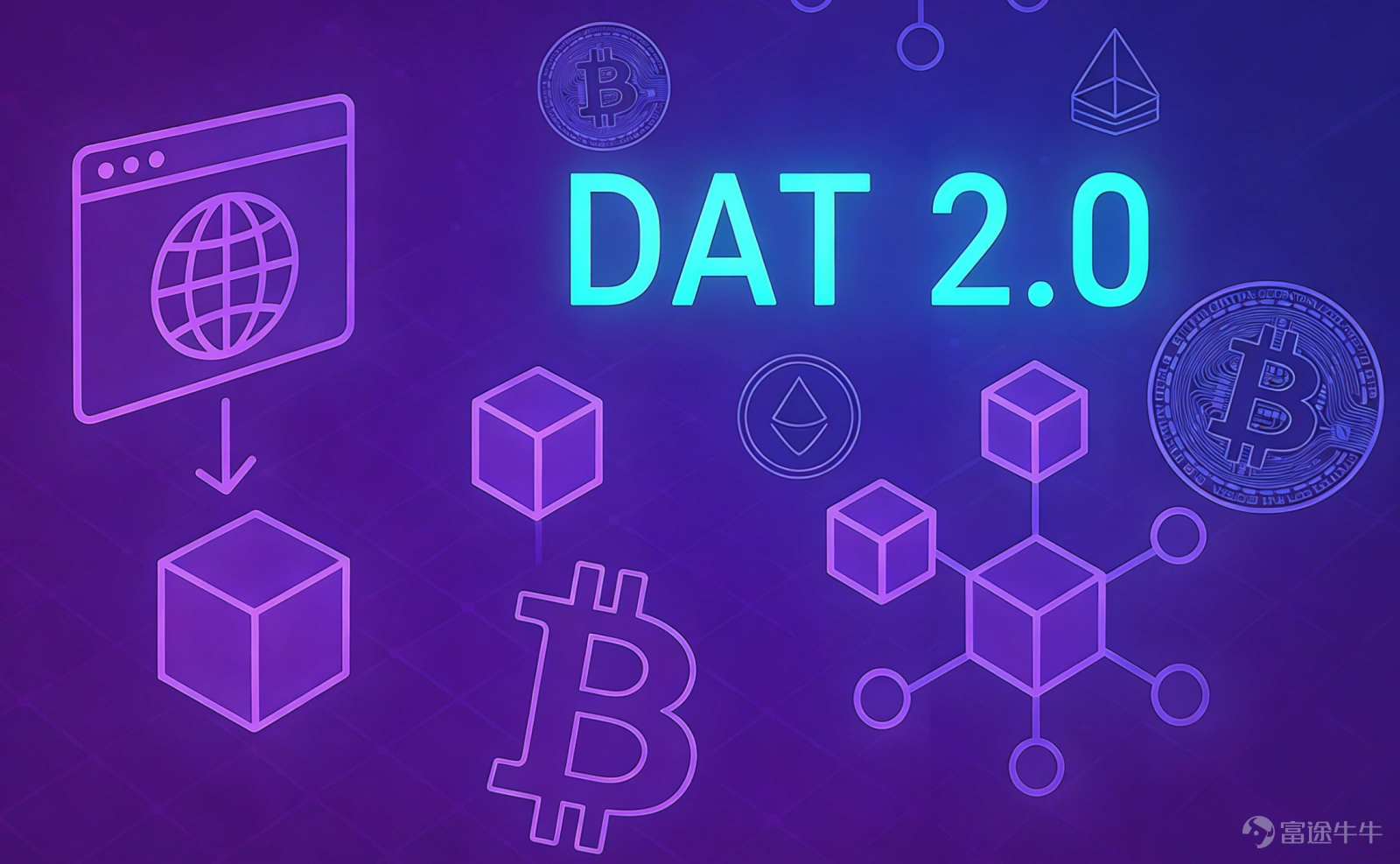
Additionally, Coinbase predicts that the 'DAT 2.0' model will emerge in 2026. This future version will no longer be limited to simple asset accumulation but will focus on professional trading, storage, and procurement of sovereign block space, treating block space as a key commodity in the digital economy.
– DAT (Bitcoin Accumulation Stocks) Target:$Strategy (MSTR.US)$ 、 $Bitmine Immersion Technologies (BMNR.US)$ 、 $福沃德工业 (FWDI.US)$ 。
3. Under the wave of AI, mining companies are transitioning to AI/HPC (High-Performance Computing)
As the network-wide computing power surpasses the symbolic 1ZH/s milestone, competition has intensified significantly, and miner profitability has dropped sharply. This trend is driving many publicly traded mining companies to shift their capacity to more profitable businesses like AI/HPC (High-Performance Computing).
Bitcoin Mining Companies in the US Stock Market's Crypto Sector for 2025$IREN Ltd (IREN.US)$、$Cipher Mining (CIFR.US)$and$TeraWulf (WULF.US)$Outperformed the vast majority of crypto assets.
Under the wave of AI, mining companies transitioning to High-Performance Computing (HPC) will become mainstream.In 2025, mining companies announced HPC contracts worth $65 billion. By the end of 2026, the proportion of HPC revenue for some large mining companies is expected to increase significantly. Their valuation logic will shift from 'Bitcoin leverage' to 'computing power infrastructure,' which will help diversify risks.According to CoinShares, by the end of 2026, the mining revenue share of leading transformative mining companies may drop below 20%.
– Mining company transformation targets: $IREN Ltd (IREN.US)$ 、 $CleanSpark (CLSK.US)$ 、 $Riot Platforms (RIOT.US)$ 、 $TeraWulf (WULF.US)$ 、 $Cipher Mining (CIFR.US)$ 、 $Hut 8 (HUT.US)$ 、 $Core Scientific (CORZ.US)$ 、 $Bitfarms (BITF.US)$ 、 $HIVE Digital Technologies (HIVE.US)$

4. Traditional financial institutions embrace stablecoin applications, ushering in the 'Hybrid Finance' era.
In 2025, the Stablecoin Act will be introduced, posing a threat to traditional financial institutions. $JPMorgan (JPM.US)$ 、 $Visa (V.US)$ and $MasterCard (MA.US)$ Traditional financial giants such as JPMorgan are actively positioning themselves in stablecoin settlements, with JPMorgan’s JPM Coin already showing potential. Siemens reported a 50% savings on foreign exchange, with settlement times dropping from several days to mere seconds.
By 2026, traditional financial institutions will further embrace stablecoins and asset tokenization.Giants like JPMorgan, Visa, and Mastercard, with their extensive customer networks and compliance advantages, will become key service integrators.
A 2025 EY survey shows that 54% of financial institutions not yet using stablecoins plan to deploy them within the next 6-12 months, potentially leading to a significant increase in stablecoin adoption by global financial institutions and corporations. By 2026, these institutions’ stocks may benefit from the scaling of stablecoins, promoting the 'Hybrid Finance' era.
– Stablecoin Targets: $JPMorgan (JPM.US)$ 、$Visa (V.US)$ 、$Mastercard (MA.US)$、$PayPal (PYPL.US)$ 、 $Circle (CRCL.US)$
5. The mainstream adoption of prediction markets is expected to inject new vitality
In October 2025, the parent company of the New York Stock Exchange (NYSE) $Intercontinental Exchange (ICE.US)$ made a strategic investment of up to $2 billion in Polymarket, marking recognition from mainstream financial institutions. Coinshares forecasts that weekly trading volume in prediction markets may exceed $2 billion by 2026.
As platforms like Robinhood integrate, prediction markets could gradually enter the public eye, benefiting related concept stocks. $DraftKings (DKNG.US)$ A standalone prediction market app was launched in 2025, and is expected to contribute additional revenue by 2026; $Robinhood (HOOD.US)$ 、 $Coinbase (COIN.US)$ 、 $Interactive Brokers (IBKR.US)$ Exchanges such as ___ introduce prediction market products, driving further user growth; betting giants $Flutter Entertainment (FLUT.US)$ are also expanding their presence in prediction markets.
– Prediction market targets: $DraftKings (DKNG.US)$ 、 $Robinhood (HOOD.US)$ 、 $Coinbase (COIN.US)$ 、 $Interactive Brokers (IBKR.US)$ 、 $Flutter Entertainment (FLUT.US)$、 $Intercontinental Exchange (ICE.US)$
How to seize the investment opportunities in the 2026 cryptocurrency market? Six key regulatory events you must know
The 2026 crypto market will be the year of practicality and institutional integration, $Bitcoin (BTC.CC)$ 、 $Ethereum (ETH.CC)$ which will lead the mainstream evolution, with concept stocks capturing value amid differentiation in niche sectors. Opportunities and risks coexist; here are six key regulatory events for the 2026 crypto market.
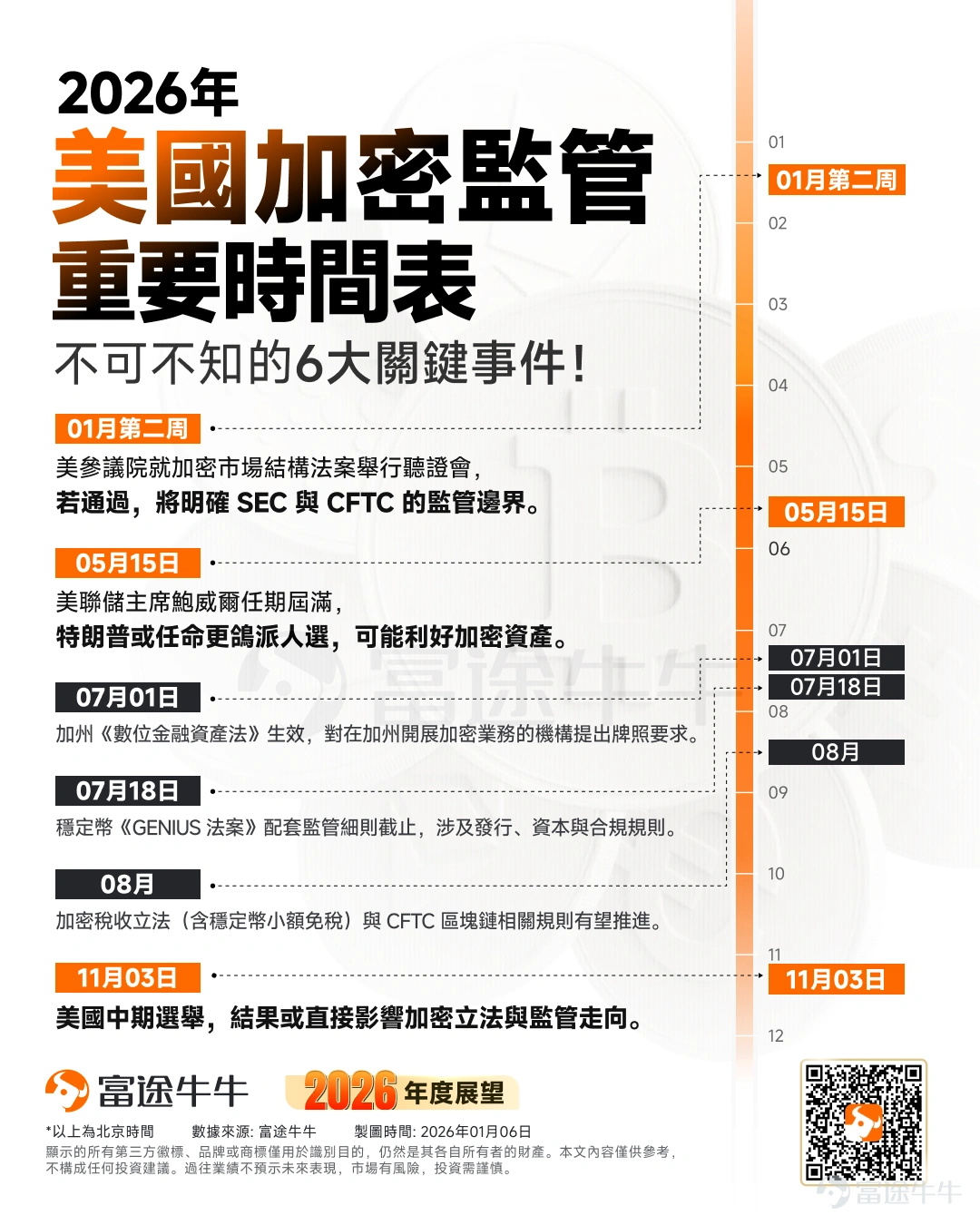
– Second week of January: The Senate is expected to hold a hearing on the Cryptocurrency Market Structure Act, the 'Clarity Act' version of which passed in the House in July 2025 but has stalled in the Senate. If passed, the bill would clarify the regulatory boundaries between the SEC and CFTC, and the SEC may introduce an 'innovation exemption' mechanism, lowering compliance thresholds for startups.
– May 15: Powell’s term as Fed Chair ends, Trump may appoint a more dovish candidate,a more accommodative monetary policy could drive growth in the crypto market.
– July 1: California's Digital Financial Assets Act takes effect,requiring licenses for institutions conducting crypto businesses in California, a hub for many crypto entrepreneurs, potentially having a significant impact on the cryptocurrency space.
– July 18: Deadline for regulatory details accompanying the GENIUS Act on stablecoins, involving issuance, capital and compliance rules.
– August: Progress is expected on crypto tax legislation (including small tax exemptions for stablecoins) and CFTC-related blockchain regulations.On December 20, Republican lawmaker Max Miller submitted a draft bill named the 'Parity Act,' which aims to establish a small tax-free threshold for stablecoins. The bill also seeks to prevent crypto lending from being considered a taxable 'asset sale.' In August 2025, CFTC Chair Caroline Pham announced a 12-month 'Crypto Sprint Initiative,' with its final task expected to be completed by August 2026.
– November 3: U.S. midterm elections, the outcome of which could directly impact the direction of crypto legislation and regulation.The advancement of the crypto industry in 2025 is largely due to the Republican Party's slim majority control of both houses of Congress. Trump, a strong supporter of crypto, losing some seats in the midterm election may negatively affect crypto policies.
Additionally, the OECD-led Crypto-Asset Reporting Framework (CARF) will officially take effect in 2027.Prior to that, starting January 1, 2026, the first 48 jurisdictions will require local crypto service providers to begin collecting user crypto wallet and transaction data in preparation for subsequent cross-border tax information exchanges. Although CARF is officially positioned for tax purposes, insiders point out that related data may be used for identity verification, anti-money laundering, and criminal investigations in the future, significantly impacting the anonymity and compliance environment of the crypto industry.
Summary
All in all, the landscape of the cryptocurrency market in 2026 represents a process of transitioning from unregulated growth toward a mature financial system. Whether it’s spot crypto trading or crypto-related stocks, investment logic needs to account for the influence of macro events while focusing on the business model, cash flow potential, and real-world application value within specific sectors.
 What do fellow investors think about the crypto market in 2026? Feel free to leave your thoughts in the comments section~
Risk Disclaimer: The above content only represents the author's view. It does not represent any position or investment advice of Futu. Futu makes no representation or warranty.Read more

Comment (1)
to post a comment
7
1