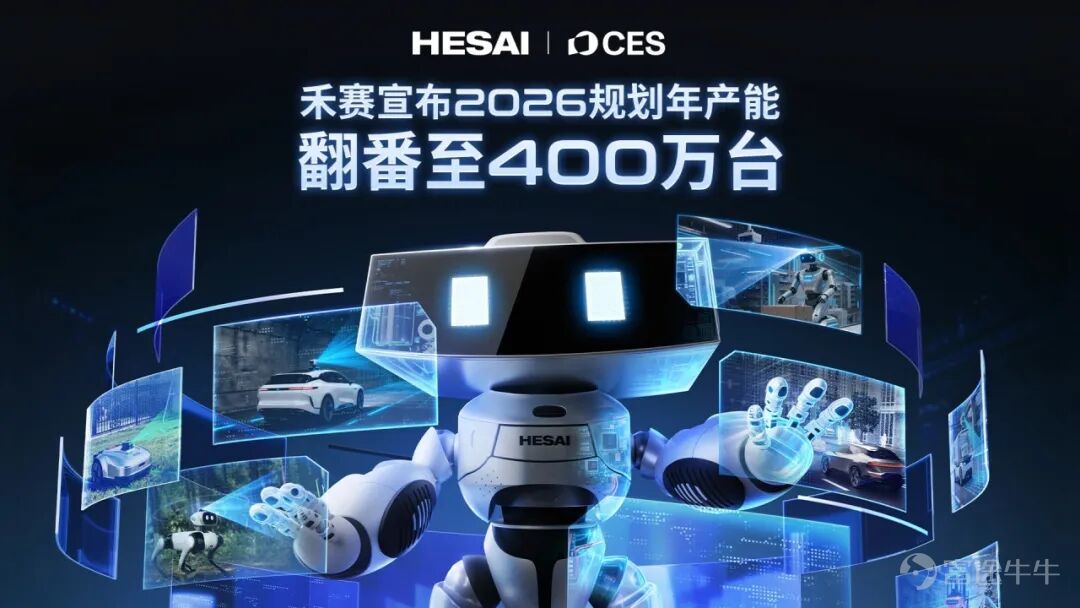
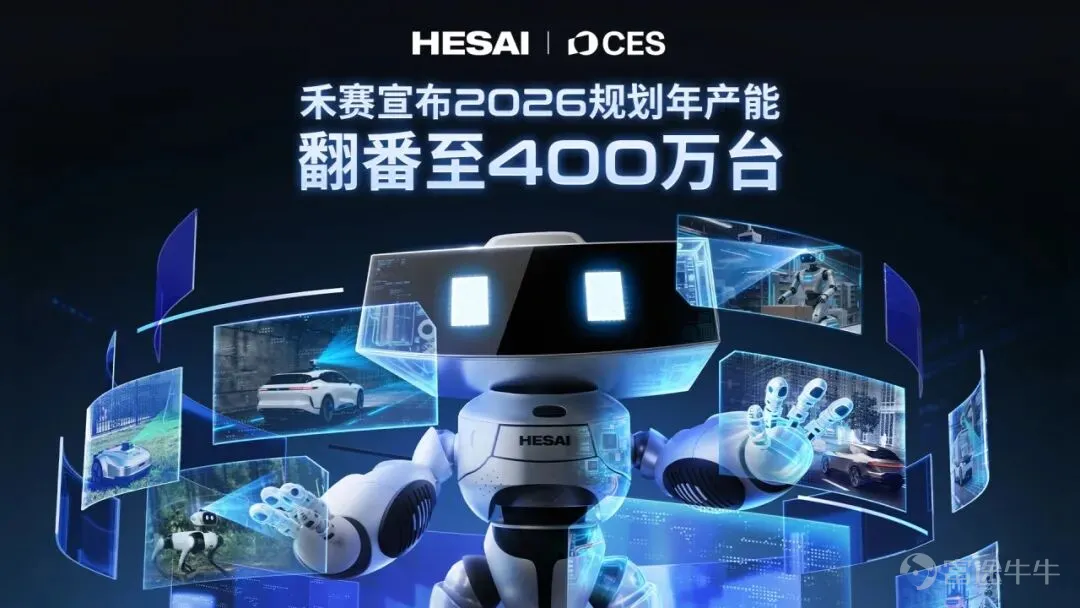
CES 2026|Hesai announces plan to double annual production capacity to 4 million units, with the Thailand overseas plant commencing operations in early 2027
On January 5, 2026 local time, at CES 2026 in Las Vegas, USA, Hesai Group (NASDAQ: HSAI; HKEX: 2525), the global leader in LiDAR technology, announced that in order to meet the growing demand for LiDAR in ADAS and robotics sectors,The company plans to increase its annual production capacity from 2 million units in 2025 to 4 million units in 2026, achieving a twofold increase. In addition, construction of Hesai's new factory in Bangkok, Thailand is proceeding steadily, with operations expected to commence in early 2027.
In-house R&D and intelligent manufacturing support doubled production capacity,
The era of ultra-large-scale mass production and delivery has arrived.
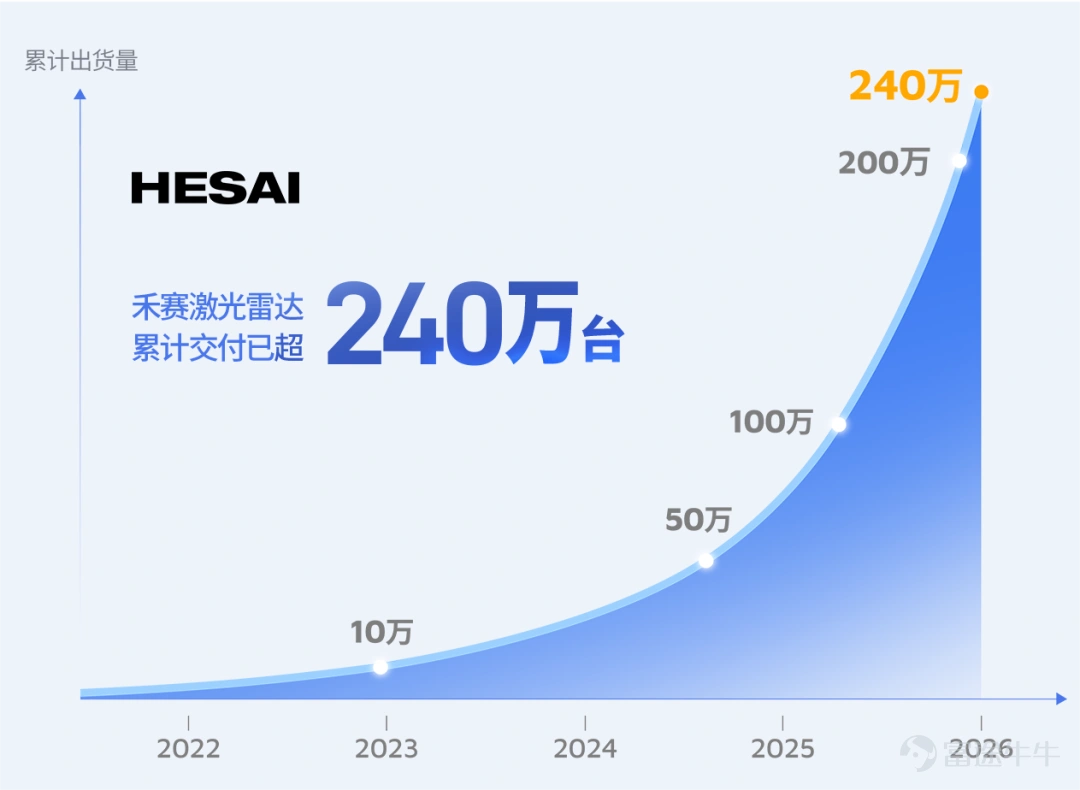
Hesai is the world's first technology company whose annual production volume has exceeded 1 million unitsand has cumulatively mass-produced and deliveredover 2 million unitsof LiDARs. In September 2025, Hesai’s 1 millionth LiDAR unit was produced on an annual basis. By November 2025, Hesai had cumulatively produced and delivered its 2 millionth LiDAR unit to customers. Continuously achieving key industry milestones, Hesai is leading the industry standard in LiDAR with its “million-unit-per-year” ultra-large-scale mass production and delivery capabilities.
Hesai has achieved a doubling of its annual delivery volume for five consecutive years. In 2025, Hesai's total annual delivery volumeexceeds 1.6 million units, with the highest monthly delivery volumeexceeding 200,000 units, and ADAS product annual delivery volumeapproximately 1.4 million units, the annual delivery volume of robot productsexceeding 200,000 units, the breakout product ATX surpassed 1 million units, the historical cumulative delivery volume of all laser radar products hasexceeded 2.4 million units。
Hesai's strong self-developed manufacturing capability is the confidence behind the plan to double annual production capacity. Hesai’s self-built integrated R&D and manufacturing center has laid a solid foundation for large-scale mass production, also ensuring high consistency and stability of Hesai's high-quality lidar in scaled production. Through the independent development of four generations of dedicated ASIC chips, Hesai has achieved rapid product iteration, high reliability, and globally replicable scale production capabilities. Currently, on Hesai's fully automated production line, one lidar unit can be produced everyEvery 10 secondsfew minutes.
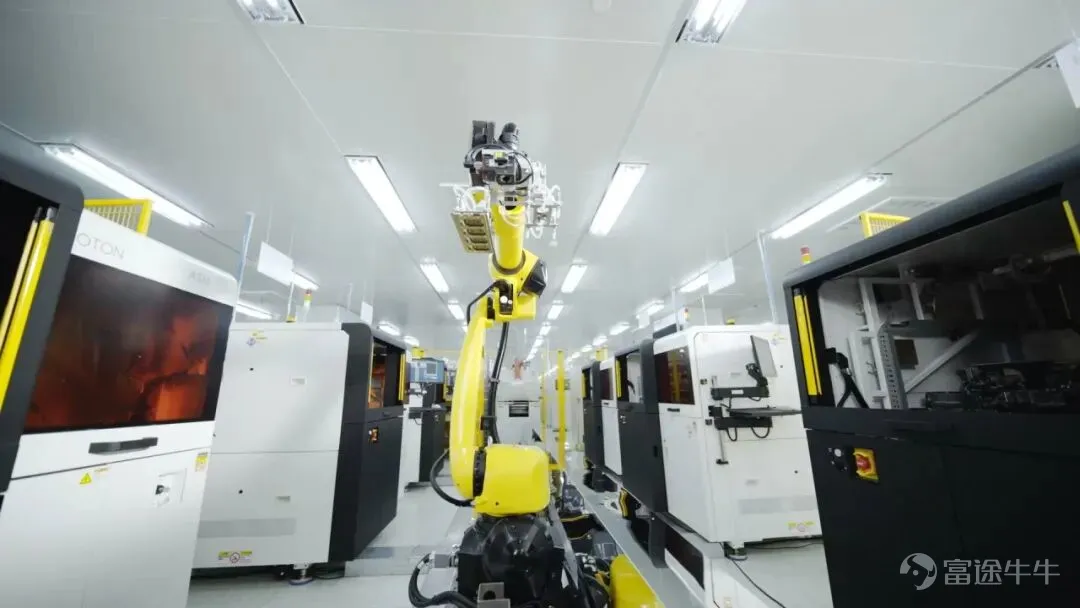
In addition, the construction of Hesai’s new factory in Bangkok, Thailand—“Galileo”—is proceeding steadily, with production expected to begin in early 2027. The Galileo factory will further enhance Hesai’s global production capacity layout and strongly support future business growth.
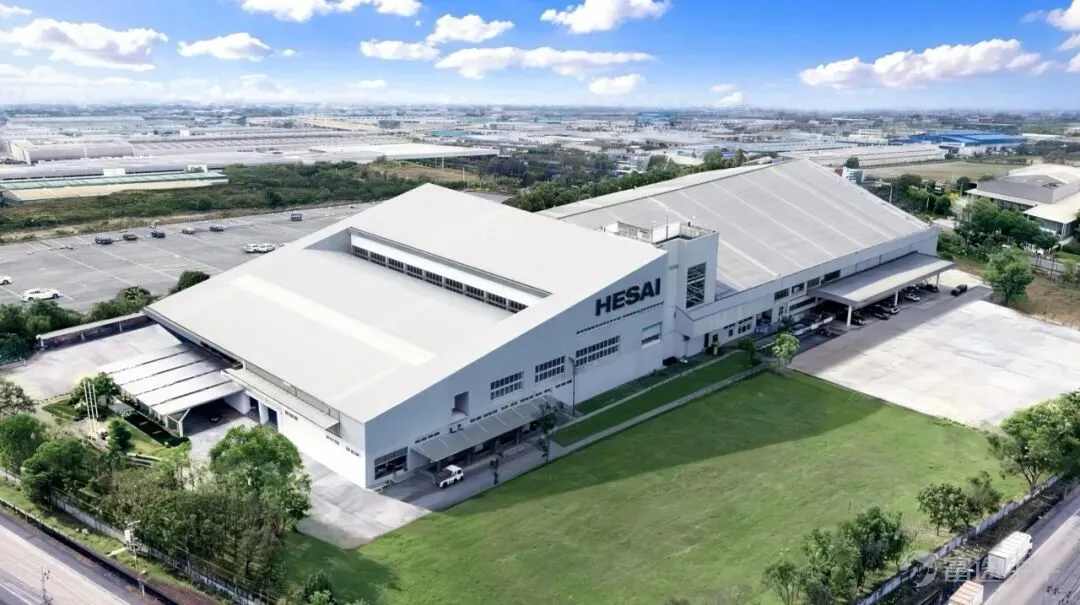
Hesai's overseas factory in Thailand — 'Galileo'
CEO of Hesai Group, Li Yifan, stated: 'As our customers expand rapidly, we are moving forward in sync. By increasing annual production capacity to over 4 million units and adding a manufacturing base in Thailand, we are building a global manufacturing system that can stably support large-scale production and delivery. Our commitment remains unchanged: to continuously provide world-class, reliable, high-quality LiDAR in scaled production.'
L3-grade automotive-standard LiDAR suite,
Comprehensively enhances driving safety
With the increasing demand for safety redundancy and gradual improvement of relevant regulations, L3-grade conditional autonomous driving vehicles will be equipped with 3-6 LiDARs. At this year's CES, Hesai officially unveiled its new-generation L3 automotive LiDAR solution, including the ultra-long-range LiDAR ETX and the solid-state short-range blind-spot detection LiDAR FTX. Both products adopt compact designs, greatly simplifying vehicle integration: ETX can be flexibly installed behind the windshield or inside the car, while FTX is specifically designed for short-range blind spot monitoring, together forming a 360° vehicle safety perception network.

Hesai has secured L3 design wins from several leading overseas automakers and domestic emerging forces. Hesai’s new-generation L3 automotive LiDAR solution has also won its first passenger vehicle production order, with mass production planned to start by the end of 2026 or early 2027.
With the rapid growth of the ADAS market, LiDAR has become a standard feature for automotive safety. As the “invisible airbag” for vehicles, LiDAR can effectively prevent collision accidents caused by visual perception deficiencies such as glare, low light, blind spots, and adverse weather conditions. Compared to pure vision-based solutions, vehicles equipped with LiDAR can reduce the risk of fatal accidents on highways by 90% and cut regular traffic accidents by 30% [1]. Currently, the significant safety value of LiDAR has gained widespread recognition in the market, with its penetration rate in China’s new energy vehicle market reaching 28%, meaning one out of every four new energy vehicles is equipped with LiDAR [2].
To date, Hesai has received production orders for over 120 models from 24 automakers, including core clients like a top European automaker, the world's best-selling new energy vehicle manufacturer, Li Auto, Xiaomi, Changan, Geely, Great Wall, Chery, Zeekr, Leapmotor, SAIC Audi, SAIC-GM, and Toyota's joint ventures. Hesai has secured full-model定点cooperation from its top two ADAS clients for 2026, ensuring 100% standard configuration. The newly released enhanced version of ATX by Hesai has already accumulated orders exceeding 4 million units from multiple leading automakers, with mass production and delivery slated to begin in April 2026.
Hesai LiDAR,
Empowering the next wave of physical AI
Beyond the ADAS market, the robotics industry is experiencing AI-driven rapid growth. As robots move from controlled environments to diverse real-world application scenarios, stable and accurate environmental perception becomes essential, and LiDAR serves as the 'AI eye' of the physical world. With its high-performance, highly reliable products, Hesai LiDAR provides critical support for the large-scale deployment of robots.
In the Robotaxi and autonomous truck markets, enterprises worldwide are accelerating the large-scale deployment of autonomous fleets. Given the highest safety requirements for L4 autonomous driving, Robotaxis require the most powerful and highest quality LiDAR, positioning Hesai as a core driver of industry transformation. At CES, attendees can experience real-time point cloud demonstrations using the 360° ultra-long-range OT128 LiDAR to understand its applications in large-scale L4 Robotaxi projects. Currently, Hesai LiDAR has been widely adopted by innovative companies such as Motional, Baidu's Apollo Go, Didi Autonomous Driving, WeRide, and Pony AI, with some models planning to feature up to 8 Hesai LiDARs, covering main and blind-spot units.
In the robotics and industrial markets, Hesai's JT series miniaturized 360° ultra-hemispheric 3D LiDAR has been widely validated. The JT series features an extremely compact size, ultra-low power consumption, and an ultra-wide field of view, making it highly flexible for integration into various mobile robots and industrial equipment. Since its launch, the cumulative shipments of the JT series have exceeded 200,000 units. At this year’s CES booth, its applications in diverse scenarios will be showcased, including MOVA (lawn-mowing robots), Vita Dynamics (smart companion robots), and RuShi (3D spatial digitization devices).
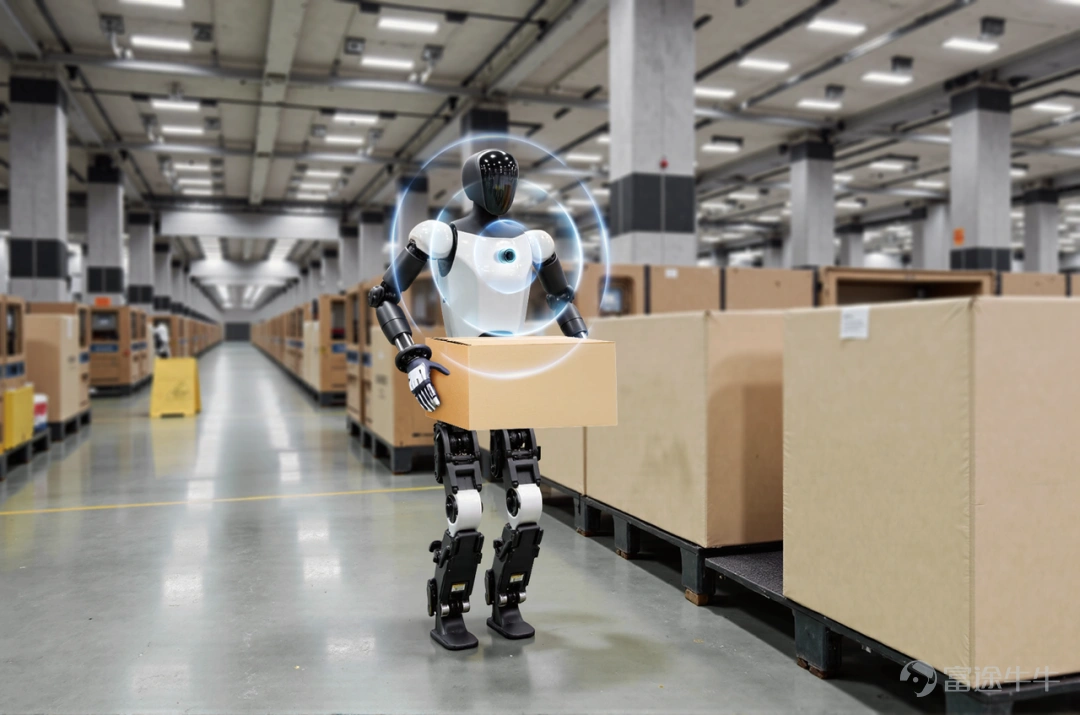
As robotics and automotive technologies move toward large-scale implementation, Hesai LiDAR is becoming a key engine for the next generation of intelligent systems. Welcome to visit Hesai’s CES booth (West Hall, LVCC) #5601) to experience firsthand how the company's latest innovations are driving autonomous driving and an intelligent future.
[1] According to official data from Li Auto
[2] According to data from Gasgoo Automotive News in November 2025
Risk Disclaimer: The above content only represents the author's view. It does not represent any position or investment advice of Futu. Futu makes no representation or warranty.Read more
Comments
to post a comment
1