

Kicking off the year with a bang! Multiple sectors in Hong Kong's stock market are quietly gaining m

[Warrant Insights] Ping An's overbought signal is triggered, how to leverage the warrant effect?
At the close on January 5, 2026, $PING AN (02318.HK)$
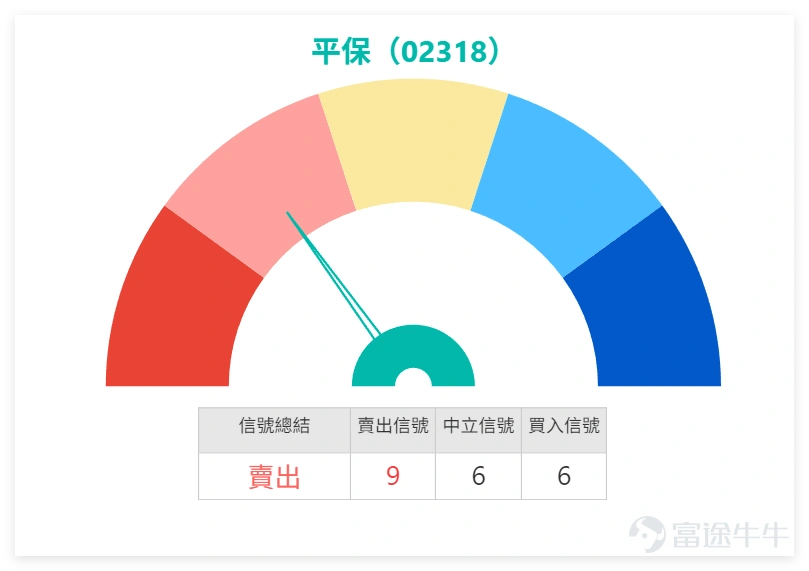
there was a notable upward movement, closing at HKD 68.6 with a daily increase of 2.69%. The trading volume reached as high as HKD 5.521 billion, showing clear signs of capital inflow. From a technical perspective,Ping An’s current share price (as of 10:43 a.m. on the 6th) is HKD 71.25. Resistance levels are concentrated at HKD 71.9 (Resistance 1) and HKD 74 (Resistance 2), while short-term support levels are at HKD 64.3 (Support 1) and HKD 60.9 (Support 2). The probability of an upward trend is currently 50%, with a 5-day volatility of 7.8%.It should be noted that its RSI indicator has reached 75, entering the overbought zone. Technical indicators summarize to a 'strong sell' signal, with a signal strength of 9. Short-term overbought correction pressure cannot be ignored.
From a sector linkage perspective, insurance stocks collectively performed strongly on January 5, becoming a market highlight.
$AIA (01299.HK)$ closing at HKD 83.9, up 0.72%. Technical indicators also show a 'strong sell' signal, with the share price approaching the HKD 85 resistance level; $CHINA LIFE (02628.HK)$ closing at HKD 29.82, surging 3.40%. The RSI at 60 shows strong upward momentum, but there is clear resistance at HKD 30.7; $CPIC (02601.HK)$ and $NCI (01336.HK)$ rising 4.03% and 5.34% respectively, both hitting recent highs. However, technical indicators from both show strong bearish signals. Only $PICC P&C (02328.HK)$ shows a neutral state technically, with an RSI of 40, not yet overbought.
Overall, insurance stocks generally rose that day but were densely flagged with overbought signals. Investors need to be wary of sector correction risks.
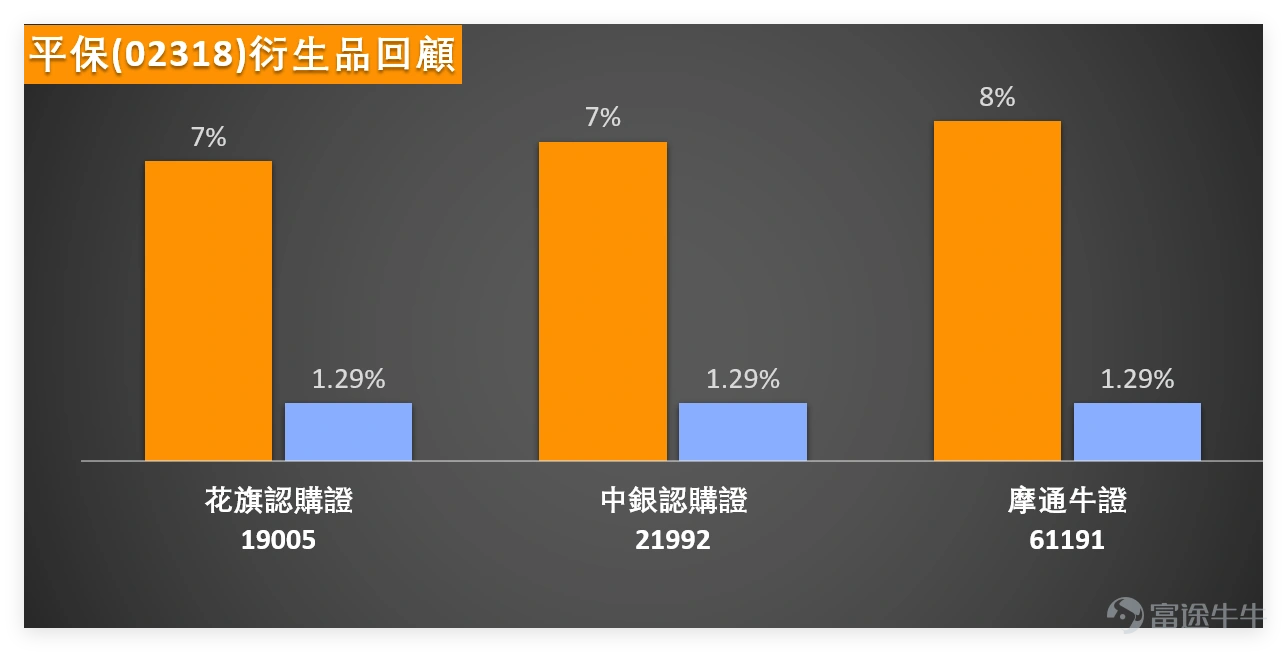
Reviewing the recent market trend, movements in the underlying stock have already driven associated warrants to become equally active. As early as December 30, 2025, three warrant products tracking Ping An had already shown initial reactions, with $CTPINAN@EC2602A.C (19005.HK)$ and $BIPINAN@EC2604A.C (21992.HK)$ both achieving a 7% increase two days later, and $JP#PINANRC2806A.C (61191.HK)$ showing even stronger performance, gaining 8% over the same two-day period, while Ping An’s underlying stock rose only 1.29%. The data comparison clearly shows the significant leverage effect of warrants. In scenarios where the underlying stock experiences a small rise, related call warrants and bull contracts can deliver higher return elasticity. This also confirms the basic logic that 'when the underlying stock rises, call warrants and bull contracts follow suit, leveraging gains through the leverage effect.'
Breaking down this linked logic, the core lies in two key factors:
First, the amplification effect of leverage multiples—warrants magnify the underlying stock's price fluctuations several times through leverage, allowing investors to achieve substantial returns even from minor fluctuations in the underlying stock.
Second, the impact of implied volatility: when the market expects continued movement in the underlying stock, implied volatility rises, further driving up warrant prices. Additionally, the distance between the exercise price and the current stock price is crucial; the closer the exercise price is to the current price of the underlying stock, the more sensitive the warrant becomes to stock fluctuations, reacting more quickly to rises and falls.
Considering the current market conditions, we have carefully selected three high-potential warrant products from the pool, providing operational recommendations based on different scenarios:For fellow investors who already hold Ping An-related warrants, it is recommended to set reasonable profit-taking levels to avoid loss of gains due to pullbacks in the underlying stock. For investors yet to enter the market, chasing highly accumulated short-term gains is not advisable; instead, prioritize products with low premiums and reasonable leverage, as follows:
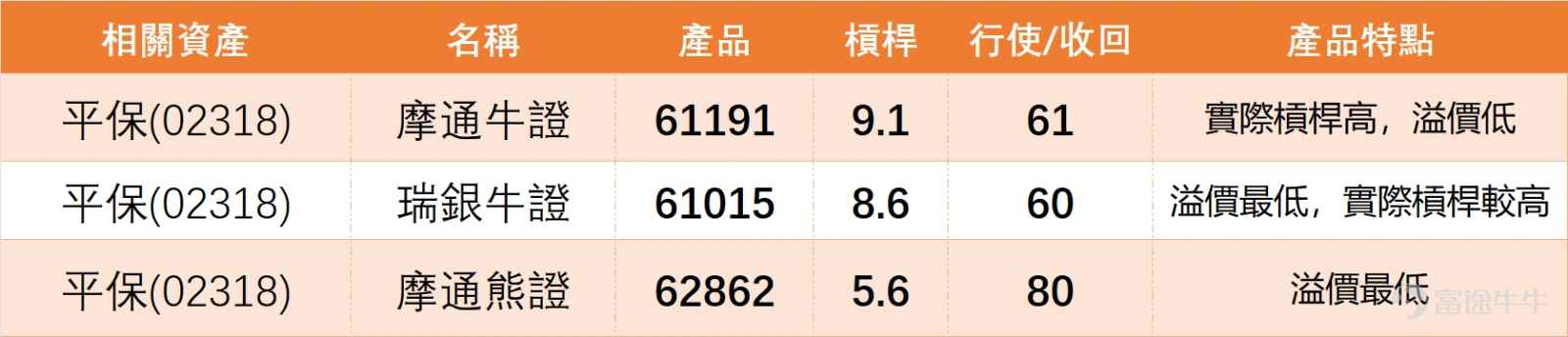
First, J.P. Morgan Bull Contract (61191): with an actual leverage of up to 9.1 times and low premium. The recovery price is 61 yuan, while the current underlying stock price at 68.6 yuan provides a reasonable safety margin. Under a scenario where the underlying stock maintains a volatile upward trend, this bull contract offers high return elasticity, while the low premium reduces the risk of valuation pullbacks, making it a relatively stable choice.
Second, $UB#PINANRC2810J.C (61015.HK)$: Lowest premium, actual leverage of 8.6 times, strike price at 60 yuan, with sufficient safety buffer. A low premium means that investors purchasing at the current price only need a slight increase in the underlying stock to break even, presenting relatively lower risk. Suitable for investors with moderate risk appetites who seek stable yet flexible returns.
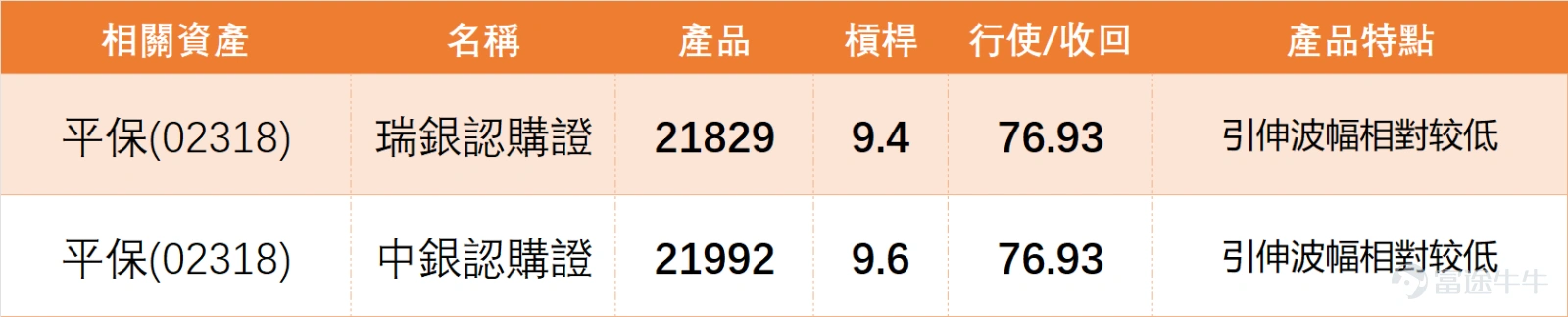
Third, BOC Call Warrant (21992): Actual leverage of 9.6 times, exercise price at 76.93 yuan, implied volatility is relatively low. Low implied volatility suggests that this call warrant is reasonably valued without excessive speculation. If the underlying stock can subsequently break through the resistance level of 71.9 yuan and move towards the exercise price of 76.93 yuan, this call warrant has significant appreciation potential. Suitable for investors optimistic about the underlying stock breaking higher levels.
A special reminder here: when choosing CBBCs, prioritize those with low premiums. High-premium products often indicate overvaluation, requiring a much larger rise in the underlying stock to cover the premium, posing extremely high risks. Just like some cross-border ETFs that experienced sharp pullbacks after being hyped up due to high premiums, chasing high-premium CBBCs could result in losses.
Risk Warning:The recent movement in insurance stocks may include short-term speculative trading. If the underlying stock does not have sustained volume support going forward, its price may face a pullback. Due to the leverage effect of CBBCs, their pullback will be much greater than the underlying stock, potentially leading to substantial losses for investors. Additionally, before entering the market, carefully check the real-time premium rate and trading volume of the CBBCs. CBBCs with excessively high premium rates or low trading volumes not only carry valuation risks but may also face liquidity risks where positions cannot be sold in time.
Did you catch this recent unusual price movement in Ping An? For whether insurance stocks can continue their upward trend, which related CBBC do you favor most?Feel free to leave your thoughts in the comment section! Want more analysis? Don’t forget to follow ‘HK Stock Warrants Jenny’ for daily updates!
Disclaimer: This article does not constitute any investment advice.
This article is for reference only and does not constitute any investment advice. The market data, opinions, and analysis contained herein may change at any time without prior notice. We shall not be liable for any loss or damage arising from reliance on the information in this article. Technical analysis merely indicates whether certain technical conditions are met; a comprehensive evaluation of asset performance should incorporate additional data. Trading decisions should not be based solely on the content of this article. Please note that past performance is not indicative of future results.
#China Ping An #Hong Kong Stock Movement #Warrants Instant Analysis #Intraday Opportunities #Hong Kong Stock Warrants Jenny #Warrants Selection #Warrants Strategy #Derivatives Hedging #Insurance Stock Market #Hong Kong Stock Investment Reference
Risk Disclaimer: The above content only represents the author's view. It does not represent any position or investment advice of Futu. Futu makes no representation or warranty.Read more

Comments
to post a comment
1