
The tech gala is here! Can CES 2026 ignite a tech rally?

Options Weekly 0105 | NFP returns, silver rebounds, Fed chair uncertainty again, will CES repeat the 'sell the fact' scenario? Here's your guide to trading at the start of the year.
This article is from the 'Options Weekly' column, which brings fellow investors a review of last week’s market, the hot topics of the current week, and analyzes potential options trading opportunities. Welcome!Click hereUpon joining the learning platform, you will receive notifications when subsequent columns are updated.
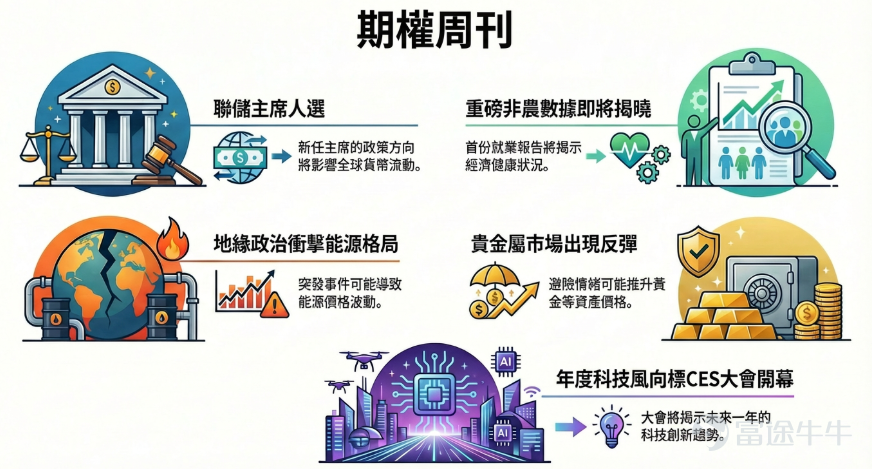
At the start of 2026, global markets stand at the intersection of multiple critical variables: the selection of the Federal Reserve Chair will soon be finalized, the first major non-farm payroll data is about to be released, geopolitical shifts are impacting the energy landscape, precious metals are rebounding, and the tech industry's annual bellwether CES conference has once again opened its doors. With more economic data and individual stock events this week, market activity is expected to pick up.
This article will systematically outline the potential paths of core events for the week and explore potential options trading strategies for investors with different risk appetites. Capturing certainty amidst uncertainty and finding opportunities in volatility.
![This article is from the 'Options Weekly' column, which provides fellow investors with a review of last week’s market action, highlights of the current week, and analyzes potential options trading opportunities. Welcome![Share Link: Click here]Upon joining the learning platform, you will receive notifications when subsequent columns are updated. At the start of 2026, the global market stands at the intersection of multiple key variables: the Fed chair selection is about to be finalized, the first major non-farm payroll (NFP) data release is approaching, geopolitical shifts are impacting the energy landscape, precious metals are rebounding, and the tech world's annual bellwether CES conference has once again begun. With more economic data and individual stock events this week, market activity is expected to pick up. This article will systematically outline the potential paths of core events for the week and explore potential options trading strategies for investors with varying risk appetites. Capturing certainty amid uncertainty, and finding opportunities in volatility. NFP set to hit on Friday, Fed chair selection in flux again? As we enter January, the biggest focus for the market is the official announcement of the Fed chair, expected this month.The market expects that the next Fed chair will be chosen between two Kevins: Kevin Hassett and Kevin Warsh. Hassett, a core member of Trump's team and Director of the White House National Economic Council, is considered a 'loyal dove,' viewed as the most market-friendly but also the most likely choice to erode central bank independence. Warsh, a former Federal Reserve...](https://nnqimage.futunn.com/sns_client_feed/999908/20260105/web-1767604093515-kLTYcK9Ker.png/big?area=2&is_public=true&imageMogr2/ignore-error/1/format/webp)
Non-farm Friday incoming, could there be another twist in the Fed Chair selection?
As we enter January, the most anticipated event for the market is the official announcement of the Federal Reserve Chair, expected this month.The market expects that the next Fed Chair will be chosen between two Kevins: Kevin Hassett and Kevin Warsh.
Hassett, currently a core member of Trump’s team and Director of the White House National Economic Council, is considered a 'loyal dove,' viewed as the most market-friendly but also the choice most likely to erode central bank independence.
Warsh, a former Federal Reserve governor, is known for criticizing the expansion of the central bank’s balance sheet. Some believe he might push for functional changes within the Fed and structural contraction of the balance sheet.
Polymarket data shows that Hassett had long been the frontrunner, with Warsh briefly surpassing him only in mid-December.However, as we entered January, Warsh's nomination probability surged again, overtaking Hassett once more.
![This article is from the 'Options Weekly' column, which provides fellow investors with a review of last week’s market action, highlights of the current week, and analyzes potential options trading opportunities. Welcome![Share Link: Click here]Upon joining the learning platform, you will receive notifications when subsequent columns are updated. At the start of 2026, the global market stands at the intersection of multiple key variables: the Fed chair selection is about to be finalized, the first major non-farm payroll (NFP) data release is approaching, geopolitical shifts are impacting the energy landscape, precious metals are rebounding, and the tech world's annual bellwether CES conference has once again begun. With more economic data and individual stock events this week, market activity is expected to pick up. This article will systematically outline the potential paths of core events for the week and explore potential options trading strategies for investors with varying risk appetites. Capturing certainty amid uncertainty, and finding opportunities in volatility. NFP set to hit on Friday, Fed chair selection in flux again? As we enter January, the biggest focus for the market is the official announcement of the Fed chair, expected this month.The market expects that the next Fed chair will be chosen between two Kevins: Kevin Hassett and Kevin Warsh. Hassett, a core member of Trump's team and Director of the White House National Economic Council, is considered a 'loyal dove,' viewed as the most market-friendly but also the most likely choice to erode central bank independence. Warsh, a former Federal Reserve...](https://nnqimage.futunn.com/sns_client_feed/999908/20260105/web-1767604093137-MPLaHqKWTa.png/big?area=2&is_public=true&imageMogr2/ignore-error/1/format/webp)
The exact timing for the announcement of candidates has not been determined, but based on Polymarket’s betting odds, it is generally expected to be in the second half of January.
Additionally, this week will bring the first key employment data for 2026.Friday's (January 9) release of the December non-farm payroll report and unemployment rate will be the main focus, with Wednesday's (January 7) ADP employment data serving as an important precursor.
The ADP data is published by the human resources company ADP, while the non-farm payroll data is collected by the U.S. Department of Labor, covering a broader sample range. This could lead to conflicting figures, but non-farm payroll data is usually the more decisive factor, especially as the impact of the government shutdown fades. Given that there are only two days between the release of ADP and non-farm payroll data, the market typically prefers to wait for the more comprehensive data.
Opportunity Analysis
Although the list of candidates frequently changes, the core logic is clear — Trump wants to select someone with a more dovish policy stance than Powell, who is more obedient to his wishes, to align with his preference for low interest rates.Even Kevin Warsh, whose stance is more conservative compared to Hassett, has publicly committed to accommodating Trump’s demand for rate cuts. Despite rampant speculation just before the nomination, it is likely to be a low-risk event because, regardless of who is chosen, an accommodative monetary environment is almost certain.
Previously, due to the prolonged U.S. government shutdown, the non-farm payroll data for October and November was distorted. Although the November unemployment rate rose to 4.6%, hitting a four-year high, the Fed also noted that the reliability of the data was questionable.
This week’s release of December data marks the return to normalcy for statistical work,and the market urgently needs confirmation of the latest state of the labor market. Analysts expect the December non-farm payrolls to increase by 57,000, compared to the previous figure of 64,000.
![This article is from the 'Options Weekly' column, which provides fellow investors with a review of last week’s market action, highlights of the current week, and analyzes potential options trading opportunities. Welcome![Share Link: Click here]Upon joining the learning platform, you will receive notifications when subsequent columns are updated. At the start of 2026, the global market stands at the intersection of multiple key variables: the Fed chair selection is about to be finalized, the first major non-farm payroll (NFP) data release is approaching, geopolitical shifts are impacting the energy landscape, precious metals are rebounding, and the tech world's annual bellwether CES conference has once again begun. With more economic data and individual stock events this week, market activity is expected to pick up. This article will systematically outline the potential paths of core events for the week and explore potential options trading strategies for investors with varying risk appetites. Capturing certainty amid uncertainty, and finding opportunities in volatility. NFP set to hit on Friday, Fed chair selection in flux again? As we enter January, the biggest focus for the market is the official announcement of the Fed chair, expected this month.The market expects that the next Fed chair will be chosen between two Kevins: Kevin Hassett and Kevin Warsh. Hassett, a core member of Trump's team and Director of the White House National Economic Council, is considered a 'loyal dove,' viewed as the most market-friendly but also the most likely choice to erode central bank independence. Warsh, a former Federal Reserve...](https://nnqimage.futunn.com/sns_client_feed/999908/20260105/web-1767604092959-eXJsGFdxch.png/big?area=2&is_public=true&imageMogr2/ignore-error/1/format/webp)
Current pricing in interest rate futures shows an 82.8% probability that the Fed will keep rates unchanged at the January meeting, maintaining the current level.If this week’s data confirms a weakening trend in the labor market (e.g., unemployment remains high at 4.6% or nonfarm payroll growth falls significantly below expectations), it may force the Fed to adopt a more aggressive stance on interest rates, potentially boosting risk assets.
Options Strategy
This week marks the first full trading week of 2026, with a relatively dense schedule of macroeconomic and industry-specific events; markets are expected to recover from the subdued holiday trading.Volatility analysis tools indicate that $SPDR S&P 500 ETF (SPY.US)$ and $Invesco QQQ Trust (QQQ.US)$Volatility for index ETFs such as SPY and QQQ remains low, particularly for SPY.
![This article is from the 'Options Weekly' column, which provides fellow investors with a review of last week’s market action, highlights of the current week, and analyzes potential options trading opportunities. Welcome![Share Link: Click here]Upon joining the learning platform, you will receive notifications when subsequent columns are updated. At the start of 2026, the global market stands at the intersection of multiple key variables: the Fed chair selection is about to be finalized, the first major non-farm payroll (NFP) data release is approaching, geopolitical shifts are impacting the energy landscape, precious metals are rebounding, and the tech world's annual bellwether CES conference has once again begun. With more economic data and individual stock events this week, market activity is expected to pick up. This article will systematically outline the potential paths of core events for the week and explore potential options trading strategies for investors with varying risk appetites. Capturing certainty amid uncertainty, and finding opportunities in volatility. NFP set to hit on Friday, Fed chair selection in flux again? As we enter January, the biggest focus for the market is the official announcement of the Fed chair, expected this month.The market expects that the next Fed chair will be chosen between two Kevins: Kevin Hassett and Kevin Warsh. Hassett, a core member of Trump's team and Director of the White House National Economic Council, is considered a 'loyal dove,' viewed as the most market-friendly but also the most likely choice to erode central bank independence. Warsh, a former Federal Reserve...](https://nnqimage.futunn.com/sns_client_feed/999908/20260105/web-1767604093243-Or594i9lEi.png/big?area=2&is_public=true&imageMogr2/ignore-error/1/format/webp)
(Left is SPY, right is QQQ)
Investors looking to bet on increased volatility may considerLong Straddle/Long Stranglestrategies. A Long Straddle typically involves buying two at-the-money options, meaning the strike price equals the market price, while a Long Strangle usually selects two out-of-the-money options. The smaller the difference between strike prices, the higher the initial cost of opening the position, but the less price movement required to reach profitability.
![This article is from the 'Options Weekly' column, which provides fellow investors with a review of last week’s market action, highlights of the current week, and analyzes potential options trading opportunities. Welcome![Share Link: Click here]Upon joining the learning platform, you will receive notifications when subsequent columns are updated. At the start of 2026, the global market stands at the intersection of multiple key variables: the Fed chair selection is about to be finalized, the first major non-farm payroll (NFP) data release is approaching, geopolitical shifts are impacting the energy landscape, precious metals are rebounding, and the tech world's annual bellwether CES conference has once again begun. With more economic data and individual stock events this week, market activity is expected to pick up. This article will systematically outline the potential paths of core events for the week and explore potential options trading strategies for investors with varying risk appetites. Capturing certainty amid uncertainty, and finding opportunities in volatility. NFP set to hit on Friday, Fed chair selection in flux again? As we enter January, the biggest focus for the market is the official announcement of the Fed chair, expected this month.The market expects that the next Fed chair will be chosen between two Kevins: Kevin Hassett and Kevin Warsh. Hassett, a core member of Trump's team and Director of the White House National Economic Council, is considered a 'loyal dove,' viewed as the most market-friendly but also the most likely choice to erode central bank independence. Warsh, a former Federal Reserve...](https://nnqimage.futunn.com/sns_client_feed/999908/20260105/web-1767604093513-hJA6UZcNs7.png/big?area=2&is_public=true&imageMogr2/ignore-error/1/format/webp)
For investors with a higher risk appetite, participation in0DTE options (options expiring on the same day) can also be considered on Friday when the non-farm payroll data is released, depending on market conditions.Trading. The premiums for end-of-month options are relatively low, offering higher potential leverage, and the daily expiration feature of index ETFs is also beneficial for deploying this strategy. However, it should be noted that end-of-month options have greater volatility and thus carry relatively higher risks.
Venezuela turmoil causes oil prices to 'fall instead of rise,' while silver rebounds strongly.
Over the weekend, the US launched a 'lightning strike' on Venezuela and detained Maduro, but the situation has not yet had a significant impact on the market. Brent crude opened lower on Monday, and the short-term trend in oil prices depends on subsequent developments. If Maduro's cabinet retains control and chaos intensifies, or if storage limitations cause continued production disruptions, there may be temporary upward pressure on oil prices.
Opportunity Analysis
As Venezuela's actual daily production accounts for only 0.8% of global crude oil output,and OPEC+ has substantial idle capacity, coupled with weakening energy demand due to a slowing macroeconomic environment in 2026, the upside potential remains limited.If the new government receives full sanctions exemptions with US support and restores damaged wells and restarts impaired upgrading facilities, medium-term production increases are possible. However, recovery faces multiple obstacles, and significantly increasing Venezuela’s oil production could take years, destined to be a gradual and slow process.
Monday$XAU/USD (XAUUSD.CFD)$ 、 $XAG/USD (XAGUSD.FX)$Rebound,Precious metals rose amid escalating geopolitical uncertainty.However, with the temporary halt of the US military attack on Venezuela, the 'safe-haven' appeal subsides, and gold will subsequently return to the macro logic of the Fed’s rate-cutting cycle.
Due to profit-taking pressure following the year-end rally in 2025, the current technical indicators need to repair the overbought condition through consolidation or a minor pullback.On the regulatory front, the CME's second increase in margin requirements for precious metals trading within a week is seen as a clear signal from regulators about an overheated market, with short-term rapid gains prompting profit-taking exits upon the margin hike signal.
Options Strategy
$iShares Silver Trust (SLV.US)$ Intense short-term tug-of-war between bulls and bears may result in volatile range-bound trading.In the medium term, prices may trend upward amid volatility, as further Fed rate cuts potentially occur by the end of Q1 2026, combined with industrial restocking in spring, which will help prices regain upward momentum.
For conservative investors, even if bullish, it’s crucial to avoid aggressively chasing high-beta assets like silver to prevent losses during volatile shakeouts. Utilize the current high volatility to set up a wider grid trading strategy, gradually accumulating positions at support levels and reducing exposure at resistance levels to lower average holding costs.
With implied volatility at an extremely high percentile (IV percentile = 98%), the cost of directly buying call options is excessively high.The Vega risk is significant (if volatility declines while the price rises, the option might fall instead of rise), so adopting a 'Spread' strategy can optimize the risk-reward ratio.
(1) Neutral to slightly bullish, capturing time value: Bull Put Spread
Action: Sell a Put at a lower support level (e.g., Strike $60) while simultaneously buying a Put at an even lower level (e.g., Strike $50) for protection.
Rationale: Capitalize on SLV's high volatility to collect substantial premiums. As long as the stock price remains above the breakeven point at expiration, this strategy will be profitable; Time Decay works in your favor.
(2) Mildly bullish, reduce costs: Call Ladder bullish strategy
Action: Buy ATM Call, sell two OTM Calls (at higher strike prices).
Logic: Only suitable for scenarios where a rise is expected but the upside is limited (e.g., it's hard to imagine the price reaching $80 within half a month), and where zero-cost position building is desired. However, note that this strategy requires active management. If the price rises too much, significant losses can occur. Once the price breaks above the higher strike price, positions must be closed or hedged.
Compared with a regular bull call spread, the Call Ladder sells one additional high-strike Call, which lowers the cost of the strategy and even achieves 'zero cost,' but introduces unlimited downside risk. This makes it more 'neutral-mildly bullish' rather than a pure bull strategy.
Will the CES event repeat last year's 'sell the fact' scenario?
On January 6th, the global tech event CES will open in Las Vegas. The key highlights of this exhibition are $Intel (INTC.US)$ 、 $Qualcomm (QCOM.US)$ and $Advanced Micro Devices (AMD.US)$ the competition for next-generation PC processors and $NVIDIA (NVDA.US)$ the physical implementation of AI.
Opportunity Analysis
During CES 2025, the semiconductor sector went through a typical 'buy the rumor, sell the fact' process,with a concentrated surge in the sector during the short window around January 2nd to 6th before and after the opening of CES, where $NVIDIA (NVDA.US)$ Up 10% cumulatively, $Advanced Micro Devices (AMD.US)$ Up 5.7%, $iShares Semiconductor ETF (SOXX.US)$ Synchronously up 6.4%. However, this upward trend hit a turning point on January 7th, after which the market saw heavy selling. NVIDIA plummeted 6% that day, and AMD fell 1.7%. This downward trend continued until January 15th.
The core factors driving the decline are mainly twofold: On one hand, macroeconomic data unexpectedly exceeded expectations—PMI and JOLTs job openings data published on January 7, 2025, both surpassed market forecasts. Strong non-farm payroll data released on January 10 directly led to a significant cooling of market expectations for interest rate cuts in 2025. On the other hand, there was the shock from a policy black swan event; between January 9 and 10, the government introduced a ban on chip sales targeting the Chinese market, further intensifying pressure on sector adjustments.
The 2026 CES schedule almost completely aligns with last year's,Market focus will remain on the keynote speeches by industry giants,With NVIDIA's Jensen Huang scheduled to speak at 4:00 pm EST on January 5 (Monday), followed by AMD’s Lisa Su at 9:30 pm. Intel will kick off its event at 6:00 pm.
![This article is from the 'Options Weekly' column, which provides fellow investors with a review of last week’s market action, highlights of the current week, and analyzes potential options trading opportunities. Welcome![Share Link: Click here]Upon joining the learning platform, you will receive notifications when subsequent columns are updated. At the start of 2026, the global market stands at the intersection of multiple key variables: the Fed chair selection is about to be finalized, the first major non-farm payroll (NFP) data release is approaching, geopolitical shifts are impacting the energy landscape, precious metals are rebounding, and the tech world's annual bellwether CES conference has once again begun. With more economic data and individual stock events this week, market activity is expected to pick up. This article will systematically outline the potential paths of core events for the week and explore potential options trading strategies for investors with varying risk appetites. Capturing certainty amid uncertainty, and finding opportunities in volatility. NFP set to hit on Friday, Fed chair selection in flux again? As we enter January, the biggest focus for the market is the official announcement of the Fed chair, expected this month.The market expects that the next Fed chair will be chosen between two Kevins: Kevin Hassett and Kevin Warsh. Hassett, a core member of Trump's team and Director of the White House National Economic Council, is considered a 'loyal dove,' viewed as the most market-friendly but also the most likely choice to erode central bank independence. Warsh, a former Federal Reserve...](https://nnqimage.futunn.com/sns_client_feed/999908/20260105/web-1767604092958-uJCVAWS7RU.png/big?area=2&is_public=true&imageMogr2/ignore-error/1/format/webp)
Key risk factors to watch are distributed across several critical time nodes,On January 5, PMI data will be released. The market expects a reading above 49 to be bullish, while a figure below 48.2 could bring bearish implications. Non-farm payrolls will be announced on January 9, which will directly influence the market’s judgment on macro policy direction. CPI data due on January 13 is also crucial. Market expectations suggest that December’s CPI may rebound due to rising rents and the end of Black Friday discounts.
Options Strategy
$NVIDIA (NVDA.US)$ :Open interest in options for the nearest four expiration dates is more concentrated around the $200 level compared to recent weeks. Regarding the trading volume of options for these four expiration dates, a large number of call and put positions are clustered around $190, making this level critical for whether NVIDIA can break out upward this week. The options market could form resistance around this price.
The current implied volatility (IV) has shown an upward trend compared to last week, reaching the 22nd percentile historically.This means that while the premiums for options are still relatively 'cheap,' they have started to rise.
$Intel (INTC.US)$ :In the distribution of Intel option trading volumes around the two expiration dates before and after the CES event, call options dominate, with a significant concentration at the $40 strike price. Meanwhile, open interest is mainly concentrated between $35 and $40.If Intel does not deliver the surprises the market expects at CES, its stock price might be 'pinned' near the corresponding range.
Intel's current implied volatility (IV) has significantly increased from last week, reaching the 56th percentile over the past year.Intel’s absolute implied volatility is notably higher than typical value stocks, meaning the premium paid by option buyers remains relatively expensive.
(1) Investors with low risk appetite or heavy positionscan take advantage of the anticipated stock price peak driven by CES (around January 5), to partially reduce positions and lock in some profits beforehand.
It’s also possible to adoptCovered Call optionsThe strategy involves selling out-of-the-money call options while holding the underlying stock. If the stock price does not exceed the strike price, the investor can keep the stock and earn the full option premium. However, this strategy has a clear drawback: if the stock price surges past the strike price, the stock will have to be sold at the strike price, effectively capping profits at a high point and potentially causing investors to miss out on additional gains from an unexpected price surge.
(2) Short-term event speculation
During CES, there may be short-term price patterns of 'initial rise followed by a pullback,' and the volatility of related stocks could be significantly elevated. Investors who wish to speculate on short-term directional opportunities brought about by events, while strictly controlling the cost of premiums, can adoptVertical Spread Strategy。
Take the bull call spread as an example: maximum profit is achieved when the underlying asset rises moderately. If the stock price rises, the sold higher-strike call option limits the maximum profit potential; even if the stock falls, the maximum loss is only the net premium paid, which won’t expand indefinitely. Moreover, in a market with rising volatility, this strategy is more stable than single-leg options. Even if volatility subsequently pulls back, the sold leg can effectively reduce vega exposure, mitigating risks from declining volatility.
(3) Risk hedging required
Given that current $CBOE Volatility S&P 500 Index (.VIX.US)$ and implied volatility (IV) are relatively low, purchasingProtective Putis relatively inexpensive. Additionally, tail risks in the market remain insufficiently hedged, making it worth keeping an eye on.
If your risk preference is very low, you can consider buying medium to long-term in-the-money put options to avoid the rapid decay of time value. In real scenarios, if the price of the underlying stock does not fall below the strike price by the expiration date, the put option will expire worthless, and investors could lose the entire premium paid initially; however, if the stock price falls as expected, it will serve as a hedge against risk.
Brian Wong Huang Zi Zheng
Futu Investment Strategy Expert
CE: BBH085
Finally, here’s a small perk for fellow investors. Welcome to claim it!Options Beginner's Package
This event is exclusively available to HK invited users. Click to learn more.Detailed event rules>>
Market conditions are complex and volatile,Options StrategyToo many options and not sure how to choose? Futubull helps you build in three easy steps,Options Strategymaking investing simple and efficient from now on!
![This article is from the 'Options Weekly' column, which provides fellow investors with a review of last week’s market action, highlights of the current week, and analyzes potential options trading opportunities. Welcome![Share Link: Click here]Upon joining the learning platform, you will receive notifications when subsequent columns are updated. At the start of 2026, the global market stands at the intersection of multiple key variables: the Fed chair selection is about to be finalized, the first major non-farm payroll (NFP) data release is approaching, geopolitical shifts are impacting the energy landscape, precious metals are rebounding, and the tech world's annual bellwether CES conference has once again begun. With more economic data and individual stock events this week, market activity is expected to pick up. This article will systematically outline the potential paths of core events for the week and explore potential options trading strategies for investors with varying risk appetites. Capturing certainty amid uncertainty, and finding opportunities in volatility. NFP set to hit on Friday, Fed chair selection in flux again? As we enter January, the biggest focus for the market is the official announcement of the Fed chair, expected this month.The market expects that the next Fed chair will be chosen between two Kevins: Kevin Hassett and Kevin Warsh. Hassett, a core member of Trump's team and Director of the White House National Economic Council, is considered a 'loyal dove,' viewed as the most market-friendly but also the most likely choice to erode central bank independence. Warsh, a former Federal Reserve...](https://nnqimage.futunn.com/sns_client_feed/999908/20260105/web-1767604093137-GIMbOaCoIS.webp/big?area=2&is_public=true&imageMogr2/ignore-error/1/format/webp)
Disclaimer
This content does not constitute any offer, solicitation, recommendation, opinion, or guarantee regarding securities, financial products, or tools. The risk of loss in trading options can be substantial. In certain circumstances, the losses you incur may exceed the initial margin deposited. Even if you have set contingency orders, such as “stop-loss” or “limit” orders, these may not necessarily prevent losses. Market conditions may render such orders unexecutable. You may be required to deposit additional margin within a short period. If you fail to provide the required amount within the specified timeframe, your open positions may be liquidated. However, you will still be responsible for any shortfall in your account resulting from such liquidation. Therefore, before engaging in options trading, you should thoroughly study and understand options and carefully consider whether such trading is suitable for you based on your financial situation and investment objectives. If you trade options, you should familiarize yourself with the procedures for exercising options and the rights and obligations upon exercise or expiration of options.
Risk Disclaimer: The above content only represents the author's view. It does not represent any position or investment advice of Futu. Futu makes no representation or warranty.Read more


Comment (1)
to post a comment
72
32