[2026 Outlook] Plan Ahead! Share the Investment Opportunities You Are Optimistic About

2026 Outlook | Wall Street's "Treasure Map" of chip stocks revealed! NVIDIA, Broadcom top the charts—what are the potential dark horses?
Fellow investors, as 2025 comes to a close and we face a brand-new 2026, instead of anxiously chasing trends, it’s better to calm down and understand the direction of the market. Follow @牛牛課堂to unlock your investment roadmap in real time. In the new year, let’s stay calm and patient, proceed steadily for long-term success, and slowly grow our wealth together.
As 2025 draws to a close, Wall Street giants have released in-depth outlook reports on the semiconductor industry for 2026. Overall,Most firms agree that 2026 will be a pivotal year for the semiconductor industry, transitioning from being "purely AI-driven" to being propelled by both "AI and the recovery of traditional cycles."
In fact, with the continuous acceleration of AI infrastructure development, the semiconductor industry is entering a new phase of "greater selectivity." Investors will no longer blindly chase all AI-related stocks but will focus more on companies' monetization capabilities, profit contributions, and key customer performance.
As the year-end approaches, how are Wall Street giants recalibrating their sector allocations? Which stocks have made it onto their "favorites" list? This article will delve into the investment research strategies and shortlists of major firms.
How do the major firms view the semiconductor sector?
I. Core Prediction: The AI Boom Continues, Overall Sales Approach $1 Trillion
Overall, major firms have provided positive forecasts for the market growth rate in 2026:
1. Market Size Growth:Bank of America Securities expects global semiconductor sales to grow by approximately 30% in 2026, moving closer to the $1 trillion mark. Citi forecasts sales growth of 18%, reaching $917.8 billion.
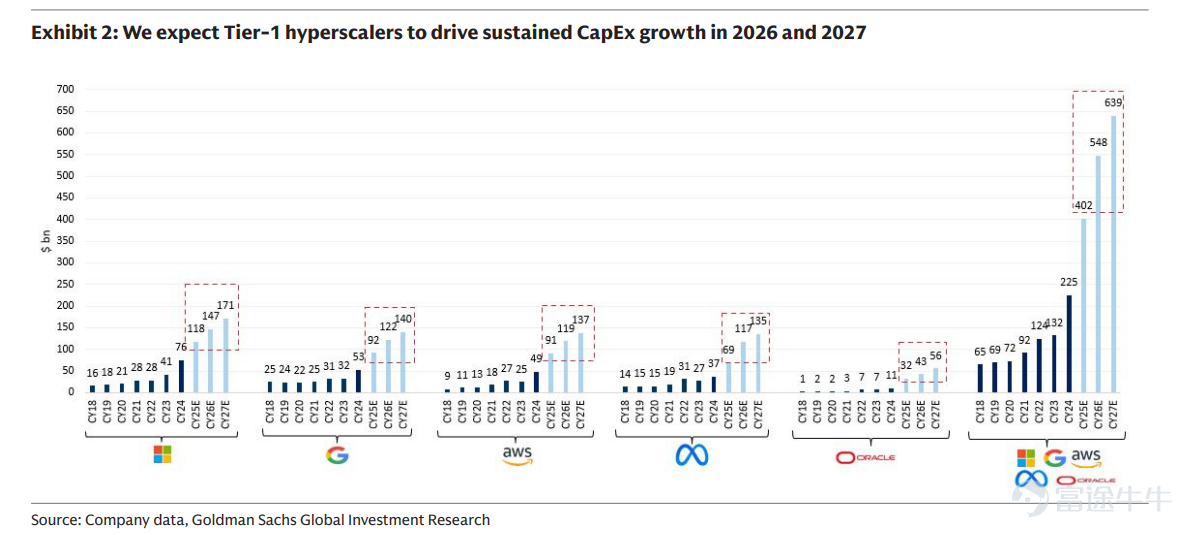
2. AI infrastructure spending:Goldman Sachs points out that capital expenditure by hyperscale cloud service providers will continue to rise, not only including top cloud companies but also expanding to startups (such as OpenAI) and sovereign nations (such as Saudi Arabia, EU).

Source: Goldman Sachs
3. AI semiconductor growth rate:Bank of America Securities expects the AI semiconductor sector to achieve a year-over-year increase of over 50% in 2026.
II. Core Drivers and Potential Risks
1. The 'second half' of transitioning from training to inference:Morgan Stanley pointed out that the market focus in 2026 will shift from model training to the 'Token growth' phase of complex reasoning, which will greatly benefit memory and front-end fab utilization.
2. The rise of custom chips (ASICs):Major banks are unanimous in their positive outlook on ASIC development. Citi expects the proportion of custom ASICs in total AI accelerators to increase from the current 35% to 45% by 2028. JPMorgan believes this figure could exceed 50% by 2028.

Source: Citi
However, both Citi and Goldman Sachs warned that the market will face cash recovery pressure from model developers like OpenAI in the second half of 2026, and investor skepticism about AI monetization capabilities may trigger significant stock price volatility.
Investment banks' 'favorite picks': The must-watch list for 2026
Compiled by fellow investors, this list includes companies favored by JPMorgan, Morgan Stanley, Bank of America, Citi, and Goldman Sachs. Overall, these major banks are no longer just chasing the infrastructure for 'AI training' but are starting to explore opportunities in cyclical recovery (analog chips) and AI edge expansion (storage).

Including AI computing power and core logic chips$Broadcom (AVGO.US)$ 、 $NVIDIA (NVDA.US)$ 、 $Marvell Technology (MRVL.US)$ 、 $Ambarella (AMBA.US)$ ;
AI connectivity and high-speed interconnects $Astera Labs (ALAB.US)$ 、 $Credo Technology (CRDO.US)$ ;
Semiconductor equipment $ASML Holding (ASML.US)$ 、 $Applied Materials (AMAT.US)$ 、 $Lam Research (LRCX.US)$ 、 $KLA Corp (KLAC.US)$ 、 $Teradyne (TER.US)$ 、 $MKS Inc (MKSI.US)$ 、 $Advanced Energy Industries (AEIS.US)$ ;
Storage and Hard Drives $Micron Technology (MU.US)$ 、 $Western Digital (WDC.US)$ 、 $SanDisk (SNDK.US)$ 、 $Seagate Technology (STX.US)$ ;
Simulation, MCU, and Industrial/Automotive $Analog Devices (ADI.US)$ 、 $Texas Instruments (TXN.US)$ 、 $Microchip Technology (MCHP.US)$ 、 $NXP Semiconductors (NXPI.US)$ 、 $MACOM Technology Solutions (MTSI.US)$ 、 $SiTime (SITM.US)$ ;
Wafer Fabrication and Testing $Taiwan Semiconductor (TSM.US)$ 、 $SMIC (00981.HK)$ 、 $ASE Technology (ASX.US)$ 。
Specifically, the following three main themes are highlighted:
Main Theme One: Establishment of the 'Double-Headed Eagle' Pattern – NVIDIA and Broadcom as Standard Components
Looking at the lists from the five major banks, the frequency of NVIDIA and Broadcom appearances is nearly 100%. This sends a strong signal:The construction of AI infrastructure is far from complete, with computing power and connectivity remaining core themes.
NVIDIA: Almost all investment banks have listed it as a core holding. Goldman Sachs pointed out its moat in AI training applications is hard to shake; Bank of America emphasized that NVIDIA's PEG (Price/Earnings to Growth ratio) remains attractive, currently at about 0.6 times, significantly lower than the overall S&P 500 index component stocks’ level nearing 2 times.
Broadcom: Considered the 'best co-pilot' in the AI era. Goldman Sachs ranked it as the top AI choice for 2026, highlighting its leading position in custom chips (ASICs) and networking chips, making it an indispensable partner for giants like Google TPU.
Overall, these two companies represent essential utilities of the AI era—while their explosive growth may not match the past two years, they offer the highest certainty.
Main Theme Two: Cyclical Recovery – The ‘Surprise’ Moment for Analog Chips
This is the biggest highlight in the 2026 outlook. Both Citi and Goldman Sachs have pointed out that after two years of inventory adjustments, analog chips are set to experience a strong cyclical rebound, potentially making it the sector with the highest return potential in 2026.
Microchip: the top pick by both Citi and Goldman Sachs. The reason is that its profit margins and stock price have undergone significant corrections, and as inventory reduction concludes, its rebound is expected to be the strongest.
In addition, Texas Instruments, Analog Devices, and NXP Semiconductors have all been included in the list of favored stocks. Overall, if AI is the attacker, analog chips will be the best choice for defense and counterattack in 2026.
Main Theme Three: Selling Shovels – Semiconductor Equipment and Memory
As chip manufacturing processes become increasingly complex (such as GAA architecture, HBM stacking), demand for manufacturing equipment and memory will remain high.
The Two Giants of Equipment Stocks:Applied Materials and Lam Research have been favored by multiple investment banks. Citi is particularly optimistic about LRCX, while Goldman Sachs and Bank of America believe equipment stocks will benefit from double-digit growth in fab spending in 2026.
The King of Memory:Micron is Morgan Stanley's 'top memory pick.' Morgan Stanley predicts a structural shortage in DRAM supply and demand, which will be a significant driver for prices and profits.
Differentiated Game Theory: The 'Secret Weapons' of Major Banks
The most interesting part lies in the 'non-consensus' choices of various investment banks, which often serve as the source of excess returns (Alpha):
1. Morgan Stanley: Embracing 'Niche Markets' and 'Chinese Assets'
Morgan Stanley is the only major bank that has included $SMIC (00981.HK)$ on its favored list. Against the backdrop of accelerating domestic substitution, this may indicate a shift in foreign capital's attitude towards China’s mature semiconductor manufacturing processes.
At the same time, Morgan Stanley highly recommends $Astera Labs (ALAB.US)$ , a rising company specializing in AI connectivity solutions, reflecting its high emphasis on PCIe/CXL technology.
2. JPMorgan, Goldman Sachs: Favoring EDA Companies
Goldman Sachs lists $Cadence Design Systems (CDNS.US)$ as its top pick, while also favoring $Synopsys (SNPS.US)$ While JPMorgan has listed $Synopsys (SNPS.US)$ as its top pick, while also favoring $Cadence Design Systems (CDNS.US)$ . EDA is hailed as the 'mother of chips,' with a business model similar to SaaS and stable cash flow. Goldman Sachs' positioning demonstrates a focus on growth while also emphasizing defense.
3. Bank of America: Betting on niche tracks with 'small but beautiful' players
Bank of America has demonstrated strong differentiated stock-picking capabilities, focusing on key enablers that provide critical support for semiconductor manufacturing:
Connectivity and transmission:
◦ $Credo Technology (CRDO.US)$ : Focuses on high-speed connectivity solutions (SerDes) and stands to benefit directly from data center bandwidth upgrades.
◦ $MACOM Technology Solutions (MTSI.US)$ : Has deep expertise in radio frequency (RF) and optoelectronics, benefiting from defense and data center demand.
Core subsystems for manufacturing:
◦ $MKS Inc (MKSI.US)$ and $Advanced Energy Industries (AEIS.US)$ : These two companies may not be familiar to ordinary investors, but they are indispensable parts of chip manufacturing. MKSI provides precision instruments, and AEIS offers precision power supplies. Bank of America’s selection of them indicates a bet on the shift of semiconductor capital expenditures from core equipment to component areas.
Testing and Automation:
◦ $Teradyne (TER.US)$ : Leader in Automatic Test Equipment (ATE), as chips become increasingly complex, the importance of testing is skyrocketing.
Summary
From this 'chip treasure map' by Wall Street, we can summarize three investment strategies for Wall Street in 2026:
 Core holdings (base portfolio):Hold firmly to $NVIDIA (NVDA.US)$ 、 $Broadcom (AVGO.US)$ , enjoying the dividends of AI development, etc.Growth holdings (offensive):Allocate to $Lam Research (LRCX.US)$ 、 $Applied Materials (AMAT.US)$ equipment stocks, as well as $Micron Technology (MU.US)$ storage stocks, betting on growth in industry capital expenditures, etc.Satellite segment (dark horse):focus on $Astera Labs (ALAB.US)$ (New type of connectivity), $Microchip Technology (MCHP.US)$ (Cyclical reversal) and $Semiconductor Manufacturing International Corporation (688981.SH)$ (Opportunities for domestic substitution amid geopolitical tensions).
However, although major investment banks collectively forecast optimism, investors still need to be wary of the risks of macroeconomic recession and the possibility that AI capital expenditure may fall short of expectations.
Risk Disclaimer: The above content only represents the author's view. It does not represent any position or investment advice of Futu. Futu makes no representation or warranty.Read more


Comments (18)
to post a comment
457
630